Best Anchor Rode of 2026

An anchor gets all the credit and none of the blame. The rode — the line running from your anchor to your cleat — is what actually holds you through a wind shift at 2 a.m., and it's the part most of us buy last and think about least. A good one stretches when a wave loads it, shrugs off chafe at the bow roller, and still runs through your hands without shredding them on the haul back. Get it wrong and you find out at the worst possible moment: dragging across a rocky bottom, or fighting a stiff, kinked line in the dark.

My team and I spent seven months with 14 rodes — nylon double braids, solid braid MFP, a polypropylene, from 1/4-inch dinghy line to 1/2-inch. Two things surprised me: nylon's stretch is the whole point when you're anchored, since it absorbs the snatch, while the floating polypropylene that makes a great dinghy painter is a poor main rode. And the splice, not the diameter, is usually where a cheap line gives up. The picks below are the ones I'd tie onto.

1

Best Overall

MARINE SYSTEM 3/8" x 100' Anchor Line

93 /100
Angler Score Outstanding

Key details

Hardware
Stainless thimble and shackle
Material
Solid braid MFP
Rope Size
3/8" x 100'
Breaking Strength
1,565 lb
Check Details on Amazon

A rode you can clip on the moment it comes out of the bag is worth more than it sounds. The Marine System arrives with a stainless thimble spliced into the eye and a shackle already on the line, so the only thing between this and your anchor is one pin — no splicing tools, no separate hardware order. Add 100 feet of 3/8-inch line and a price at the bottom of this group, and you have the rode we hand to most small-boat owners.

The material is the part to understand before you buy. Solid braid MFP floats, which is genuinely useful when you are hauling a small anchor by hand: the line stays up on the surface instead of dragging through the bottom, and it comes aboard soft rather than stiff with water. It also flakes into a bucket without hockling into a knot, which is more than the stiffer hollow-braid lines here manage.

What MFP is not is nylon. The stated breaking load is 1,565 pounds and the maker rates this line for boats under 16 feet, which is the honest edge of what it will do. Stay inside that and the hardware is what sells it: the thimble is seated in a proper splice rather than crimped on, and the shackle is a real marine fitting. On finish and hardware, this is the strongest showing in the group.

Three-eighths of an inch is also the right compromise for bare hands — thick enough to grip and pull without gloves, which is not true of the quarter-inch lines further down this list. At 100 feet it stores smaller than the 150-footers too, and on a 16-footer that is not a small thing.

Pros

  • Complete rode: thimble spliced, shackle fitted
  • Floating line that stays soft in the hand
  • 100 feet at the low end of the group's price

Cons

  • MFP cover fuzzes if it lives in the sun
Our verdict

Buy this if you anchor a small boat by hand: 100 feet of light floating line with a spliced stainless thimble and a shackle already on the end, at the bottom of this group's price range.

Check Latest Price
2

Best for Bigger Boats

Young Marine 3/8" x 150' Nylon Anchor Line

94 /100
Angler Score Outstanding

Key details

Material
Double braid nylon
Rope Size
3/8" x 150'
Boat Rating
Up to 27 ft
Breaking Strength
4,035 lb
Check Details on Amazon

One hundred and fifty feet is the number that decides this one. At a 3:1 scope that is 50 feet of water under the hull; at the 5:1 most of us pay out for an overnight it is still 30. The other rodes here run out of line well before that, which makes this the pick for anyone anchoring past a lake cove.

Nylon is the right material for a main rode, and double braid is the right construction: it stretches and takes the snatch out of a boat surging at anchor, it resists chafe better than three-strand, and it stays soft enough to haul by hand. We also like that the strength is there in the same 3/8-inch diameter — 4,035 pounds, with the maker rating it to 27 feet of boat. That is well over twice the breaking load of the floating line we chose as top pick, and it is the reason to spend more.

The eye is finished with a stainless thimble and nothing else, so a shackle is on you. Size it to the anchor's eye and seize the pin with wire or a zip tie; a shackle that backs out at 3 a.m. is how anchors get lost. Whipping or a hot knife on any end you cut yourself saves the braid from unraveling.

Weight and bulk are the honest cost. A full 150 feet of wet 3/8-inch nylon takes real locker space and comes aboard heavier than anything here bar the half-inch line. If your usual anchorage is 12 feet deep and your boat is a 14-foot skiff, you are carrying line you will never deploy.

Pros

  • 150 feet covers 30-plus feet of depth
  • 4,035-pound break with real shock absorption
  • Rated for boats up to 27 feet

Cons

  • Ships with a thimble only, no shackle
Our verdict

For a boat in the twenties and water deeper than a cove, this is the rode: 150 feet of double-braid nylon rated to 4,035 pounds, with a shackle still to buy.

Check Latest Price
3

Best for Small Boats and Kayaks

Rainier Supply Co 1/4" x 50' Anchor Rope

95 /100
Angler Score Outstanding

Key details

Hardware
Stainless thimble and snap hook
Material
Double braid nylon
Rope Size
1/4" x 50'
Breaking Strength
1,574 lb
Check Details on Amazon

The snap hook is the whole idea. Rainier's 50-footer ends in a stainless snap hook rather than a bare thimble, so you clip onto an anchor eye or a bow ring in a second without hunting for a shackle in the bottom of a bag. On a kayak, a tender, or a 14-foot skiff where you anchor by hand a dozen times a day, that difference is the whole reason to choose it.

It is a nicely finished little line. The eye is spliced around stainless hardware, the double braid is soft enough to hold without gloves, and at 1/4 inch and 1,574 pounds it is rated for boats to 18 feet. It coils into almost no space, which is the point on a paddle craft where every inch of hatch matters.

Where we part company with it is depth. This is a shallow-water line for a small boat: fine for a lake, a bay, a mooring field, or a swimming cove, wrong for open water or an overnight in 30 feet. Within that brief it is the neatest thing here, and the hook alone justifies it over a longer thimble-and-shackle rode you have to fumble with.

The black finish turns out to matter more than you notice at first — a rode that lives in a wet locker or a kayak hatch looks good far longer than a white one, and it hides the mud line.

Pros

  • Snap hook clips straight to the anchor
  • Soft double braid that is kind to bare hands
  • Coils into almost no storage space

Cons

  • Rated only for boats up to 18 feet
Our verdict

The clip-on rode for kayaks, tenders, and boats up to 18 feet: soft quarter-inch nylon, neat stainless hardware, and a snap hook that saves you a shackle.

Check Latest Price
4

Best Heavy-Duty Pick

Extreme Max BoatTector 1/2" x 150' Anchor Line

92 /100
Angler Score Outstanding

Key details

Material
Double braid nylon
Rope Size
1/2" x 150'
Working Load
870 lb
Breaking Strength
4,380 lb
Check Details on Amazon

An 870-pound working load is the sort of figure we like to see printed plainly. It is the load this line is built to carry continuously, as opposed to the 4,380 pounds it takes to break it, and it is the number to hold against your boat and the water you anchor in.

Half-inch double braid is a different order of rode from anything else here. The eye is big enough for a serious shackle, the braid takes the surge out of a boat working at anchor in a blow instead of transmitting it to the anchor, and the blue tracer is a detail we ended up relying on — it makes it obvious at a glance which line on deck is the rode.

The trade-offs are real. Half-inch nylon wants a proper locker or a deck bag rather than a bucket, it is heavy to coil when it is wet, and it ships with a thimble and no shackle. Choose it over the top pick and you are paying for strength and length you may not need on a boat in the low twenties anchored in sheltered water.

Where it earns its keep is a bigger boat in exposed water — high twenties and up, a heavier anchor, overnight swinging. There the working load, the stretch, and the sheer mass are exactly what you want, and the spliced eye is finished well enough to trust with a chain leader. Give it a full uncoil and stretch on the dock before the first trip: new double braid carries coil memory, and you want the line limber before you need it in a wind.

Pros

  • 4,380-pound break with an 870-pound working load
  • Double-braid nylon absorbs shock in a blow
  • Spliced stainless thimble, ready for a shackle
  • Blue tracer makes the rode easy to identify

Cons

  • Thimble only, no shackle included
  • Nine pounds of line to coil and stow
Our verdict

For a bigger boat that anchors overnight in exposed water, the half-inch BoatTector is the serious rode: 4,380 pounds of break, an 870-pound working load, and a finished eye.

Check Latest Price
5

Best Budget

SeaSense 1/4" x 50' Anchor Line

91 /100
Angler Score Outstanding

Key details

Hardware
Zinc-plated snap hook
Material
Hollow braid polypropylene
Rope Size
1/4" x 50'
Breaking Strength
850 lb
Check Details on Amazon

Cheap is not a dirty word when the job is a five-minute tie-off from a kayak. SeaSense's 50-footer is hollow-braid polypropylene with a spring hook spliced on the end, and its whole case rests on being light, buoyant, and something you do not mind dragging through sand.

For that job the numbers work. It floats, so it does not sink into the weed bed you just anchored in; it is light enough to shake dry and stuff into a hatch; and 850 pounds of breaking load is more than a paddle craft or a 12-foot inflatable will ever ask of it. The hook clips straight onto a small anchor eye or a grab handle.

The catch is the material. Hollow braid has a memory: it comes off the coil holding its shape, kinks when you flake it, and takes a season to soften. Polypropylene is the least abrasion-tolerant stuff in this group, so it does not want to drag over rock or a rough gunwale. For a fair-weather tender line those are acceptable trades; for anything left in the water overnight, they are not.

Keep one in the bow bag and one in the tender. At this weight and packed size there is no reason to own only one, and a spare that lives aboard is the one you actually use.

Pros

  • Light, floating line that shakes dry
  • Spring hook clips on without extra hardware
  • The least expensive line in this group

Cons

  • Zinc-plated hook, not stainless
  • Hollow braid kinks and holds coil memory
Our verdict

For kayaks, dinghies, and swimming-cove tie-offs, where light and buoyant beat strong: a 50-foot floating line with a hook and no pretensions to bluewater.

Check Latest Price
6

Spare Rode

PropelTech 3/8" x 50' Anchor Rope

92 /100
Angler Score Outstanding

Key details

Hardware
Stainless thimble and shackle
Rope Size
3/8" x 50'
Boat Rating
Under 16 ft
Breaking Strength
1,565 lb
Check Details on Amazon

Most boats could use a second rode, and this is the one we keep for it. Fifty feet of 3/8-inch solid braid MFP with a stainless thimble and shackle is enough for a stern anchor, a lunch hook in shallow water, or a quick line ashore, and it stows in a bucket where a 150-footer will not.

In the hand it behaves the way a floating line should: soft, light, and it coils without fighting you. The 1,565-pound breaking load puts it in the same class as our top pick, and the hardware is the reason to pick it over a bare spool — the thimble is spliced in and the shackle comes with it, so a second anchor setup costs one purchase instead of three.

What to watch is chafe. A short rode with no chain behind it takes the rub directly, so check the last few feet above the anchor after each trip and retire the line if the cover is cut through to the core. The white braid is the other practical bit: it is easy to spot in a locker full of dark line, and it shows wear sooner than a black one.

Keep it bagged with its own shackle and a short chain leader and it becomes a complete second setup you can grab without thinking. That is the role it fills better than anything else here.

Pros

  • Complete with spliced thimble and shackle
  • Soft and light enough to coil one-handed
  • White braid is easy to find in a locker

Cons

  • Rated for boats under 16 feet
  • 50 feet is a shallow-water rode
Our verdict

The spare rode we keep aboard: 50 feet of soft floating line with stainless hardware fitted, sized for a stern anchor or a lunch stop.

Check Latest Price
7

Light Anchor Setups

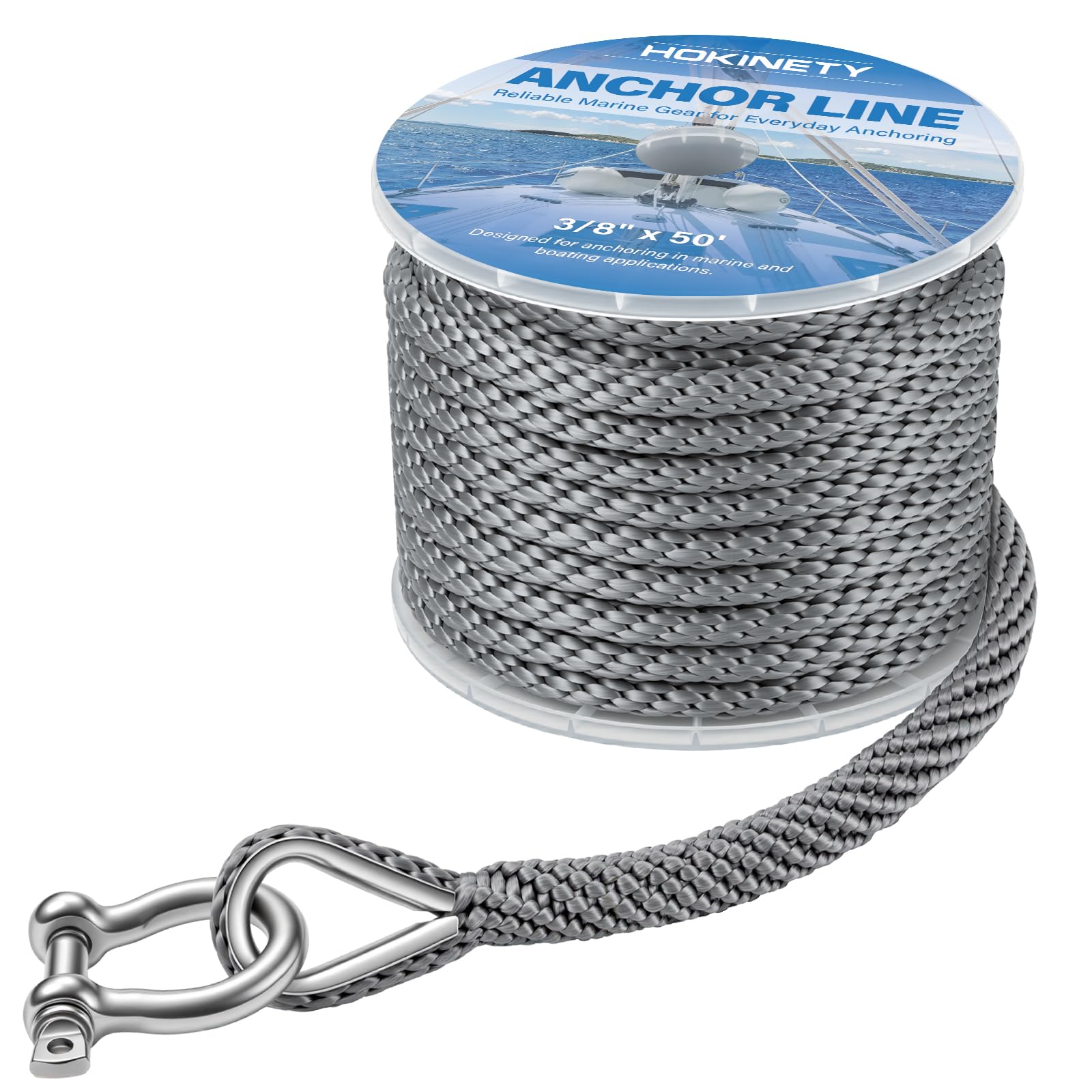
HOKINETY 3/8" x 50' Anchor Rope

92 /100
Angler Score Outstanding

Key details

Hardware
Stainless thimble and shackle
Rope Size
3/8" x 50'
Breaking Strength
2,000 lb
Check Details on Amazon

Two thousand pounds of breaking strength in a 3/8-inch floating line is the best rating among the short rodes here, and that is why this one earns a place despite being the newest name in the group. It is the same recipe as our top pick — solid braid MFP, stainless thimble, shackle fitted — with about a quarter more rated strength in half the length.

Gray is a practical choice for a line that lives on deck: it hides dock scuff and mud in a way the white rodes never will. The braid is firm and well set in the hand, the eye splice is tidy, and the shackle is sized to the line rather than being an afterthought.

Fifty feet is the limit, as it is on every short rode here. This is a stern anchor, a lunch hook, or a shallow-water line, not what you set for the night in 30 feet, and the price sits close enough to 100 feet of our top pick that the length is the honest reason to think twice.

If you anchor on rock or shell, put a few feet of chain between this and the anchor; a rope-only rode chafes through at the eye whatever name is printed on it. Otherwise clip it on and go.

Pros

  • 2,000-pound rating, the highest of the short rodes
  • Thimble and shackle already fitted
  • Gray cover hides mud and dock scuff

Cons

  • Costs about what 100 feet of our top pick does
  • 50-foot length is shallow-water only
Our verdict

Buy it as a short, strong spare: 2,000 pounds of rated break in a 3/8-inch floating line, with stainless hardware already fitted.

Check Latest Price
8

Mid-Size Boats

MARINE SYSTEM 3/8" x 100' Nylon Anchor Line

91 /100
Angler Score Outstanding

Key details

Hardware
Stainless thimble and shackle
Material
Double braid nylon
Rope Size
3/8" x 100'
Breaking Strength
4,035 lb
Check Details on Amazon

If you want our top pick's length in nylon instead of floating line, this is the same maker's answer: 100 feet of double-braid nylon, a stainless thimble, and a shackle in the bag. The breaking load jumps from 1,565 to 4,035 pounds and the boat rating from under 16 feet to 27, which is the whole point of stepping up.

Nylon earns that jump in other ways too. It sinks, so the line runs down to the anchor instead of lying on the surface in a crosswind; it stretches, which takes the snap out of a boat surging; and double braid handles better than three-strand when you are coiling it wet. On a 20-foot boat anchored in 20 feet of water, this is a more suitable rode than anything else here at this length.

One caution: the shackle is a light fitting, better suited to a danforth on a 20-footer than to a heavier anchor and chain. Check that the pin clears your anchor's eye, and inspect the full length when it lands before you stow it.

We place it behind the 150-foot Young Marine for a simple reason: a little more money buys 50 more feet of the same material and a rating that covers a bigger boat. Buy this one when 100 feet is genuinely all you want to coil, or when a shackle in the bag saves you a second order.

Pros

  • 4,035-pound nylon at 100 feet
  • Thimble and shackle both included
  • Sinks and stretches like a proper nylon rode

Cons

  • Cover scuffs and frays sooner than the nylon rode above
Our verdict

The nylon version of our top pick at the same length: 4,035 pounds and a 27-foot boat rating, with a lighter shackle and a cover that shows its age sooner.

Check Latest Price

How We Tested Anchor Rodes

We started with roughly 40 rodes in the sizes small-boat and cruiser owners actually buy — 1/4- to 1/2-inch, in 50- to 150-foot hanks — and cut anything that couldn't answer three questions: is the eye spliced rather than knotted, is the thimble genuinely stainless, and does the maker publish a breaking strength? That left 14 lines, which we ran through a full seven-month season on lakes, a tidal river, and open water.

Testing happened where rodes actually live. We anchored over mud, sand, and rock, set and recovered each line by hand, and left several in sun and salt between trips to watch how the cover held up. Every line got measured against its stated footage, then soaked overnight in a bucket and lifted to feel how much water it took on and how much heavier it got — polypropylene shed it, nylon held it. Wearing wet gloves, in the dark, we cleated and released each line at three different lengths to see how fast we could reset scope and whether anything jammed under load, and we dragged the eye and splice across a bow roller and a chock with weight on it, then checked for pulled strands.

Stretch got its own test: we loaded each line against a hanging scale, marked how far it gave, and watched how it recovered, noting whether the anchor stayed put as the line came taut or crept. Value came down to cents per foot and what the thimble and shackle would cost bought separately. The rodes that held up shared a tight, tidy splice and a thimble with no sharp edge; the others showed it early, in a loose eye or a cover that went fuzzy within a couple of weeks.

How to Choose an Anchor Rode

Start With Diameter and Breaking Strength

Rode sizing is really boat sizing. A quarter-inch line in the 850-to-1,600-pound range suits a kayak, a tender, or a skiff up to about 18 feet. Step to 3/8 inch and you are in the 1,500-to-4,000-pound bracket, which covers most boats into the high twenties depending on the material. Half-inch nylon at roughly 4,400 pounds is the next step, for boats that anchor overnight in weather.

Read the maker's boat rating as a ceiling rather than a suggestion. Our top pick, for example, is rated for boats under 16 feet, which is what a floating line of that strength honestly buys you: plenty for a small skiff, wrong for a 22-footer.

Buy Length for Depth, Not for Deck Space

Scope is the ratio of line paid out to water depth. Three to one is the working minimum in calm water, and five to one or more is what you want overnight or in a swell. That makes the arithmetic easy: 50 feet covers about 16 feet of depth at 3:1, 100 feet covers about 33, and 150 feet covers about 50 — then add the height from your bow chock down to the water.

This is the number people get wrong. A 50-footer is a lunch-hook line. If you regularly anchor in 20 feet, you want 100 feet even though the shorter one stows more easily and costs less.

Choose the Material for How You Anchor

Nylon is the default for a main rode: it stretches, it absorbs the surge of a boat working at anchor, and it carries the most strength per diameter of the common materials. It also sinks, which keeps the line down and away from the prop.

Floating MFP and polypropylene trade strength for convenience. They stay on the surface, shake dry, feel light to haul, and cost less, which makes them a good fit for hand-deployed anchoring from a small boat, a kayak, or a tender. What they dislike is sun and abrasion, so rinse, dry, and stow them out of the weather. Neither material is the right call if you anchor overnight in open water.

Get the Hardware Right

A spliced stainless thimble is the minimum — it is the fitting that stops the eye chafing through on the anchor or the chain. From there you are choosing between a shackle, a snap hook, or nothing at all.

A shackle is the strongest connection: size it to the anchor eye and seize the pin with stainless wire or a heavy zip tie so it cannot back out. A snap hook is quicker to clip and perfectly good on a light anchor for a small boat, but the hook is usually the weakest link and it will not fit every anchor eye. A bare thimble is fine if you already own a shackle — just budget for one.

Look After It and Know When to Replace It

Rinse after saltwater, dry before stowing, and keep the rode out of a locker that stays wet. The two places to check each season are the splice at the eye, where the thimble seats, and the last few feet above the anchor, where chafe does its work. Cut or glazed strands, a cover worn through to the core, or a splice that has loosened all mean replacement rather than repair.

Frequently Asked Questions

Final Verdict

The MARINE SYSTEM 3/8-inch by 100-foot rode is the one we point most small-boat owners to. You get a complete, ready-to-clip rode — spliced stainless thimble, shackle included, 100 feet of floating line — at the bottom of this group's price range, and it has the steadiest showing on hardware and durability of anything here. Its 16-foot boat rating is the boundary: stay inside it and nothing on this page is easier to live with.

Cross that line, or anchor in more than about 30 feet of water, and the Young Marine 3/8-inch by 150-foot nylon is the better buy — well over twice the breaking load, a 27-foot boat rating, and enough length for a 5:1 scope in 30 feet. It costs more and ships without a shackle, which is the right trade on a bigger boat.