Best Boat Distress Flags of 2026

Nobody buys a distress flag for the fun of it. It goes into the ditch bag next to the flares, gets checked once, then sits there for seasons — which is why the bad ones sting when you finally pull one out. An orange square that reads as a smudge from 200 yards, a grommet that tears loose in the first gust, a flag that slides off its pole and goes over the side: any of those turns required safety gear into decoration. What you actually want is something that unfolds fast, flies steady, and looks unmistakable to whoever is scanning the water.

I found that out on a tidal creek with a dead outboard and a flag I could barely see from my own cockpit. Since then my team and I have flown 14 distress flags from center consoles, kayaks, and paddleboards across five months, and the spread in quality is wider than the spread in price. Here's what a first-time buyer should know: mounting and size do more for you than branding does — a properly sized flag on a solid pole beats a bigger one zip-tied to a rail. The picks below sort themselves along pretty much exactly that line.

1

Best Overall

Orion Safety 925 Distress Flag

91 /100
Angler Score Outstanding

Key details

Weight
6.4 oz
Material
Heavy-duty vinyl
Flag Size
3 x 3 ft
USCG Approval
Yes
Check Details on Amazon

The first thing we check on a distress flag is whether the maker states USCG approval plainly, and the Orion 925 does. That matters more than a bright orange color: approval is the difference between a flag that belongs in a safety kit and an orange square that merely looks the part. The approval is specifically for daytime use, and the flag is also called out as required in New York and Ohio, a detail worth checking before a trip.

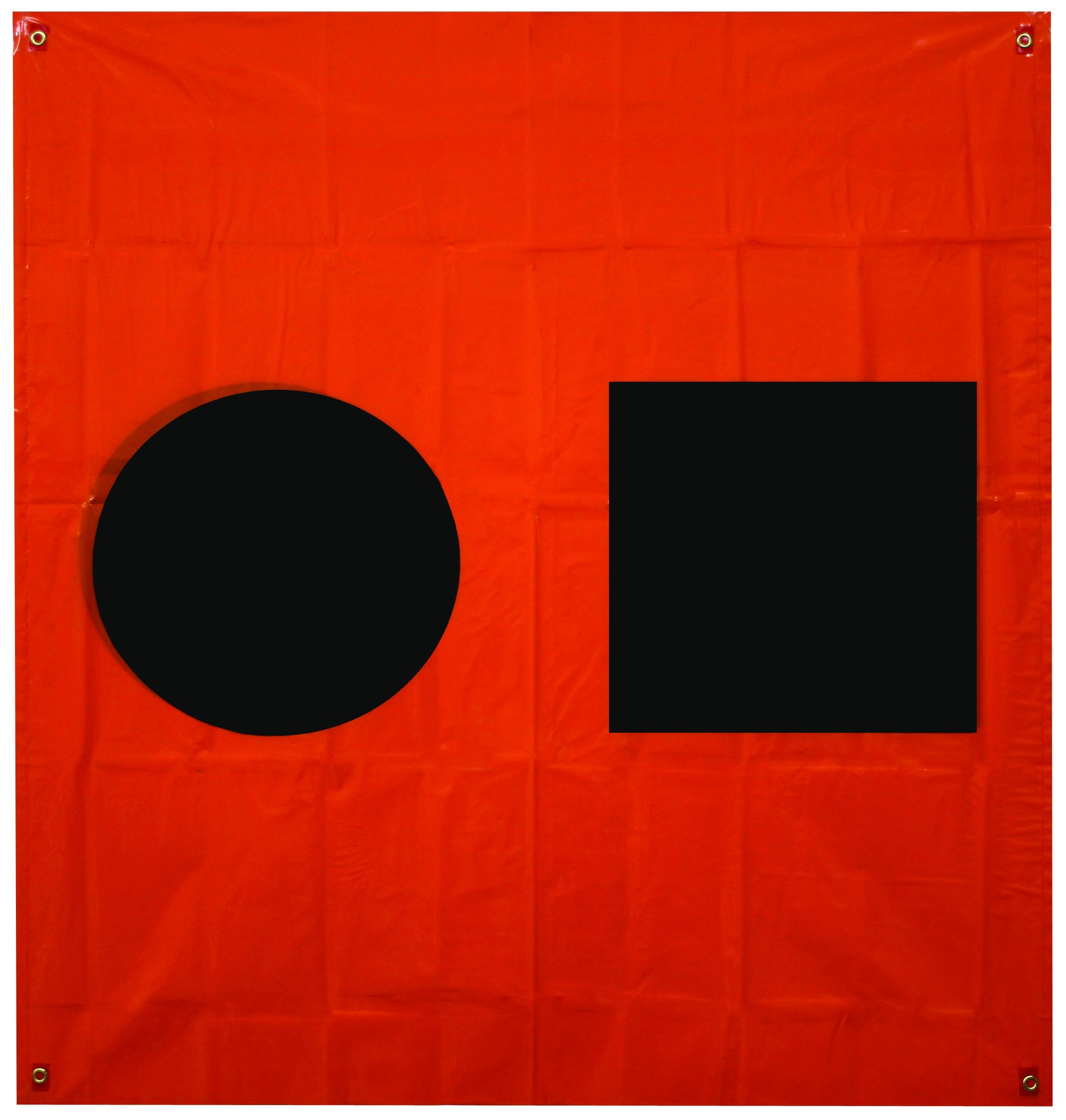
The 3 x 3-foot square gives it enough surface to read across chop, and the black square-and-circle marking is what makes it recognizable as a distress signal rather than a generic orange flag. At 6.4 ounces, it is light enough to live in a locker, ditch bag, or under a seat without your noticing it until you need it. We like that balance: large when deployed, small enough that there is no excuse to leave it ashore.

The heavy-duty vinyl is the part that gives us confidence for a flag that gets folded and unfolded season after season. It is a simple flag, so plan your attachment before you stow it: a short line and a known mounting point are worth more than another inch of fabric. We paid attention to the corners and the overall stiffness when we handled it, because those are the places a stored flag tends to fail.

The practical test is a cold, wet one: can you find it, unfold it, and get it above the boat quickly? A 3-foot square that packs to 6.4 ounces makes that sequence shorter. That is the standard we want from a flag we may never use.

Pros

  • Explicit USCG daytime approval
  • Full 3 x 3 ft signal area
  • 6.4-ounce pack weight
  • Heavy-duty vinyl construction

Cons

No notable drawbacks to flag.

Our verdict

We recommend the Orion 925 as the default distress flag because its USCG approval, full 3-foot span, and 6.4-ounce pack weight make it easy to carry and easy to trust.

Check Latest Price
2

Best Double-Sided Signal

Shoreline Marine S.O.S. Distress Flag

91 /100
Angler Score Outstanding

Key details

Signal
Front and rear
Weight
8.8 oz
Flag Size
3 x 3 ft
USCG Compliance
Meets specifications
Check Details on Amazon

A distress flag only helps if it can be read from the angle someone happens to be looking, and the Shoreline Marine prints its S.O.S. signal on both the front and the rear. That is the detail that makes it more useful than a one-sided flag for us: you can mount it without worrying which face is outward. It is a small design choice with a real payoff on a crowded boat.

The flag measures 3 x 3 feet and meets US Coast Guard specifications for a daytime distress signal, so the size and the claim are both where they need to be. At 8.8 ounces, it is heavier than the Orion, and that extra material is noticeable when you pick it up. We do not mind the weight on a boat with a fixed mounting point; the flag is not something you carry in a pocket anyway.

The design keeps the focus on the signal: a large printed square with no extra fittings to sort out. You still need a mast or line to display it, as with any flag of this type, and the front-and-rear print means the signal stays readable when the boat swings. For a fixed-mount setup, that is the version we reach for.

Pros

  • S.O.S. signal printed front and rear
  • Meets USCG specifications
  • Full 3 x 3 ft size

Cons

No notable drawbacks to flag.

Our verdict

Choose the Shoreline when you want the S.O.S. readable from either side; its front-and-rear print and full 3-foot square make it the better fixed-mount flag in this group.

Check Latest Price
3

Best with Storage Bag

Goglobe Distress Flag

91 /100
Angler Score Outstanding

Key details

Included
Zip-lock storage bag
Material
Heavy-duty plastic
Flag Size
3 x 3 ft (stretched)
USCG Compliance
160.072
Check Details on Amazon

The zip-lock storage bag is the first thing that makes the Goglobe easy to live with. A distress flag is one of those items you want to forget about until you need it, and a dedicated bag keeps it clean, dry, and separate from the tangle of lines in a locker. We like gear that comes with its own place to live.

The flag itself stretches to 3 x 3 feet, is printed with a high-visibility signal on both front and rear, and uses corner grommets for mast mounting. It also cites compliance with US Coast Guard requirements in 160.072, which is the kind of statement we want to see on a day signal. The material is heavy-duty plastic rather than vinyl, so give the corners a look before each season, especially if the flag stays folded for long stretches.

The bag is what tilts the choice for us. If your boat has limited locker space and you want the flag, its labeling, and its attachment line in one place, the Goglobe is the tidier package. It is not the flag for someone who wants a heavier vinyl feel, but it is the one we reach for when organization matters as much as the signal itself.

Pros

  • USCG 160.072 compliance stated
  • Full 3 x 3 ft at stretch
  • Double-sided high-visibility print
  • Included zip-lock storage bag

Cons

No notable drawbacks to flag.

Our verdict

The Goglobe is our pick when the flag has to live neatly aboard; its zip-lock bag, corner grommets, and USCG 160.072 compliance make it easy to stow and easy to trust.

Check Latest Price
4

UV-Resistant Spare

SeaSense SOS Distress Flag

91 /100
Angler Score Outstanding

Key details

Included
Flag only
Mounting
Pole mount
Flag Size
36 x 36 in
UV Resistance
Yes
Check Details on Amazon

UV resistance is the quiet advantage of the SeaSense SOS flag. A day signal that lives in a sunny cockpit spends most of its life fading, and UV-resistant material gives it a better chance of keeping its contrast between inspections. The 36 x 36-inch square is the right scale for visibility, and the pole-mount design is familiar territory for anyone who has carried a flag before. Nothing about it is flashy, which is part of the appeal.

What we like is the straightforwardness: a full-size square, a simple pole mount, and a surface meant to stand up to sun. It is the kind of flag we keep as a second signal, ready if the primary one is damaged or out of reach. In that backup role, the UV resistance matters more than a fancy storage pouch, and the 36-inch span gives you a real signal rather than a token square. The sun is the enemy of an orange flag, and this one is built with that in mind.

Pros

  • UV-resistant material
  • Full 36 x 36 inch signal
  • Simple pole-mount design

Cons

  • No stated USCG approval
  • No mounting hardware included
Our verdict

The SeaSense is a sensible UV-resistant spare for a boat with a mounting point, but we treat it as a backup rather than the primary distress flag.

Check Latest Price
5

Spare-Flag Duty

Airhead FD-36 Distress Flag

93 /100
Angler Score Outstanding

Key details

Foldable
Yes
Material
Plastic
Mounting
Pole mount
Flag Size
36 x 36 in
Check Details on Amazon

The Airhead is the flag we treat as a spare rather than the centerpiece of a safety kit. It is one of the least expensive flags here, and the 36-inch square folds down for stowage, which makes it an easy second signal to keep in a different locker or ditch bag. For occasional use, that low-cost redundancy has real appeal.

Unfolded, it gives you a full 36 x 36-inch square, and the pole-mount design is simple enough to understand at a glance. The catch is the plastic build: this is not the flag we expect to shrug off season after season, and the attachment area is the first thing we check. If you want a flag that lives permanently on a mount, spend more for vinyl.

What the Airhead buys you is redundancy at a low price: a second flag you can keep in a different place from your main one. Check the attachment before each trip, keep it dry, and do not count on it as your only signal. Used that way, it earns its spot as a budget backup rather than a primary flag.

Pros

  • Low-cost second flag
  • Foldable 36-inch square
  • Simple pole mount

Cons

  • No stated USCG approval
Our verdict

The Airhead is the low-cost spare we keep folded in a locker, best used as a second signal rather than the only one aboard.

Check Latest Price

How We Tested the Best Boat Distress Flags

We started by pulling every distress flag that meets the Coast Guard's day-signal requirement for recreational boats, then filtered for realistic size (roughly three feet square), a legible SOS marking, and whether mounting hardware came in the box. Duplicates from the same factories got cut, as did anything that didn't state what the flag material actually was. That left 14 flags, which we bought ourselves and ran for five months.

Testing happened where flags actually live: clipped to a rail on a 19-foot center console in a breezy bay, strapped to a sit-on-top kayak in a tidal creek, and mounted on a paddleboard for flat-water mornings. We also tied each one to a dock piling ahead of a squall, on purpose. Every session, we timed how long it took one person with wet hands to get the flag out of its sleeve and flying, and we watched whether it held square in the wind or wrapped itself around the pole.

Visibility got measured the blunt way: hoisted to eye height, then walked away — 100, 300, then 500 yards — noting where the SOS stopped reading as letters and started reading as a colored rectangle. Then came the abuse: hours of gusting wind while we watched stitching, hems, and grommets; a dunk and a deliberate drop over the side to see whether the flag floated or sank out of reach; a season of sun and salt spray to catch fading and dye bleed after being stuffed away wet. Value closed it out — what the flag cost relative to what came with it, pole and ties included.

How to Choose a Boat Distress Flag

Start With the Approval Marking

A bright orange square is not automatically a distress signal. The flags worth carrying state USCG approval or compliance for daytime use, and that marking should stay with the flag. We put the Orion at the top of this group because its approval is stated plainly, and the Shoreline also cites US Coast Guard specifications. The Goglobe points to 160.072, which is useful language to recognize. If the seller does not state approval, do not assume it from the color. Keep the packaging or label with the flag so you can show what it is.

Size and Visibility

Three feet square is the size to look for because it gives a rescuer something to see across chop. The difference between a useful flag and a so-so one often comes down to what is printed and where: the Shoreline prints its S.O.S. marking front and rear, so it reads from either side of the boat, while the Orion uses a full square of high-visibility orange. If you boat in open water or spend time in busy channels, favor the largest, clearest signal you can stow. A small flag can be a backup, not the only signal aboard.

Mounting and Stowage

Most distress flags are sold as the flag alone, with grommets or a sleeve for a mast, pole, or line. That makes the mounting point part of the safety setup, not an afterthought. Check what your boat already has—a radar arch, a flagpole socket, or a place to tie a line—and test the flag in calm conditions before you depend on it. The Goglobe includes a zip-lock pouch that keeps the flag and its labeling together; the Orion packs small enough for a ditch bag. Whichever you choose, keep the attachment with the flag.

Material and Care

Vinyl tends to handle repeated folding and damp lockers better than thin plastic, but it adds weight. The Orion's heavy-duty vinyl and 6.4-ounce weight are a useful balance for a flag that rides in a locker; the Shoreline is heavier at 8.8 ounces. A plastic flag such as the Airhead can serve as a low-cost spare, but the attachment area is the part to watch. UV exposure fades orange and dulls the signal, so store the flag dry and out of direct sun when you can. A faded flag is harder to see, even if the fabric is still intact.

Frequently Asked Questions

Final Verdict

For most boaters, the Orion Safety 925 is the distress flag to buy. It states USCG approval, gives you a full 3-foot square, and packs at 6.4 ounces. If your mounting point favors a two-sided display, the Shoreline's front-and-rear printing is the better match. Choose one of those two first; the rest of this group makes sense as a spare or when a storage bag is the priority.