
Best Camping Lanterns of 2026

The best hour of a camping night is the one after the sun drops, when the cards come out and someone is still poking at the fire — right up until the lantern fizzles, dims, and turns the whole site into a game of find-the-cooler. Lanterns fail in predictable ways: a beam so narrow you light one square foot of picnic table, a battery that quits on night two, a housing bulkier than the stove you packed it next to. The right one fixes all of that quietly. It hangs there, spreads even light across the whole table and the faces around it, and you stop thinking about it entirely.

I've burned through a shoebox of forgettable ones over a decade of camping, and over the past six months my team and I ran 14 lanterns through real evenings — on the deck, in tents, and through a two-day outage at my house. Here's what first-time buyers get wrong: the lumen number on the box is the least trustworthy spec in this category, since a 1,000-lumen spotlight can be less useful than a 300-lumen globe. Below are the ones we kept grabbing for, from pocket-size to site-filling.

1

Best Overall

EZORKAS 2-Pack Rechargeable Lantern

96 /100
Angler Score Outstanding

Key details

Size
3.54 x 3.54 x 7.87 in
Mounting
Magnetic base, freestanding
In The Box
Two lanterns and two USB cables
Power Source
USB rechargeable plus 3 AA backup
Check Details on Amazon

Two power sources in one small lantern is the reason this pair sits at the top of our list. Each unit carries a built-in battery you top up over USB, and each still has a bay for three AA cells, so a flat charge is an inconvenience instead of the end of the evening. Not one of the other lanterns here offers both.

We keep coming back to the magnets under the base. Set one on a tailgate, stick it to the truck's hood while you cook, or hang it from a tent loop by the handle — the placement options are the widest in this group and they cost nothing in size. There's a red warning light with strobe and SOS as well, which is the part of an emergency lantern most designs treat as an afterthought.

Up close the light spreads in a full circle, so four people at a table aren't all angling for one hot spot. The body is water resistant rather than sealed, which makes it a fair-weather and light-rain lantern. The collapsing handle doubles as the switch — pull to open and light, push to close — and both lanterns and two USB cables come in the box.

Pros

  • Runs on a USB charge or three AA cells
  • Magnet base, hook, and flat-bottom placement
  • Red strobe and SOS for emergencies
  • Two lanterns and two USB cables included

Cons

  • No lumen rating published
  • No charging adapter in the box
Our verdict

The lantern we hand people first: USB charging with AA backup means it survives a long trip, and the magnet base puts light where you need it.
Check Latest Price
2

Best for the Whole Family

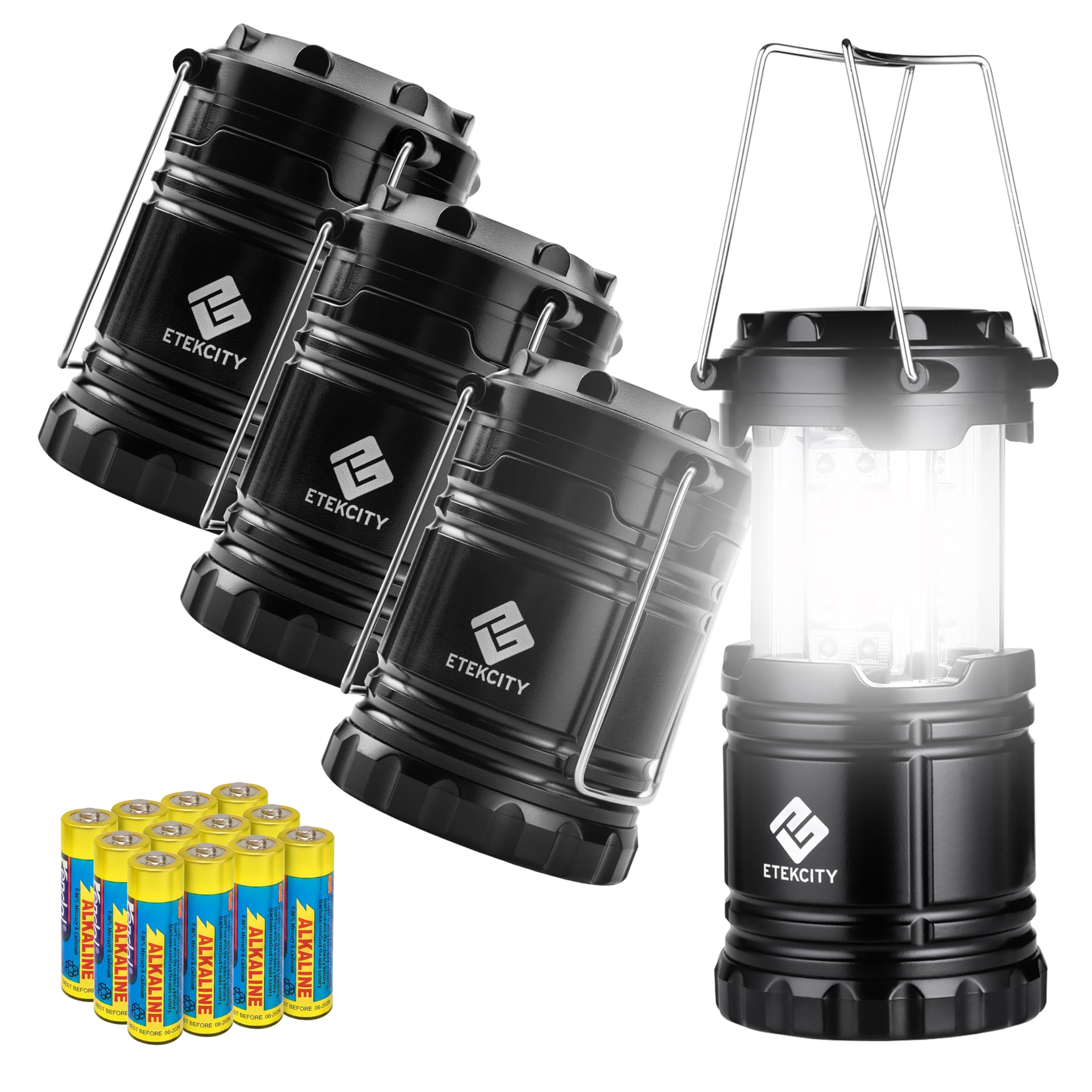
Etekcity LED Camping Lanterns 4-Pack

95 /100
Angler Score Outstanding

Key details

Runtime
Up to 50 hours
Batteries
3 AA each, 12 included
Folded Size
3.46 x 3.46 x 4.86 in
Light Output
154 lumens
Check Details on Amazon

Four lanterns and the twelve AA batteries that run them arrive together, so nothing else needs sorting out on the night the power drops. Each unit takes three cells, and the count in the box is exactly enough — no spares, no leftovers to lose.

Output is 154 lumens, the lowest here, and that shapes what the set is for. In a tent, a hallway, or a bunk room it's comfortable to read by; on an open campsite it lights the table and not much past it. Etekcity claims up to 50 hours, which is a long time at this brightness.

Storage is where these surprise: folded, one is about the size of a large phone, and four of them take less room in a gear bin than a single propane lantern. The collapsing action is also the switch and the dimmer, which is easier to explain to a kid than a three-mode button. The plastic body is water resistant, not something to leave out in a storm.

Pros

  • Four lanterns and 12 AA batteries included
  • Folds to roughly phone size for storage
  • Up to 50 hours of claimed runtime

Cons

  • 154 lumens is modest for a whole site
  • Water-resistant only, not sealed
Our verdict

This is the set we buy for outages — four lanterns and the batteries for them, best where you need coverage rather than reach.

Check Latest Price
3

Best Lantern and Flashlight in One

Eveready 360 PRO 3-Pack

95 /100
Angler Score Outstanding

Key details

Runtime
Up to 16 hours
Mounting
Hook, magnet base, folding handles
Batteries
AA, included
Light Output
350 lumens area, 60 lumens directional
Check Details on Amazon

The second job is what sells these: unlatch the handles, pull the lantern open and it lights an area at 350 lumens; press the button and the same unit throws a 60-lumen beam up to 100 meters down a trail or into an engine bay. A lantern that doubles as a flashlight means one less thing in the pack.

Three ways to park it — a hook underneath, magnets in the base, and folding handles on top — and the set arrives as three, so tent, table, and glovebox are covered. Batteries come in the box, which matters more than it sounds on the night you need light immediately.

Our only real complaint is the housing. It's bright and even in area mode, but the plastic feels lighter in the hand than the Streamlight and the switchgear is the simplest kind. For a kit that gets stored and used a few nights a year that's fine; for a lantern that lives in a truck bed, the Siege is the better spend.

Pros

  • Area light plus a 100-meter directional beam
  • Hook, magnets, and folding handles for placement
  • Three lanterns with batteries included
  • Red flashing and SOS modes

Cons

  • No rechargeable option; AA cells only
  • Directional beam is only 60 lumens
Our verdict

We like three lanterns that each turn into a flashlight, batteries included; it's the family kit that gets stored and forgotten until it's needed.

Check Latest Price
4

Best for Wet, Rough Use

Streamlight 44931 Siege

96 /100
Angler Score Outstanding

Key details

Runtime
Up to 295 hours on low
Batteries
3 D alkaline
Light Output
540 lumens
Water Resistance
IPX7, floats
Check Details on Amazon

If your lantern rides in a boat locker, a truck bed, or a pack that gets set down in wet grass, this is the one. The Siege is sealed to IPX7 — a meter of water for thirty minutes — and it floats, which is not a spec you'll find on the collapsing plastic lanterns here.

What we appreciate most is how much of the design assumes rough handling: a recessed power button that won't fire inside a duffel, D-rings top and bottom so it hangs upright or inverted, and a globe you can lift off to throw light in every direction. Output runs to 540 lumens on high, with medium, low, and a red SOS mode below that.

Runtime is the headline: 295 hours on low from three D cells, which is measured in weeks rather than evenings, and low is bright enough to read by without waking the tent. It's a bigger lantern than the collapsible ones at four inches across, so it wants a shelf or a hook rather than a pocket — the trade for a body that shrugs off being sat on.

Pros

  • IPX7 sealed and it floats
  • Up to 295 hours on low
  • D-rings hang it upright or inverted
  • Removable globe widens the light

Cons

  • Heavy once three D cells are in
  • Highest price in this group
Our verdict

This is the one we take when weather is the plan: sealed to IPX7, floating, and happy to hang upside down in the rain.

Check Latest Price
5

Brightest Battery-Powered

Lepro 1000LM LED Lantern

93 /100
Angler Score Outstanding

Key details

Runtime
Up to 12 hours at full output
Batteries
3 D alkaline, not included
Light Output
1,000 lumens
Water Resistance
IPX4
Check Details on Amazon

A thousand lumens from three ordinary D cells is the whole pitch, and it holds up as a way to light a picnic table, a fish house, or a whole site without a charger in sight.

The four modes do more work than the number does: daylight white for cooking and cleanup, warm white for a table you're sitting at, both together for maximum output, and a flashing mode. Long-press dimming means you don't jump from a dim glow to something blinding in one click.

Brightness is where the box and the night part ways a little. A thousand lumens is a ceiling reached on fresh cells in the combined mode, and twelve hours is the claim at that setting — expect to trade output for runtime as the cells drop, which is normal for alkaline power and worth planning around on a long trip.

Where this one earns its place is as the big-site lantern of the group: it's the brightest thing here that runs on batteries you can buy at a gas station, and the removable cover and bottom hook make it easy to hang over a table. It's not the one to carry far and it isn't rechargeable, but for car camping it does the job of two smaller lights.

Pros

  • 1,000 lumens, the brightest battery-powered pick
  • Warm, cool, and combined light modes
  • IPX4 rated for rain and snow

Cons

  • Runs on three D cells, not included
  • Battery door takes care to seat and close
Our verdict

Our maximum-brightness pick: the strongest light here from store-bought batteries, made for a car-camping table and a big site.

Check Latest Price
6

Best Solar Option

LuminAID Nova Inflatable Solar Lantern

93 /100
Angler Score Outstanding

Key details

Weight
5.3 oz
Runtime
Up to 24 hours
Charging
Solar about 10 hours, or micro-USB 1 to 2 hours
Light Output
75 lumens
Check Details on Amazon

Deflated, this is a flat packet weighing a third of a pound; inflated, it's a soft cube of light you hang from a tent loop by its strap. Ten hours of direct sun or a couple of hours on micro-USB fills it, and there's nothing else to pack — no cells, no charger, no cable to lose.

Seventy-five lumens doesn't sound like much next to the 1,000-lumen lanterns here, and it isn't: this lights a tent, a hammock, or a card game for two, and it stops there. The upside is a soft, diffuse glow with no hot spot, and IP67 sealing that makes rain and a dunking in a lake a non-event.

That makes it the backpacking and emergency-bag lantern rather than the campsite one, and it's the only pick here you can top up from the sun for days on end. Longevity is the thing to watch: the internal cell can quit after a handful of charge cycles, so buy it somewhere with an easy return and keep it charged between trips.

Pros

  • Packs flat and weighs 5.3 ounces
  • Charges from the sun or micro-USB
  • IP67 waterproof and dustproof

Cons

  • 75 lumens suits a tent, not a campsite
  • Needs 10 hours of direct sun to solar charge
Our verdict

What we take backpacking: charges from the sun, packs flat, and lights a tent at a fraction of the weight.

Check Latest Price
7

Bright Basecamp Light

AYL 1800LM Rechargeable Lantern

95 /100
Angler Score Outstanding

Key details

Battery
4,400 mAh rechargeable, doubles as power bank
Runtime
Up to 12 hours
Light Output
1,800 lumens
Water Resistance
IP44
Check Details on Amazon

Eighteen hundred lumens and a phone charger in the same body is a combination nothing else here offers, and on a stormy weekend it's the light we plug in first. The 4,400 mAh cell runs the lantern for up to 12 hours, and the USB output puts a partial charge back into a phone when the grid is down.

Controls are the fiddly part. Four dimmable modes — daylight, warm, both, and flash — cycle through one button, and the slip-proof handle hangs from a hook or sits on a table. IP44 is the lightest weather protection in this group: fine for rain and splashes, not for a dunking. At 10.25 inches tall it's also the tallest lantern here, so it rides in a crate rather than a pack.

Pros

  • 1,800 lumens, the highest output here
  • 4,400 mAh battery doubles as a phone charger
  • Warm, cool, and combined dimmable modes

Cons

  • Some units stop holding a charge
  • IP44 is the least weather protection here
Our verdict

We keep this one in the car because it can rescue a phone as well as light a table — the most useful extra here in an outage.

Check Latest Price
8

Long Basecamp Nights

Coleman 400L LED Lantern

94 /100
Angler Score Outstanding

Key details

Runtime
30 hours high, 70 hours low
Batteries
4 D alkaline, not included
Light Output
400 lumens
Beam Distance
12 meters high, 8 meters low
Check Details on Amazon

Thirty hours on high and seventy on low is the reason to look at this one: it's a lantern you switch on Friday and forget about until Sunday.

Output is 400 lumens with a 12-meter beam on high, which is more reach than the area-only lanterns and enough to walk a trail or light a picnic table. A bail handle with a carabiner clips to a branch, a tent frame, or a pack strap.

It's a simple build — a screw-on base, one switch, and a three-year limited warranty behind it. The four D cells aren't included, and the lantern is 1.4 pounds before they go in, so it lives on a table rather than in a pack.

Our read: this is the basecamp lantern for a long trip where the light sits in one place and the batteries need to outlast a weekend. If you want something that folds into a glovebox, the Eveready or the Etekcity set does that better; if you'd rather not think about batteries again this season, this is the one.

Pros

  • 70 hours on low, 30 on high
  • 12-meter beam distance on high
  • Three-year limited warranty
  • Carabiner bail handle for hanging

Cons

  • Four D cells, not included
Our verdict

We leave this one on the picnic table all weekend: 70 hours on low, a beam that reaches, and a warranty behind it.

Check Latest Price

How We Tested Camping Lanterns After Dark

We started by pulling together every lantern we could find that had a real following, then filtered by what actually travels: battery type, packed weight, whether it can hang, and whether the price made sense for something you might leave in a damp tent. That left 14, from palm-size inflatables to a big water-resistant model that takes up half a tote. We spent six months with them.

Brightness got judged by spread, not by the spec sheet. I set each lantern on a picnic table at full power, walked about 20 feet back, and noted whether the far end of the table and the ground around it were lit or whether everything outside the center was swallowed by shadow. I also carried each one down a dark path to the bathhouse to see how far ahead I could actually see. For battery life, we ran every lantern on its highest setting until output visibly dropped, timed it, then repeated on low — and logged what came in the box, since a lantern that ships with batteries and a charging cable is a different value proposition than one that needs both bought separately.

Size and ease of use we tested the unglamorous way. All 14 went into one canvas tote so I could feel the difference in a packed car, and I hung the smallest ones from a tent loop and a ridgeline to see if they dragged or swung into the door. Then I turned each one on and off in the dark, one-handed and then in gloves, and noted whether I could find the button by feel or had to hunt for it with a phone light. The ones that stayed in my kit over the winter all got there on the same strengths: even light, honest runtime, and a switch you can work half-asleep.

How to Choose a Camping Lantern

Match the power source to how often you use it

A rechargeable lantern is the pleasant one to live with — no cells to buy, one cable to top it up — but a rechargeable that has sat in a drawer since last summer is a dead lantern on the night you need it. Disposable AA or D cells sit for years and are replaceable at any gas station, which is why stored emergency kits still favor them.

We look for a lantern that does both. The EZORKAS set runs on its built-in cell and still takes three AAs as a fallback, which covers a week-long trip and a two-night outage with the same light. Solar suits backpacking and little else: it needs about ten hours of direct sun to be useful, so it's a supplement, not a plan.

Read lumens as a range, and check the runtime beside it

Output figures are quoted at their best setting, and the runtime printed next to them usually isn't. A 1,000-lumen lantern claiming 12 hours is spending much of that time at a lower output, so look for the low-mode runtime as well — that's the setting you'll actually read and eat by.

As a rough map: 75 to 200 lumens lights a tent or a small room; 350 to 500 handles a picnic table and the ground around it; 1,000 and up lights a whole site or a room you're working in. Bigger isn't better if it means four D cells and a lantern you won't carry.

Count the cells before you commit

Cell size decides weight, running cost, and how often you're buying batteries. AA lanterns are light and cheap to feed, which is why the multi-packs use them; D cells buy long runtime and high output but add heft — the Streamlight and the Lepro take three each, the Coleman four.

Do the arithmetic for a set: four lanterns at three AA cells each is twelve batteries, and the Etekcity pack ships with exactly that many. Buy a spare set of the right size when you buy the lantern and you won't be caught mid-trip, which is the single most common way a good lantern lets people down.

Decide how it will hang, sit, or stick

Most campsite frustration is placement, not brightness. A hook needs a loop above it, D-rings let a lantern hang upright or inverted for a wider spread, magnets need steel — a tailgate, a hood, a fridge during an outage — and a flat base needs a table you're willing to give up.

Check the tent before you buy: not every model has a hang loop at the height you want, and a collapsing lantern needs clearance above it to open. If yours has no loop, a magnetic or freestanding lantern like the Eveready set is the safer bet.

Take weather ratings literally

IPX4 means splashes from any direction; IPX7 means a meter of water for thirty minutes, and the Siege floats as well. Water resistant is not waterproof, and a lantern left out overnight in real rain will find the difference.

If the lantern lives in a boat, a truck bed, or a pack that gets set down in wet grass, pay for the sealing. If it goes tent to table and back into a dry bag, splash protection is enough and you can spend the difference on batteries.

Frequently Asked Questions

Final Verdict

The EZORKAS two-pack is what we point most people to: USB charging with an AA fallback covers a weekend trip and a nights-long outage with the same lantern, and the magnetic base does more for real campsite use than another couple of hundred lumens would.

If the lantern lives outdoors in the rain, buy the Streamlight Siege instead — sealed, floating, and happy to hang upside down. If you want three lights plus a flashlight mode for a family kit, the Eveready set is the better shape.