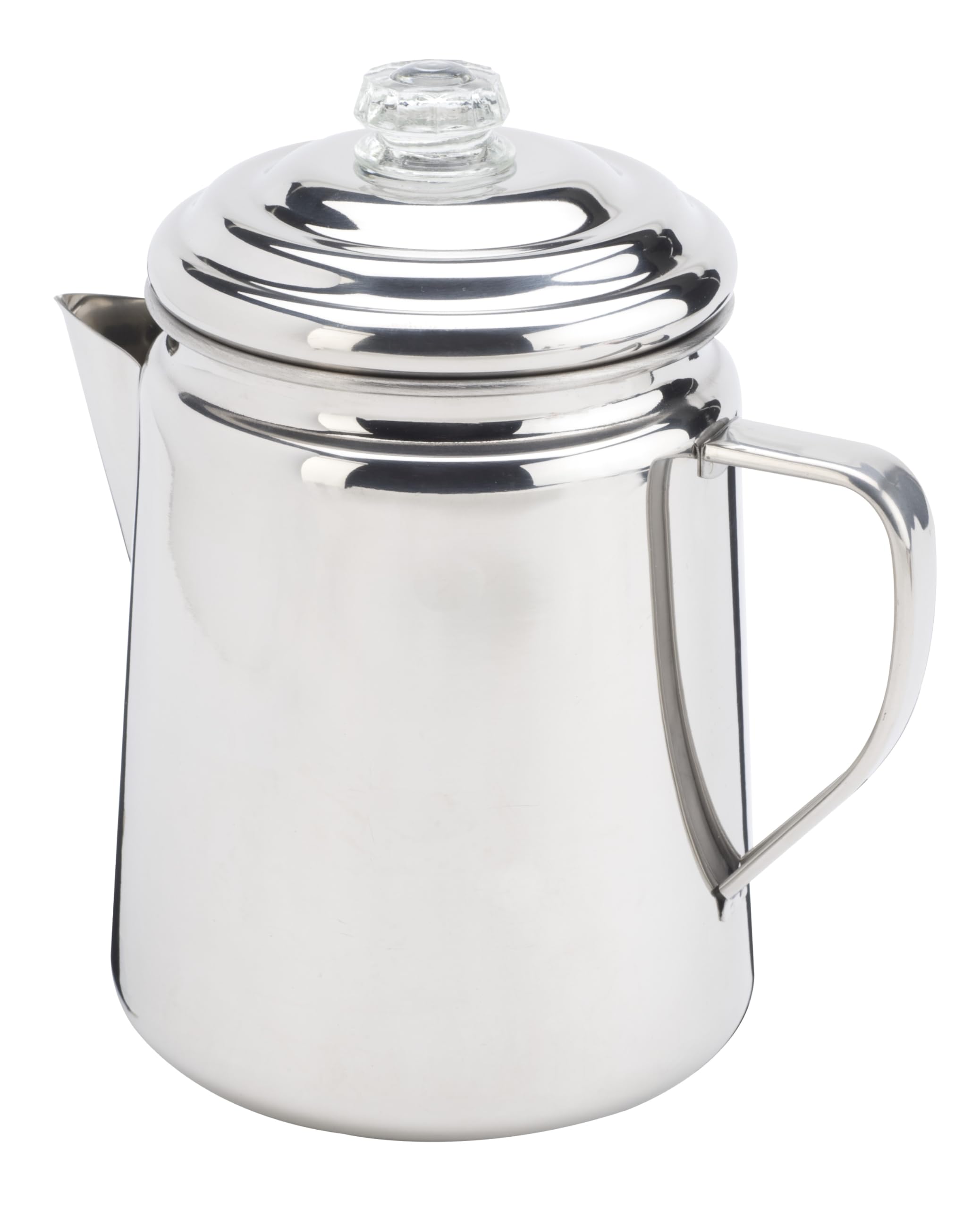
Best Camping Percolators of 2026

The best part of a camping morning isn't the sunrise — it's the sound of a percolator muttering on the stove. Then comes the part nobody photographs: scorched coffee, grounds that slip past the basket, a handle too hot to grab. A percolator is a simple pot with a dozen small places to go wrong, and the difference between a good one and a frustrating one shows up in the cup and at the washbasin. The right one brews coffee you actually want a second cup of, rinses clean before the fire dies, and needs no babysitting.

I've made camp coffee plenty of mediocre ways, so I was picky going in. Over six months, my team and I brewed with 12 percolators on camp stoves, over open fire, and on a kitchen range, and the pattern held across all of them. Here's what first-timers don't know: percolator coffee recirculates through the basket, so how fast the pump moves water and how coarsely you grind matter as much as the pot itself. The ones below earned a permanent spot in my camp bin.

1

Best Overall

COLETTI Bozeman 12-Cup

89 /100
Angler Score Excellent

Key details

Weight
2 lb
Capacity
12 cups
Cleaning
Dishwasher safe
Material
Stainless steel
Check Details on Amazon

Twelve cups sounds like a crowd until you do the arithmetic: a percolator cup is five ounces, so the Bozeman's top mark is 60 ounces — about five mugs, or four if everyone comes back for a second pour. That is exactly the size of a normal camping weekend, and it is why this is the pot we recommend first. You get a full brew for four people without running a second round while the eggs go cold.

The brew path is what sells it. Basket, stem, and lid are stainless steel, the only non-metal part is the glass viewing top, and there is no aluminum in the pot at all — a real distinction in a category where the cheap pots are thin aluminum. We like the window for a practical reason: percolator coffee is a timing job, and watching the first bubbles come up is how you know to cut the flame. The advice to grind coarse and keep the heat low is worth following. A packet of filter discs comes in the box, and they do cut the silt in the last cup.

Cleanup is the quiet win. The basket and stem lift out together, a rinse at the wash station gets the grounds out, and the pot is dishwasher safe once you are home. At 2 pounds and about seven inches across, it drops into the camp box beside the stove without a fight.

Two boundaries. There is no bail handle, so this is a stove, grill, or grate pot rather than one you hang over flames — the Stansport and the Scoutmaster cover that. And the glass top is the part to protect: wrap it when the pot travels, and leave the knob loose until everything is cool.

Pros

  • 12 cups pours 60 ounces, about five mugs
  • Stainless basket, stem, and lid, no aluminum
  • Rinses at camp, dishwasher safe at home
  • Filter discs included in the box

Cons

  • No bail handle, so stovetop and grate only
Our verdict

For stove-based campers brewing for two to five people, this is the pot we point to first: 60 ounces, an all-stainless brew path, and dishwasher cleaning at home.

Check Latest Price
2

Best Budget

Farberware Classic 8-Cup

91 /100
Angler Score Outstanding

Key details

Capacity
8 cups
Cleaning
Dishwasher safe
Material
Stainless steel
Dimensions
9.25"D x 6.25"W x 8.25"H
Check Details on Amazon

The Farberware is the least expensive pot in this group, and it behaves most like the drip machine you left at home: a mirror-polished stainless body, a permanent basket, a clear knob on the lid, and a stated date with the dishwasher. Eight cups is 40 ounces, or three mugs — right for a couple, thin for four.

For two people we think it is the sensible buy. It heats quickly, holds coffee hot, and the basket rinses out in seconds, with nothing to assemble and nothing to buy. The detail worth knowing is the inward lip just below the rim, which traps the last half cup: you tilt and wait for it, or you leave it. Not a reason to skip the pot, but it is why the pot never quite empties.

The basket assembly has two small annoyances. A little spring sits under the strainer, pops loose during washing, and disappears down a drain if you are not careful, and the cup markings inside are faint once the pot is full of dark coffee. Rinse the parts in a bowl instead of under a running tap and both stop mattering.

Pros

  • Lowest price in this group, still all stainless
  • 8 cups is 40 ounces, right for two or three
  • Permanent basket, so no filters to buy
  • Dishwasher safe and it stows small

Cons

  • Clear lid knob is the first part to crack
Our verdict

If you are brewing for two or three and want to spend as little as possible, this stainless pot heats fast, rinses in seconds, and cleans up in the dishwasher.

Check Latest Price
3

Best for Two

Petromax Perkomax 5-6 Cup

91 /100
Angler Score Outstanding

Key details

Weight
1.9 lb
Capacity
5-6 cups
Material
Enameled steel
Heat Sources
Induction, ceramic, campfire
Check Details on Amazon

This is the pot in the group you would be happy to leave on the kitchen table as well as the campfire: black enameled steel, a glass top, and a shape that reads camp kitchen rather than coffee maker. At 1.5 liters it is a two- or three-person pot, and for a couple who wants one good pot instead of two adequate ones, it is the one we point to.

What the extra money buys is heat-source flexibility and finish. Petromax lists it for the barbecue, the campfire, a ceramic glass cooktop, a cooking plate, and an induction hob — the widest set of options here — and the enamel means the coffee sits against a fused-glass coating rather than bare steel. The filter is reusable, and at 1.9 pounds and roughly six inches across it packs like a kettle.

The trade-offs are size and care. Five or six cups goes fast with three drinkers, and enamel is a finish you set down rather than slide; the rim will pick up marks if you are careless with a grate. It is also the priciest pot in this group, which we think is fair for the induction compatibility and the finish, and hard to justify if the pot only leaves the cupboard twice a year.

Pros

  • 1.5 liters suits two or three drinkers
  • Works on induction, ceramic, barbecue, and campfire
  • Enamel finish looks good enough for the table

Cons

  • Priciest pot in this group
  • Enamel needs gentler handling than bare steel
Our verdict

For a couple who wants one good-looking pot that works on induction, ceramic, barbecue, or campfire, this enameled steel percolator is worth the premium.

Check Latest Price
4

Best for Big Groups

COLETTI Scoutmaster 24-Cup

91 /100
Angler Score Outstanding

Key details

Handle
Steel wire bail
Weight
3 lb
Capacity
24 cups
Material
18/8 stainless steel
Check Details on Amazon

Twenty-four cups is a different kind of pot. At five ounces a cup that is 120 ounces, close to a gallon — what a scout troop, a family reunion, or a hunting cabin actually drinks before the bacon is out of the pan. Nobody buys this for a couple, and that is the point: it is the only pot here built for a crowd.

The build is the argument for it. 18/8 stainless throughout, a reinforced steel wire bail for hanging the pot over a fire, a glass view top, and 20 paper filters in the box. The base is wide enough to sit steadily on a grate, which matters when the pot weighs 3 pounds before the coffee goes in.

We think it earns its place for the mornings when the whole camp drinks at once, and we say so as a specialist recommendation rather than a general one. You do not have to fill it — a half pot is a normal 12-cup brew with more headroom and a slower climb to the perk — but if your group is three people, buy the Bozeman and save the cupboard space.

Pros

  • 24 cups, about 120 ounces, for a whole camp
  • 18/8 stainless with a steel wire bail
  • 20 paper filters included

Cons

  • Needs a wide, stable grate once it is full
Our verdict

If your camp drinks by the dozen, this 24-cup 18/8 stainless pot with a steel bail is the only one here built for the job.

Check Latest Price
5

Camp Stove Brewing

Coleman Stainless 12-Cup

91 /100
Angler Score Outstanding

Key details

Filter
Reusable basket
Weight
2.2 lb
Capacity
12 cups
Material
Stainless steel
Check Details on Amazon

The first thing to know about the Coleman is the glass window in the lid. It is how you watch the perk, and it is also the part that fails: once it cracks, the pot is out of service. Everything else is straightforward — 12 cups, stainless steel, a reusable basket, and no paper filters to pack.

The body is wide and stable, which is what you want on a propane stove or a grill side burner, and the brew comes out smooth and hot. Twelve cups is the same 60 ounces as our top pick, so it pours for the same four or five people. Give it time to come up; this is a lot of water to move.

Heat is the other thing to plan for. On a glass-top stove the handle stays cool enough to grab; over a fire it gets genuinely hot, and a full pot wants two hands and a glove. Drop the flame the moment it starts perking and the coffee stays sweet instead of scorched.

We think it is the right pot for a basecamp that already has a stove and a routine, where a wide body and a stable base matter more than packing small. As a first camping percolator, the Bozeman is the easier call. This is the pot that stays on the stove all weekend rather than the one that rides in a pack.

Pros

  • 12 cups of stainless for four or five people
  • Wide, stable body for a camp stove or grill
  • Reusable basket, no paper filters needed

Cons

  • Glass view top is the part that breaks
  • Handle gets hot over a fire
Our verdict

A stable, wide-bodied 12-cup stainless pot for a basecamp stove, as long as you accept that the glass window in the lid is the part that ends its life.

Check Latest Price
6

Campfire Brewing

Stansport Aluminum 9-Cup

89 /100
Angler Score Excellent

Key details

Handle
Wire bail handle
Capacity
9 cups
Material
Aluminum
Dimensions
4.75"D x 4.75"W x 8"H
Check Details on Amazon

The wire bail is the reason to look at the Stansport: it hangs from a tripod or a fire hook, so you get coffee without hauling a stove. Nine cups is 45 to 54 ounces by Stansport's own five-to-six-ounce cup count, which is a mug each for four people with a little left in the pot.

Aluminum is what makes it light, and you notice the difference against the stainless pots here when the kitchen box comes out of the truck. It is also what makes it the pot to handle carefully: the walls are thin enough to dent, and both handles get seriously hot over a fire, so a glove is not optional. Everything comes apart for washing, the grounds stay in the basket, and the coffee is good.

We think it is the fire pot for someone who wants to spend little and does not mind babying a thin body — it does what the expensive pots do while weighing less. Rinse it the same night and dry it before it goes back in the box, because aluminum keeps a stain. If you would rather throw the pot in the truck bed and forget it, pay for stainless.

Pros

  • Wire bail hangs over a fire
  • Light aluminum body for the camp box
  • All parts come apart for washing

Cons

  • Both handles get too hot to grab bare-handed
  • Thin aluminum walls dent with rough handling
Our verdict

For campfire coffee with no stove in sight, this light aluminum pot hangs from its bail and does the job, provided you pack a glove and treat it gently.

Check Latest Price
7

Small RV Kitchens

Eurolux 9-Cup

89 /100
Angler Score Excellent

Key details

Weight
1.9 lb
Capacity
9 cups
Cleaning
Dishwasher safe
Material
Stainless steel
Check Details on Amazon

The Eurolux is a 9-cup stainless pot with a clear top, a wooden handle, and a dishwasher-safe body, sold on a no-plastic pitch. Which is why its own material list is a surprise: plastic is named right alongside the stainless steel, aluminum, and brass. We want that cleaned up before we trust the claim.

As a pot, it is a reasonable middle option. Nine cups is 45 ounces, about three generous mugs, and the wooden handle is a genuinely nice touch when you are pouring at a picnic table. We think it makes sense for someone who wants a mid-size stainless pot without a bail handle — though three other pots here do the same job with fewer question marks.

The thing to watch is the clear top. When it goes, the pot stops percolating altogether — no window, no perk — so it belongs in a padded corner of the box rather than loose with the skillet. Rinse the basket promptly, too; the pot is dishwasher safe at home, but a camp wash is a rinse and a shake, and old grounds are what make the next pot taste tired.

Pros

  • 9-cup stainless body with a wooden handle
  • Dishwasher safe at home

Cons

  • Handle gets very hot over a flame
  • Lid is not secured while pouring
Our verdict

A workable 9-cup stainless pot with a wooden handle for mid-size RV and tent mornings, though its plastic-free pitch and its own material list do not agree.

Check Latest Price

How We Brewed Our Way Through 12 Camping Percolators

We started with every percolator we could find that works without electricity, then narrowed by what matters for camp coffee: stainless steel or enameled steel bodies with no aluminum or plastic in the brew path, capacities from 5 to 24 cups, and baskets that lift out easily with one hand while wearing a glove. That filtering left us with 12 pots, which we brewed with for six months.

Testing happened where percolators actually live — three weekend camping trips, one rainy morning under a tarp, a backyard fire pit, and my kitchen gas range. To compare fairly, we used the same coarse grind and the same water-to-coffee ratio in every pot, tasted them side by side, and noted bitterness, sludge at the bottom of the cup, and whether a second cup an hour later had turned harsh. We also timed how long each one took to reach a perk and how long it needed to settle before pouring.

Cleaning was judged at a cold campsite spigot, where we checked whether grounds stuck to the basket, hid in the spout, or cemented themselves under the lid. We grabbed every handle bare-handed mid-brew, packed each pot in a duffel beside a stove and skillet to see how much room it truly takes up, and knocked the glass-topped lids against a cooler and picnic table to see what survived. Each pot also sat off the heat for 20 minutes so we could check whether the last cup was still warm.

At the end of six months we went back through all 12 looking for dents, wobbly bases, and handles that had worked loose — the failures that only appear once the novelty wears off.

How to Choose a Camping Percolator

Count ounces, not cups

A percolator cup is a five-ounce measure left over from the drip pots our grandparents used, so an 8-cup pot holds 40 ounces — three mugs — and a 12-cup pot holds 60, about five. Read every listing that way and the choice gets simple: two people, 8 to 9 cups; four or five people, 12; a whole camp, 20 or more.

Buy for the biggest morning of the trip rather than the average one. The exception is a pot with a bail handle: a 24-cup pot filled halfway is a normal brew with extra headroom and a slower climb to the perk.

Stainless, aluminum, or enamel

Stainless is the material we favor for camping. It survives being dropped, it usually goes in the dishwasher at home, and it does not pick up the metallic edge thin aluminum can give a pot that sits on the heat too long. Aluminum buys weight: a 9-cup pot that feels almost empty in the hand, with walls thin enough to dent and handles that run hot.

Enameled steel is the prettiest of the three and needs the most care, because enamel is a glass coating and a bang against a grate can chip it. Pick stainless for a pot that lives in the truck, aluminum for one you carry, enamel for one you want on the table.

Stovetop, grill, or hanging over the fire

A pot with a wire bail — the arched handle over the top — can hang from a tripod or a fire hook, which is how you make coffee when there is no stove at all. A pot without one is a stove, grill, or grate pot; set it on something stable and keep the lid on.

If you plan to cook over open flame, check that the handle is steel rather than plastic, and expect the whole pot, handles included, to get hot enough to need a glove.

Mind the glass window and the flame

Nearly every metal percolator here has a clear knob or window in the lid, and it is the part that fails: cracked in a pack, over-tightened while hot, or chipped against a grate. Treat it as glass. Wrap it when the pot travels, loosen the knob only when it is cool, and never use the knob as a handle.

The window earns the risk, because percolator coffee is a timing job. Watch for the first bubbles, drop the flame to low, and let it perk gently; a hard boil pushes grounds past the basket and turns the coffee bitter.

Cleaning and packing it home

At camp the routine is rinse, not wash: knock the grounds out, rinse the basket and stem, and let everything dry before it goes back in the box. A damp percolator smells like a tackle box by day three.

Pack the pot with the basket out and the lid off so air moves, and give it a dedicated corner of the crate rather than the bottom, where the bail and the knob get leaned on.

Frequently Asked Questions

Final Verdict

If you want one pot for a normal camping weekend, the COLETTI Bozeman is the easy recommendation: 60 ounces of all-stainless brewing, a basket that rinses clean at the wash station, and a body that goes in the dishwasher at home. It is the pot we take when we do not yet know what the stove will look like.

The switch points are group size and fire. If the pot has to serve more than six people, the Scoutmaster's 24 cups is the only one here built for it; if there is no stove and the pot has to hang over flames, the Stansport's bail handle is the difference. Everyone else should buy the Bozeman and stop shopping.