Best Camping Tarps of 2026

A camping tarp is about as low-tech as gear gets: a coated sheet of fabric, some reinforced corners, and a few tie-out points. That simplicity is exactly why the differences between a good one and a bad one stay hidden until the weather turns. The trade-off is genuine, too — the thick, cheap tarps that feel reassuringly heavy in the package are the ones you start resenting on the hike in, while the featherweight shelters ask for more money and a little more care. What you're really buying is a dry square of ground to sit on, cook on, and sleep under when the forecast flips at dinnertime.

I've been stringing tarps over hammocks and tent pads for years, and over the past six months my team and I have pitched, staked, re-pitched, and slept under 14 of them, in everything from a drizzly backyard overnight to a properly gusty weekend above treeline. The lesson that keeps repeating: the fabric almost never fails first — the tie-outs and corners do, usually at the worst possible moment. Below are the ones that held their shape, shed water, and still packed down small enough to justify the space in my bag.

1

Best Overall

Wise Owl Hammock Rain Fly

94 /100
Angler Score Outstanding

Key details

Size
11 x 9 ft
In The Kit
4 stakes, 6 guy lines, 2 bags
Packed Weight
18.9 oz
Waterproof Rating
3,000 mm PU
Check Details on Amazon

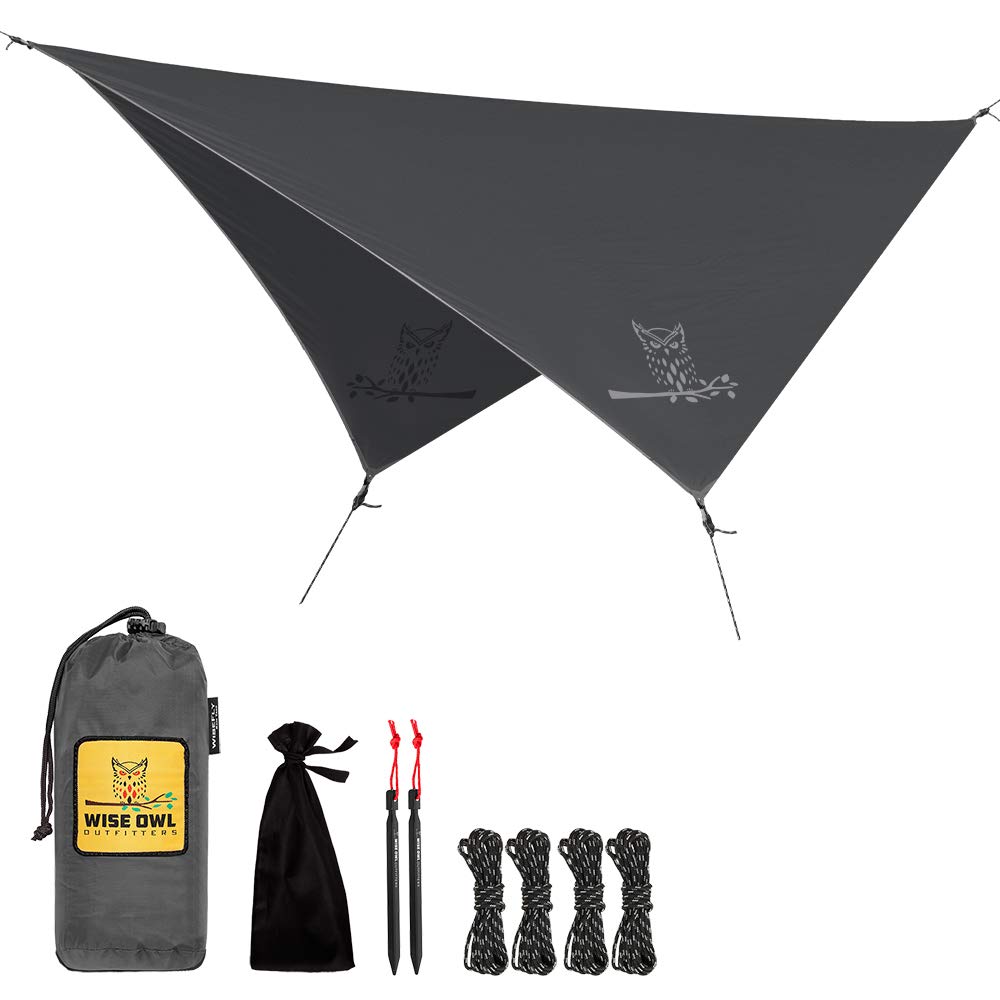
The sack holds an 11-by-9-foot ripstop nylon fly, six 10-foot guy lines, four aluminum stakes, a stake pouch and a waterproof carry bag, and the lot weighs 18.9 ounces. That complete kit is much of why this is the tarp we point people to first. Tarps that arrive bare leave you cutting paracord and hunting for rocks, and the first wet night is a poor time to find that out. The fabric is PU-coated to 3,000 mm with taped seams, mid-range among these picks and enough for steady rain if the pitch is tight.

Pitching is where a light nylon tarp earns or loses its keep. Ripstop this thin relaxes once it wets out, so set the ridge low, angle one end into the weather, and take up the slack after the fabric has had a chance to soak. Strung diagonally, the 11-by-9 rectangle covers a gathered-end hammock with room to sit up underneath; pitched flat, it shelters two sleepers and their packs. The attachment points sit where you need them for a ridge line and four corners, and the corner stitching is clean, which is not something we can say for every fly at this size.

Where it gives ground is footprint. This is a shelter you sit under rather than stand in, and a picnic table with four people around it will feel crowded; the 12-by-10 shapes here are the ones for that. The stuff sack is a snug fit once the lines are attached, so roll the tarp rather than folding it and it slides in without a fight.

Pros

  • Stakes, guy lines and bags included
  • 18.9 oz packed weight
  • 3,000 mm PU coating with taped seams
  • Easy to pitch and take down

Cons

  • 11 x 9 ft is a sit-under shelter, not a stand-up one
Our verdict

The tarp we recommend to most people: 18.9 ounces, taped 3,000 mm seams, and the stakes, lines and bags already in the sack.

Check Latest Price
2

Best for Two-Person Coverage

FREE SOLDIER Camping Tarp

94 /100
Angler Score Outstanding

Key details

Size
10 x 10.5 ft
Material
210T ripstop polyester
Packed Weight
1 kg (2.2 lb)
Waterproof Rating
2,500 mm PU
Check Details on Amazon

Put this beside our top pick and the trade is plain: 118 by 126 inches of 210T ripstop polyester against 11 by 9 feet, for roughly twice the packed weight at a kilo. What the extra fabric buys is a shelter two adults can sit in side by side with packs stowed between them, plus enough span to pitch one end low and one end high when the weather is arriving from a known direction.

The seams are the part we rate highest. They are heat-sealed and taped rather than stitched and taped, which is what keeps a 2,500 mm coating honest along a ridge line, and the tie-outs are numerous and properly reinforced. Polyester also holds its tension when it wets, so once this tarp is tight it tends to stay tight through a long night of rain rather than sagging into a pocket.

The limit is carrying distance. At a kilo this is a car-camping and short-walk tarp, not something you want on a long approach, and the edge seam is the place to look it over before a trip; loose thread working out of the hem is the usual first sign that a corner is about to go. Catch it at home with a needle and it never becomes a story.

Pros

  • 10 x 10.5 ft covers two people and gear
  • Heat-sealed, taped seams rated 2,500 mm
  • Many reinforced tie-out points
  • Polyester holds tension when wet

Cons

  • No stakes or peg bag in the kit
Our verdict

Buy this one when two people need to wait out a storm together: more coverage than our top pick, at the cost of a kilo in the pack.

Check Latest Price
3

Best Value Shelter Kit

KALINCO Camping Tarp

91 /100
Angler Score Outstanding

Key details

Size
10 x 10 ft
Packed Weight
1.8 lb (0.83 kg)
Tie-out Loops
19
Waterproof Rating
3,000 mm PU
Check Details on Amazon

A 10-by-10-foot 210T polyester tarp, six aluminum stakes, six guy lines with tensioners and a carry bag all arrive together, and the price sits below the other full kits in this guide. We think it is the best value of that group, and what convinces us is the small stuff: the stakes are aluminum rather than wire, the lines come with their tensioners already threaded, and the fabric carries the same 3,000 mm rating as flies that cost noticeably more.

Nineteen tie loops, three of them along the ridge line, is more than most people will use and exactly what you want when the forecast turns. Pitch it flat for shade, drop a corner as a wind break, or run a line down the middle for a proper A-frame. Every fix point is double-stitched and the center seam is taped, so the places water usually finds are already covered. At 1.8 pounds it goes into a daypack without complaint.

What it is not is a specialist. This is the tarp for the camper who wants one shelter that covers a picnic table, a tent door or a pair of camp chairs, and who does not want a different pitch for every forecast. For that, the value is hard to argue with.

Pros

  • 10 x 10 ft with a 3,000 mm PU coating
  • Six aluminum stakes and six guy lines included
  • 19 tie loops, three on the ridge line
  • Double-stitched fix points and taped center seam

Cons

  • 10 ft ridge is tight over an 11 ft hammock
Our verdict

The best-value shelter kit here: a 10-by-10 tarp with six stakes and six guy lines, priced below the other complete kits.

Check Latest Price
4

Most Tie-Down Options

Gold Armour Rainfly Tarp

92 /100
Angler Score Outstanding

Key details

Size
12 x 10 ft
In The Kit
Stakes, ropes, tensioners, 2 centerlines
Tie-down Loops
33
Waterproof Rating
5,000 mm
Check Details on Amazon

Thirty-three tie-down loops is the number that separates this tarp from everything else here. On a 12-by-10-foot rectangle that is enough for a ridge line, two pulled-out porch corners, a dropped side wall against the wind and a couple of points left over for hanging packs or a gear hammock. If you like trying a different pitch every trip, that count is worth more than a few saved ounces.

The 5,000 mm waterproof rating is the highest in this group, and the seams are taped to match. Two centerlines, stakes, ropes and tensioners come in the bag, so a basic A-frame goes up without additions. The twelve-foot ridge gives more covered length than the 10- and 11-foot tarps, which shows up as dry space at the ends of a hammock or a dry strip in front of a tent door.

Rigging practice matters with a shelter this size. A short length of shock cord at each tie-out lets the whole tarp breathe in a gust instead of loading one stitch line, and it takes a minute to add. Rigged that way, this is the most flexible shelter here, and the one to choose if you prefer adjusting your pitch to carrying two tarps.

Pros

  • 33 tie-down loops for porch and storm pitches
  • 5,000 mm waterproof rating, seams taped
  • 12 x 10 ft span covers hammock and gear
  • Stakes, ropes, tensioners and 2 centerlines included

Cons

  • Tie-out tabs can tear under hard tension
Our verdict

Our pick for the camper who re-rigs every trip: 33 tie-down loops, 5,000 mm waterproofing and a 12-by-10-foot span.

Check Latest Price
5

Best Budget Rain Fly

Unigear Hammock Rain Fly

93 /100
Angler Score Outstanding

Key details

Size
9.8 x 9.8 ft
Material
210D ripstop Oxford
Fix Points
8 reinforced
Waterproof Rating
3,000 mm PU
Check Details on Amazon

Not every camper needs 33 tie-outs. If you are new to hammock camping and want a fly that simply works, this is a 9.8-by-9.8-foot square of 210D ripstop Oxford with six stakes and six ropes in the bag, and it asks nothing beyond tying two corners to two trees and pegging the rest down.

Each of the eight fix points is reinforced with a triangular double layer and double stitching, and that is the detail we like most. Corner reinforcement is where inexpensive tarps cut, and these hold their shape when the pitch is pulled tight. The 210D Oxford has more body than the 210T polyester on several picks here, so it resists abrasion across a ridge line and does not flap itself loose overnight.

Pitched as a diamond over a hammock, or thrown up as a lean-to at a lunch stop, it does what a fly is for: sheds water, blocks a cold wind, and comes down dry enough to shake out and pack. Nothing about it is fussy. The lines, pegs and bag all arrive together, and the fabric has enough body to hang without a fight.

Pros

  • 3,000 mm PU on 210D Oxford
  • Reinforced, double-stitched fix points
  • Six stakes and six ropes included
  • Least expensive rain fly here

Cons

  • 1.1 kg is heavy for its coverage
  • Eight fix points limit porch-style pitches
Our verdict

The least expensive fly here, and the one that asks the least of you: 3,000 mm Oxford, double-stitched corners, six stakes and six ropes.

Check Latest Price
6

Best Tent Footprint

Clostnature Tent Footprint

92 /100
Angler Score Outstanding

Key details

Size
87 x 59 in
Storage
Drawstring bag
Material
210T ripstop polyester
Packed Weight
9.8 oz
Check Details on Amazon

This is a footprint, not a shelter, and that distinction decides whether it is right for you. At 87 by 59 inches it is cut for a small two-person tent floor: enough to keep the floor off gravel and pine roots, small enough that it does not stick out past the tent and collect rain into the seam.

At 9.8 ounces it is the lightest thing in this guide, and it disappears into a tent stuff sack along with the poles. The 210T ripstop polyester is coated and does stop ground moisture wicking up through a tired tent floor, which is more than the floor alone manages after a few seasons of use.

What we think of it comes down to thickness. The fabric is thin, and a sharp stick or a jagged rock under the tent will find it, so clear and level the ground before you lay it down and it protects the floor the way it should. As an emergency shelter it is a stretch, since 87 inches is short for an adult to lie under, so buy it for the ground and not the sky.

Pros

  • 9.8 oz and packs down small
  • Coated ripstop keeps ground damp out
  • Protects the tent floor from abrasion
  • Drawstring storage bag included

Cons

  • 87 x 59 in suits small tent floors only
Our verdict

A ground cloth built for the job: 9.8 ounces of coated ripstop that keeps a tent floor off rock, roots and damp ground.

Check Latest Price
7

Best Budget Ground Tarp

Amazon Basics Camping Tarp

93 /100
Angler Score Outstanding

Key details

Size
9.5 x 11.3 ft
Material
Polyethylene, 2-sided lamination
Packed Weight
2.2 lb
UV Protection
Yes
Check Details on Amazon

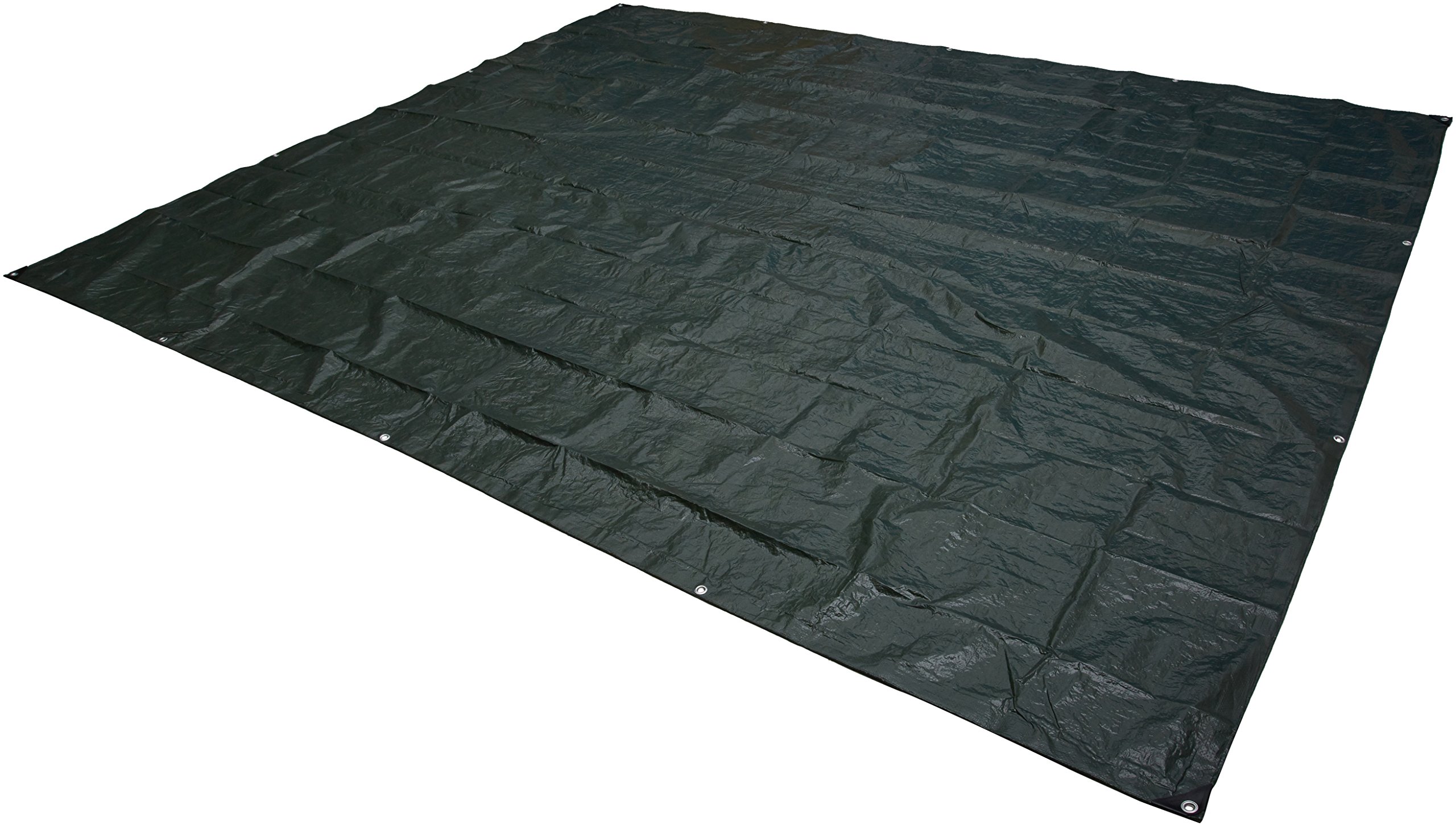
There is not a cheaper way to put a waterproof layer on the ground. This is a 9.5-by-11.3-foot sheet of ripstop polyethylene, laminated on both sides, with reinforced corners and grommets along the edges. Laid under a four-person tent it covers the floor with a little to trim; strung over a woodpile or a picnic table it keeps whatever is underneath dry.

Polyethylene is the right material for ground duty and the wrong one for anything ambitious. It is fully waterproof, UV treated and shrugs off gravel and branches better than coated nylon, which is why we keep it in the car rather than in a pack.

The heavy-duty framing deserves a caveat. The film is thinner than the name suggests, and a sharp stick, a hot ember or a corner dragged across pavement will get through it. Treat it as a ground sheet and a cover for gear rather than a windbreak to tension hard.

What it is genuinely good at is the unglamorous work around a campsite: under the tent, over the firewood, on the ground beneath a cooking setup, folded behind the seat between trips. Nothing here beats it for that, and nothing here is easier to replace when it finally wears through.

Pros

  • 9.5 x 11.3 ft covers a large tent floor
  • Laminated polyethylene on both sides
  • Reinforced corners and edge grommets
  • UV treated

Cons

  • Stiff, crinkly polyethylene packs bulky
Our verdict

The budget route to a dry ground layer: 9.5 by 11.3 feet of double-laminated polyethylene with reinforced corners and edge grommets.

Check Latest Price
8

Utility Coverage

CARTMAN Poly Tarp

93 /100
Angler Score Outstanding

Key details

Size
10 x 12 ft
Thickness
8 mil
Packed Weight
2.7 lb
Grommet Spacing
36 in
Check Details on Amazon

This is the tarp that lives in the garage and turns out to be useful at camp. CARTMAN's 10-by-12 is a general-purpose polyethylene cover, and the marked size is the finished size, which is worth checking because cut size and finished size are different numbers on some tarps.

Eight mil gives the sheet some body in the hand. The hems are heat-sealed and folded over a rope core so they do not crack along the crease, the grommets sit every 36 inches, and the corners get plastic reinforcement. Staked out over a picnic table or a tent, it holds a shape in wind that a light nylon fly will not.

The grommets are also the weak point. Load one corner with a full water jug or a rope pulled hard and the metal can pull through the film; run a bungee or a knotted rag through the grommet to spread the load and it holds. The sheet does not breathe either, so leave a gap at the ridge if you pitch it tight over a tent in cold weather and you will not wake up to condensation on the underside.

Where it earns its place in a camping kit is under the tent, over the picnic table, or wrapped around gear in a truck bed. It is not the tarp we take on a hike, and it is not the one to sit under in a downpour unless you like the sound of a drum. For covering a lot of ground cheaply, it is the pick here.

Pros

  • Finished 10 x 12 ft size
  • 8 mil film with heat-sealed, rope-cored hems
  • Grommets every 36 inches
  • Rides out wind without flapping

Cons

  • 2.7 lb of polyethylene packs bulky
Our verdict

A utility tarp that doubles as a tent floor: 10 by 12 feet of 8-mil polyethylene with heat-sealed hems and grommets every three feet.

Check Latest Price

How We Tested the Best Camping Tarps

We started with more than 40 tarps, pulled from brands we already trust and from lesser-known names with strong review records, then narrowed by the things that actually decide a purchase: listed size (everything from compact 8-by-10 shelters to 10-by-15 footprints), packed weight, whether stakes, guyline, and a stuff sack come included, and price relative to square footage. That filter left us with 14 tarps, which we used for six months across backyard overnights, hammock hangs, a windy ridge trip, and a few rainy car-camping weekends.

Water resistance got tested two ways. Each tarp was pitched at a shallow A-frame and hosed down for a steady ten minutes while we watched for water pooling in the sag, misting through the coating, and seepage at the seams. Then we slept under them in real rain and checked in the morning whether the underside was damp, whether condensation had formed, and whether the floor beneath stayed dry.

Weight and size we measured rather than trusted: every tarp went on a kitchen scale with and without its bag, and we stuffed each one back into its own sack to see how realistic the packed dimensions were and how long a solo pitch took in wind. Durability and thickness we judged by handling — how stiff or floppy the material felt when folded, whether light showed through, and how the corners and grommets were reinforced — and we re-inspected every tie-out after each trip for stretching, fraying, and pulled stitches. Finally, we weighed what each one cost against what it delivered, since a budget tarp that needs a second season of use to trust isn't much of a value.

How to Choose a Camping Tarp

Start With Where It Goes

Overhead shelter and ground cover are different products even when they are the same rectangle of fabric. Overhead, you want a coated nylon or polyester with a rated waterproof coating, taped seams and enough tie-outs to hold a shape. Underneath, you want abrasion resistance and a coating that does not mind being knelt on. Polyethylene is cheap, fully waterproof and tough against gravel, but it is heavy and loud overhead; coated nylon and polyester cost more and weigh far less.

One trap worth knowing: a ground sheet that extends past the tent floor catches rain and channels it under the tent. Fold or trim the footprint so it sits an inch or two inside the floor line, and never let it stick out on the uphill side of a sloping site.

Match Size and Shape to Your Pitch

The 10-by-10 and 9-by-9 tarps here are hammock and two-person shelters: big enough to sit under, not to stand in. A 12-by-10 rectangle adds two feet of ridge line, and ridge line is the dimension that matters over a hammock, since an 11-foot hammock needs an 11-foot ridge or its ends hang out in the rain. Squares forgive diagonal pitches; rectangles cover better in an A-frame.

For ground use, measure the tent floor rather than the tent. The Clostnature footprint is 87 by 59 inches, which suits a small two-person floor. A larger floor needs a larger sheet, and a 10-by-12 poly tarp trims down to fit with a knife and no sewing.

Read the Waterproof Rating, Then the Seams

A 2,500 to 3,000 mm polyurethane coating is the working range for camping tarps, and the 5,000 mm tarp here is the one for sustained, wind-driven rain. We rate seam treatment above the headline number: taped or heat-sealed seams are what stop water tracking along a stitch line, and a high rating on a stitched-only seam will still drip.

Watch the wording, too. Water resistant is not waterproof, and a fly described that way will wet through in a long storm. For ground use the rating matters less than the film: polyethylene is waterproof by nature, so thickness and abrasion resistance are what you are comparing.

Count Tie-Outs and Check the Bag

Eight reinforced points will hold an A-frame. Twelve or more lets you pull out a porch, drop a wind wall or hang gear, and 33 is for people who enjoy the rigging as much as the shelter. Look for double stitching or triangular reinforcement at every point, because that is where inexpensive tarps fail first.

Check what is actually in the sack before you leave. Several tarps here ship with lines but no stakes, and the ones with four guy lines assume pegs already in your kit. Run a short shock cord between the tarp and each line to absorb gusts; it takes the peak load off the stitching and costs nothing in coverage.

Frequently Asked Questions

Final Verdict

If you want one tarp for camping and no further research, buy the Wise Owl. It is the lightest complete kit here, the 3,000 mm coating and taped seams handle real rain, and the stakes and guy lines are already in the bag.

Take the FREE SOLDIER instead when two people need to share a shelter and the walk from the car is short. If the goal is protecting a tent floor rather than building a roof, skip both and get the Clostnature footprint: 9.8 ounces, nothing to rig, and it packs down with the tent.