Best Crappie Jig Heads of 2026

A crappie jig head is a hook, a weight, and a paint job, and crappie anglers argue about all three. The tradeoff built into the category is the hook wire itself: light wire pulls free from a snag and still drives into a papery crappie mouth, while heavy wire survives timber and big fish but can cost you a hookset. That's the real decision sitting in the tackle aisle, along with whether the collar will hold a soft plastic without tearing it after the third fish. Get both right and you spend less time retying and more time with a net in your hand.

I've been digging jig heads out of a rust-stained box for 20 years, and I still run a thumbnail across every hook point before it goes in the boat. Over the past four months, my team and I fished 16 different jig heads — bare ball heads, painted heads with molded 3D eyes, 1/32-ounce versions — over brush piles and stake beds until each one caught fish or embarrassed itself. Cheap jigs are cheap for a reason, and the difference usually shows up on the third fish, not the first. That's exactly what the list below reflects.

1

Best Overall

Strike King Mr. Crappie Slab Slasher 1/16 oz

90 /100
Angler Score Outstanding

Key details

Hook
Eagle Claw #2 black nickel
Hook Bend
45 degree
Pack Size
8 jig heads
Head Weight
1/16 oz
Check Details on Amazon

Sixteenth-ounce lead and a #2 hook is the pairing most crappie plastics want, and the Mr. Crappie Slab Slasher gets it right: a black nickel Eagle Claw in a 45-degree bend, a barb forged into the shank to hold a soft plastic tail, and a head that returns strongly on forward-facing sonar. The name on the package belongs to Wally Marshall; the hardware is what earns the spot.

That hook is why this one is our top pick. A #2 on a 1/16-ounce head is the ratio crappie fishing is built around, with enough gap to hold a two-inch tube or curly tail and a small enough bite that a fish can take the whole thing. Eagle Claw's black nickel wire is a clear step up from the generic bronze hooks on most bulk bags, and the shank barb does the rest: nose-hook a plastic and it stays where you put it, cast after cast, and the same head will hold a live minnow under a slip float.

The catch is the count. Eight heads to a pack puts this at the top of the price range here, and a couple of packs go a long way when you are casting open water rather than dragging timber. Lose jigs by the dozen in standing cover and the math changes — buy a bulk bag for that water and save the Slab Slashers for the spots you can fish clean.

What we keep coming back to is how little you have to think about it. The barb holds a plastic without glue, the point comes out of the back of a two-inch bait where it should, and the head is heavy enough to cast and light enough to fall slowly, so the only decision left is where to put it.

Pros

  • #2 Eagle Claw in a 45-degree bend
  • Shank barb holds plastics and live bait
  • Strong return on forward-facing sonar
  • 1/16 oz suits most crappie plastics

Cons

  • Chartreuse is the only color in this size
Our verdict

We recommend the 1/16-ounce Slab Slasher first: a sharp #2 Eagle Claw, a barbed shank that holds plastics, and the weight most crappie plastics are built around.

Check Latest Price
2

Best for Wind and Deep Brush

Strike King Mr. Crappie Slab Slasher 1/8 oz

90 /100
Angler Score Outstanding

Key details

Hook
Eagle Claw #2 black nickel
Hook Bend
45 degree
Pack Size
8 jig heads
Head Weight
1/8 oz
Check Details on Amazon

Twice the lead, same hook. The 1/8-ounce Slab Slasher carries the identical #2 Eagle Claw and 45-degree bend as our top pick, and that is the point: when the wind gets up or you are dropping into deep brush, you change weight without changing anything else about the rig. It is the heavier half of one decision, and it is the one we tie on when the boat will not hold still.

What you give up is hang time. A heavier head falls faster and swings less on the cast, which is right for fish pinned to the bottom of a brush pile and wrong for suspended crappie that want the bait drifting down past their noses. Fishing shallow water with it simply puts more lead in front of a fish than the fish need.

The sonar argument favors it, too. Strike King builds these with forward-facing sonar in mind, and a bigger lead head returns a stronger signal than a 1/32-ounce, so it is easier to follow the fall on screen and judge where the bait sits relative to the pile. Fish electronics seriously and the 1/8 stays tied on while the 1/16 waits its turn.

Pros

  • Same #2 Eagle Claw as our top pick
  • 1/8 oz cuts wind and reaches depth
  • Heavier head shows better on sonar

Cons

  • Chartreuse only, eight heads per pack
  • More lead than shallow, calm water needs
Our verdict

We reach for this one when the wind picks up or the fish are deep: same head, same hook, twice the lead.

Check Latest Price
3

Best Bulk Value

Temorah Unpainted Ball Jig Heads

89 /100
Angler Score Excellent

Key details

Hook
Bronze, #4
Finish
Unpainted lead
Pack Size
50 jig heads
Head Weight
1/16 oz
Check Details on Amazon

Fifty unpainted lead ball heads with bronze hooks, in a size run that starts at 1/32 ounce with a #6 and climbs to 1/2 ounce with a #3/0; the 1/16-ounce pack carries a #4. There is no paint to chip and no eyes to clog, and bare lead lights up on livescope in a way painted heads sometimes do not.

Per head, nothing else on this list comes close, and the hooks arrive sharp enough to fish straight out of the bag. What you are buying is a component rather than a finished lure: bare lead you can paint, powder-coat, or tie, in a range wide enough to cover everything from a 1/32-ounce crappie head to a half-ounce something for bigger water.

Order by the hook as much as the ounce, since the 1/32 carries a #6 and the 1/16 a #4, and match that to the plastic you thread. For anyone fishing brushy water on light line who expects to lose jigs, this is the bag to buy first; for a finished head with paint and eyes out of the pack, keep looking.

Pros

  • Lowest per-head cost in this group
  • Sharp bronze hooks out of the bag
  • Size run from 1/32 to 1/2 oz
  • Unpainted lead shows on livescope

Cons

  • Soft wire bends out of snags and can snap
  • Heads read small for their stated weight
Our verdict

Our value pick for anglers who lose jigs in brush: fifty sharp, unpainted heads at the lowest per-head cost here.

Check Latest Price
4

Best for Low Light

Dovesun Glow Ball Jig Heads

88 /100
Angler Score Excellent

Key details

Pack Size
40 jig heads
Bait Keeper
Double collar
Glow Finish
White only
Head Weight
1/32 oz (0.8 g)
Check Details on Amazon

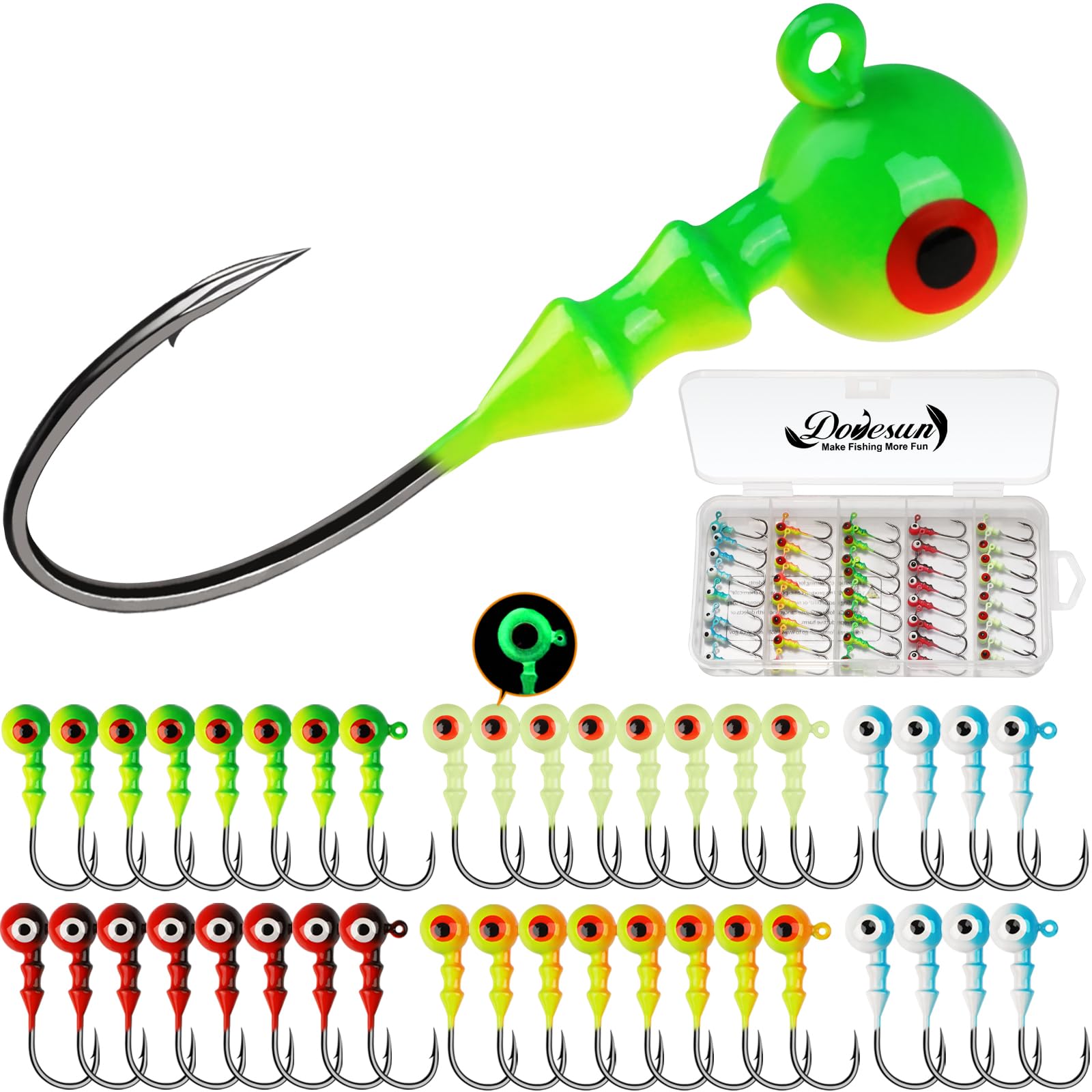
Last light is when a glow head earns its keep, and this set is built for it: eight weights across the line, five colors per weight, and a white that glows in the dark. This is the 1/32-ounce, forty-piece set, which is a slow, shallow presentation, best under a float or swum over the top of a brush pile.

The finish is the pleasant surprise. Two-tone paint lays on even, the eye sockets come clear of paint, and the double collar grips a plastic without a dab of glue, so you can rig a bait in the dark without hunting for the trailer hook. That is more than we can say for most painted heads in this price range.

Our take: buy these for the glow and the paint, not for range. At 1/32 ounce they are a calm-water head, and if you need to get deeper, buy the same jig in a heavier weight rather than pinching a split shot above it, because the extra hardware dulls the action you paid for.

Pros

  • White heads glow in the dark
  • Clean eye sockets and even paint
  • Double collar holds soft plastics

Cons

  • Only the white color glows
  • Small line tie fights snaps and swivels
Our verdict

Buy these for last light: white glow heads that actually glow, a clean two-tone finish, and a double collar that keeps plastics on.

Check Latest Price
5

Best Starter Set

Goture Round Jig Heads with Tackle Box

87 /100
Angler Score Excellent

Key details

Hook
High-carbon steel
Storage
Compartment tackle box
Pack Size
50 jig heads
Head Weight
1/16 oz (1.5 g)
Check Details on Amazon

Fifty jig heads that arrive sorted into a compartment box sounds like a small thing until you have spent ten minutes untangling loose lead on a moving boat. We like this set for that alone, and for a size run that includes the odd increments, 1/36, 1/32, 1/28, 1/16 and 1/8 ounce, so you can dial in a fall rate instead of jumping between the standard weights.

The heads are unpainted with high-carbon steel hooks and a keeper on the collar. That keeper is the part to think about before you buy: it grips a grub or a curly tail well enough, less so a hollow tube that wants a longer hold, so pair the head with the plastic you actually throw rather than the other way around.

If you are building a box from scratch, restocking after a summer of losing jigs, or fishing water you have never seen, this is the least fussy way to do it: one order, one box, enough weights to find the pattern. Already know you fish 1/16 ounce almost exclusively? Buy a bag of that weight and skip the rest.

Pros

  • Fifty heads sorted in a compartment box
  • Uncommon sizes including 1/36 and 1/28 oz
  • Sharp high-carbon steel hooks

Cons

  • Heads run compact for their stated weight
Our verdict

We like this as the starter set: fifty heads across five sizes in a compartment box, so a new crappie angler can find the fall rate instead of guessing.

Check Latest Price
6

Best for Micro Plastics

Bobby Garland Itty Bit Jig Heads

88 /100
Angler Score Excellent

Key details

Hook
Eagle Claw #8
Pack Size
20 jig heads
Bait Keeper
Down-style keeper
Head Weight
1/48 oz
Check Details on Amazon

At 1/48 ounce with a #8 Eagle Claw, this is the smallest head on our list by a wide margin, smaller than the 1/32-ounce heads most people picture when they say micro.

That is the whole point. Tiny plastics, tiny tubes, Bobby Garland's own Itty Bit Swim'R: a 1/48-ounce head falls slowly and stays in the strike zone over shallow cover, and the down-angled keeper is shaped to hold a body barely longer than the hook shank.

We keep a pack of these for the days when crappie are keyed on something small and will not look at a two-inch bait, and for dock shooting, where a slow fall under a light float is the entire game. Twenty to a pack, unpainted, sharp out of the bag, and the kind of jig that makes a light rod feel like the right tool.

One thing to plan for: the gap on a #8 is small, so the hookset needs to be a lift rather than a swing, and a soft tip does more for you here than a fast one. That is the price of fishing a bait this small, and it is a fair one.

Pros

  • 1/48 oz falls slowly over shallow cover
  • Sharp Eagle Claw #8 hook
  • Down keeper sized for tiny bodies

Cons

  • Won't cast far or fish deep
Our verdict

We keep these for tiny plastics and picky fish: a 1/48-ounce head with a sharp #8 Eagle Claw and a keeper built for bodies under two inches.

Check Latest Price
7

Painted Heads

Dr.Fish 3D Eye Sickle Jig Heads

90 /100
Angler Score Outstanding

Key details

Eyes
3D painted
Hook
Sickle, #6
Pack Size
10 jig heads
Head Weight
1/32 oz
Check Details on Amazon

Three things separate the Dr.Fish heads from the bare-lead bags on this list: a sickle-shaped hook, a pair of barbs molded in to grip a plastic, and a painted head with large 3D eyes. Ten to a pack, sold in 1/32, 1/16 and 1/8 ounce.

The eyes are the detail worth checking on any painted head, and these come through clean, with no paint sealing the socket and no flecks across the pupil. The chartreuse reads brighter than most, and the finish holds up better than the cheaper painted jigs, which tend to chip at the collar first.

The sickle bend tucks the point slightly inward, which is the shape you want when crappie are short-striking and you are setting into a paper mouth. It is also why these fish well on a slow lift rather than a hard swing, so let the rod load before you come tight.

Where it fits is simple: if you want a finished, eyed head straight out of the pack and you fish small plastics, this is the nicest paint of the small packs here. It is a box-completer in this company rather than the bag you refill from.

Pros

  • 3D eyes come clear of paint
  • Bright, chip-resistant painted finish
  • Sickle hook suits a crappie's mouth
  • Double barbs grip soft plastics

Cons

  • 1/32 oz packs a short #6 hook
  • Only ten heads per pack
Our verdict

Our pick for a finished, painted head: clean 3D eyes, a sickle hook that suits a crappie's mouth, and paint that holds up better than most.

Check Latest Price
8

Color Variety

Bombite Crappie Jig Heads 40-Pack

86 /100
Angler Score Excellent

Key details

Colors
Five bright colors
Pack Size
40 jig heads
Bait Keeper
Wire keeper
Head Weight
1/16 oz
Check Details on Amazon

Forty heads in five bright colors, each with big 3D eyes, a V-cut point and a wire keeper soldered to the collar. The color spread is the draw, and 1/16 ounce is a sensible weight to build a box around.

The wire keeper is the functional difference. It holds a soft plastic from sliding down the shank cast after cast, and it is gentler on a bait than a molded barb, so the same plastic survives more fish. Threading it takes a second longer than pushing a bait onto a barb, and after a dozen fish that trade pays off.

Five colors in one box is more useful than it sounds. Crappie can be color-shy one morning and take anything the next, and having black, chartreuse and a couple of brights on hand lets you test that without buying five separate bags.

We see this as the color-and-keeper pick: the one to buy when you want a handful of bright heads with wire keepers for docks and laydowns and you are willing to baby the hook a little. Want plain heads to lose in cover without thinking about it? An unpainted bulk bag does that job better.

Pros

  • Five bright colors in one box
  • Wire keeper holds plastics without glue
  • Gentler on soft baits than a barb

Cons

  • Thin wire does not tolerate bending back
  • Narrow head profile for its weight
Our verdict

Choose these when color and a wire keeper matter more than hook strength: forty bright heads for docks and laydowns, provided you don't reef on the wire.

Check Latest Price

How We Tested Crappie Jig Heads

We started with a sweep of what's actually sold as a crappie jig head: bare unpainted ball heads, painted heads with molded eyes, and 1-ounce slab heads for fishing current. Everything got sorted by weight, hook size, wire gauge, and cost per jig rather than cost per pack, since a 40-pack and a two-pack often land in the same place once you divide it out. Cleanly molded collars and useful weight ranges rose to the top, and we ordered 16 different jig heads to fish.

Late March through July, we fished them from a boat over brush piles and stake beds, and from a dock tight-lining under slip floats in eight to twelve feet of water. Each jig got the same knot and the same 2-inch plastic, and stayed tied on until it landed crappie or ended up in the snag box. I ran a thumbnail down every hook point before its first cast and again after it had been dragged over gravel — a point that slides instead of grabbing tells you the third fish will come unhooked. We also leaned on snagged jigs on purpose to see whether the wire straightened and pulled free or cost us line, then bent the light-wire hooks back to check they returned instead of snapping.

Paint was judged by how it looked after a morning of banging off rock, and by whether molded eyes stayed glued on past a dozen fish. We counted fish per jig to compare hookup ratios and how many shook loose at the boat, checked that the hook gap cleared the body of a fat grub, and noted which collars tore plastics. At the end we went back through each pack to see how many jigs were actually fishable, since bent hooks, clogged eyes, and uneven collars quietly wreck the value of a cheap 40-pack.

How to Choose Crappie Jig Heads

Weight Comes First

Carry two weights rather than one. A 1/32-ounce head is the calm-morning, shallow-cover choice, 1/16 ounce is the all-rounder that suits most plastics on most days, and 1/8 ounce is for wind, current, and dropping through deep brush. The trap is buying by the ounce label and nothing else: a light head in a stiff crosswind drags your line and lifts the bait out of the strike zone, and no amount of lure swapping fixes that.

If you fish one lake at one depth, buy a bag of the weight that gets you there. If you move around, a small assortment beats a big bag of the wrong size, and the Goture set covers the middle of the range in one order.

Match the Hook to the Lead

A jig head is a package deal: the hook was chosen by whoever poured the lead, and the ratio between the two matters more than either number alone. The pattern that works is roughly #6 on a 1/32, #4 on a 1/16, and #2 on an 1/8, which is what Strike King and Temorah ship in those weights.

A heavy head with a short hook will not hold a three-inch swimbait, and a big hook on a light head kills the action you bought the light head for. Before ordering, picture the plastic you actually fish and ask whether the gap clears it.

Think About Wire Before You Fish Brush

Light wire sets through a crappie's paper mouth; heavier wire survives being dragged out of a laydown. Those pull in opposite directions, and it is the real difference between the bags here. A softer hook, like the Temorah, straightens when you lean on it, which gets your jig back from a snag and costs you a fish if it is a good one. Eagle Claw's black nickel on the Strike King heads sits at the other end.

Four-pound line around brush rewards the softer wire. Timber, docks, and anything with shoulders rewards the heavier.

Keepers, Paint, and Eyes

The keeper decides whether your plastic survives the cast. A molded barb on the shank is simplest and grips well, a wire keeper is gentler on a bait, and a down-angled keeper like Bobby Garland's is sized for bodies under two inches. Match the keeper to the plastic, not to the fish.

On finish, unpainted lead shows up clearly on sonar and takes paint if you coat your own, while painted and glow heads are for water where fish need to see something. Check the hook eye before you rig, because a bead of paint in the eye costs you a jig every time.

Frequently Asked Questions

Final Verdict

The Strike King Mr. Crappie Slab Slasher in 1/16 ounce is the head we point people to first, because it solves the part of crappie fishing you can actually control: a sharp #2 Eagle Claw, a barb that holds a plastic, and a weight that suits most of the baits in your box. Add a pack of the 1/8-ounce version for wind and deep brush.

If you fish standing timber and expect to lose jigs, refill from the Temorah fifty-count instead and save the Slab Slashers for the clean water.