
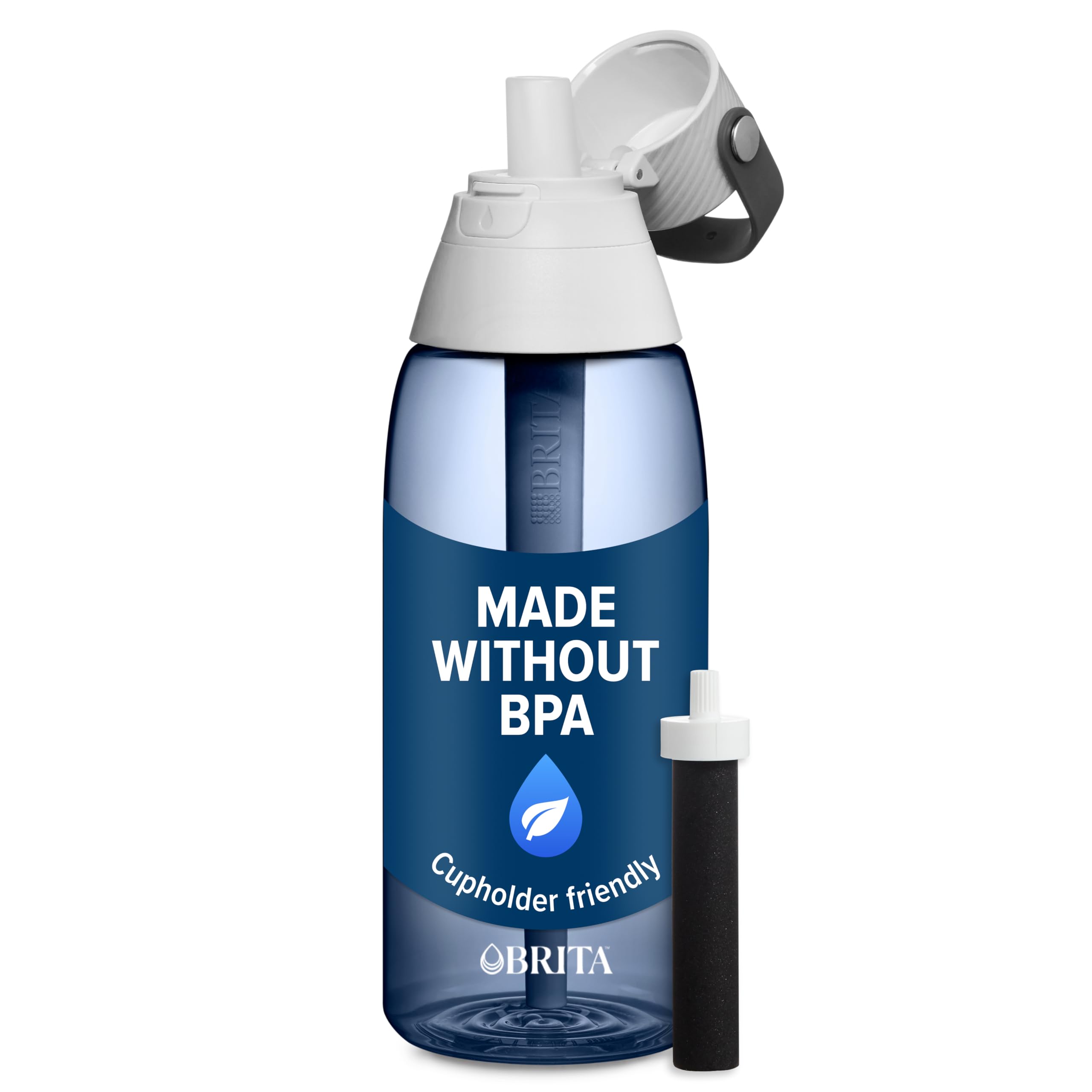
Best Filtered Water Bottles of 2026

A filtered water bottle is two products pretending to be one: a filter that decides how your water tastes and a bottle that decides whether you'll carry it. Most models get one right and fumble the other — sweet-tasting water that takes a minute of hard sucking to earn, or a good-looking bottle whose cartridge you'd be swapping every few weeks. What you're really buying is drinkability, out of something that won't soak your bag on the commute.

I've carried one for years — my building's tap water tastes faintly of a swimming pool — and over six months my team put 12 bottles through desk days, gym bags, trailheads, and back seats. The first lesson: a cartridge built for chlorine and lead in city water is a different animal from a hollow-fiber membrane meant for a stream, and buying for the wrong water is the most common mistake. We weighed every bottle full and washed each by hand and in the dishwasher, because a bottle you resent carrying or dread scrubbing stays home. What's below are the ones that kept their spot.

1

Best Overall

BRITA Premium Filter Bottle 36 oz

93 /100
Angler Score Outstanding

Key details

Body
BPA-free plastic
Capacity
36 oz
Cleaning
Top-rack dishwasher safe
Filtration
Activated carbon block
Check Details on Amazon

Thirty-six ounces is why this one rides in the truck instead of living in a cabinet, and it's the bottle we recommend first to anyone who just wants their tap water to taste better all day. That's a full morning of drinking before a refill, and it's still light enough to hook a finger through the loop when your other hand is full of gear. The filter is an activated carbon block, so it goes after chlorine taste and odor along with some particulates — it cleans up treated water, and Brita is direct that it is not a purifier.

Day to day the design does what you want it to. The push-button lid opens one-handed, the straw reaches the bottom, the wide neck fills from a tap or a cooler spigot, and the whole bottle goes on the top rack of the dishwasher. Filters are rated at 40 gallons or about two months, they're stocked in every grocery store, and one replaces a few hundred single-use bottles before it's spent.

Two things to know going in. The straw makes you pull — water through a carbon block doesn't come up the way it does through a plain straw, so plan on a real draw rather than a sip. And the lid and filter need to be seated firmly after a wash; press the filter home and screw the cap down, or you'll find a damp bag later. Neither matters for desk, car, boat, or campsite water that already comes from a treated supply.

Pros

  • 36-ounce capacity covers a long day out
  • Carbon block cuts chlorine taste and odor
  • Bottle body is top-rack dishwasher safe
  • Replacement filters are cheap and widely stocked

Cons

  • Straw takes a real pull to draw water
  • Plastic body won't hold a chill
Our verdict

For tap water you already trust, this is the one we hand people: the most capacity here, the lowest running cost, and a body that goes in the dishwasher.

Check Latest Price
2

Best for Questionable Water

GRAYL GeoPress 24 oz

93 /100
Angler Score Outstanding

Key details

Weight
15.9 oz
Removes
Viruses, bacteria, protozoa, chemicals
Capacity
24 fluid ounces
Cartridge Life
65 gallons (250L)
Check Details on Amazon

Viruses are the line most bottles here don't cross. The GeoPress is rated for rotavirus, norovirus, and hepatitis A on top of the bacteria and protozoa, and the cartridge also adsorbs VOCs, PFAS, pesticides, heavy metals, and the flavors and odors that make bad water taste like bad water. Twenty-four ounces, a 65-gallon cartridge, and a ten-year warranty covering workmanship and materials.

There's no straw and no pumping. You fill the outer cup, drop the inner press in, and push; water is forced through the cartridge and rises clean in the middle. GRAYL claims eight seconds, and the mechanism really is that quick in our hands, but it is a push — you're leaning your weight onto it and the last inch takes a firm shove. Anyone with hand or shoulder trouble should know that before ordering, because there's no gentler way to work this bottle.

Empty it's 15.9 ounces and a little over ten inches tall, which makes it a pack bottle rather than a desk bottle. It's also rated to 1,000 ppm total dissolved solids, higher than either LifeStraw here, so hard mineral-heavy water that would clog a finer membrane sits within its range.

Where it earns its place is the trip where you can't answer the question of whether the tap is safe: a fishing camp on a strange well, a border town, a long flight. Press it, pour into the cap, drink. For office water it's more bottle than you need and the pressing gets old if you're drinking all day; for water you're unsure about, nothing else in this guide removes viruses.

Pros

  • Removes viruses as well as bacteria and protozoa
  • No straw, no pumping, no waiting
  • Cartridge rated for 65 gallons
  • Covered by a ten-year warranty

Cons

  • Pressing takes real upper-body force
  • Tall and heavy for a daypack pocket
Our verdict

The GeoPress is the bottle we pack when we can't vouch for the water: it's the only one here that removes viruses as well as bacteria and protozoa, and the price buys that difference.

Check Latest Price
3

Best for Cold Water

BRITA Insulated Stainless 20 oz

91 /100
Angler Score Outstanding

Key details

Body
Double-wall stainless steel
Care
Dishwasher safe
Capacity
20 oz
Cold Retention
24 hours
Check Details on Amazon

The 36-ounce plastic Brita is the better everyday bottle; this is the one to buy when cold matters more than volume. Same carbon filter, same push-button lid and carry loop, but the body is double-wall stainless, it holds cold for a full 24 hours by Brita's rating, and the 3.23-inch width is narrow enough for a car cup holder.

Twenty ounces goes quickly when you're actually thirsty, and the filter takes up room inside, so we found ourselves refilling at lunch on a warm afternoon. The straw is work too — you're pulling water through a carbon block and nobody would call it a swig. What the steel buys you is temperature, and that's the difference between water you finish and water you leave sitting in the console.

Where it makes sense is anywhere your water is going to get warm: a boat, a truck cab, a job site, a long summer drive. In an office the plastic 36-ouncer is cheaper and holds nearly twice as much; outdoors in July, this is the one you'll be glad you brought. The filters are the same ones the rest of the Brita line uses, so restocking stays simple.

Pros

  • Holds cold for a full 24 hours
  • Narrow enough for a car cup holder
  • Same chlorine-reducing Brita filter

Cons

  • 20 ounces empties fast
  • Plastic lid latch is the first part to fail
Our verdict

Buy the insulated Brita if cold water is the whole point — a boat, a truck cab, a long summer drive — and accept that twenty ounces goes quickly.

Check Latest Price
4

Best Long-Term Value

LifeStraw Go Series 1 L

87 /100
Angler Score Excellent

Key details

Weight
9.45 oz
Removes
Bacteria, parasites, microplastics
Capacity
1 liters
Membrane Life
1,000 gal (4,000 L)
Check Details on Amazon

A thousand gallons is the number that sells this bottle. The membrane microfilter is rated for 4,000 liters — about five years of daily use — and the carbon stage ahead of it handles 26 gallons, roughly two months. Run that against what you spend on bottled water and this stops looking like an outdoor gadget and starts looking like the cheapest clean water you can carry.

The membrane is doing the real work: 99.999999% of bacteria, 99.999% of parasites, and microplastics, with the carbon taking out chlorine and the organic notes that make water taste flat. That's a different job from the Brita bottles, which improve treated tap water rather than make an unknown source safe. It's rated to 300 ppm dissolved solids, so hard or brackish water isn't its job — the GeoPress handles that.

The cost is at the mouthpiece. Pulling a liter through this filter takes effort, and the spout holds a little water that ends up on your shirt if the cap isn't screwed all the way down; we check it before the bottle goes back in a pack. At 268 grams it carries easily, and it isn't insulated, so it's a drink-it-fresh bottle rather than an all-day-cold one.

Pros

  • Membrane rated for 1,000 gallons
  • Removes bacteria, parasites, and microplastics
  • Carbon stage improves taste
  • Light enough to carry all day

Cons

  • Hard suction through the filter
  • Not insulated
Our verdict

A thousand gallons of filtered water for the price of one bottle is the argument here; the hard pull at the straw is the trade you make for it.

Check Latest Price
5

Best Ultralight

Katadyn BeFree 1 L

93 /100
Angler Score Outstanding

Key details

Weight
2.24 oz
Capacity
1 liters
Flow Rate
2 liters per minute
Pore Size
0.1 micron hollow fiber
Check Details on Amazon

Two point two four ounces, empty — lighter than the water it carries, and lighter than anything else in this guide. The BeFree is a soft flask with a hollow-fiber filter screwed into the neck: 0.1 micron, 2 liters a minute, a wide mouth that fills from a stream or a tap in seconds, and a body that rolls into a jersey pocket when it's empty.

The squeeze is what we like about it. There's no sucking through a carbon block and no plunger to press: you fill, screw the cap down, and squeeze the bag, and water comes out fast enough to fill a bottle or a friend's cup. Cleaning is a swish of clean water and a shake, with no backflushing kit to lose at the bottom of a pack.

The flask is the part that doesn't last. Pinholes and seam splits show up in the soft body under hard use, and the filter outlives the bag it came in — so treat the bottle as a wear item and the filter as the purchase. For a day hike, a run, or a float where every ounce gets argued over, that's a fair trade. For a commute it isn't: no insulation, no straw, and a soft body that wants its own pocket.

Pros

  • 2.24 ounces and packs flat
  • Fast 2 liters-per-minute flow
  • Cleans with a swish, no backflushing
  • Wide mouth fills from almost anything

Cons

  • Soft flask develops pinholes and seam splits
  • No insulation and no straw
Our verdict

Backpackers and runners should start here: 2.24 ounces, rolls flat, fills fast — just expect the soft flask to wear out before the filter does.

Check Latest Price
6

Emergency Backup

SurviMate 5-Stage Filter Bottle

87 /100
Angler Score Excellent

Key details

Weight
10.1 oz
Capacity
22 oz
Filtration
5-stage, 0.01-micron UF
Filter Life
1,500L (396 gallons)
Check Details on Amazon

Five stages, a 0.01-micron ultrafiltration membrane, and 1,500 liters of filter life put the SurviMate in the same conversation as bottles that sell for considerably more. It's also the only one here with a compass built into the cap, which tells you exactly who it's aimed at: a boat bag, a go-bag, a truck glovebox.

The compromises show up at the straw. Water comes through slowly and with a carbon edge for the first few fills — SurviMate says to expect black carbon particles on first use and to flush the bottle, and that flush is worth doing before you judge the taste. The vent under the spout can drip, so this is a bottle to carry upright rather than toss in a bag beside a book.

Where it earns its place is as a spare: the bottle that lives in the locker or the emergency tote and gets checked once a season, not the one you sip from at a desk. Ten ounces is light on a dive bag, the clip goes onto a pack strap, and 1,500 liters is a long time between cartridges. Just don't buy it expecting an easy drink.

Pros

  • 0.01-micron, five-stage filtration
  • 1,500 liters of filter life
  • Built-in compass and carry clip
  • Light at 10.08 ounces

Cons

  • Slow, hard pull through the straw
  • Vent drips if the bottle lies on its side
Our verdict

A light, long-lived filter for a boat locker or a go-bag; the slow pull and the carbon taste are what keep it off your desk.

Check Latest Price
7

Cold Water, Travel

LifeStraw Go Insulated 24 oz

87 /100
Angler Score Excellent

Key details

Body
Stainless steel
Weight
1.14 lb
Capacity
0.7 liters
Membrane Life
1,000 gal (4,000 L)
Check Details on Amazon

Half a kilo before you put water in it. The stainless Go is the heaviest bottle in this group at 515 grams, and the filter hardware sits inside a 24-ounce body, so you carry more bottle and hold less water than the number on the listing suggests.

What the weight buys is a steel bottle around the same membrane and carbon filters as the plastic Go: bacteria, parasites, and microplastics out, chlorine taste gone, and 4,000 liters of membrane life before anything needs replacing. It's the version to take to a hotel where the tap is doubtful and you want the water cold rather than merely safe.

Our hesitation is the combination of small capacity and high weight. Twenty-four ounces with a filter inside means refilling often, and the suction is the same hard pull as the plastic bottle. For a road trip or a week in a rented apartment that trade is reasonable and the cold water earns the heft. For hiking, take the plastic Go or the BeFree and save the half-kilo.

Pros

  • Steel body holds temperature
  • Same pathogen filtration as the plastic Go
  • 4,000 liters of membrane life

Cons

  • Heavy at 515 grams empty
  • Filter leaves little usable water in 24 ounces
Our verdict

For hotel rooms and road trips where the tap is doubtful and you want cold water, this works; hikers should take the lighter plastic Go instead.

Check Latest Price

How We Tested 12 Filter Bottles Over Six Months

We started by rounding up every filter bottle that published a real filtration standard — a micron rating or a certification — and crossed off anything whose cartridge you couldn't reorder. From roughly 40 candidates we narrowed to 12, weighing capacity, insulation, mouthpiece style, and filter cost per gallon alongside the sticker price. Once they arrived, we weighed each one empty and full and checked whether it fit a bike cage and a car cup holder, since a bottle you resent carrying is a bottle that stays in the cupboard. Each then went into rotation for six months with testers who commute, hike, work out, and drink a lot of tap water.

Taste came first, because nothing else matters if you don't want to drink. We filled each bottle from the same kitchen tap, chilled it overnight, and tasted it against unfiltered tap in unmarked cups, noting chlorine, metal, and any plasticky edge. We timed how long eight ounces took to drink — a great filter that demands 45 seconds of hard suction is a bottle that stays full — and watched whether flow held steady or faded as the cartridge loaded up. The purifier-style bottles got a second round on creek water from a local trail, inspected for grit and aftertaste, and we noted whether each lid could be opened and drunk from one-handed while walking.

Leak testing was less dignified: each bottle rode sideways in a tote next to a laptop for a two-hour commute, then got shaken upside down over a sink. We dropped every one three times from counter height onto tile, watching for hinge cracks, stripped lid threads, and bite valves that quit sealing after a few dozen openings. Temperature retention got an eight-hour check — cold water in at 8 a.m., a thermometer reading at 4 p.m. — and cleaning got an honest look: bottle brushes, dishwasher cycles where the maker allowed them, and whether the filter housing came apart far enough to reach the corners. We also logged what replacement cartridges cost per gallon, because a bottle that's cheap up front and expensive to keep is no value at all.

How to Choose a Filtered Water Bottle

Taste filters and purifiers do different jobs

A carbon block, which is what the Brita bottles use, reduces chlorine, odor, and particulates, and that is all we ask of it: it makes treated municipal water pleasant to drink. A hollow-fiber or ultrafiltration membrane (Katadyn, LifeStraw, SurviMate) goes after bacteria, protozoa, and sediment, while the GeoPress adds virus removal and chemical adsorption on top.

Buy for the water you will actually meet. Filling from a kitchen tap, an office cooler, or a campground spigot, a carbon bottle is enough and easier to drink from. Filling from a stream, a well, or a tap in a country whose water you don't trust, you need a membrane or a purifier, and a carbon bottle is not a cheaper substitute.

Budget for the drinking effort

Every design here asks something at the mouth. Straws make you pull against the filter, the GeoPress needs your body weight behind a plunger, and a soft flask needs a squeeze. The stronger the filtration, the more resistance you feel, and that trade is never printed on the label.

If you sip constantly at a desk, a carbon straw bottle is the least demanding of the serious options. If you have hand or shoulder limits, skip the press bottles entirely — there is no gentle way to run one, and that matters more than the spec sheet suggests.

Capacity, weight, and what the filter displaces

Capacity on the label is not capacity in the bottle. A cartridge sits inside, and on 20- to 24-ounce models that is a noticeable slice of your water — the insulated LifeStraw feels smaller than its stated volume for exactly this reason. Empty weight across this group runs from 2.24 ounces to 515 grams, a difference you feel by mid-afternoon.

A liter, about 34 ounces, is the sensible day-hike size. Twenty to 36 ounces suits a commute, a boat, or a truck. Match weight to how far you are carrying the thing rather than to the biggest number on the listing.

Insulation and cleaning decide whether you keep using it

Double-wall steel holds cold for a full day and doesn't sweat on a car seat, but it is heavier and it doesn't like being dropped. Plastic is lighter and easier to live with — the 36-ounce Brita goes on the top rack of a dishwasher, while several bottles here are hand wash only.

Whichever you pick, the straw and mouthpiece are where buildup starts. Rinse them daily, let them dry open, and replace the cartridge on the maker's schedule instead of waiting for the taste to turn.

Filter life is where the cost lives

The bottle is a one-time purchase; the cartridge is the running cost. Brita rates its filters at 40 gallons or about two months, LifeStraw's carbon stage at 26 gallons with a 4,000-liter membrane behind it, the GeoPress cartridge at 65 gallons, and the SurviMate at 1,500 liters.

Before committing to an unfamiliar brand, confirm that replacement cartridges are actually sold and priced sensibly. A filter bottle with no filter supply is scrap with a handle.

Frequently Asked Questions

Final Verdict

Most people asking for a filtered water bottle want better-tasting tap water in something they can refill all day, and the Brita Premium 36-ounce does that with the most capacity here, the least fuss, and the cheapest filters in this guide. Start there unless your water is the problem rather than the taste.

If it is — a stream, a foreign tap, a well at a rented cabin — go straight to the GRAYL GeoPress. It costs more and it takes muscle to press, and neither of those matters when the alternative is water you don't trust.