Best Fish Finders of 2026

The fish are there — the screen says so. You drop a jig, watch it fall, and nothing happens for twenty minutes. That's the most common way a fish finder lets people down: not by dying outright, but by telling a slightly wrong story about what's under the boat. A good one separates a brush pile from a rock ledge, keeps your lure visible in the cone, and marks fish you can actually catch. My team and I have spent eight months with 12 units on kayaks, in a small aluminum boat, and through the ice.

Here's what nobody tells a first-time buyer: the transducer and where you mount it matter more than the screen you paid for. A modest unit seated cleanly will out-read an expensive one shooting through air bubbles or a scuffed hull. That's why the picks below run from a castable sonar you throw from the bank to a console unit with side imaging. What they share is a display you can read in morning glare and a return you can trust.

1

Best Overall

Garmin Striker 4

93 /100
Angler Score Outstanding

Key details

Sonar
CHIRP plus flasher
Display
3.5 in
Mounting
Tilt/swivel, transom transducer
Max Depth
1,600 ft freshwater / 750 ft saltwater
Check Details on Amazon

The smallest screen in this guide sits on our top pick, and that's a deliberate call. At 3.5 inches the Striker 4's display is roughly the size of a deck of cards, but behind it is a full CHIRP sonar head with a waypoint map, a depth rating of 1,600 feet in fresh water and 750 in salt, and a body that weighs eight ounces. Kayak, jon boat, or a five-gallon bucket on the ice — the unit moves with you, and nothing else here covers that many situations.

CHIRP is the part that matters on the water. Instead of a single ping, the Striker sweeps a band of frequencies, and the return is a cleaner arch with better target separation: the difference between a fish sitting tight to a brush pile and the brush pile itself. We spent most of our time in the traditional sonar view, but the built-in flasher earns its place for vertical jigging and through the ice, where a dial showing your jig and the fish in the same instant beats a scrolling graph.

Installation is where this one quietly wins. The box contains the tilt/swivel mount, transom and trolling-motor brackets, the transducer, and its own power supply, so there's no 12-volt run to plan. The head is IPX7 rated, which in practice means a soaking at the ramp isn't fatal. Before you drill, though, walk the transducer cable's route back to where the head will sit — on a long boat that's the part of the job that surprises people.

What you give up is screen. Split 3.5 inches between sonar and map and neither half has much room, and the small numerals wash out faster in direct sun than the 4- and 5-inch displays here do. If you fish big open water and want the chart legible at a glance, that's a trade worth spending on. For ponds, rivers, and a boat you trailer twice a month, it isn't a trade at all.

Pros

  • CHIRP sonar rated to 1,600 feet in fresh water
  • Runs on its own batteries, so no 12 V wiring
  • Eight ounces, so it moves between boats
  • Flasher view for ice fishing and vertical jigging

Cons

  • No built-in lake maps, just a waypoint map
Our verdict

We recommend it as the default first fish finder: genuine CHIRP sonar, waypoint mapping and its own power supply, in a package light enough for a kayak.

Check Latest Price
2

Best Midrange with Built-In Mapping

Humminbird Helix 5 G3

88 /100
Angler Score Excellent

Key details

Power
Corded electric
Sonar
Dual Spectrum CHIRP
Display
5 in color TFT
Mapping
Basemap, 10,000+ lakes; AutoChart Live
Check Details on Amazon

The Helix 5 costs meaningfully more than our top pick, and the reason is on the screen: Humminbird's basemap covering more than 10,000 lakes and the continental U.S. coastlines, plus AutoChart Live, which draws depth contours, bottom hardness, and vegetation as you idle across water nobody has charted. That's a different tool from a depth finder with waypoints, and it's the one to buy if 'where am I on this lake' is a question you ask every trip.

Five inches of color TFT is the sweet spot for a console or a kayak with a wide rail — big enough for a split sonar-and-chart view, small enough that the 2.1-pound head doesn't take over a small boat. We found the softkey menu quicker to live with than a touchscreen once the boat is moving, because you're pressing a physical button instead of aiming a finger. Dual Spectrum CHIRP adds a real choice too: a wide beam for coverage when you're scanning a flat, a narrow one for detail on a drop-off.

Two things to plan for. It wants a 12-volt feed and a transom-mounted transducer, so installation is a wiring afternoon rather than a battery swap. And bottom tracking at speed depends on where that transducer sits — mount the puck too low or in turbulent water and the trace drops out when you come on plane, which is true of every transom unit here but stings most on a unit you bought for mapping. Test at speed before you trust the contour line.

Pros

  • Basemap covers 10,000+ lakes and coastlines
  • AutoChart Live draws contours, hardness and vegetation
  • 5-inch color screen with physical softkey controls
  • Wide or narrow Dual Spectrum CHIRP beam

Cons

  • Needs a 12 V feed and a transom install
Our verdict

Buy the Helix 5 if you fish unfamiliar lakes and want contours on the screen without stepping up to a chartplotter; it's the midrange unit we trust for mapping.

Check Latest Price
3

Best for Side Imaging

Humminbird Helix 7 G4

84 /100
Angler Score Excellent

Key details

Display
7 in color TFT
Imaging
MEGA Side and Down Imaging
Mapping
Basemap; AutoChart Live
Imaging Range
125 ft per side
Check Details on Amazon

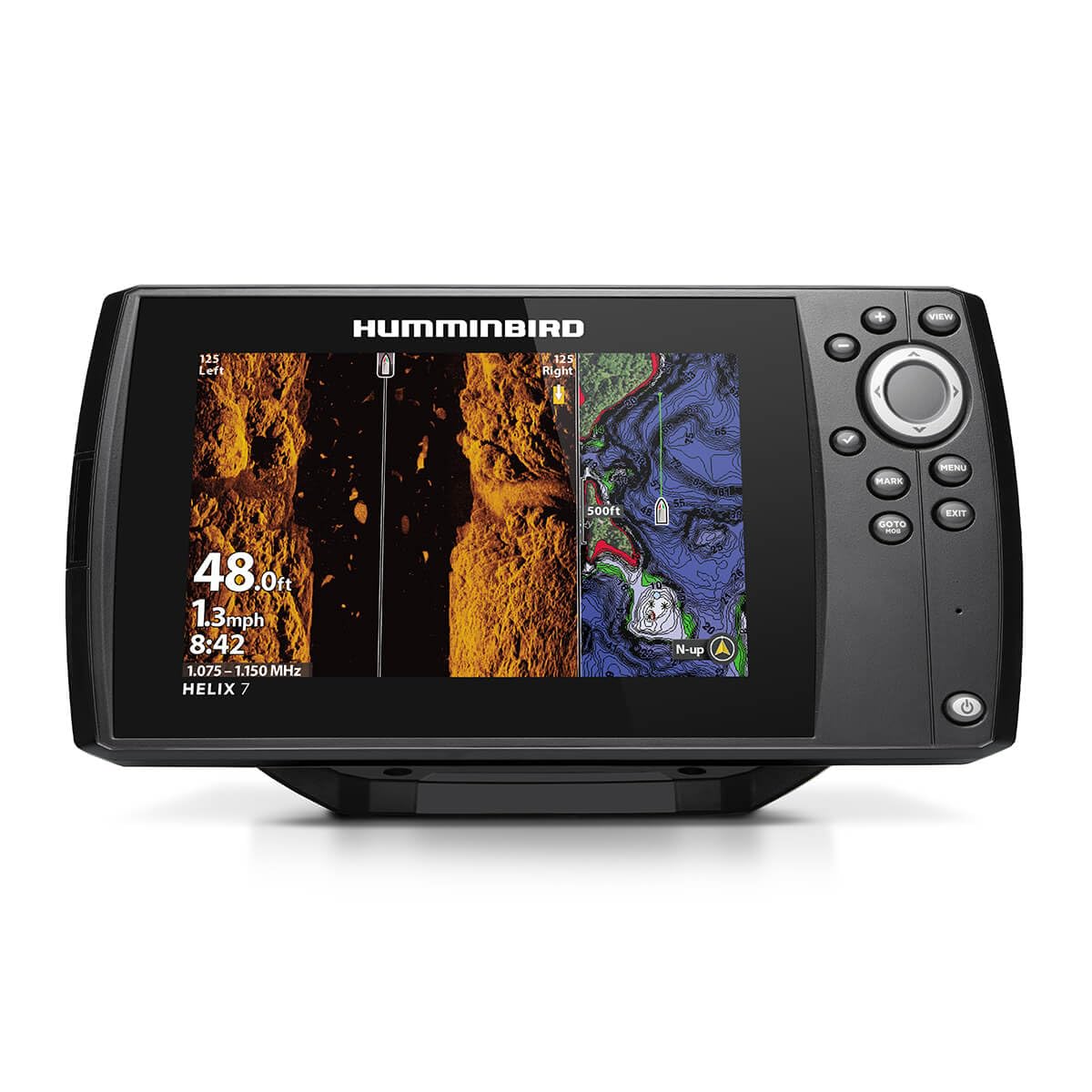
One hundred twenty-five feet. That's how far off each side of the boat the Helix 7's MEGA Side Imaging reaches, and it's the reason to look at this unit at all. Traditional sonar shows a cone under the transducer; side imaging paints a strip of bottom out to the edges of that swath, so a brush pile, a dock cable, or a rock ledge appears before you're on top of it.

The rest of the package is a 7-inch color TFT with Dual Spectrum CHIRP, MEGA Down Imaging under the hull, the same 10,000-lake basemap and AutoChart Live mapping as the Helix 5, and a gimbal bracket with the transducer in the box. On a console with room for it, those seven inches are the difference between reading a split view and squinting at one — side imaging, down imaging, and chart side by side asks a lot of a 5-inch screen.

It's also the pick that asks the most of your boat. You need console space, a clean 12-volt run, and a transom mount placed where the transducer sees undisturbed water; get that wrong and the readout breaks up in chop and drops out at speed. Side imaging rewards practice, too. The first passes look like static until you learn what a stump looks like from the side, and the anglers who get the most from it make a few slow passes over structure they already know.

Our read is that this is the unit for someone who covers water and hunts structure, and the wrong one for someone who wants a number under the boat. Both are legitimate ways to fish; only one of them needs 125 feet of side scan.

Pros

  • MEGA Side Imaging reaches 125 feet each side
  • 7-inch screen handles three-way split views
  • AutoChart Live contour mapping built in
  • Gimbal mount and transducer included

Cons

  • Bottom tracking can drop out at speed in chop
  • Wants console space and a clean 12 V run
Our verdict

For structure fishing on bigger water, the Helix 7's 125-foot side scan earns its keep; we recommend it to anglers who will actually use the wide view.

Check Latest Price
4

Best Castable

Garmin Striker Cast

84 /100
Angler Score Excellent

Key details

Sonar
Traditional 2-D and ice flasher
Mapping
GPS with Quickdraw Contours
Max Depth
200 ft
Wireless Range
Up to 200 ft
Check Details on Amazon

The Striker Cast is a 75-gram sonar ball on a 20-foot tether. Tie it to a rod, cast it where you think the fish are, and reel it back slowly while your phone shows depth, water temperature, and marks streamed over Bluetooth from as far as 200 feet. There's no transducer to mount, no hole to drill, and nothing wired into the boat.

GPS is more useful here than it sounds. Quickdraw Contours builds one-foot depth contours of whatever water you drag it across and the app keeps them, so a morning casting from a dock turns into a map you come back to. Traditional 2-D and an ice flasher mode both live in the app, and the whole kit — tether, bag, USB charging cable — fits in a tackle bag.

Two hundred feet is also the hard ceiling, and on deep, hard-bottom lakes a castable transducer gives up ground to a mounted unit with a bigger one: marks get sparser and less decisive. The wireless link is the other soft spot. Leave the phone on the bank and walk up the dock and you can lose the connection, so keep it with you. Fish water you can reach with a cast, and this is the most natural way we've found to read structure from shore.

Pros

  • No transducer install
  • GPS with 1-foot Quickdraw contour mapping
  • Streams to a phone from up to 200 feet
  • Ice flasher and 2-D sonar modes

Cons

  • Rated to 200 feet, so deep water is out
  • Wireless link can drop with the phone far from the water
Our verdict

We recommend Striker Cast for bank anglers, dock scouts and ice fishermen who want sonar without an install — inside its 200-foot range, it's the simplest way to see what's down there.

Check Latest Price
5

Tight Spaces

Lowrance Eagle 4X

82 /100
Angler Score Excellent

Key details

Beam
44 degrees at 200 kHz
Display
4 in IPS
Mounting
Surface, panel, flush
Max Depth
500 ft
Check Details on Amazon

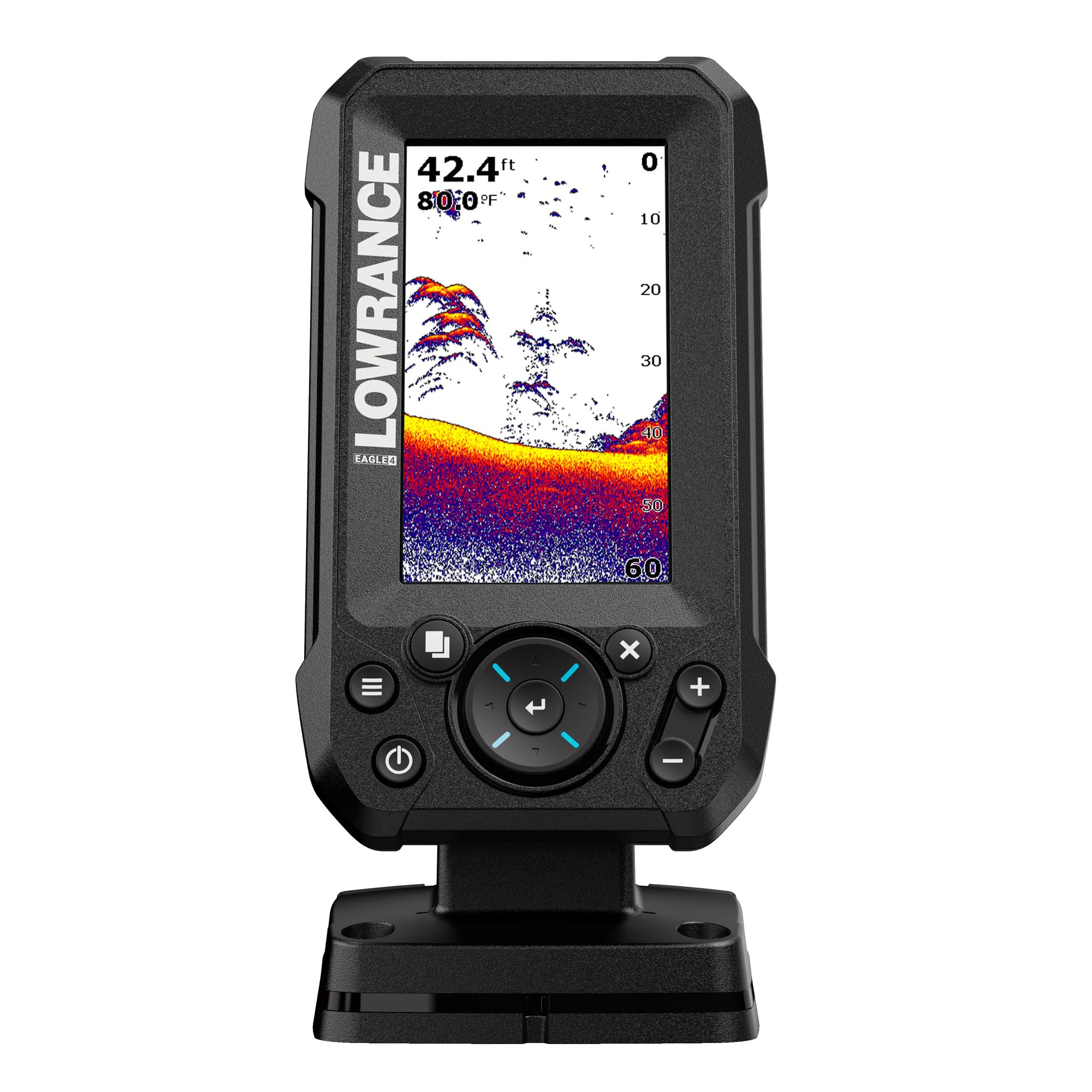
The detail that sells the Eagle 4X doesn't show up in most listings: a 4-inch IPS display that stays legible through polarized sunglasses and at an angle. On a tiller boat or a trolling-motor mount, where the head sits low and off to one side, that isn't a luxury. Around it is a deliberately simple unit — auto-tuning sonar that sets itself, a 200 kHz bullet transducer with a 44-degree beam, a 500-foot depth rating, and a twist-lock connector so the head comes off the boat between trips.

What we appreciate is how little it asks of you: no menus to learn, no settings to tune, no power project beyond a feed for the head. The trade is capability. This is basic sonar with fish icons, depth, and zoom, and if you want waypoints and a contour map, the Striker 4 covers that for about the same money. For the angler who wants to know how deep the flat is and whether anything is sitting on it, the bright screen and the lack of fuss are the whole point.

Pros

  • IPS screen stays clear through polarized lenses
  • Auto-tuning sonar sets itself
  • Twist-lock connector removes in seconds

Cons

  • Sonar only
Our verdict

A bright, unfussy 4-inch sonar unit we recommend for tiller boats and trolling-motor mounts where space is tight and mapping isn't the goal.

Check Latest Price
6

Down Imaging

Lowrance HOOK Reveal 5

82 /100
Angler Score Excellent

Key details

Power
12 V DC
Sonar
CHIRP plus DownScan, FishReveal
Display
5 in
Mapping
C-MAP US inland, about 4,000 lakes
Check Details on Amazon

FishReveal is why this one stays on the list. Lowrance overlays the fish arches from CHIRP sonar onto the DownScan image, so a bright smudge on the bottom gets a shape and target separation instead of staying a smudge. Add the SplitShot transducer, a 5-inch screen, and preloaded C-MAP inland maps of roughly 4,000 U.S. lakes, and you're getting the most imaging for the money in this group.

Genesis Live adds custom contours over any map, and auto-tuning sonar keeps settings from becoming a project. The caveats are practical. It's a 12-volt unit and the box doesn't tell you which battery to run or how to route the power, so plan that side yourself. If the transducer doesn't read on the first trip, sort it out immediately rather than fishing around it — a sonar fault on day one is an exchange, not a repair.

Readability is the other consideration. The speed, depth, and temperature strip along the bottom is small, and if your eyes aren't what they were, the 7-inch Helix is the kinder screen. Everyone else gets real down imaging and real lake maps in a compact head, which is a combination nothing else here offers in the middle of the price range.

Pros

  • FishReveal overlays arches on the DownScan image
  • C-MAP maps of about 4,000 inland lakes
  • SplitShot CHIRP and DownScan transducer included
  • Auto-tuning sonar keeps settings simple

Cons

  • No battery or power-wiring guidance included
Our verdict

We recommend the HOOK Reveal 5 to anglers who want down imaging and real lake maps without premium money — and who don't mind wiring it in.

Check Latest Price
7

Ponds and Creeks

Yoocylii Handheld Fish Finder

82 /100
Angler Score Excellent

Key details

Beam
45 degrees at 200 kHz
Carry
Neck strap included
Display
4.6 cm LCD
Max Depth
328 ft
Check Details on Amazon

Pocket money buys a surprising amount of sonar here. The Yoocylii is a palm-sized handheld with a neck strap, a 4.6-centimeter LCD, and a 200 kHz transducer on a cable you toss over the side. It reads depth to 328 feet, shows fish as small, medium, or large icons with their approximate depth, and sketches the bottom as weed, sand, or rock.

Operation is about as simple as it gets: five sensitivity settings, a fish alarm, and no menus worth learning. That simplicity is the appeal for pond hopping, for scouting a farm pond before you commit a morning to it, and for handing a kid something that turns fishing into a hunt. It runs on batteries, so a spare set in the tackle box covers a weekend.

Set expectations by the screen. At 4.6 centimeters it's a small target in full sun, and the readings are approximate — this won't separate a fish from a weed clump the way a CHIRP unit will, and shallow mossy bottoms confuse it. We treat it as a scouting tool rather than an instrument, and for the price of a couple of crankbaits that's a fair trade on water you can walk around.

Pros

  • Palm-size body with a neck strap
  • Shows depth, fish size and bottom type
  • Reads to 328 feet

Cons

  • Small LCD is hard to read in bright sun
  • Approximate, icon-based readings only
Our verdict

For ponds, creeks and camp boats, this handheld tells you the depth and whether fish are around for very little money; we recommend it as a scouting tool, not serious sonar.

Check Latest Price

How We Tested 12 Fish Finders on the Water

We started with more than 40 models pulled from manufacturer spec sheets and retailer listings, then cut anything that duplicated a screen size or price bracket we already had covered. That left 12 units: displays from roughly 3.5 to 7 inches, transducers ranging from a plain skimmer to side imaging, plus castable and handheld options. We bought them at retail and kept a running note on what each one gave us for the money.

Testing ran eight months, from the spring thaw through first ice. Each unit was strapped to a kayak crate, clamped to the transom of a 14-foot aluminum boat, or hung over the side on a float, and we timed the install solo with basic hand tools. We noted whether the bracket held at trolling speed, whether the cables reached where the battery actually sat, and how many trips it took before the menu stopped slowing us down.

On the water we ran the same circuit: a deep channel edge, a sunken brush pile, and a flat that holds suspended fish, comparing each screen against a contour we already knew. We fished the marks rather than just counting them, jigging first and then trolling crankbaits. On bright afternoons we tilted each display into direct sun to see if a lure stayed readable, checked depth against a hand line in 8, 20, and 40 feet, logged battery draw across a full day, and watched how cleanly each unit paired with a phone before we lost signal in a canyon arm.

How to Choose a Fish Finder

Match the Unit to How You Fish

Three physical formats cover almost every buyer. A mounted unit with a transom transducer is the most capable: fixed screen, larger transducer, and on the better ones GPS and lake maps. A castable unit trades reach for freedom — nothing to install and it goes where a boat can't. A handheld is the pond tool: cheap, pocketable, and approximate.

Be honest about the water you fish most, and watch for the word compact. In a listing it usually describes a fixed unit that still wants a 12-volt feed, not something you can slip in a jacket. If you fish from a rented boat or a friend's pontoon, a castable or a battery-powered mounted unit saves you from drilling someone else's hull.

Understand What Each Sonar View Shows You

Traditional CHIRP sonar sweeps a band of frequencies and returns cleaner arches with better target separation than a single-frequency ping; it's the core view and the one you'll use most. DownScan and Down Imaging sharpen the picture of structure directly beneath the boat, and side imaging throws a wide swath to the sides — the tool for finding brush, ledges, and docks before you're on top of them. Beam angle matters too: a 44-degree beam covers more shallow water per pass, a narrower beam holds detail deeper.

One trap: a maximum depth figure describes the best case in fresh water, at slow speed, over a hard bottom. Treat it as a ceiling, not a promise, and expect any transom transducer to lose the bottom now and then in rough water.

Size the Screen for Your Eyes and Your Mount

Screen size is a real fork in the road. A 3.5-inch display is fine for sonar alone, but split it with a map and both halves get cramped; 5 inches is the smallest we choose for regular split-screen use, and 7 inches is what makes a three-way sonar, imaging, and chart view comfortable.

Readability matters as much as size. Color TFT and IPS panels hold up better in sun, and if you wear polarized sunglasses, look at the display in person or buy from somewhere with easy returns rather than trusting a product photo.

Plan the Power and the Transducer Before You Drill

Mounted units need power — some from their own battery pack, most from a fused 12-volt lead — and all of them need a transducer sitting in clean water. On a small boat that usually means a dedicated battery and a fused lead; on a kayak, a compact pack and a rail mount.

The transducer is where installs go wrong. Mounted too low or behind a strake, it sees turbulence and the depth trace drops out the moment you come on plane. Fit it, run the boat at speed, and check the reading before you build a season around it.

Frequently Asked Questions

Final Verdict

The Garmin Striker 4 is the one we recommend by default. It brings CHIRP sonar, waypoint mapping, and its own power supply in an eight-ounce package that moves from kayak to jon boat to ice bucket, and nothing else here covers that many situations for the money.

Move up for a reason: the Humminbird Helix 5 if you fish unfamiliar lakes and want contours in front of you, or the Helix 7 if you hunt structure on big water and will use 125 feet of side scan. Fish from the bank, and the Striker Cast is the better answer than any of them.