
Best Fish Measuring Boards of 2026

A good day on the water can turn sour in the ten seconds it takes to find a tape measure while a fish flops on the deck. A dedicated measuring board fixes that: nose to the bump, tail pinched, number read, fish back in the water. What separates a good one from a frustrating one shows up later — markings that fade or glare, edges that warp after a season in a hot locker, a slick board that slides overboard on a windy drift.

Over the past five months, my team and I have measured a lot of fish on 14 different boards, from stubby 20-inchers that live in a kayak crate to 36-inch aluminum models built for big stripers. The lesson that surprised me most: bigger numbers aren't automatically easier to read, and the grippiest board isn't always the one that floats. Accuracy is a two-part job — a true zero at the bump and a scale you can trust at a glance — and the picks below get both right.

1

Best Overall

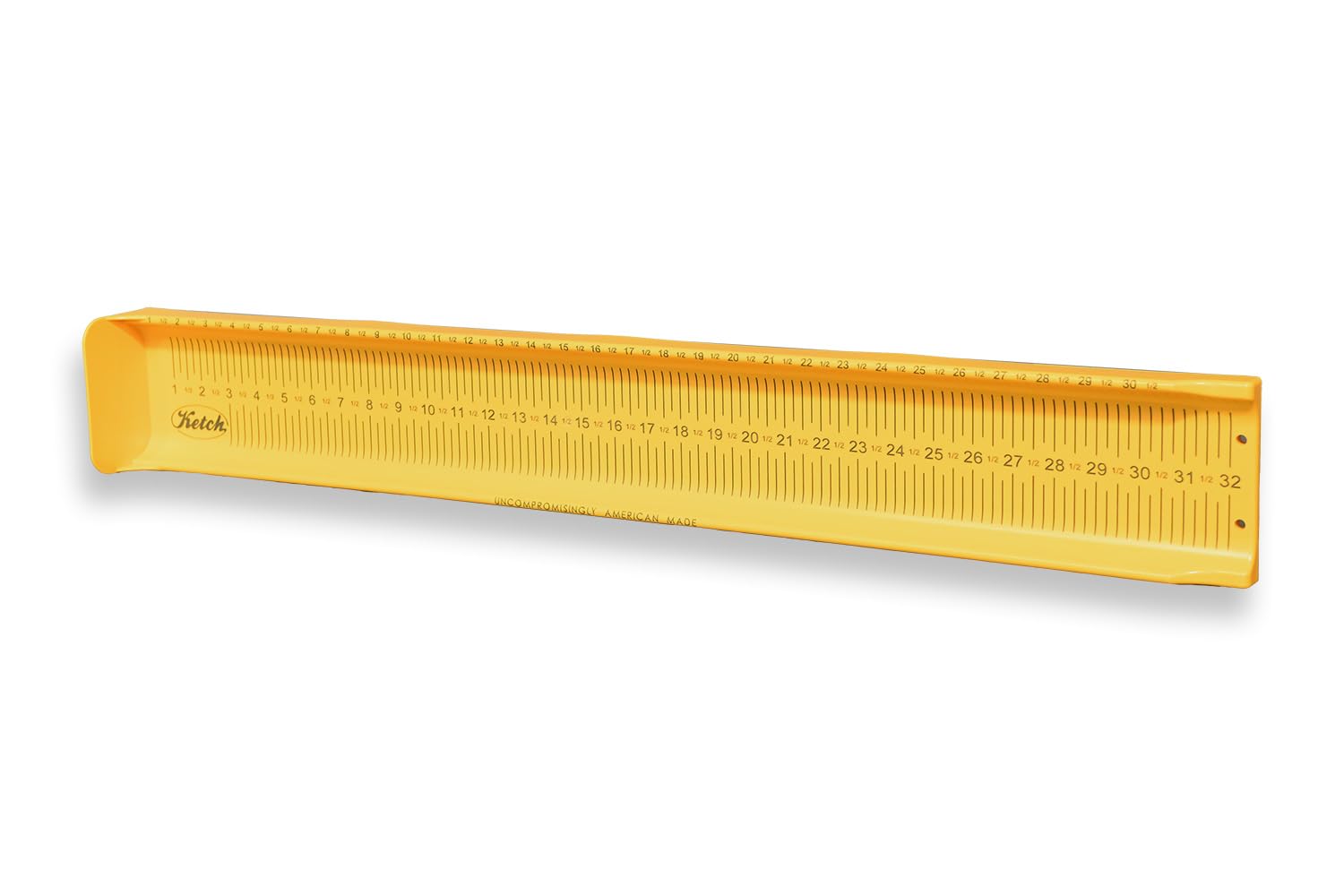
Ketch Karbonate 32-Inch

93 /100
Angler Score Outstanding

Key details

Material
Polycarbonate
Fish Hold
Built-in Kradle
Measuring Length
32 in.
Readout Accuracy
±0.25 in.
Check Details on Amazon

A 32-inch polycarbonate surface and a built-in Kradle make the Ketch Karbonate the board we reach for first when a fish has to be measured quickly and correctly. The length gives you room for everything from slot-limit bass to long inshore fish, and the Kradle gives a fish a cupped place to settle instead of sliding across a flat ruler. That matters when you are leaning over the gunwale with one hand on the fish and the other on the board.

The stated readout accuracy of plus or minus a quarter inch is the kind of detail that sounds small until you are close to a minimum-size line. We paid close attention to the scale because a board is only useful if you can read it at a glance with wet hands. The polycarbonate body is light enough to handle easily, and it has the solid feel we want when a fish is flopping against the edge. The Kradle is the feature that separates it from the simpler aluminum boards here: it does more than give you a length, it helps you keep the fish in place while you take one.

This is a premium board, and it is the one we recommend for tournament anglers and boat anglers who measure a lot of fish. The 32-inch length is a help on open deck and a nuisance in a tight kayak, so if space is short, the compact Frabill below makes more sense. For everyone else, the combination of length, fish control, and fine stated accuracy is the most complete package here.

Pros

  • Built-in Kradle helps hold fish steady
  • 32-inch length handles bigger fish
  • Stated accuracy of plus or minus 0.25 inch
  • Lightweight polycarbonate body

Cons

  • Premium price versus the aluminum picks
Our verdict

We recommend the Ketch as the default board for boat and tournament anglers: its 32-inch polycarbonate surface, built-in Kradle, and stated quarter-inch accuracy make measuring bigger fish easier and more consistent.

Check Latest Price
2

Best Slim Aluminum Board

Frabill Bump Board 32-Inch

91 /100
Angler Score Outstanding

Key details

Width
2.5 in.
Markings
Large black numbers
Material
Gold-anodized aluminum
Measuring Length
32 in.
Check Details on Amazon

If you want a long board without the Ketch's premium, the Frabill 32-inch aluminum board is the straightforward alternative. It is a 2.5-inch-wide strip of gold-anodized aluminum with large black numbers running its length. The slim shape slides into a rod locker or under a seat, and the non-corrosive aluminum is a sensible choice for saltwater use.

The 2.5-inch width is the main compromise. It stores easily, but a big fish has less surface to settle on than it does in the Ketch's Kradle, so you may spend more time steadying the fish with your hand. On calm water and with smaller fish, that is a minor annoyance. With a heavy, active fish on a rocking deck, it is the difference between a quick measurement and a two-handed wrestling match.

What we like most is the simplicity. There is no joint to lock, no folding section to fuss with, and no plastic hinge to wear out. You lay the board down, put the fish against the end, and read the number. For a boat angler who wants a long, low-maintenance board and does not need a fish cradle, this is the value pick of the group.

Pros

  • Long 32-inch measuring surface
  • Gold-anodized aluminum resists corrosion
  • Slim 2.5-inch body stores easily

Cons

  • Printed markings can wear with use
Our verdict

We keep this aluminum board in the boat bag when we want a long, simple measuring surface; it costs less than the Ketch and has clear black markings.

Check Latest Price
3

Best for Big Fish

Lee Fisher 36-Inch Aluminum

91 /100
Angler Score Outstanding

Key details

Width
3.5 in.
Material
Anodized aluminum
Thickness
1/8 in.
Measuring Length
36 in.
Check Details on Amazon

The Lee Fisher is the board for fish that make a 32-inch board look short. At 36 inches long and 3.5 inches wide, it gives you the longest measuring surface in this group and a wider platform than the Frabill aluminum boards. The anodized aluminum is 1/8 inch thick, so it feels like a proper tool rather than a painted strip, and the aqua-blue finish is easy to spot when it is lying on the deck.

The integrated bump board and pre-drilled lanyard hole are the details we appreciate. The bump gives you a positive stop for the fish's nose, and the hole means you can tie the board off instead of watching it slide toward the scuppers. The anodized finish is also the right choice for saltwater, where a bare steel ruler is a liability.

This is a big-water board. On a center console or a bay boat, the extra length is exactly what you want when a striped bass or redfish is longer than your forearm. The 36-inch surface means you are not guessing at the tail end of a good fish, and the wider body gives you more room to keep it straight. If you regularly measure fish over 30 inches, the Lee Fisher earns its space.

Pros

  • 36-inch length handles trophy fish
  • 3.5-inch width gives more fish room
  • Anodized aluminum works in saltwater
  • Pre-drilled lanyard hole

Cons

  • 36-inch length is awkward on kayaks
Our verdict

We recommend this one for big fish and saltwater boats: the 36-inch anodized aluminum body gives the longest measuring surface here and the 3.5-inch width helps steady a heavier catch.

Check Latest Price
4

Best Compact Board

Frabill Benchmark 22-Inch

92 /100
Angler Score Outstanding

Key details

Width
2.5 in.
Markings
Large black numbers
Material
Gold-anodized aluminum
Measuring Length
22 in.
Check Details on Amazon

The 22-inch Benchmark is the sensible board for a kayak angler who mostly measures bass, walleye, and schoolie stripers. It is 2.5 inches wide, about the width of a paddle shaft, so it takes up little space in a kayak crate, and the gold-anodized aluminum gives you the same corrosion resistance as the longer Frabill. If your idea of a measuring board is something that lives in a crate and comes out only when a fish is close to the limit, this is the size that makes sense.

The numbers are large and black against the gold finish, which is the right call for a board you will read in flat light or with wet hands. We also like that it is a fixed board: no folding sections, no locking mechanism, no joint that can loosen after a season of bouncing around in a kayak. You put it on your lap, line up the fish, and read the length.

For a kayak angler who fishes bass and walleye, this is a compact, simple board that does the job without taking over the boat. It is also a good choice for a small skiff or a canoe where a 32-inch board is more obstacle than tool.

Pros

  • Compact 22-inch length fits kayaks
  • Gold-anodized aluminum resists corrosion
  • Large black markings are easy to read

Cons

  • 22-inch maximum limits trophy fish
Our verdict

We like this compact Frabill for kayaks and inshore trips where a 22-inch board covers the fish you keep, and its aluminum build resists corrosion without eating much deck space.

Check Latest Price
5

Bass and Walleye

Rite-Hite 20-Inch

90 /100
Angler Score Outstanding

Key details

Mounting
Pre-drilled screw holes
Fish Range
10 to 20 in.
Increments
1 in.
Measuring Length
20 in.
Check Details on Amazon

A 20-inch board with one-inch increments and pre-drilled mounting holes is the Rite-Hite's whole pitch. It is the board we point to when the job is a quick legal check, not a tournament-grade measurement. The 20.5-by-2-by-1.75-inch body is small enough to leave mounted in a little boat and simple enough to keep there.

One-inch increments are the whole story here. They are fast to scan when you are checking a bass against a slot limit, but they will not tell you whether a fish is 17 3/4 or 18 1/4 inches. For crappie, walleye, and bass where the legal line falls on a whole inch, that is fine. For a tournament where every fraction matters, choose a board with finer markings.

The screw holes are a genuinely useful detail: you can mount the board where you need it and not worry about it sliding around under a fish. For a small boat, a dock box, or a fixed measuring station, that is more useful than a fancy fish cradle. It is also the least expensive board here, which makes it an easy choice for an angler who wants a simple keep-or-release check.

Pros

  • Pre-drilled holes mount flat to a deck
  • One-inch increments scan quickly
  • Compact 20-inch board for bass and walleye

Cons

  • 20-inch maximum is short for big fish
Our verdict

We recommend this board for bass and walleye anglers on a budget who need a simple, fixed 20-inch measuring surface with mounting holes that let you leave it on the deck.

Check Latest Price

How We Chose and Tested 14 Fish Measuring Boards

We started by pulling every board we could find between 20 and 36 inches, then cut the list by material, scale type, and price. Boards with printed scales that looked likely to wear, models shorter than the slot limits most anglers fish under, and anything without a real stop at the zero mark came off first. That left 14 boards, which we used over five months of inshore trips, lake days, and a few soggy kayak launches.

Accuracy came first. We laid a steel tape along each board from the nose stop to the far end and noted any spot where the marks drifted, then measured dowels cut to known lengths and checked whether the nose sat flush at zero. For readability, we read each scale in flat morning light and again with the sun low and directly in our eyes, with dry hands and with wet, fish-slimed ones. Boards with thin, low-contrast markings fell out of contention fast.

Durability and flotation got the rougher treatment. We left boards in a hot truck bed, hosed them off, dropped them corner-first onto concrete, and checked for warping, peeling edges, and cracks near the handle. Then we floated each one in a calm cove and in wind-blown chop to see whether it stayed up on its own or needed a leash. The boards that made the list measured straight, read clean in bad light, and survived a season of being tossed around.

How to Choose a Fish Measuring Board

Match the length to the fish you actually catch

A 20- or 22-inch board is enough for most bass, crappie, walleye, and schoolie stripers, and it fits a kayak crate without becoming an obstacle. Move to 32 inches if you fish mixed inshore water or want one board that covers slot-limit redfish and bass. A 36-inch board is for big fish and big decks; it gives you room at the tail end but takes up real space. Measure your longest likely fish, not the average one, because a board that is too short tells you nothing at the moment you need it.

Width and fish control matter as much as length

A wide board or a cupped surface gives a fish somewhere to settle, which is the difference between a one-person measurement and a wrestling match. A 2.5-inch-wide aluminum strip stows easily but offers little containment; a Kradle or trough shape costs width and storage space but helps on a rocking deck. If you mostly measure calm fish or measure with two hands, a narrow board is fine. If you fish alone and handle active fish, pay for the containment.

Read the markings before you trust the board

Black markings on a gold or yellow finish are easier to see than low-contrast etched lines, and large numbers help when your hands are wet. Check the increment spacing too: one-inch marks are fast for a legal check, while quarter-inch accuracy matters if you fish tournaments or track length closely. Raised or painted markings can wear; rinse and dry the board after saltwater use, and avoid grinding sand into the scale.

Choose fixed, expandable, or mounted with your deck in mind

Fixed boards are the simplest and most rigid, with no joint to flex or lock to fail. Expandable boards store shorter but depend on a secure locking section; if it slips, your measurement is only as good as the looseness in the joint. Pre-drilled holes or a lanyard hole keep the board from sliding overboard, and they make a permanent measuring station possible on a boat. The best choice is the one that stays where you put it when the deck is wet.

Frequently Asked Questions

Final Verdict

The Ketch Karbonate is the board we recommend first because it does the two hardest jobs at once: its 32-inch surface gives you length, and the built-in Kradle helps keep a wet fish still while you read the scale. The stated plus-or-minus quarter-inch accuracy is the detail that pushes it ahead for tournament and boat anglers.

If you want a long aluminum board and do not need the fish cradle, the Frabill 32-inch is the practical value pick. For big fish and saltwater decks, the Lee Fisher's 36-inch surface is worth the extra length; kayak anglers should look at the compact Frabill 22-inch.