Best Fish Stringers of 2026

A stringer is the least expensive piece of gear in the boat and the one most likely to cost you dinner. You net the fish, get the hook out clean, ease it back in the water — then a snap bends open or a swivel gives out, and you watch your catch drift off. All it has to do is keep fish alive, fresh, and attached to you until you head in, and the failures live in the hardware, not the line: a clip a gauge too thin, a coating that cracks and lets the core rust.

Over four months of spring and summer fishing, we ran 16 stringers through real days on rivers, lakes, and a rough jetty — no bench testing, just wading, paddling, and clipping fish on with cold, wet fingers. The pattern was clear: length is what shoppers fixate on, clip thickness is what decides whether you keep your catch, and a little more money usually buys thicker wire and a better swivel rather than a nicer box. The picks below run from short wading stringers to long cable setups for kayaks and deep water.

1

Best Overall

Lindy Chain Stringer

87 /100
Angler Score Excellent

Key details

Length
60 inches
Material
Heavy-duty chain
Snap Count
9 movable snaps
Check Details on Amazon

Adding a fish should be the easy part of a good day, and this is the stringer that makes it so: unclip a snap, run it through the gill plate, clip it back on the chain, and every fish already hanging stays in the water. That single move is what puts the Lindy at the top of this group. Nine swiveled snaps slide along the chain, so the catch spreads out instead of bunching at the bottom, and each snap has a latch that stays shut until you open it.

Sixty inches is a sensible working length from a gunwale, a dock, or a kayak, and the heavy-duty chain has enough heft to hang straight and stay where you dropped it. We liked the wire loop at the free end, which gathers the snaps you are not using so the spare hardware does not swing around while you are unhooking a fish. The snaps open with a thumb and lock with a click, which matters more than it sounds when your hands are cold and wet.

A chain rinses clean and dries without holding water or slime the way rope does, so it comes out of the bag smelling like metal rather than last Saturday's catch. Clip a float to the free end when your fish hang over deep water or around structure, and the whole rig stays where you left it.

Pros

  • Add or release fish without lifting the catch
  • Nine movable snaps spread fish along the chain
  • Chain rinses clean and does not hold slime

Cons

  • Five feet of chain runs short from a high bank
  • Heavier in a vest than rope or paracord
Our verdict

Our pick for most anglers: the snap chain lets you add a fish and release one without hauling your whole catch out of the water, and the hardware is built to last more than a season.

Check Latest Price
2

Best for Boats

Rapala Metal Stringer

88 /100
Angler Score Excellent

Key details

Color
Black and brass
Weight
4.8 oz
Stringer Type
Coated metal cable with sliding clips
Check Details on Amazon

Coated cable, a black-and-brass finish, and clips that slide: the Rapala is the most polished stringer in this group, and the one that feels like boat equipment rather than something you stuffed in a pocket. It sets the standard here for hardware, and it is priced accordingly at the premium end of these picks.

We paid close attention to the clips, because a snap that springs open is how a limit gets away. These hold shut, slide freely on the coated cable, and do not tangle when you drop the whole rig over the side. Each clip takes more than one fish, so a limit rides on a fairly short run of cable, and unhooking one to cull it takes a second.

At 4.8 ounces it hangs off a kayak crate or a console cleat without complaint, and the coating means a pike cannot saw through the line. Adding a float is the one upgrade worth making if your fish hang over deep water or around docks.

Pros

  • Clips stay closed and slide without tangling
  • Coated cable resists teeth and salt
  • Each clip holds several fish

Cons

  • Premium price against the chain and rope picks
Our verdict

Spend more here if you fish from a deck and want clips that stay closed on cable that will not tangle — this is the most refined stringer we handled.

Check Latest Price
3

Best Budget

Eagle Claw Poly Stringer

89 /100
Angler Score Excellent

Key details

Length
7 feet
Material
Heavy-duty poly
Item Weight
0.8 oz
Check Details on Amazon

Seven feet of thick poly rope, and that is the entire product, which is exactly why it works from a muddy bank. Thread a fish, tie off to a root or a stake, and the length keeps your catch in the water below you while you keep casting. Nothing on it needs a freshwater rinse-and-oil ritual, and nothing on it is going to jam at the wrong moment.

We were struck by how little there is to it: 22.68 grams, well under an ounce, rolled into a shirt pocket. The poly is smooth enough not to chew up gill plates the way twisted rope can, and there is no chain to rattle or kink on the way out of the truck. For trout and panfish it is about as fuss-free as a stringer gets.

What you trade for that simplicity is sorting speed. Every fish slides onto the same line, so a full stringer has to come up when you add the next one, and a big fish pushes the rest down the rope. In cold water with a modest limit that is a fair trade; when we are keeping a lot of fish, we reach for a snap chain instead.

Pros

  • Seven feet keeps bank-caught fish in water
  • Under an ounce and pocketable
  • Smooth poly is easy on gill plates

Cons

  • Rope holds water and slime until rinsed and dried
Our verdict

For bank and dock fishing, this plain seven-foot rope does the job with nothing to break, and the length is what keeps your catch in the water.

Check Latest Price
4

Best for Sharp-Toothed Fish

Lindy Coated Cable Stringer

0 /100
Angler Score Fair

Key details

Length
6 feet
Material
Vinyl-coated stainless steel cable
Package Dimensions
8.15 x 3.31 x 0.87 inches
Check Details on Amazon

No clips, no snaps, no chain — six feet of vinyl-coated stainless cable, and that bareness is the point. For pike, bluefish, or anything with teeth that shred a rope, the coating is what keeps the stringer intact and keeps gill plates off frayed thread. Fish slide on and off the smooth surface instead of catching on a weave.

The cable will not rot or weaken in the sun, and the slim diameter slides through the water with less drag than rope, which matters when a fish runs while it is still on the line. Packed down it is an 8.15 x 3.31 x 0.87-inch bundle that drops into a tackle tray next to the pliers.

What you give up is convenience at the tie-off. There is no clip to snap onto a belt loop, so anchoring is your job: a stake in the bank, a cleat on the boat, a deck line on the kayak. We keep it as the toothy-fish option and still take a chain when we plan to add fish all afternoon.

Pros

  • Coating protects against teeth and fraying
  • Will not rot or weaken in sunlight
  • Packs into a tackle box tray

Cons

  • Coating can kink and take a set after a big fish
  • Six feet is short for high-bank work
Our verdict

Buy this one for pike, bluefish, and other toothy fish; the coated cable outlasts rope and packs smaller than a chain, though you rig your own tie-off.

Check Latest Price
5

Best with a Float

Foreverlast Generation II

89 /100
Angler Score Excellent

Key details

Float
EVA float
Length
15 feet
Item Weight
10.6 oz
Cord Diameter
0.81 cm
Check Details on Amazon

Fifteen feet of smooth rubber cord with an EVA float on the cork end, and the float is the reason to look twice. In current, or hanging off a kayak over deep water, it keeps fish up near the surface instead of dangling straight down into snags. That is a real difference when you are drifting and cannot easily reach the stringer.

We were pleasantly surprised by the brass junctions at both ends: you can work a fish off the far end without dragging the whole stringer back through every fish you have caught. That, more than the length, is what earns it a place for long days of keeping and culling. The quick release at the cork end makes unloading a full stringer a short job instead of a wet one.

The cord is 0.81 cm across, thick enough to be easy on hands and smooth enough that teeth do not catch, and the whole rig weighs 10.56 ounces. Fifteen feet is a lot of cord in the water; in a slow river or off a kayak it is exactly the amount you want.

Pros

  • Float keeps fish up off the bottom
  • Quick release at the cork end
  • Tangle-free rubber cord

Cons

  • Bulky to roll and carry compared with a rope stringer
Our verdict

For kayaks, current, and deep water, the EVA float and quick-release cork end do more than extra length alone — this is the long-reach pick.

Check Latest Price
6

Packing Light

Paracord Planet 550 Fish Holder

91 /100
Angler Score Outstanding

Key details

Length
10 feet
Included
Metal threading needle and 1-inch split ring
Breaking Strength
550 lb
Check Details on Amazon

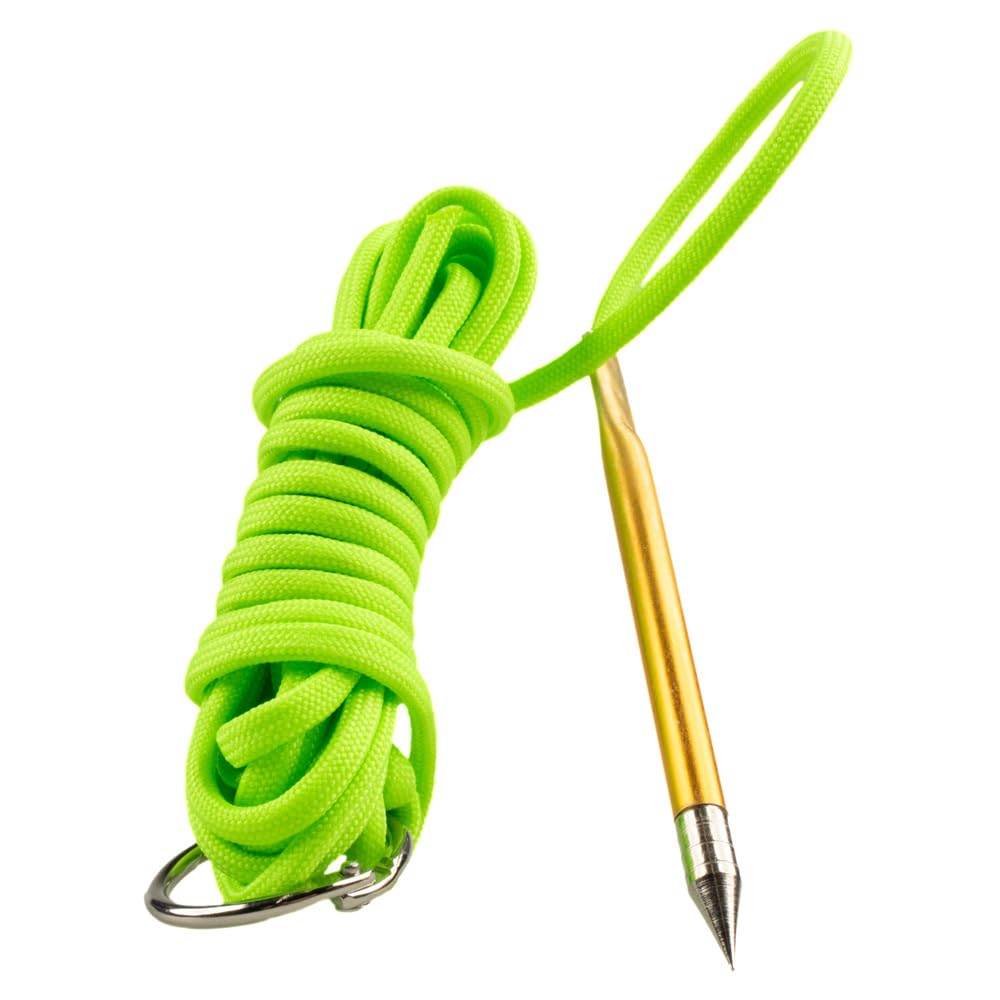
Ten feet of neon-green 550 paracord, a metal threading needle, and a one-inch split ring, coiled into something that disappears in a shirt pocket. Packed size is the whole idea here: it lives in the bottom of a bag until the day you need it, and the bright color means you can find it on a gravel bar or in a cooler of water.

The needle is the good part. It is long enough to push through the gills from outside the fish, so your hand never goes into a mouth full of teeth, and the braided nylon slides rather than scratching as you pull it through. Breaking strength is 550 pounds, far beyond anything a freshwater fish will put on it, and the cord will not rot or fade in the sun.

Two things we noted while handling it. The cord is thin in the hand when a heavy fish surges against it, and the needle is pressed onto the end rather than threaded in, so give it a tug before every trip instead of finding out mid-bite.

As a backup, a kayak-space stringer, or the spare you hand a friend, it is an easy yes. It is not the one for a long day of keeping fish, because everything slides onto a single cord, but nothing else here takes up as little room.

Pros

  • Disappears into a vest pocket
  • Long needle keeps hands out of the gills
  • 550-pound breaking strength

Cons

  • No snaps, so the whole catch rides one cord
Our verdict

Keep one of these in your pack as a spare: ten feet of 550 cord with a long needle, small enough to forget until the fish are biting.

Check Latest Price
7

Spearfishing and Diving

Spearfishing World Float Stringer

92 /100
Angler Score Outstanding

Key details

Hardware
Stainless carabiner
Material
Stainless steel
Rod Size
7 x 1/4 inches
Cable Length
33 inches
Check Details on Amazon

Thirty-three inches. That number decides this stringer before anything else does: clipped to a weight belt or a dive float it is exactly right, and hung from a gunwale or a high bank it is short enough to be frustrating. It is dive gear that happens to be a stringer, and it is happiest in salt water.

The stainless rod is 7 inches long and a quarter inch thick, with ridges machined into it so your grip does not slip while you push it through a gill plate underwater. Everything is stainless for salt water, the coating on the cable keeps it from fraying or tearing the fish on the swim back, and the carabiner releases in a second so your catch slides straight off the end.

We treat it as dive gear first: the carabiner is made to clip to a buoy or a weight belt, so plan on supplying the float yourself if you are towing fish behind a kayak. As dive and kayak equipment it is the most purpose-built stringer here; for a family afternoon on a dock, chain and rope reach further and hold more fish.

Pros

  • All-stainless build for salt water
  • Ridged rod gives a grip underwater
  • Carabiner releases for fast unloading

Cons

  • Short 33-inch cable limits it to dive and kayak work
Our verdict

Purpose-built for spearfishing and diving: all stainless, easy to load one-handed underwater, and short by design rather than by accident.

Check Latest Price
8

Kayak Fishing

YEESOOM Fish Stringer Clip

89 /100
Angler Score Excellent

Key details

Material
304 stainless steel
Clip Width
7.1 inches
Extended Length
78 inches
Package Dimensions
16.14 x 7.36 x 1.61 inches
Check Details on Amazon

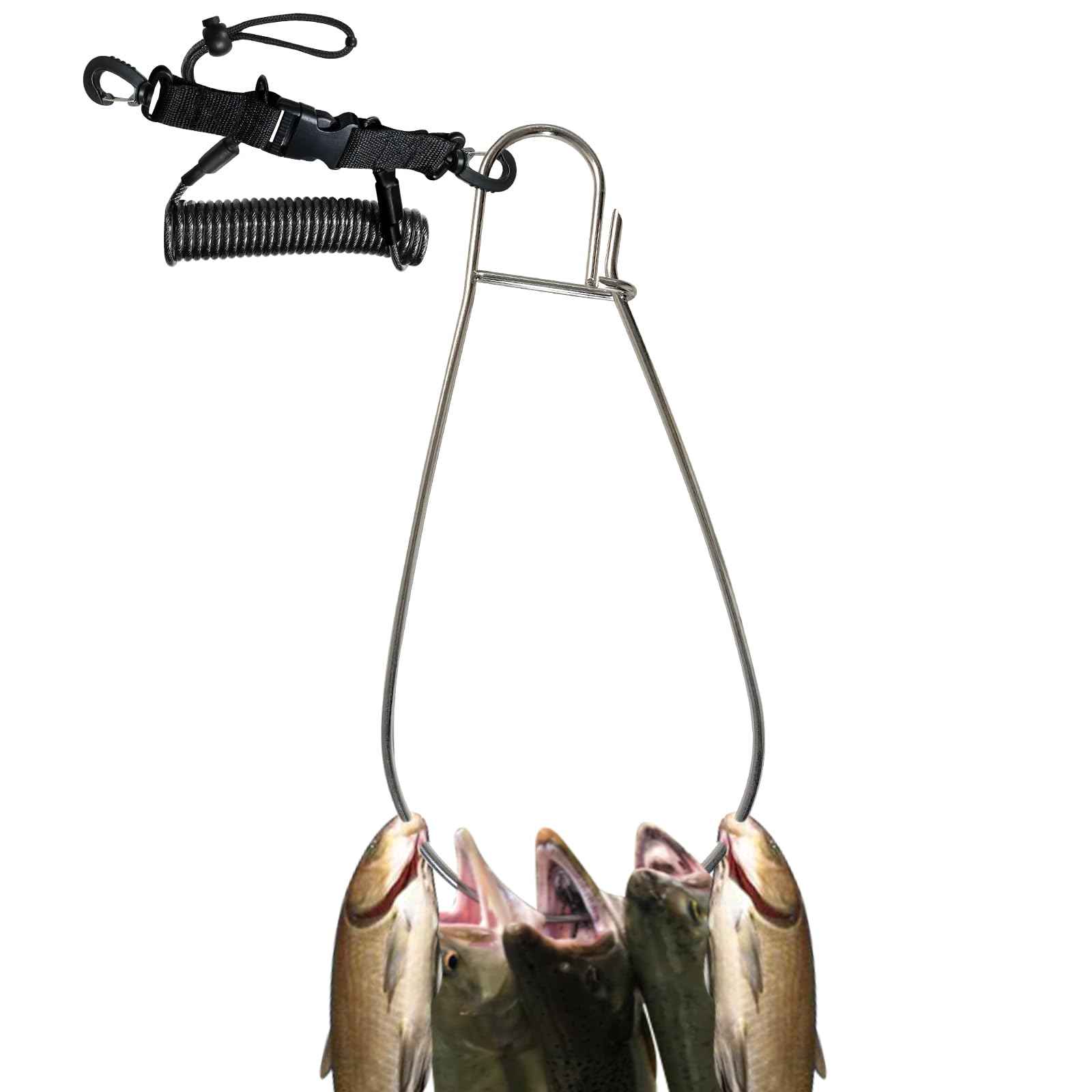
The clip is 7.1 inches across the bottom and made from extra-thick 304 stainless, the widest opening in this group. That width is what lets you hang several big fish without stacking them on top of one another, which is the difference between a clean string and a tangled one when the fishing is fast.

The lanyard is a steel-core spring cord that stretches to 78 inches. Clipped to a kayak deck line, it lets fish trail well behind the hull while you keep paddling, and it pulls back in short when you need to add another.

We found the pointed tip slides through a gill plate in one push, which is what you want when you are treading water, and the stainless construction means a rinse at the end of the day is the whole maintenance routine.

For kayak fishing, diving, and spearfishing, the wide clip and the stretch do things a fixed chain cannot. It is a specialist's tool, though: from a bank you want the reach of a long rope or chain, and this will not give it to you.

Pros

  • Wide clip holds multiple large fish
  • Stretches to 78 inches for kayak work
  • Stainless build suits salt water

Cons

  • Long clip and bungee are bulky to stow
Our verdict

If you fish from a kayak or dive, the oversized stainless clip loads easier with cold, wet hands than a snap chain — this is the one-handed pick.

Check Latest Price

How We Tested Fish Stringers (and What Bent First)

We started from the stringers anglers actually buy — roughly 40 listings, from paracord-and-needle rigs to coated stainless cable with carabiners — and cut anything with no stated length, vague hardware, or photos where the clip looked like a bent paperclip. That left 16, which we bought at retail and fished with from early spring into midsummer.

Testing happened where stringers get used: wading a shallow trout river with the stringer looped on a belt, paddling a kayak on a bass lake with fish going straight back into the water, and a few afternoons off a jetty where the current does the tugging for you. We stretched each one flat against a tape measure, because stated lengths run long more often than you would think. Every snap and carabiner got opened and closed 50 times, then again with wet gloves on, to see whether it took one hand or two. We hung weighted bags from each clip and kept adding until something bent, noting whether it sprang back or stayed open. And we dragged each one over gravel and through reeds to see what snagged and whether the coating scuffed down to bare core.

Durability was judged over weeks, not minutes: each stringer spent days damp in a bucket between trips, and we checked swivels and clips for rust and the cord for mildew. We also logged how small each packed down, how many big fish the clips held without crowding, and what the price actually bought — thicker wire and better snaps, or just nicer packaging.

How to Choose a Fish Stringer

Measure the Reach Before Anything Else

Length decides whether a stringer works where you fish. From a boat gunwale or a dock, five or six feet puts fish below the surface; from a high bank or a bridge, you want at least seven feet or your catch hangs in the air instead of the water. On a kayak, length is less about dropping fish and more about keeping them clear of the hull and the paddle.

Stand where you fish, measure from your hand down to the waterline, then add a foot. A short stringer on a tall bank is the most common mismatch in this category, and it is the one thing no amount of good hardware fixes.

Snaps, Clips, or Plain Threading

How a fish goes on matters more than how the stringer looks. A snap chain or a clipped cable lets you open one connection, add the fish, and close it while every other fish stays in the water — the difference between a two-second job and hauling a full catch onto the bank. Plain rope and bare cable are lighter and smaller, but every fish rides the same line and slides together.

If you keep more than a handful per trip, or you cull and release, pay for the clips. If you fish a couple of hours for a meal of panfish, threading a rope is no hardship.

Hardware Against Teeth and Salt

Rope is fine for trout, panfish, and bass in fresh water. For pike, bluefish, and anything with teeth that can abrade a line, vinyl-coated cable lasts longer and is easier on gill plates. In salt water, stainless components are what keep a stringer from stiffening and seizing after a few trips.

Look past the line to the snaps, clips, and rings — those are the parts that fail first, and a heavy-duty cable with cheap snaps is still a weak stringer.

The Free End Needs a Home

Every stringer has two ends, and the one you hold gets forgotten. Decide the anchor before you leave: a stake or forked stick on a bank, a cleat or deck line on a boat, a buoy or weight belt in the water. A float keeps fish near the surface and away from snags, and it makes the whole rig easier to find if it slips.

One hard rule: clip to the boat or the bank, never to your body. A heavy fish or a snag on a line tied to you is how a good day turns dangerous.

Frequently Asked Questions

Final Verdict

The Lindy chain stringer is the one we hand most anglers: 60 inches of chain with nine sliding snaps, enough hardware to keep a catch spaced out and to add or release a fish without lifting the rest. If you fish from a boat deck and want clips that stay shut on cable that will not tangle, the Rapala is a fair step up. If you are standing on a bank with a stake and a bucket, buy the Eagle Claw poly rope and put the difference toward bait.