Best Fishing Gloves of 2026

The back of my hands used to burn first — a red patch between the wrist and the knuckles that showed up every June and stayed until September. Fishing gloves fix that, and more: they stop a wet hand from sliding on a rod grip, save your palms from braid and gill plates, and hold warmth on a forty-degree morning. But the wrong pair is worse than none — one that bunches at the thumb or lets sun through thin mesh comes off by ten and stays off.

Over the past five months, my team and I have fished 14 pairs — sun gloves, wool cold-weather gloves, fully waterproof ones, cut-resistant fish handlers — from bass boats, kayaks, and rocky trout banks. The surprise: fingerless isn't automatically cooler, and a UPF label on the back of the hand says nothing about the fingertips hanging out in the sun. What separated the keepers had less to do with cost than with fit at the fingers and grip when wet. Here's what held up, and what each pair is genuinely for.

1

Best Overall

KastKing Sol Armis Fingerless

93 /100
Angler Score Outstanding

Key details

Care
Machine washable
Cuff
Extra long
Fabric
90% polyester, 10% spandex
Sun Protection
SPF 50
Check Details on Amazon

The first thing that registers is the cuff. KastKing runs the Sol Armis fabric well past the wrist, so a short-sleeve shirt does not leave a stripe of bare skin at the base of your hand, which is the spot a long day on the water punishes first. The fingers are open from the first knuckle, and the palm carries a microfiber panel rather than the same thin knit as the back.

For warm-weather fishing, this is the pair we reach for. The fabric is 90% polyester and 10% spandex with four-way stretch, and it sits cool enough that we stopped noticing it between casts. SPF 50 is the headline, but what earns it the top spot is coverage: the protection runs over the back of the hand and up the wrist without bunching under a rod grip.

Stretch does the fitting work. The Large-X-Large band covers hands that usually fall between the two sizes, and the pull tabs at the cuff let you get them on one-handed. They are machine washable, they pack flat, and the Prym1 Silver Mist print is more interesting than most boat gloves manage.

What they will not do is shrug off abuse. The microfiber palm and tabs are the wear points KastKing built up, but a knit this thin has limits, and the seams are where it shows first. These are rod-and-reel gloves rather than paddling gloves, and a day gripping a kayak shaft asks more of them than they were made for. Wash them cold, air dry, and they will see a season.

Pros

  • SPF 50 with an extra-long cuff
  • Four-way stretch fits between sizes
  • Microfiber palm holds a wet rod
  • Machine washable and packs flat

Cons

  • Seams are the first failure point with hard use
Our verdict

Our pick for most warm-weather fishing: SPF 50 coverage to the wrist, a grip panel that holds a wet rod, and a thin fit that stays out of the way.

Check Latest Price
2

Best Sun Gloves With Palm Grip

Palmyth UV Fingerless

93 /100
Angler Score Outstanding

Key details

Care
Machine washable
Palm
Partial synthetic leather
Pulls
Wrist and fingertip
Sun Protection
Certified UPF 50+
Check Details on Amazon

Where the KastKing leans on stretch fabric, Palmyth builds a partial synthetic-leather palm into its sun glove, and that palm is why we keep these for anyone who fishes with wet hands all day. The leather sits exactly where the rod handle does, with silicone grip areas that stay tacky when everything in the boat is slick, and the rest of the glove is a thin, quick-drying polyester knit.

The UPF 50+ here is certified and woven into the fabric, so it does not wash off or wear off when the glove is soaked, which matters on a boat where your hands are wet more often than dry. The long cuff covers the wrist, and there is a pull at the wrist and another at the fingertip so you can peel them off without dragging a wet glove inside out.

Fit lands true to the size chart, with room for narrower hands, and the knit is cool enough for a full day on a drift boat. The weak point is the one that shows up on every thin glove here: the seams at the thumb and the palm edge. Ours have held so far, but this is a pair to buy two of rather than a pair to expect five seasons out of.

Pros

  • Certified UPF 50+ woven into the fabric
  • Synthetic leather palm with silicone grip
  • Wrist and fingertip pulls for wet hands
  • Machine washable and quick to dry

Cons

  • Seams at the thumb and palm can separate
Our verdict

The sun glove we hand to wet-handed anglers: certified UPF 50+ that will not wash out, plus a leather palm that keeps its hold on a slick rod.

Check Latest Price
3

Best Waterproof Cold-Water Gloves

KastKing IceRiver Waterproof

88 /100
Angler Score Excellent

Key details

Care
Hand wash only
Lining
1mm polar fleece
Material
2.2mm neoprene
Waterproofing
100% waterproof; glued seams
Check Details on Amazon

Neoprene is the whole argument here, and the IceRiver uses 2.2mm of it with seams that are bound, stitched, and glued. That last detail is what makes the waterproof claim believable, because seams are where a wet glove fails and these are sealed rather than simply sewn. Water rolls off the back of the hand, and the shell stays soft enough to work a reel in cold air.

Inside, a 1mm polar fleece lining does the warming without turning the glove into a boxing mitt. At just over five ounces, they are light for how much coverage you get, and the cuff runs long enough to tuck under a jacket sleeve. Sizing follows the chart closely and should feel snug, since neoprene stretches to your hand and buying up gives you a glove that slides.

The palm is embossed with a raised pattern. It bites well on a rod handle and on a wet rope; on smooth, wet plastic it is less convincing, and that is the honest limit of a rubber palm. You also give up feel. This is a full glove, and neoprene does not let you roll a knot tight the way bare fingers do.

Cold, wet hands are the point. For ice fishing, a late-fall float trip, or a spray-soaked boat, this is the pair we take, and the warmth-to-bulk ratio is the best in this group. If you are tying on a new fly every ten minutes, go fingerless and accept cold fingertips, because the IceRiver is for the hours when dry hands matter more than dexterity.

Pros

  • 2.2mm neoprene with glued, sealed seams
  • 1mm fleece lining warms without bulk
  • Embossed palm grips rod handles and rope
  • Long cuff tucks under a jacket sleeve

Cons

  • Palm slips on smooth, wet plastic
  • Full neoprene costs fine dexterity
Our verdict

For cold, wet days when dry hands matter more than feel, the IceRiver is the pair we take: sealed neoprene, fleece lining, and no bulk.

Check Latest Price
4

Best Cold-Weather Fingerless Gloves

Palmyth Wool 3-Cut Fingerless

91 /100
Angler Score Outstanding

Key details

Care
Hand wash only
Palm
Synthetic leather with silicone print
Material
Wool/nylon blend
Finger Coverage
3-cut exposed fingers
Check Details on Amazon

Three cut-outs is a different idea from a five-finger fingerless glove. Palmyth leaves the fingers you actually work with bare, for knots, line, and hook eyes, while the rest of the hand stays inside a wool and nylon knit. In cold air that is a better trade than either extreme, because you get warm knuckles and bare fingertips in the same glove.

The wool blend wicks, so a hand that gets damp from spray does not stay cold and clammy inside it. A synthetic-leather palm with a silicone print runs across the grip area and holds a wet rod handle better than plain knit, and the knit itself is soft rather than scratchy, which is not a given with wool. Both details only matter once you are on the water in bad weather, which is exactly when you will be glad of them.

Buy your size carefully. This is the one glove here that consistently runs small, and the little finger is cut long, so sizing up is the safer call for anyone between sizes. The knit also frays at the fingertips with hard use, so hand wash and air dry to get more out of a pair. For cold-weather fishing where you need a couple of bare fingertips and warm hands the rest of the time, this is our pick.

Pros

  • Wool blend warms without being scratchy
  • Three cut-outs keep working fingers bare
  • Silicone-print palm holds a wet rod
  • Wicks moisture instead of holding it

Cons

  • Runs small, with a long little finger
  • Knit frays at the fingertips with hard use
Our verdict

Our cold-weather fingerless pick: wool warmth across the hand, three bare fingertips for knots, and a grip palm that works when wet.

Check Latest Price
5

Best for Cut Resistance

Schwer A7 Cut Resistant

91 /100
Angler Score Outstanding

Key details

Pack Size
2 pairs
Touchscreen
Yes
Palm Coating
Sandy nitrile
Cut Resistance
ANSI A7
Check Details on Amazon

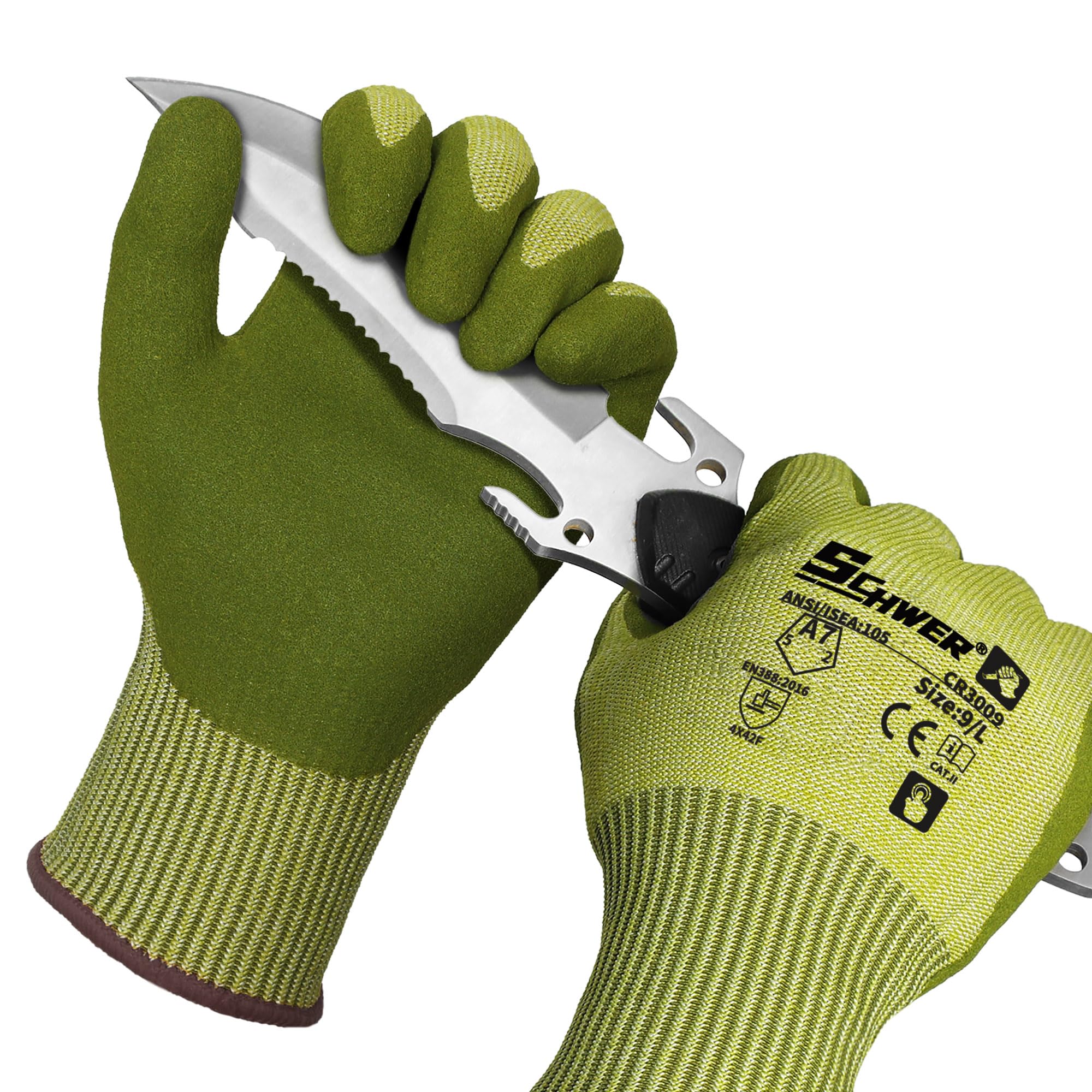
Nothing else in this group is built for the moment a fish's teeth come near your hand. The Schwer pair carries an ANSI A7 cut rating, which is a lab score against a sliding blade rather than a promise about a thrashing bluefish, but it is the only rating here that speaks to slicing at all. In a set of sun gloves and wool knits, that makes it the one to wear when you are unhooking something with a mouth full of hardware.

The palm is coated in sandy nitrile, which grips a wet tool, a wet line, or a wet fish better than knit or leather. The knit underneath is HPPE and metal wire, and the gloves are machine washable, which matters after a morning of bait. You get two pairs in the pack, so one can live in the boat bag while the other dries, and the fingertips work a touchscreen without peeling the glove off.

What it is not is a sun glove. The knit is warm enough to be uncomfortable in July, and the shell is water repellent rather than waterproof, so a soaking leaves it heavy for the rest of the day. The cut rating is not puncture protection either; spines and hooks still find a way. Wear it for filleting, unhooking, and handling fish with sharp hardware, and keep the thin gloves for casting.

Pros

  • ANSI A7 cut resistance
  • Sandy nitrile palm grips wet fish and tools
  • Touchscreen-friendly fingertips
  • Two pairs per pack, machine washable

Cons

  • Water repellent rather than waterproof
  • Stiff knit takes a few outings to break in
Our verdict

The only glove here rated for cuts: wear it for filleting, unhooking, and any fish with teeth, and keep a soft pair for casting.

Check Latest Price
6

Best Budget Fish-Handling Gloves

Berkley Coated Grip

92 /100
Angler Score Outstanding

Key details

Fit
One size, ladies' cut
Care
Hand wash only
Palm
Textured grip coating
Check Details on Amazon

One size is the catch. Berkley shapes this glove around a narrower hand, and it is the only pair here described as ergonomically designed for a woman's hand, which is why it feels right where a men's large flops at the fingertips. It is still one size, and it is cut generously with long fingers, so it suits a medium hand better than a small one and will swim on anybody at the far ends of the range.

The palm is coated in a raised texture that does one job very well: it holds a slimy fish. Bait, bluegill, something thrashing in the bottom of the boat, the coating bites where bare skin slides, and it keeps the smell off your hands, which is most of the reason people buy a handling glove in the first place. It is flexible enough to bait a hook without taking it off.

Think of it as a handling glove rather than a fishing glove. For unhooking, baiting, and grabbing fish at the back of the boat, it is the pair we keep within reach, and the one we hand to anyone who would rather not touch the catch. It packs into a pocket and does not mind living in a tackle box between trips.

Pros

  • Textured palm holds slimy fish
  • Shaped for a narrower hand
  • Flexible enough to bait a hook
  • Keeps fish smell off your hands

Cons

  • Hand wash only
Our verdict

A cheap, grippy handling glove shaped for a narrower hand, best kept in the boat for unhooking and grabbing fish rather than casting.

Check Latest Price
7

Slimy Fish Handling

Big Worm Fish Handling

91 /100
Angler Score Outstanding

Key details

Fit
One size, L to XL
Care
Hand wash only
Grip
Textured palm and fingers
Material
Rubber
Check Details on Amazon

A fish that does not want to be held is a slippery, spiny argument, and bare hands lose it, which is the whole case for these. The Big Worm gloves put a raised texture across the palm and up the fingers, and the fingers are what make the difference when you are trying to get a thumb under a gill cover. We rate that grip above the coated Berkley palm for anything with its fins still up.

One size is the limitation: they are cut for large to extra-large hands, with fingers long enough for a big palm, and smaller hands will swim in them. The rubber is breathable enough for summer heat, they rinse clean under a tap, and they are the pair you leave in the boat for bait and unhooking rather than the pair you wear all day. Not a sun glove, not a winter glove, and not trying to be either.

Pros

  • Textured palm and fingers hold slimy fish
  • Keeps bait and slime off your hands
  • Breathable enough for hot days
  • Rinses clean and stows in a tackle box

Cons

  • One size, cut for large to extra-large hands
  • No sun protection or warmth
Our verdict

The pair for slimy, spiny fish: textured grip across the palm and fingers, cut for large hands, and happy to live in the boat bag.

Check Latest Price

How We Chose and Tested Fishing Gloves

We started with about 40 pairs pulled from retailer listings and fishing-forum threads, then cut anything that didn't state a UV rating, came in only one size, or looked like a gardening glove with a fish printed on it. That left 14 pairs, fished over five months — first light on a bass lake, a kayak in a headwind, a cold tailwater where the guides iced up, and the tailgate at the end of the day with a fillet knife.

Fit decided most of it. Before anyone wet a line, we measured palm circumference and middle-finger length on each tester, matched them to every size chart, and noted who got a snug palm with room at the fingertips and who got a seam running under the knuckles. Each pair went out for full eight-hour days; we logged cuffs that crept up the wrist, thumbs that twisted, and palms that went clammy by noon. For sun protection we held the fabric against a bright sky to see how much light bled through, then compared tan lines after long cloudless afternoons.

Grip and toughness got the ugly tests. We held wet rods, lipped fish, unhooked trebles, and dragged a gloved palm across braided line under tension to see what scuffed or sliced. Waterproof pairs sat in a bucket, then stayed on through a full knot-tying session while we watched for water at the cuff. Every pair went through repeated soak-and-dry cycles, and we checked fingertips, thumb seams, and cuff elastic for fraying — that's how we sorted the ones that stay on your hand from the ones that end up in the bottom of the bag.

How to Choose Fishing Gloves

Match the glove to the water

Sun gloves are thin polyester or spandex knits rated SPF or UPF 50, cut to keep UV off the back of the hand and wrist while you cast. They are cool, they dry fast, and they do nothing for you in cold spray. Cold-water gloves are fleece-lined neoprene, which is what keeps hands dry and warm when the deck stays wet. Wool and knit fingerless gloves sit between the two, built for cold air rather than cold water.

Most anglers who fish year-round end up with two pairs in the boat bag, and that is the honest answer. Buy the sun glove first if you fish warm months, the neoprene glove first if your season runs into freezing mornings.

Decide how much finger you are giving up

Fully fingerless gloves leave all five fingertips bare. Three-cut gloves free only the fingers you work with, usually the ones used for knots and line, while the rest of the hand stays covered. Full gloves and convertible mitts cover everything, with magnets or hook-and-loop tabs to peel a flap back when you need bare skin.

More coverage means more protection and less feel, and there is no universal answer: a baitcaster in cold rain wants the flap, a fly angler tying on a small midge wants bare fingertips. The trap with any fingerless design is that it protects the back of your hand and wrist, not the pads of your fingers, which still burn.

Grip is a wet-surface question

Almost every fishing glove has some palm treatment, and they fail in different places. A microfiber palm holds a rod reasonably and dries quickly. Synthetic leather with a silicone print is the most convincing on a wet cork or EVA handle. A coarse rubber or nitrile texture is what you want on a slimy fish. Embossed neoprene grips rope and rod handles but can slide on smooth, wet plastic.

Decide what you grip most, a handle or a fish, and buy for that. A glove that is superb on a thrashing bass is not automatically the one that keeps hold of a rod all afternoon.

Waterproofing, warmth, and the fit that follows

Neoprene is measured in millimeters, and the number tells you what you are getting: 2.2mm with a fleece backing is a cold-water glove that still lets you work a reel, while heavier material gets clumsy quickly. Neoprene should fit snug, because it stretches to your hand, so sizing up gives you a glove that slides around.

Wool and knit gloves are the opposite: they are cut close and often run small, so size up if you are between sizes. One-size handling gloves are the wildcard, and they tend to run long in the fingers.

Cut resistance is a rating, not a guarantee

An ANSI A7 glove has been tested against a sliding blade at a set force, which is useful information if you fillet a lot of fish or unhook something with teeth. It is not puncture protection, though: spines, hooks, and the tip of a fillet knife still find a way through a knit. Wear the cut-resistant glove on the hand that holds the fish and use a lip grip or a wet towel for anything with a serious set of teeth.

Sun gloves and wool gloves offer no cut protection at all. If your fishing involves filleting, keep a rated glove in the bag rather than trusting the pair you cast in.

Frequently Asked Questions

Final Verdict

Start with the KastKing Sol Armis. It covers the wrist, keeps a wet rod in your hand, and stays thin enough that you forget you have it on, which is what a sun glove has to do to actually get worn.

Add the KastKing IceRiver when the water turns cold and the deck stays wet; sealed neoprene and a fleece lining are worth the lost feel. And if you fillet your own catch, the Schwer pair belongs in the bag beside them.