
Best Fishing Hook Sharpeners of 2026

A truly sharp hook digs into a thumbnail with almost no pressure; a dull one skates right off — and off a fish's jaw, too. That sliver of difference is what separates a solid hookset from the one that got away, and it's why I stopped retiring bent-point hooks and started touching them up instead. Over the past four months, my team and I have worked through 14 sharpeners — diamond stones, files, grooved hones — on everything from size 2 trebles to heavy saltwater jigs.

Here's what nobody tells a first-time buyer: groove shape matters more than grit. A narrow single groove will burn through a small trout hook in two strokes, while a wide V or a flat stone lets you follow the curve of the point without flattening it. Portability counts just as much — the sharpener that actually gets used is the one clipped to your vest or rattling in the tackle box, not the one sitting on the workbench at home. Every pick below earned a permanent spot in my kit.

1

Best Overall

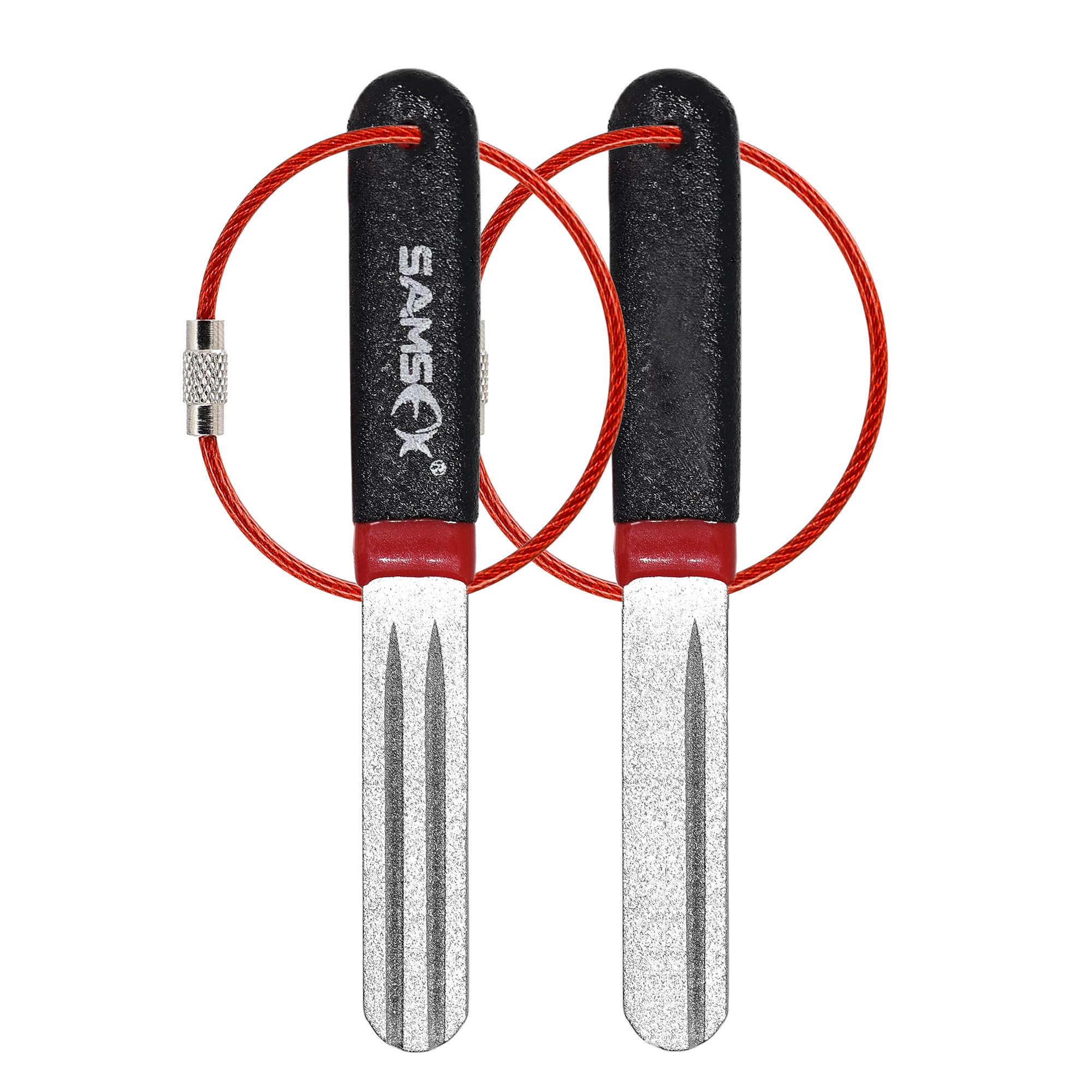
SAMSFX Dual-Grit Hook File

89 /100
Angler Score Excellent

Key details

Pack
2 files
Grits
200 / 400
Length
4 in
Grooves
3 (2 coarse, 1 fine)
Check Details on Amazon

A 200-grit face for taking down a rolled point and a 400-grit face for polishing what is left is the whole reason this is the file we recommend first. Each one runs four inches, with a dipped handle, a short lanyard rope, and grooves cut into both faces — two on the coarse side, one on the fine.

The groove layout is what we pay attention to now. Two channels on the 200 side give heavier hook wire somewhere to sit while you draw it through, so the point does not skate out mid-stroke; the single 400 groove is narrow enough to keep a small point honest. We use the coarse side on hooks that have been dragged over rock or bounced off a piling, and the fine side for the touch-up before the next cast.

The two-pack is the quiet advantage. One file lives on a vest zipper and one in the boat's tool tray, and neither is ever the reason a good fish gets a second chance. Four inches is long enough to work a 2/0 hook in a couple of strokes and short enough that it does not fight a pocket for space.

What it will not do is turn a wrecked hook into a good one. Once the point has folded or lost noticeable length, cutting it off is the honest move — no groove puts metal back. For everything short of that, this pair covers it.

Pros

  • Two grits, 200 and 400, on one file
  • Three grooves across both faces
  • Dipped handle holds up with wet hands
  • Two files in every pack

Cons

  • Diamond surface dulls with steady use
Our verdict

Two grits, three grooves, and a grip that still works with wet hands: this is the file we tell most anglers to buy first.

Check Latest Price
2

Best for Boat Bags

Kraken Bass Retractable Hook Sharpener

89 /100
Angler Score Excellent

Key details

Grit
600
Length
8.62 in
Weight
1.6 oz
Sharpening Faces
3, grooved
Check Details on Amazon

This is the priciest sharpener in the group by a clear margin, and the money goes into the housing rather than the abrasive. A 600-grit diamond stone is bonded to a triangular block that retracts into a slim plastic handle, with three grooved faces you can rotate through as one loads up with metal.

The retracting body is what sold us. A bare stone that rides loose in a boat bag collects chips and gets ground against jig heads and pliers; this one disappears into its own handle and comes out with its surface intact. It also slips into a shirt pocket like a pen, which matters a lot more on a kayak than on a boat with a console to set things on.

Six hundred grit is a polishing grit, and that is the trade. It brings a good point back to sticky-sharp in a few passes but it is slow on a genuinely blunt hook, so if you routinely fish points down to flat, plan on more strokes or keep something coarser nearby. What you are buying here is a tool that arrives in the condition you left it.

Pros

  • Stone retracts into its own handle
  • Three grooved faces to rotate through
  • Carries like a pen in a pocket

Cons

  • Single 600 grit is slow on a blunt point
Our verdict

If your sharpener rides loose in a boat bag, the retracting stone is worth the premium — it reaches the water with its grit intact.

Check Latest Price
3

Best for Small Hooks

Dr. Slick Hook File

88 /100
Angler Score Excellent

Key details

Grits
Fine and medium
Length
4 in
Surface
Diamond, dual grooves
Check Details on Amazon

Small hooks are a different job, and this is the file built for them. Four inches of diamond-coated steel with a fine side and a medium side, two grooves cut along its length, and a green handle that is easy to find in a vest pocket.

The narrow profile is the point. It slips between the arms of a small treble and works a point without dragging across the barb, and the fine side leaves an edge that is polished rather than merely toothy. Anglers fishing barbless — where a sticky point is the difference between a solid hookset and a long-distance release — get the most out of it.

Small is also the caveat. On heavy wire, big siwash hooks and saltwater trebles, the slim abrasive takes noticeably more strokes than the wider tools here, and it is easy to give up halfway and retie instead. For the small stuff, the form factor earns its keep: it does the work of a much bigger stone at the only spot that matters, right at the point.

Pros

  • Slim four-inch file reaches small hooks
  • Fine and medium sides for polishing
  • Drawstring loop keeps it on a vest

Cons

  • Heavy-wire hooks take many more strokes
Our verdict

Buy this one if your hooks are small: the slim file polishes a fine point that wider hones skate right past.

Check Latest Price
4

Best for Big Hooks

Lansky Multi-Groove Hook Sharpener

86 /100
Angler Score Excellent

Key details

Weight
0.35 oz
Grooves
3, multi-size
Material
Marine-grade plastic
Attachment
Key ring or vest
Check Details on Amazon

The grooves on this hone are wide, and that tells you what it is for. Three channels are cut into a small plastic body and they suit hooks with some diameter to them — the heavy trebles, jig hooks, and big singles that turn up in a saltwater box. Fine-wire dry-fly hooks tend to skate through without getting much done.

The plastic is marine grade, so it does not discolor or go chalky after a season of salt, and it needs no oil or water to work. At 10 g it disappears on a vest loop or a key ring, and it is one of the few tools here that genuinely does not care whether it gets put away wet.

On a heavy hook the wide channel earns its keep quickly: the point sits in the groove, you draw it through, and the burr comes off in a handful of strokes. The finish it leaves is coarser than a fine diamond file achieves — fine for a bait hook headed for a live bait, less so for anything you want needle-sharp.

Our take: this belongs in the box that goes on the saltwater boat, not the vest you wear on a trout stream. Match it to the hooks you actually tie on. If most of them are heavier than a 1/0, the wide grooves will feel made for you; if they are smaller, put the money into a slim file instead.

Pros

  • Marine-grade plastic shrugs off saltwater
  • Clips to a vest loop or key ring
  • A few strokes restores a big hook

Cons

  • Grooves too wide for fine-wire small hooks
Our verdict

A saltwater boat-box tool for hooks with some wire to them, where wide grooves and marine plastic do the work fine files cannot.

Check Latest Price
5

Best Two-Pack for the Vest

Skylety Double-Sided Hook File

86 /100
Angler Score Excellent

Key details

Pack
2 files
Grits
Fine and medium
Length
3.93 in
Grooves
3
Check Details on Amazon

Where our top pick labels its faces by grit number, this pair goes with fine and medium and lets the grooves do the explaining. Two files just under four inches, each with a rubberized grip, a lanyard, and a light green body that stands out against dark tackle-bag lining. One face carries a single groove, the other two.

The two-pack is the reason to buy. One file rides on a vest, one stays in the boat, and the one you can put a hand on is the one that gets used. We appreciate the grip most when hands are wet and cold — dipped handles go slick in that condition and this one stays usable — and the lanyard means it hangs off a zipper pull instead of vanishing into a pocket. The grooves take a treble point cleanly, and the pair has kept hooks fishing a whole season of freshwater trips without either one being replaced.

Pros

  • Two files with lanyards, vest and boat
  • Grip stays usable with wet hands
  • Compact 3.93-inch length

Cons

  • Sides labeled fine and medium, with no grit numbers
Our verdict

Two lanyarded files for the vest and the boat, with a grip that still works when your hands are wet and cold.

Check Latest Price
6

Best for Polishing a Point

Miyake Diamond Hook Sharpener

86 /100
Angler Score Excellent

Key details

Grits
600 / 800
Length
4 in
Grooves
3
Warranty
1 year
Check Details on Amazon

Six hundred and 800 grit, three grooves, four inches, one file per pack. Those are the finest grits in this group, and they set the job: this is a hone for keeping a good point good rather than rebuilding a bad one.

It is the one we hand to the angler who sharpens every hour and rarely lets a point get away from them. The non-slip dipped handle works with wet hands, the lanyard rope hangs it off a vest, and the 800 side leaves a point that is polished rather than merely sharp — the difference you notice when a hook has to slide through a bony jaw instead of punching into soft tissue. A one-year manufacturer warranty is unusual at this level, and worth something on a tool that lives outdoors. A rolled point will take a while, though; fine grits cut slowly and there is only so long you want to spend on one hook.

Pros

  • 600 and 800 grits polish a point
  • Three grooves for hook placement
  • One-year manufacturer warranty

Cons

  • Fine grits are slow on a damaged point
Our verdict

The pick for anglers who touch up hooks before they dull — 600 and 800 grits leave a polished point, with a year of warranty behind it.

Check Latest Price
7

Surf and Bank

SE Dual-Grit Hook Stone

86 /100
Angler Score Excellent

Key details

Grits
200 / 400
Handle
Dipped, wrist lanyard
Pieces
1
Check Details on Amazon

A hook bounced along jetty rocks has a burr you can feel with a thumbnail, and this stone is built for that exact problem. One 200/400 diamond stone, a dipped handle that keeps your fingers behind the work, and a yellow lanyard loop for your wrist.

The 200 side is coarse enough to take a burr down in a handful of strokes; flip to 400 and polish the new point. It runs dry, needs no oil, and the flat faces will touch up a fillet knife or a pair of scissors as readily as a hook, which is more than the grooved hones here can claim.

For the surf bag this is the sensible shape: light, cheap enough to own two, and small enough to live in a plug-bag pocket unnoticed until you need it. Tether it — a wet hand loses small stones, and a lost sharpener is the one you needed. In the hand it runs smaller than the product photos suggest, so expect a pocket tool rather than a bench stone.

Pros

  • Coarse 200 side cuts a burr fast
  • Wrist lanyard keeps it off the bottom
  • Flat faces work on hooks and knives

Cons

  • Runs smaller in the hand than photos suggest
Our verdict

A light, coarse stone for the surf bag: it knocks a burr off in a handful of strokes and the wrist loop keeps it aboard.

Check Latest Price
8

Hooks and Knives

XILEWHZF Folding Diamond File

88 /100
Angler Score Excellent

Key details

Pack
4 pieces
Grits
400 / 600
Design
Folding, grooved both faces
Length
5.16 in
Check Details on Amazon

Four of these come in the pack, each a fan-shaped handle that folds over the stone. Closed, it is a flat package about five inches long that slides into a shirt pocket; open, the handle gives you something to hold that keeps your knuckles clear of the hook.

The faces carry 400 and 600 grit, with one groove on one side and two on the other, so a hook can be laid in and drawn through instead of freehanded. The honeycomb pattern on the surface bites fast — noticeably faster than a plain diamond plate on a machete or a pair of pruners, which is clearly part of the design brief here.

That breadth is the appeal and the compromise. A face coarse enough to sharpen a garden tool is grabby on a size 6 hook, and the fine control you get from a slim file is not quite here. It is a tool that would rather be in a truck box than a vest.

Buy it if you want one sharpener for the camp kit, the glovebox, and the tackle box, and you are not fussy about the last few percent of finesse on a small point. For dedicated hook work, the slim files in this guide reach a fine point with more control; this one earns its place where hooks share a drawer with everything else that needs an edge.

Pros

  • Folding handle covers the stone in transit
  • 400 and 600 grits, grooved both faces
  • Four in the pack for bag, boat, and truck

Cons

  • Folding handle feels light for the job
Our verdict

A four-pack for the truck box and the camp kit, where hooks share a drawer with knives and pruners rather than living in a vest.

Check Latest Price

How We Tested the Best Fishing Hook Sharpeners

We started by pulling every hook sharpener with real user reviews behind it, then filtered by grit, groove count, weight, handle material, and price so the shortlist covered pocket files, double-sided diamond stones, and bench-style hones rather than eight versions of the same thing. Fourteen of them went into my vest, my tackle box, and the truck's glove compartment for four months. They sharpened hooks on a tailgate at 5 a.m., on a rocking boat deck, at the kitchen table while I tied flies, and thigh-deep in a trout stream with cold hands.

Before each hook touched a stone, I dragged the point across my thumbnail to see whether it bit or slid, then repeated the test afterward and counted strokes. A good sharpener brought a rolled 2/0 point back in three or four light passes; a coarse one chewed the point into a needle that would snap. I also ran finished points across scrap leather and a rubber band to check whether they caught and held.

Portability got tested honestly — each sharpener rode in a vest pocket with keys and a carabiner, and I weighed them on a kitchen scale to see which ones I'd actually carry. Handles were gripped with wet, fish-slimed fingers to check for slip. I matched every groove against hooks from size 12 up to 5/0, watching for diamond grit shedding, stones peeling off their backing, and files clogging after a few weeks of saltwater use. The ones that stayed sharp and intact earned their place.

How to Choose a Fishing Hook Sharpener

Coarse for rebuilding, fine for polishing

Every sharpener here removes metal, and the grit decides how fast. A 200 or 400 diamond face cuts quickly enough to take down a burr or tidy a slightly rolled point, but it leaves a toothy edge. A 600 or 800 face cuts slowly and leaves a polished point that slides through a bony jaw instead of catching on it.

If your hooks get damaged — rocks, pilings, a bad cast under a bridge — start coarse. If you touch up every hour and rarely let a point go, a fine hone and a light hand does more for you than a coarse one, and it takes less metal off the hook over a season.

Grooved hones versus flat stones

A groove holds the hook at a consistent angle while you draw it through, which is why a multi-groove hone can restore a point in a few strokes with no real skill involved. The trap is groove width: a channel wider than your hook wire lets the point roll instead of sharpen, so match the tool to the hooks you tie on rather than to the ones in the photo.

Flat faces, like the ones on the SE stone and the folding file here, are more versatile. They handle knives, scissors, and hooks you want to work freehand at your own angle — just less foolproof when your hands are cold.

How it travels matters as much as how it sharpens

A diamond surface riding loose in a tackle box gets chipped and ground against pliers, and a stone without a lanyard eventually goes over the side. Decide where the sharpener lives before you buy it: a lanyard or key ring for a vest, a retracting body or folding cover for a boat bag where everything gets thrown together, and a two-pack if you fish from more than one place.

Wet, cold hands change the choice too. A dipped or rubberized grip is worth having, and it is the reason several of the picks here have one.

What the extra money actually buys

Every tool on this page sharpens with the same abrasive — fine diamond particles bonded to a surface — so the premium goes into the housing, not the cutting. That means a retracting body, marine-grade plastic that will not chalk in salt, a folding cover, or a manufacturer warranty.

None of that makes a hook sharper. All of it makes the tool more likely to be intact and findable when a fish is thrashing at the net. If your sharpener lives in a dry vest pocket and comes out twice a trip, keep the money and buy a second cheap file instead.

Frequently Asked Questions

Final Verdict

Buy the SAMSFX two-pack first. Two grits and three grooves cover everything from a ten-second touch-up to taking down a burr, the dipped handle works with wet hands, and the second file means one lives on the vest while one stays in the boat.

If your sharpener rides loose in a bag and gets abused, the Kraken Bass and its retracting stone are the upgrade worth paying for. And if your hooks run small, take the Dr. Slick instead — its slim file reaches a fine point the wider tools cannot.