Best Fishing Reels of 2026

A spinning reel does one real job: hold your line, then hand it back at the tension you asked for. The smoothness you feel on the retrieve, the way line peels off the spool on a cast, the drag that either wears a fish down or gives it a free run — all of it is that same job done well or badly. And the price tag tells you less than you'd think; I've had inexpensive reels outlast costly ones and watched a silky-feeling reel turn gritty after a season in the truck bed.

Over the past eight months, my team and I have fished 14 spinning and spincast reels from ponds to lake docks to a jetty or two. The max drag number on the box matters far less than whether the drag starts up gradually instead of jerking. Not everyone wants to work for a fish, either: a push-button spincast is still the quickest way to get a kid, or a tired adult, casting on the first try. The picks below are the ones that stayed on my rods.

1

Best Overall

Penn Battle IV Spinning Reel

94 /100
Angler Score Outstanding

Key details

Weight
11.6 oz
Bearings
5+1
Max Drag
15 lb
Gear Ratio
6.2:1
Check Details on Amazon

Salt and sand are what quietly end a spinning reel's life, and the Battle IV is the reel in this guide with the most metal in the fight: an all-aluminum body and sideplate, a forged and machined aluminum spool, a brass main gear, and six total bearings including the instant anti-reverse. That is why it is our top pick. Nothing about the design ties it to one kind of water, so it covers a bass lake on Saturday and an inlet jetty the following weekend.

Drag is where a reel at this level earns its keep. The HT-100 carbon-fiber stack is rated to 15 pounds, which on a 3000-size frame is enough for redfish, striped bass, and catfish in current. What matters more than the peak number is how the drag starts, since a stack that grabs instead of easing out is how light leaders break, and carbon washers under a big knob are the right hardware for that job. The knob is wide enough to work with wet fingers, which sounds trivial until you are adjusting it in the rain.

At 11.6 ounces it is the heaviest reel here, and that is the honest trade for all that aluminum. A graphite frame flexes under a locked-down drag in a way metal does not, but you feel the extra weight on a light rod by the end of a long day. The 6.2:1 gear picks up 35 inches per turn, quick enough to take slack before a fish turns. Fish ultralight tackle for panfish and this is more reel than you need.

Set against the rest of this list, the trade is clear. The Wrath II is lighter and easier on the wallet, the Sedona carries more line for bigger water, and neither is built around as much metal. If your year is all freshwater, spare your wrist. If salt is any part of it, this is where we start.

Pros

  • All-aluminum body with a brass main gear
  • 15-pound carbon HT-100 drag
  • Handles freshwater and inshore saltwater
  • 35 inches of line per turn

Cons

  • No reverse switch for back-reeling
Our verdict

Our pick for one reel that handles freshwater and inshore saltwater for years: the aluminum body and 15-pound carbon drag earn the extra weight.
Check Latest Price
2

Best Budget Spinning Reel

KastKing Brutus Spinning Reel

92 /100
Angler Score Outstanding

Key details

Weight
10.5 oz
Max Drag
17.5 lb
Gear Ratio
5.2:1
Check Details on Amazon

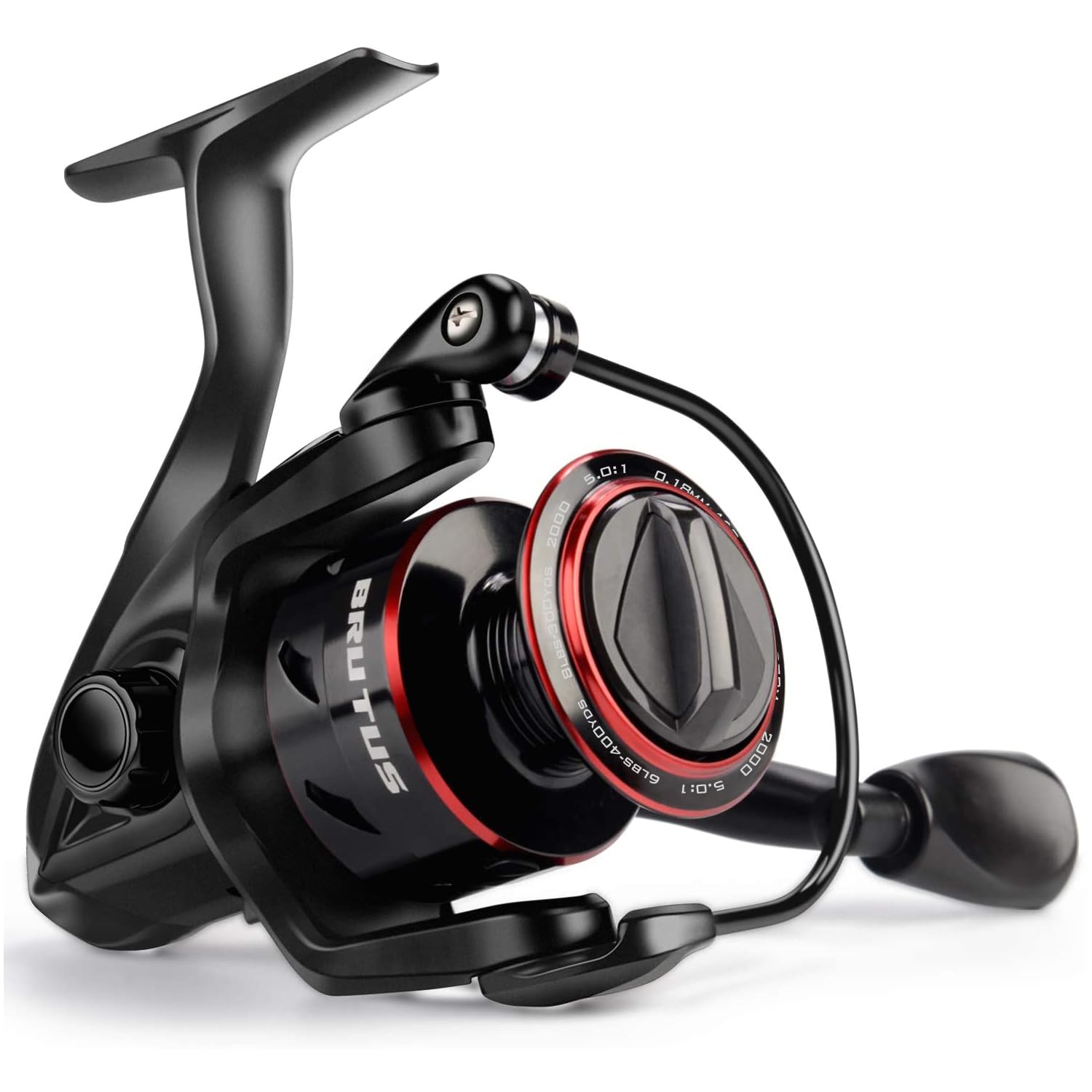
A 2000-size frame at 299 grams is the weight that makes a six-foot rod feel like nothing, and the Brutus sits right there: graphite frame and rotor, a CNC-machined aluminum spool, and a 5.2:1 gear. We noticed the balance before anything else about it, because the reel sits close to the hand instead of pulling the tip down.

What keeps us coming back is how much drag KastKing squeezes into a reel this small. The carbon-fiber stack is rated to 17.5 pounds on this size, more than the Penn Wrath II claims on a bigger 4000 frame, and you do not need all of it for it to matter: the reserve is what lets you lean on a fish heading for a dock piling. The handle swaps from left to right with a screw, and the spool is machined rather than molded, which is not a given at this level.

The catch is how long it lasts. This is a reel we think of in seasons rather than decades, and the graphite handle arm on the smaller sizes is where the savings show up. Buy it as a first spinning reel, a spare behind the truck seat, or the outfit you hand a visiting friend, and the arithmetic works out just fine.

Pros

  • 17.5 pounds of drag on a 2000 frame
  • 299 grams balances a light rod
  • Machined aluminum spool
  • Handle swaps left or right

Cons

  • Realistic lifespan is a few seasons
Our verdict

We point budget-minded anglers here: a light 2000-size spinning reel with genuine drag, bought with the expectation of a few good seasons.

Check Latest Price
3

Best Big-Water Spinning Reel

Shimano Sedona 23 Spinning Reel

89 /100
Angler Score Excellent

Key details

Weight
11.2 oz (310 g)
Bearings
3+1
Max Drag
24.3 lb
Gear Ratio
6.2:1
Check Details on Amazon

A 5000-size reel that weighs 11.2 ounces is an odd and useful thing, and it is why the C5000XG is here. It holds 190 yards of 4-pound mono or 400 yards of 1.5 PE braid and still hangs on a rod like something smaller, so a long session on the sand or a day dropping baits from a boat does not leave your forearm aching. Shimano's Silent Drive internals and a 6.2:1 gear pulling 41 inches a turn fill out a package built for big water.

Twenty-four pounds is the maximum drag figure; 13.3 pounds is the one Shimano calls practical, and that gap is worth understanding, because the lower number is what you can actually fish without cranking the spool solid. Thirteen pounds of usable drag turns a striper in current, and the carbon and felt internals hold that setting rather than spiking. What we appreciate most is that the capacity and the drag arrive without an ounce of extra frame.

The spec that looks weak is three plus one bearings, low beside the twelve-plus-one counts further down this page. Count is not smoothness, though, and the way this reel is put together is the reason it made the list. The real caveat is size: a C5000 is more reel than a bass or trout angler needs, and it will feel like it on a light rod.

Pros

  • 24.3-pound drag with 13.3 pounds usable
  • Long line capacity for surf and boat
  • 11.2 ounces on a 5000-size frame
  • 41 inches of line per turn

Cons

  • C5000 is more reel than freshwater fishing needs
Our verdict

For beach, pier, and boat fishing where line capacity and drag decide the day, we rate this the strongest big-water spinning reel in the group.

Check Latest Price
4

Best Saltwater Reel for the Money

Penn Wrath II Spinning Reel

90 /100
Angler Score Outstanding

Key details

Weight
12.6 oz
Bearings
2+1
Max Drag
15 lb
Gear Ratio
6.2:1
Check Details on Amazon

The Wrath II is not sealed, and that one fact shapes how you own it. Penn builds it on a corrosion-resistant graphite body with a machined anodized aluminum spool, and it takes salt fine as long as you rinse it in fresh water and keep a little grease on the works after a trip. Skip that and the drag and bearings are where it tells you first.

What earns it a place is the balance of the thing. At 12.64 ounces on a 4000 frame it feels planted rather than heavy, the 6.2:1 gear brings back 37 inches a turn, and the felt front drag is rated to 15 pounds, enough for surf bass, bluefish, and pier fishing on 20-pound braid. We keep coming back to it as the reel that lives in the truck for saltwater trips nobody planned.

Its spot in this list sits between two good options: lighter and easier on the wallet than the Battle IV, bigger and more salt-ready than the budget spinning reels. For an angler who fishes the surf a few times a season and wants a name-brand reel that will still be on the rod next year, that is the whole argument.

Pros

  • Graphite body with machined aluminum spool
  • 15-pound felt front drag
  • 4000-size capacity for surf
  • 37 inches of retrieve per turn

Cons

  • Felt drag washers are less forgiving of grit than carbon
Our verdict

The saltwater reel we suggest when you want Penn's build and a 4000-size spool without the top pick's weight or cost.

Check Latest Price
5

Best Spincast Reel

KastKing Brutus Spincast Reel

89 /100
Angler Score Excellent

Key details

Weight
9.88 oz
Bearings
5+1
Max Drag
11 lb
Gear Ratio
4.0:1
Check Details on Amazon

Most push-button reels are right-hand retrieve only, and the Brutus is one of the few that is not: the aluminum double-paddle handle moves to either side with a screw, which matters when the kid doing the casting is left-handed. The rest of it is a well-sorted spincast, with five stainless double-shielded bearings, a 4.0:1 gear, 15.75 inches of line per turn, and a graphite body.

The drag is the surprise. Eleven pounds is a lot for a size-30 spincast, and the stainless dual-pickup system lays line back on the spool without the lurching retrieve that makes cheaper push-buttons feel like toys. It throws a quarter-ounce jig without drama, which is the entire point of a spincast in the first place.

The weight is the trade: at 9.88 ounces it is heavier than the basic push-button reels, and you notice it on a five-foot rod by the end of an afternoon. That heft is also why it feels solid in the hand instead of rattly, and it is the reason we are comfortable handing it to a kid who is not careful with gear.

Pros

  • Reversible handle, rare on a spincast
  • 11 pounds of drag on a size 30
  • Solid, non-rattly graphite body
  • Smooth dual-pickup line lay

Cons

  • Line release can start hanging up after heavy use
Our verdict

We hand this one to beginners and kids: push-button simple, with a swappable handle and enough drag to land more than panfish.

Check Latest Price
6

Best First Reel for Kids

Zebco 202 Spincast Reel

91 /100
Angler Score Outstanding

Key details

Weight
7.68 oz
Gear Ratio
2.8:1
Line Capacity
110 yd/10 lb
Line Per Turn
15 in
Check Details on Amazon

The 202 shows up spooled with ten-pound line and takes about a minute to mount on a rod, and that is most of the pitch: a push-button reel a seven-year-old can work without a lesson. All-metal gears, a 2.8:1 gear, a dial-adjustable drag, and 7.68 ounces of body that will survive being set down on a dock rather than placed.

What it does well is the first hundred trips. The button sits on top of the body where small hands reach it, the quick-set anti-reverse stops the handle spinning backward, and the slow 2.8:1 gear means a kid cranking with both hands will not rip a small hook out of a bluegill's mouth. It is a starter reel that behaves like one on purpose.

Our advice is to treat the line it comes with as a placeholder. Fresh six- or eight-pound mono is the single biggest improvement you can make to this reel, and it takes ten minutes with a spool and a pair of scissors. Do that and the 202 casts cleanly enough that a beginner spends the afternoon fishing instead of picking out tangles.

Pros

  • Pre-spooled and ready to fish
  • All-metal gears at a starter level
  • Push-button simple for small hands

Cons

  • Right-hand retrieve only
  • Line capacity caps it at panfish and small bass
Our verdict

The reel we hand a kid first: push-button simple, pre-spooled, and tough enough to survive a season of being dropped.

Check Latest Price
7

Ultralight and Travel

Daiwa Crossfire LT Spinning Reel

82 /100
Angler Score Excellent

Key details

Weight
9.2 oz
Bearings
3+1
Max Drag
22 lb
Gear Ratio
5.3:1
Check Details on Amazon

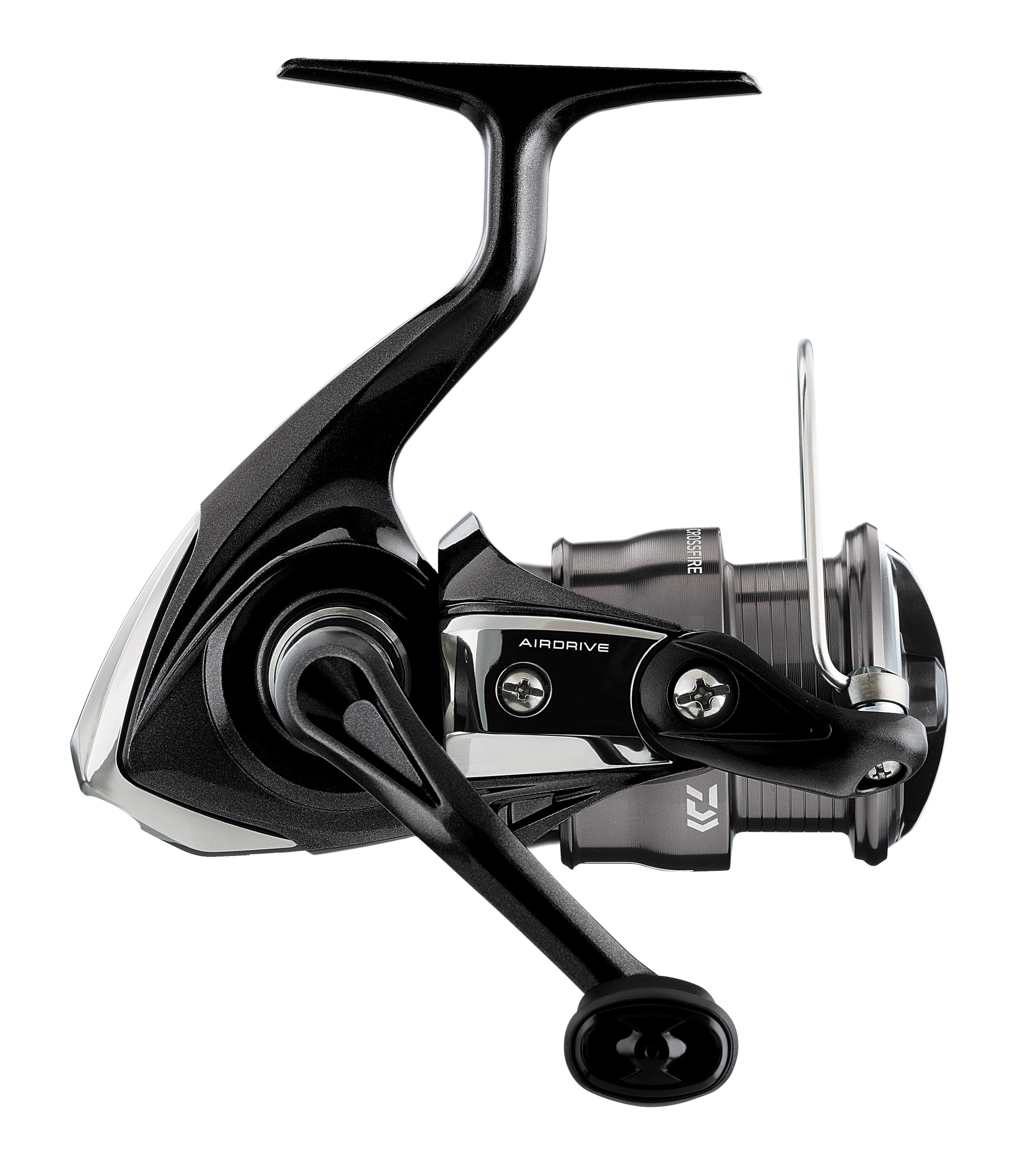
At 9.2 ounces the Crossfire LT is the lightest 3000-size reel on this page, and that number shapes the rest of it. Daiwa's AIRDRIVE rotor and bail are built to take less effort to turn, and the difference shows up late in the day, on a rod you have been holding since morning.

The rest is sensible rather than flashy: a 5.3:1 gear, 22 pounds of maximum drag from the ATD Type-L system, and an LC-ABS spool shaped so line leaves with less friction. That last part is the one we notice, because a spool that lets line peel cleanly is what keeps a light lure going where you aimed it.

The handle screw is the thing to check before a trip; keep it snug and it stays put. Otherwise this behaves like a more deliberate reel than its place in the list suggests, with an unhurried 5.3:1 gear that suits working a lure rather than ripping it back.

Where it earns its spot is as the travel reel or the light-tackle reel: light enough for an ultralight rod after bluegill and crappie, modest enough that a lost one does not ruin a trip. It will not outlast the Battle IV and it does not pretend to. For panfish, crappie, and schoolie bass, the weight saving is what we notice every trip.

Pros

  • 9.2 ounces on a 3000 frame
  • 22-pound ATD drag
  • LC-ABS spool for cleaner casting
  • Unhurried 5.3:1 gear for finesse work

Cons

  • No reverse switch for back-reeling
Our verdict

A light 3000 for ultralight rods and travel bags; we give up the reverse switch for the weight it saves.

Check Latest Price
8

Cheap Spare Reel

QINGLER Summer Centron Spinning Reel

87 /100
Angler Score Excellent

Key details

Bearings
12+1
Max Drag
13 lb
Gear Ratio
5.1:1
Check Details on Amazon

Twelve ball bearings plus one anti-reverse bearing is a startling count on any reel, and this is the least expensive one here. What the count buys is a handle that turns freely out of the box and a bail that snaps over cleanly, the two things a beginner notices first, before they know anything about drag.

The rest of the spec sheet asks little of your wallet: a 5.1:1 gear, 13 pounds of drag, a CNC-machined aluminum spool, and a folding handle that lets the whole reel pack flat in a bag. The gear ratio is the number that matters here, because 5.1:1 is a sensible all-round speed for working a lure and picking up slack.

The caveat that matters is the anti-reverse. It engages with a slight lag rather than instantly, and you feel it when you set a hook hard or work a lure with a steady retrieve. That is a real limitation for a lure angler and close to irrelevant for someone drowning a worm under a bobber, which is the fishing this reel is built for.

We keep it on the list for two jobs: the beginner who is not sure they will stick with fishing and should not spend much finding out, and the spare that lives in the car so a broken line does not end an afternoon. It does those jobs well. It is not the reel to build a decade around.

Pros

  • Least expensive spinning reel in this guide
  • 12+1 bearings and a 5.1:1 gear
  • Folding handle packs flat
  • 13 pounds of drag

Cons

  • 3000 frame runs small for its class
  • Folding handle feels light-duty
Our verdict

The least expensive open-face reel here, and a fair way to find out whether spinning gear suits you.

Check Latest Price

How We Chose and Tested the Best Fishing Reels

To build the shortlist, I started with reels that were actually in stock at mainstream retailers, then narrowed by size (mostly 1000 through 4000, plus a few spincast models for anglers who want a push button), line capacity, gear ratio, and price band, so nothing in the test cost wildly more or less than the reel beside it. Fourteen of them went onto rods and into my truck. Eight months later, most are still there.

The first thing every reel faced was a slow retrieve with a three-pound weight tied off, cranked from slack and then fast under load — that's where binding, rotor wobble, and a hollow-feeling handle show up before a fish ever does. Then casting: I threw a three-eighths-ounce plug into a headwind, counted overruns, and watched how line left the spool at the start of each cast, since a reel that lays line unevenly will loop and stall by the second or third trip. Drag got checked by hand first, pulling line off at the strike setting to feel whether it started smooth or jerked, and then on real fish in ponds, off a lake dock, and once on a jetty at dawn.

For durability I did what I actually do: laid a couple in the sand, dunked one, rinsed and re-greased, then fished those again a month later to see if anything had loosened or gone rough. I weighed each reel on a kitchen scale, then fished a full six-hour day with it to judge how the shoulder felt by the last hour. Value came last — what a reel cost relative to how it behaved when the fish were actually on.

How to Choose a Fishing Reel

Start with size class and line capacity

What a reel holds decides what it can do. A 2000- or 3000-size spinning reel carries enough 8- to 10-pound line for bass, trout, and schoolie stripers and usually weighs under ten ounces; a 4000 or 5000 adds capacity and drag for surf, pier, and boat work at the cost of a few ounces and some feel with light lures. Spincast sizes run on their own scale, where a Zebco 30 is small and a 40 is the step up.

Match the size to the line rating printed on your rod and you are most of the way to a decision. Fishing two or three times a year from shore? A 3000 covers it.

Read the drag numbers honestly

Every reel here publishes a maximum drag, and almost none of them will be fished anywhere near it. The useful figure is the practical rating: the Sedona lists 24.3 pounds maximum against 13.3 pounds practical, and the second number is the honest one. Ten-pound line breaks at about ten pounds, so fifteen pounds of smooth drag covers most inshore fishing.

Washer material matters as much as the rating. Carbon fiber starts cleanly and shrugs off grit; felt is smooth when new and less tolerant of sand, which is worth knowing before you buy a reel that will see the beach.

Weight, balance, and the bearing-count trap

A reel that outweighs the rod wears you out. Nine to twelve ounces is normal for a 3000, and the lightest here is 9.2 ounces, which you feel at hour six rather than hour one. Bearings are marketing as much as engineering: twelve bearings in an inexpensive reel do not buy the smoothness of three good ones in a Shimano, so weigh the count against frame material and drag hardware.

Put the reel on the rod before you commit. If the outfit tips forward in your hand, the reel is too heavy for that blank, whatever the spec sheet says.

Saltwater is a maintenance decision

Any of these reels can go in the salt; what separates them is what happens afterward. A graphite body with a felt drag needs a freshwater rinse and a dab of grease after each trip, and it will tell you when you skip one. Metal bodies and carbon washers tolerate more neglect.

If salt is most of your fishing, pay for the metal. If it is a couple of trips a summer, rinse what you already own and spend the difference on fresh line.

Spincast or spinning for a beginner?

Push-button spincast reels are the easier start: no bail to flip, no line to feather, and the Zebco 202 arrives spooled. The trade is drag and capacity — the biggest spincast here holds 190 yards of 8-pound line and tops out at 11 pounds of drag.

A 2000 or 2500 spinning reel takes an afternoon to learn and leaves room to grow into bigger water. If the angler is under ten, start with the push button and move up when the drag starts limiting them.

Frequently Asked Questions

Final Verdict

Most anglers should buy the Penn Battle IV. It covers fresh water and inshore salt on the same rod, and the all-aluminum body and carbon drag are what the extra weight and money buy you. If your fishing is all freshwater, the KastKing Brutus 2000 gives up metal and longevity but not smoothness.

For saltwater on a tighter budget, the Penn Wrath II is the middle path, as long as you rinse it after every trip. And if the beach is where you fish, move up to the Sedona's line capacity — that is the one requirement that changes the answer.