
Best Fly Tying Kits of 2026

A fly tying kit looks generous in the product photo and disappointing on the desk. The vise lets the hook creep, the bobbin has a burr that frays thread, and half the feathers have nothing to do with the patterns in the little booklet. What separates a kit you're still using next season from one that gets shoved in a drawer is unglamorous: jaws that grip a size 16 hook without marring it, a base that holds still while you crank thread, and materials picked to actually finish the flies the instructions promise. Get those right and a kit turns a shoebox of feathers into a dozen fishable flies.

Tying is fiddly enough without fighting your own tools, and the contents list matters less than you'd expect — a lean kit whose materials all match its own booklet beats a two-hundred-piece box of random hackle. I've tied on and off for years, and over the past six months my team and I worked through eleven kits, from bare-bones starter sets to loaded travel cases. The picks below are the ones still clamped to my desk.

1

Best Overall

WETFLY Deluxe Fly Tying Kit

88 /100
Angler Score Excellent

Key details

Vise
Super AA with C-clamp
Tools
Scissors, hackle pliers, hair stacker, bobbin, threader
Materials
Natural hackle, dubbing, marabou
Pieces Included
24
Check Details on Amazon

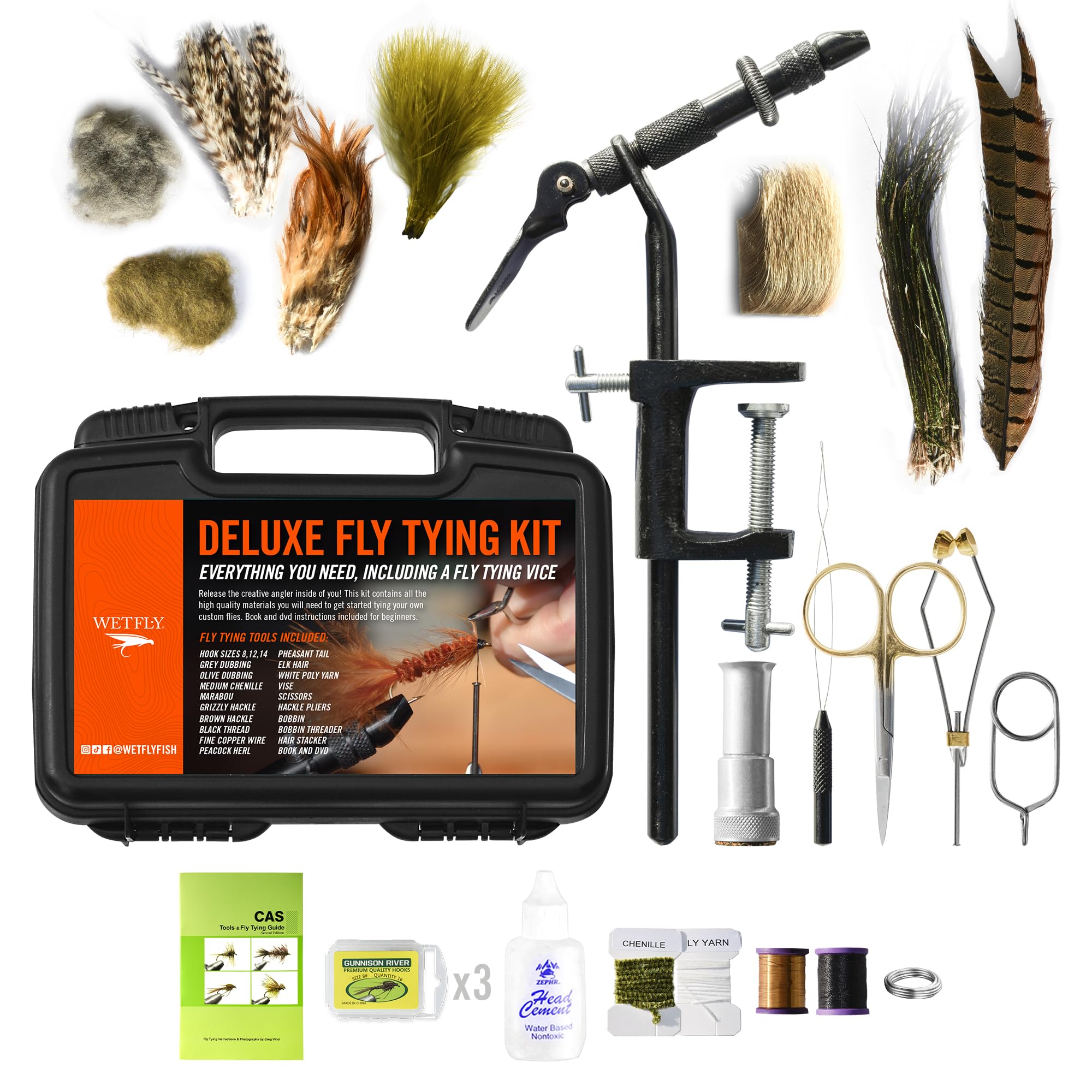
Twenty-four pieces sounds like a marketing number until you read the list: a Super AA vise with a C-clamp, scissors, hackle pliers, hair stacker, bobbin and bobbin threader, plus natural hackle, dubbing and marabou. That combination is why we give it the top spot here, a real vise and real materials in one box, at mid-pack money rather than premium money.

The vise is the part that decides it for us. A C-clamp base locks onto a table edge and holds while you tension thread, and that stability is the difference between learning to wrap and fighting the tool. The material list earns its place too: hackle, dubbing and marabou are what the patterns you will actually fish are built from, so the practice carries over to the fly you tie at the water.

What it isn't is a bench supply. Twenty-four pieces gets a beginner through the first dozen flies, then it's hooks, more thread and head cement. That's a small complaint, and we can live with it: the tools are sound rather than special, and the vise is the piece worth the money here, with the feathers coming along for the ride.

Pros

  • C-clamp vise and a full tool set together
  • Natural hackle, dubbing, and marabou included
  • Midrange price against the kits here

Cons

  • C-clamp needs a table edge with clearance
Our verdict

The default we hand a friend who wants to start: a real C-clamp vise, a full tool set, and natural materials, with nothing critical left to buy.

Check Latest Price
2

Best for Materials

Ninnifly Fly Tying Kit

85 /100
Angler Score Excellent

Key details

Hooks
60
Bobbins
2 ceramic-tip
Flies Covered
About 60
Pieces Included
More than 100
Check Details on Amazon

Sixty hooks and materials for roughly sixty flies is the number that separates this kit from the other full kits here. Ninnifly also packs two ceramic-tip bobbins, so you can keep two thread colors loaded instead of re-spooling between patterns, along with bodkins, scissors, hair stacker, whip finisher, dubbing and chenille, all in a compact travel case.

What that volume buys is time at the vise, enough hackle and chenille for pattern after pattern rather than a handful of flies and then a shopping trip, and repetition is what actually teaches tying. Including the hooks matters too. They aren't a given in this group, and a kit without them is a kit you can't use on day one.

The case does its job: the tools and materials close up in something smaller than a shoebox, and it travels without shedding feathers. Once you start adding your own chenille and a couple more thread colors, you will want a bigger box, but that's a good problem to have at this price.

Pros

  • 60 hooks and materials for about 60 flies
  • Two ceramic-tip bobbins for two thread colors
  • Compact travel case for the whole kit

Cons

  • Clamp vise is basic, not a long-term keeper
Our verdict

We reach for this one when the goal is volume: 60 hooks, materials for about 60 flies, two bobbins, and a case that travels.

Check Latest Price
3

Best Vise

Kingfisher Clarkfork Fly Tying Vise Kit

84 /100
Angler Score Excellent

Key details

Vise
True rotary, two ball bearings
Build
Hard anodized marine-grade aluminum
Included
Complete tool kit
Hook Range
26 to 4/0
Check Details on Amazon

Jaws that grip hooks from size 26 to 4/0 tell you what this kit is before you read another line: a serious vise with tools thrown in, rather than a tool set with a vise attached. The Clarkfork's head is true rotary on two ball-bearing housings, and the arms, bearing housing, handle, shaft and base plate are hard anodized marine-grade aluminum. It is the most vise in this group, which is why we treat it as the step-up pick.

Rotary earns its keep once you are tying more than a dozen patterns a season. Spinning the hook to see the far side while you wrap cleans up heads and spreads materials evenly, and a head that turns without a hitch is the difference between using the feature and ignoring it. The jaw range means one vise covers midges through bass streamers.

What's missing is everything you tie with. There is a complete tool kit in the box, but no feathers, dubbing, thread or hooks, so plan on a material starter pack alongside it, which is fine if you already have a drawer of supplies and less fine as a first purchase. The vise sits on a pedestal plate, so give it flat, clear bench space or a way to weight it before you start wrapping.

Pros

  • True rotary head on two ball bearings
  • Hardened steel jaws fit 26 to 4/0 hooks
  • Anodized marine-grade aluminum build
  • Complete tool kit in the box

Cons

  • Costs more than the other full kits here
Our verdict

If you already know you will keep tying, start here: a true rotary vise that grips hooks from 26 to 4/0, tools included, materials not.

Check Latest Price
4

Best for Learning Patterns

Anglerhaus Fly Tying Tool Kit

86 /100
Angler Score Excellent

Key details

Weight
About 2 lbs
Included
Vise, five tools, materials, case, instruction book
Flies Covered
More than 32
Patterns Covered
6 popular flies
Check Details on Amazon

An instruction book is usually the first thing a budget kit cuts, and it is the first thing a new tyer actually needs. Anglerhaus puts one in the box and aims it at six popular patterns, with the materials to tie them and five tools to work with. Five tools is a short list next to the larger kits here, and that is the trade: fewer pieces, a clearer path.

There is a vise too, plus a heavy-duty case that takes the whole setup, which is the combination we want for a kitchen-table tyer who packs it away between sessions. Materials are sized for more than 32 flies, so you get several passes at each pattern instead of one and done, and repetition is where the muscle memory comes from.

Our reservation is scope. Six patterns is a course rather than a hobby, and once you have tied them the book has nothing more to teach, so you are choosing materials on your own. If the goal is finding out whether tying sticks before you spend more, that finish line is the point. If you already know it will, the WETFLY's larger kit leaves more room to grow.

Pros

  • Instruction book built around six patterns
  • Materials sized for more than 32 flies
  • Heavy-duty case holds the whole setup
  • Vise and five tools included

Cons

No notable drawbacks to flag.

Our verdict

We recommend it for the book: six patterns with matching materials, a vise and five tools, and a case that holds the lot.

Check Latest Price
5

Tools-Only Travel Set

XFISHMAN 12-in-1 Fly Tying Tool Kit

86 /100
Angler Score Excellent

Key details

Tools
12
Bobbins
4
Material
Stainless steel
Tool Bag
Holds 10 to 15 tools
Check Details on Amazon

Four bobbins is the detail that makes this set worth a look. Load each with a different thread and you stop re-spooling every time a pattern changes color, which on a winter evening of small nymphs is most of the work. The rest is a stainless 12-piece set with scissors, hackle pliers, hair stacker and whip finisher among the pieces, in a retro-styled bag that holds 10 to 15 tools.

This is a second bench set, not a first one. Your vise is already sorted; what has worn out is the single bobbin you have re-spooled a thousand times, and four loaded ones plus a bag that keeps them together is the least expensive fix in this group. That is the case for it: a set that earns its place by what it saves you at the vise rather than by how much comes in the box.

The whip finisher is the piece to sort out early, since the style does not suit every hand and it is the first tool to swap. Everything else is workhorse stainless, and the bag turns the set into a travel kit that packs smaller than a full box of tools and materials, which is why it ends up in a duffel rather than on a bench.

Pros

  • Four bobbins for four thread colors
  • 12 stainless tools in a travel bag
  • Bag holds 10 to 15 tools

Cons

  • No vise, thread, or tying materials
Our verdict

For a tyer who already has a vise, this is the set we suggest: 12 stainless tools and four bobbins that stay loaded.

Check Latest Price
6

Premium Gift Set

Dr. Slick Fly Tying Tools Gift Set

89 /100
Angler Score Excellent

Key details

Case
Double-foam waterproof fly box
Tools
7
Weight
10.4 oz
Material
Solid brass
Check Details on Amazon

The case is the clever part: a double-foam waterproof fly box that holds the seven tools and closes over flies, so what you carry to the river is also what you tie with. For a travel kit or a gift, that is a better idea than another canvas roll.

Inside are seven tools, with scissors, bobbin, bobbin threader and hair stacker among them, on solid brass handles that give each piece real weight. They are the frequently used tools rather than filler, and foam on both halves holds them so nothing shifts when the box shuts.

As a gift it is the one we reach for: the box looks like something before it is opened, and a fly fisher who already ties will use every piece in it. The brass is what earns the money, since a heavier handle sits steadier in the hand than the light aluminum in the budget sets, and steadier tools mean fewer wraps that slip.

Pros

  • Case doubles as a waterproof fly box
  • Solid brass handles on all seven tools
  • Gift-ready presentation

Cons

  • No vise included, so it is not a starter set
  • Costs more than several complete kits here
Our verdict

This is the gift we choose for a tyer who already has a vise: seven brass-handled tools in a case that doubles as a fly box.

Check Latest Price
7

Budget Tool Starter

Kingfisher Intro Brass Tool Kit

87 /100
Angler Score Excellent

Key details

Tools
5
Bobbin
Ceramic insert
Material
Brass
Package Size
7.28 x 4.13 x 1.1 inches
Check Details on Amazon

The least expensive kit in this group, and it still gets the detail that matters most on a bobbin: a ceramic insert in the stem, which keeps fine thread from being cut by a metal edge. That is the difference between a budget bobbin you fight and one you forget about.

What is in the case is five tools, namely hackle pliers, the bobbin, a bobbin threader, a whip finisher and all-purpose scissors, in brass, in a package about 7 by 4 inches. Treat it as a complement to a bench rather than a kit in itself: it is the set that lives in a travel bag, or the one you buy alongside a vise you picked yourself.

Two habits worth forming with any set at this level. Keep the scissors away from wire and heavy ribbing, the quickest way to dull them. And handle the threader gently, because the fine wire is the part that separates from its handle first, on this set and most others.

For a first bench on a tight budget, this plus a modest vise makes more sense than one box that claims to include everything. You end up with tools that hold up and a vise you chose, instead of a vise that came free with the feathers.

Pros

  • Ceramic insert protects fine thread
  • Five core tools in a compact case
  • Least expensive kit in this group

Cons

  • Tools only, with no vise or tying materials
Our verdict

We point new tyers here when the budget is tight: five brass tools and a ceramic-tipped bobbin that protects fine thread.

Check Latest Price
8

Long-Session Comfort

Loon Outdoors Complete Fly Tying Kit

88 /100
Angler Score Excellent

Key details

Tools
Loon Ergo series
Weight
4.8 oz
Includes
Tying materials
Pieces Included
15
Check Details on Amazon

Fifteen pieces, and they are Loon's Ergo line rather than generic stainless: yellow grips, shaped handles and a finish you notice after an hour of wrapping. If you tie in long sittings, hand fatigue gets you before your material supply does, and grip design is the thing that answers it.

There are tying materials in the box as well, which puts this ahead of a pure tool set for someone building a bench from scratch. One thing to settle before you order: the listing never names a vise, unlike the Clarkfork kit here, so if you are starting from zero, confirm that or budget for one separately.

The case is the small annoyance. Tools sit deep enough that lifting one out takes a pinch of fingers rather than a grab, which you notice every time you switch from scissors to bobbin.

Where this lands: it is the premium choice for a tyer who already has a vise and wants tools that feel good for a decade. The ergonomics are what the extra money buys, and if you tie two or three evenings a week, they are worth it.

Pros

  • Ergonomic Ergo tools with yellow grips
  • 15 pieces include tying materials
  • Built for long sessions at the vise

Cons

  • Premium price for 15 pieces
Our verdict

We recommend it to tyers who will pay for comfort: 15 Ergo tools and materials, with the vise the thing to confirm first.

Check Latest Price

How We Tested Fly Tying Kits

We started with a shortlist of roughly thirty kits and cut it down by reading contents lists the way a beginner would, asking whether each one paired a vise and bobbin with hooks, thread, and materials for the flies its own booklet teaches, or padded the piece count with beads and chenille. Price only entered as a tiebreaker on value. Eleven kits made the cut, and they lived on my kitchen table for six months.

Every vise got the same abuse. I locked in a size 16 dry fly hook and a 2/0 streamer hook and cranked thread hard enough to flex the jaws, noting whether the hook slipped, spun, or came out scarred. I braced a palm against each base mid-wrap to see if it skated across the table, and on the rotary models I flipped the fly constantly, since turning it to inspect the far side is the difference between even hackle and a lopsided collar.

Then the tools themselves. Bobbins were run through a full spool of thread to see where the tensioner wore or the ceramic tube chipped, scissors went through wire and hackle stems, and every whip finisher got a fair shot at a clean head on the first try, whether or not I'd used that style before. Finished appearance was the honest scorecard — lumpy bodies and collapsed hackle usually meant something upstream in the kit was fighting me.

Last, we handed each kit to a colleague who had never tied a fly and timed how long it took her to finish the first pattern using only the booklet, with no help from me. Kits that assumed prior knowledge, or that left out a hook size the instructions called for, failed that test fast. Completeness is easy to claim on a box and easy to disprove at the table.

How to Choose a Fly Tying Kit

Judge the Vise Before the Tool Count

Every kit here lives or dies on whether the jaws hold a hook at real thread tension and whether the head stays put while you wrap. Rotary is where listings blur: true rotary spins the hook around its own axis, while an offset head only tilts. If the description does not say which, assume the simpler one. A C-clamp base needs a table edge with room underneath; a pedestal plate needs flat, clear space and a little weight. Work out which your tying table can take before you compare anything else.

Decide Whether You Want Materials in the Box

A kit with a vise, tools and materials gets you tying the day it arrives; a tool set assumes you already own a vise and a stash. Starting from zero, buy the complete kit and accept the compromise on the vise, which is the logic behind the WETFLY's 24 pieces and the Ninnifly's 60 hooks. Already tying? Buy tools. Better bobbins and scissors improve every fly you make, while a second beginner vise improves nothing.

Read the Piece Count Carefully

Over 100 pieces usually counts hooks, beads, tools and feathers together. What matters is how many flies the materials will tie, and whether hooks come in the box at all, because several sets here leave them out. The Ninnifly covers about 60 flies and the Anglerhaus more than 32 flies' worth, and both include hooks. Since hooks and thread are the recurring cost of tying, a kit that covers them buys you a season before the first reorder.

Plan for Space and Consumables

Most kits are built to pack away: a small case for a tool set, something closer to a briefcase for a full kit with vise and materials. Give yourself a tabletop about the size of a placemat, with materials within reach and an edge the clamp can bite. Then budget for what your kit leaves out, including head cement, extra hooks and a second thread color, before you decide the kit itself costs too much.

Frequently Asked Questions

Final Verdict

The WETFLY Deluxe kit is the one we recommend, because it gets a beginner from box to finished fly without a second order: a C-clamp vise that holds a hook, a full tool set, and natural materials to tie with, at midrange money. If you already own a vise, skip it and buy tools instead, where the XFISHMAN set with four loaded bobbins is our pick.

And if you know you will stay with tying, the Clarkfork's true rotary vise is worth the step up, materials or not.