Best Ice Fishing Fish Finders of 2026

Ice fishing is mostly waiting, and the electronics are the only thing keeping the waiting honest. A good finder tells you the depth under a fresh hole and whether the marks stacked beneath your jig are actually fish — and at ten below, everything you like about a summer unit turns against you. Batteries sag, LCD screens gray out, transducer cables stiffen like coat hangers. What you're really shopping for is a finder that keeps reading in the cold, on a battery that lasts the day, in a package one person can drag onto the ice.

My team and I spent a full ice season with 11 of them, first ice in December through late ice in March, drilling holes from eight-foot weed flats out to 40-foot basins. One thing first-timers rarely hear: a flasher's instant dial and a sonar unit's scrolling history solve different problems, and either is only as accurate as the transducer sits level in the hole. The picks below are the ones that kept reading when our fingers quit.

1

Best Overall

Garmin Striker Plus 4 Ice Bundle

91 /100
Angler Score Outstanding

Key details

Mapping
Quickdraw Contours
Display Size
4 inches
Display Type
WVGA color
Ice Transducer
Dual Beam-IF
Check Details on Amazon

The transducer in this box is what you are paying for. Garmin's cheaper portable kit ships with a transom-mount puck and a foam float to hang it from; this bundle ships with a dual-beam ice transducer built to hang in the hole. That difference is not subtle on the ice — a transducer that sits level gives you a clean bottom line and a jig mark that stays put, which is the whole reason we hand this one to someone heading out for the first time.

The head unit is a 4-inch color screen running Garmin CHIRP sonar, and in the flasher view it reads the way a jigging tool should: your lure as a mark, fish rising to meet it, bottom holding steady underneath. Four inches sounds tiny next to the boat units in a tackle shop, but on the ice the screen sits an arm's length from your knees and fills that space comfortably.

Quickdraw Contours turned out to be the feature we leaned on most. It draws a map from the sonar as you move, so a weed edge or a hump you found at noon becomes a shape you can find again next weekend instead of a waypoint with a story attached. The bag, rechargeable battery, charger, and tilt mount all travel in one handle-topped case, and the warranty runs two years where the Humminbird gives one.

If you already own a good boat finder and only need a hole-hopper, the smaller Garmin below does most of this for less money. As a first ice unit that keeps working in July, though, this is the bundle that leaves nothing on the list.

Pros

  • Ice-specific dual-beam transducer in the box
  • 4-inch color CHIRP display
  • Quickdraw Contours mapping built in
  • Two-year warranty, longer than the Humminbird's

Cons

  • Pricier than the Striker 4 kit
  • 4-inch screen is small for open-water use
Our verdict

We recommend it as the default ice kit: an ice transducer, flasher view, mapping, and a bag that holds everything, with nothing left to buy before your first trip.

Check Latest Price
2

Best Value

Garmin Striker 4 Portable Kit

93 /100
Angler Score Outstanding

Key details

Sonar
CHIRP
Max Depth
1,600 ft freshwater, 750 ft saltwater
Display Size
3.5 inches
Flasher View
Built-in
Check Details on Amazon

Two jobs in one box. The Striker 4 kit gives you a 3.5-inch CHIRP head unit, a rechargeable battery and charger, a handled bag, a foam float, transom and motor mounts, and a kayak in-hull mount. The built-in flasher format is the setting that matters when you are standing over a hole instead of sitting at a console.

We keep coming back to this one on price and breadth: it does most of what the ice bundle above does for a good deal less, and it is better on open water, where the 1,600-foot freshwater depth range and a transom mount make more sense than a hole-hanger. If you fish both seasons and want to own one screen, this is the sensible compromise, and the kayak mount means it is not gathering dust between hard-water trips.

The 3.5-inch display is where the savings show. In flasher mode the marks are still legible, but next to the 4- and 5-inch screens here it is the one you squint at in flat light. The head unit also rides a tilt and swivel mount that pops loose when the bag gets bounced around in a truck bed, so tuck it into a side pocket for the walk out and it stays where you put it.

Pros

  • One kit for boat, kayak, and ice
  • Built-in flasher format for vertical jigging
  • 1,600 ft freshwater depth range
  • Battery, charger, and bag included

Cons

  • 3.5-inch screen is the smallest of the Garmin kits
  • GPS marks spots but draws no charts
Our verdict

We point most people here when they want one unit for the boat and the ice — it costs less than the top pick and switches modes without extra parts.

Check Latest Price
3

Best Dedicated Flasher

Vexilar FL-8se Genz Pack

88 /100
Angler Score Excellent

Key details

Display
LED
Max Depth
120 ft
Beam Angle
19 degrees
Display Size
2.6 inches
Check Details on Amazon

A flasher dial does not scroll. Everything in the cone — bottom, your jig, a fish nosing up to it — appears as a mark in real time, and that instant read is why people who jig all winter never switch to a chart-style screen. The FL-8se is that idea with the fewest parts: a 2.6-inch LED dial and a 19-degree ice transducer, and not much else.

Nineteen degrees is a wide look, and in 10 to 25 feet that helps — you are watching a whole column of water rather than a dinner plate directly under the hole, which means a fish has to travel less far to show up. We like how little there is to set: no gain graph to interpret, no mode you can leave it in by accident. The dial is also legible in bright sun, which is more than we can say for a color screen on a glare day.

The ceiling is 120 feet, so this is a panfish and perch tool rather than a laker rig, and there is no GPS, no mapping, and no open-water transducer in the box. For the angler who fishes the same few flats and wants to watch a fish commit to a jig, none of that counts as a real loss — the dial is the entire point.

Pros

  • Instant flasher read with no menus
  • 19-degree cone covers a wide column
  • Stays readable in bright sun
  • Simple enough to hand to a beginner

Cons

  • 120-foot depth ceiling
  • No GPS or open-water transducer
Our verdict

Buy it if you want a pure jigging flasher with nothing to configure: instant marks, a wide cone, and no menus between you and the hole.

Check Latest Price
4

Best Big Screen

Humminbird ICE Helix

0 /100
Angler Score Fair

Key details

Sonar
Dual Spectrum CHIRP
Battery
9Ah with charger
Display Size
5 inches
Ice Transducer
XI 9 1521
Check Details on Amazon

Open the box and it is a full kit: the ICE Helix head with a 5-inch display, an XI 9 1521 ice transducer on an 8-foot cable, a transom-mount CHIRP transducer with a suction-cup mount, a gimbal mount, a portable bag, and a 9Ah battery with charger. Nothing else here ships with both an ice and an open-water transducer, which makes this the closest thing to a single purchase that covers February and July.

The screen is the largest in this group, and the ICE views are the reason to want the extra inches rather than a size contest. Flasher, A-scope, zoom, and interference rejection are all in there, and that last one matters more than it sounds when six anglers are stacked on the same flat and everyone's sonar is talking over everyone else's.

All that capability costs you in bulk. The shuttle carries the battery and the head together, so hole-hopping means picking the whole assembly up and moving it; this is not a bag you sling over one shoulder and forget about. It is the unit you commit to a spot with, not the one you scout with.

Bench-check the battery before you drive anywhere: charge it at home, confirm it takes and holds a charge, and you have removed the likeliest reason a first trip starts badly. Add a one-year warranty — a year shorter than Garmin's ice bundle — and this is a buy for the angler who values screen real estate over trimming weight.

Pros

  • 5-inch screen, the largest in this group
  • Ships with ice and open-water transducers
  • Flasher, A-scope, zoom, and interference rejection
  • 9Ah battery and charger included

Cons

  • Shuttle and battery are bulky to haul
  • One-year warranty, versus two from Garmin
Our verdict

We recommend it when you want the biggest screen and both transducers in one purchase and do not mind carrying a shuttle to get them.

Check Latest Price
5

Best for Shallow Water

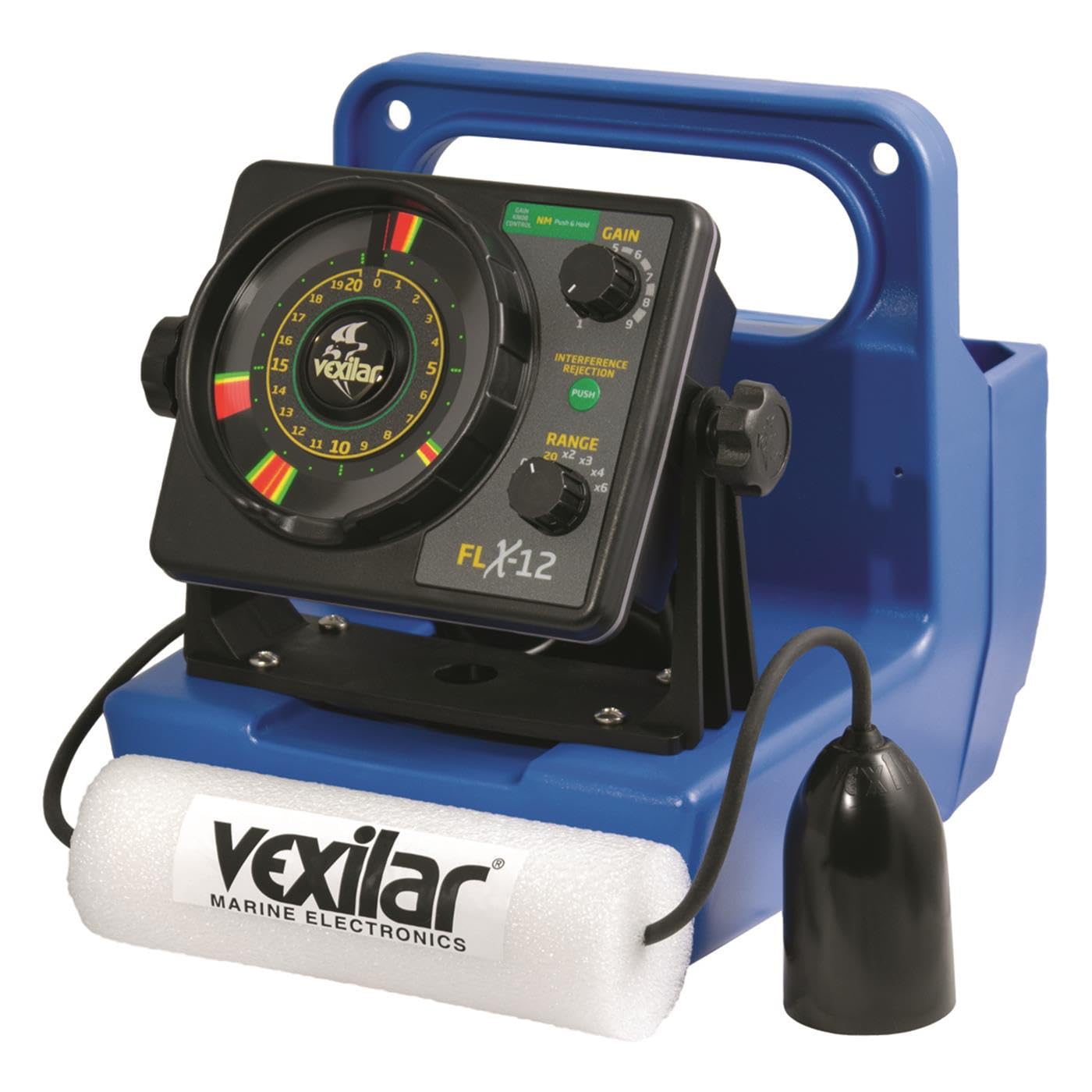
Vexilar FLX-12 Genz Pack

87 /100
Angler Score Excellent

Key details

Ice-ducer
12 degrees
Max Depth
120 ft
Night Mode
Yes
Low Power Mode
Yes
Check Details on Amazon

Shallow water is where flashers fall apart. In five or six feet a normal gain setting paints the whole column solid and you cannot tell a weed from a perch. The FLX-12's low-power mode cuts the output so that skinny column stays readable, and its 12-degree Ice-Ducer keeps the footprint tight enough that what you see is what is under the hole.

Five depth ranges to 120 feet let you pick the slice you are actually fishing instead of squinting at a compressed dial, and a night mode dims the LED for pre-dawn setups when your dial is the only light on the lake. It is a small piece of thinking that pays off in the hour before sunrise, which is when the crappie bite tends to happen anyway.

What you give up is coverage. Twelve degrees is a narrow look, and in 30 feet of water it is a small circle under your boots; if you roam deep basins, the FL-8se's 19-degree cone shows you more water for less money. This one is for the shallow flats, and it is the priciest flasher here — charge it fully before the season and confirm it takes a charge, because a pack that sat since March is the classic way a first trip goes sideways.

Pros

  • Low-power mode for very shallow water
  • Tight 12-degree Ice-Ducer
  • Night mode for low light
  • Five depth ranges to 120 feet

Cons

  • 12-degree cone shows a small patch in deep water
  • The most expensive flasher here
Our verdict

Our pick for shallow panfish water and pre-dawn starts, where the low-power mode and tight cone do work a wide-beam flasher cannot.

Check Latest Price
6

Packing Light

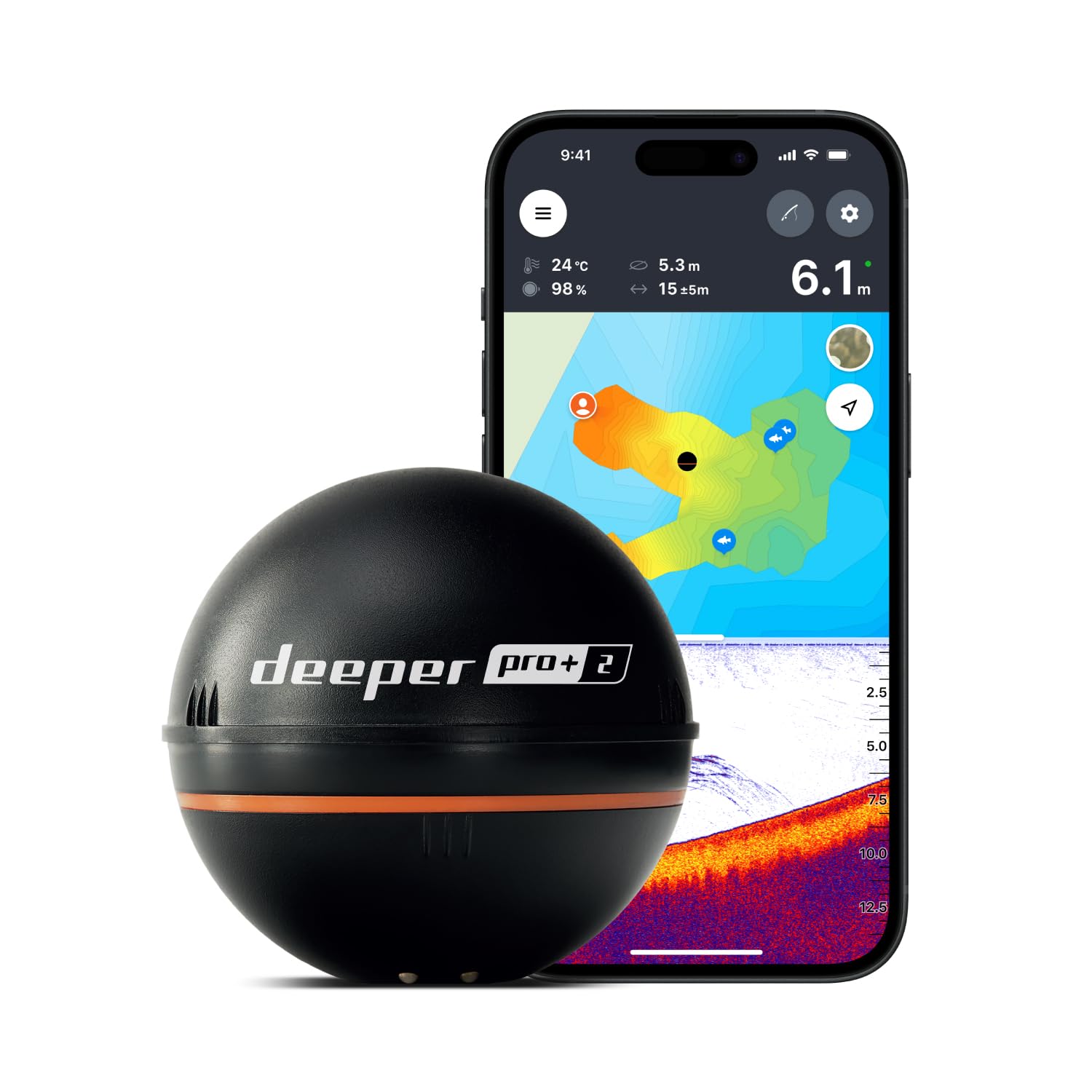
Deeper PRO+ 2 Sonar

83 /100
Angler Score Excellent

Key details

GPS
Built-in
Weight
3.2 oz
Max Depth
100 meters
Connection
Wi-Fi to phone app
Check Details on Amazon

The trade-off is the whole story. The Deeper weighs 3.2 ounces, fits in a jacket pocket, and has no screen at all — everything it sees lands on your phone over its own Wi-Fi. That is either the most convenient thing on the ice or the most irritating, and which one depends entirely on how your phone behaves at ten degrees.

For ice fishing you tie it off and lower it under the hole. It reads depth and fish, the built-in GPS plots where you are, and the Fish Deeper app builds maps you can return to. There is no cable to tangle and nothing to set down on the ice, which is why this is the unit that goes in a pocket when the sled is already full of shelter, auger, and cooler.

Plan around two things. The link between the puck and the phone is the weak point — it can drop when the two separate or the signal has to push through slush and ice — and your phone, not the Deeper, is what dies in the cold. A warm inside pocket and a small power bank cover most of that. The picture is also broad rather than surgical: it tells you what is down there, not precisely how a fish is responding to your jig.

Pros

  • 3.2 ounces and pocket-sized
  • Built-in GPS with app mapping
  • No cable, bag, or shuttle to carry
  • Cheapest way here to get GPS mapping

Cons

  • No screen of its own
  • Wi-Fi link can drop on the water
Our verdict

Buy it if you want sonar that disappears into a pocket and you are happy reading a phone; jigging anglers should take a flasher instead.

Check Latest Price
7

Occasional Ice Trips

LUCKY Portable Fish Finder

80 /100
Angler Score Excellent

Key details

Runtime
5 to 6 hours
Max Depth
328 ft
Beam Angle
45 degrees
Display Size
2.5 inches
Check Details on Amazon

The cheapest route onto the ice with sonar. The LUCKY is a handheld display with a cabled transducer you drop through the hole: a 2.5-inch screen showing depth, water temperature, and fish symbols, a 45-degree beam, and a depth ceiling of 328 feet. The whole thing weighs about as much as a water bottle and lives in a coat pocket between uses.

What it is good at is the two minutes before you commit. Drop the sensor, read the depth, see whether anything is suspended in the column, and move on — the setup is about as close to one button as sonar gets. On a lake you have never fished, that is worth real money, and it is the reason this stays in the bag as a second unit even when a flasher is along.

What it is not is a jigging tool. There is no flasher dial, so you get fish symbols rather than a live mark climbing to your lure, and the readings are coarse enough that structure and fish can blur into each other. Treat the water resistance as splash protection too — the display is the part that does not want to go in the hole, so keep it off the slush.

Pros

  • Least expensive unit here
  • Pocketable 2.5-inch handheld
  • 45-degree beam and 328-foot depth
  • Almost no menus to work through

Cons

  • No flasher view for watching a jig
  • Five to six hours of runtime per charge
Our verdict

It is the pick if you want a cheap depth and fish check before you set up, and you are not expecting to jig off the screen.

Check Latest Price

How We Tested Ice Fishing Fish Finders

We started by gathering every finder sold as an ice-fishing setup: traditional flashers, sonar and GPS combos built into a shuttle or pack, and castable pucks that work open water in November and a drilled hole in January. Anything that needed a separate case, battery, and transducer before it could actually fish got flagged, because those add-ons change the real price of the thing. That narrowed the field to 11 units, which we fished from first ice through late ice.

Every unit went out on the same rotation: a pre-dawn drag to the spot, four to six hours of jigging, and at least one night session in a pop-up. We charged each battery to full and logged the hours it ran before the low-voltage warning, and noted how the screen looked at that point, since a display that grays out in flat light is useless even with charge left. Screens were read at arm's length in single-digit temperatures, with a note on whether we could separate our jig from a fish holding two inches off bottom. Packed kits got weighed, then timed from bag to fishing with gloves on.

Accuracy was checked the blunt way: we dropped a weighted line to the mud and compared it to what the screen claimed, then fished two units side by side to see which one got rattled by interference. We marked waypoints on the GPS units and came back a week later to see how close the arrow walked us to the hole, including on a low, snow-heavy sky. Fish tracking was judged by jigging a known lure and watching whether the unit showed a fish rise to it or lost the mark when fish hugged bottom. Castable units got paired to a phone on the ice, with a note on how long the connection held and whether maps had to be downloaded before we left the truck. And we counted what came in the box, because a unit that needs a case, charger, and mount bought separately rarely turns out to be the bargain it looked like online.

How to Choose an Ice Fishing Fish Finder

Flasher Dial or Scrolling Sonar

A flasher shows one instant, repeated: bottom, your jig, and anything swimming up to it all in the same live frame. A scrolling sonar screen keeps a few seconds of history, which is useful when you are moving and less useful when you are watching a perch stare at a bait. If you jig, buy for the flasher view — either a dedicated dial like the two Vexilars or the flasher mode built into the Garmin units.

If you want one screen for July and January, a combo unit earns its keep. Just know that you are buying a compromise: the Garmin bundles do both jobs well, but neither one is as single-minded as a dial that does nothing else.

The Transducer and the Cone Angle

The transducer decides what the screen is even allowed to show. An ice transducer hangs level in the hole and gives a clean vertical read; a transom transducer with a foam float will work, but it hangs at whatever angle the float settles into. Cone angle is the other half of the equation: 19 degrees covers a wide column and suits 10 to 30 feet, a 12-degree cone is tighter and keeps shallow, snaggy water legible, and a dual-beam lets you switch between the two.

The trap is assuming wider is always better. A wide cone in six feet of water is looking at a lot of nothing, and a narrow cone in 35 feet is a dinner plate under the hole. Match the angle to your usual depth and you will see more fish, not more screen.

Screen, Battery, and the Cold

Cold attacks both halves of these units. Batteries lose usable capacity as the temperature drops, so the runtime on the box is closer to a summer figure than a January one — carry a charged spare or a power bank on a long day and charge at room temperature. Screens behave the same way, and a large color display that looks wonderful in the shanty can go dim and slow in serious cold.

A 2.6-inch flasher dial draws very little and stays readable in flat sun; a 5-inch color screen gives you more to look at and asks more of the battery. Buy the display that matches how you fish rather than the biggest one on the shelf.

Packability and What Is Actually in the Box

Count the box before you commit. Some of these are complete bundles — head unit, transducer, battery, charger, and bag — and some are a head unit you would still need to power and mount. The Garmin kits arrive ready to fish; the Humminbird ships as a shuttle with a 9Ah battery inside, which is a different carrying proposition entirely.

Portable covers everything here from a 3-ounce castable sonar to a shoulder bag with a battery in it, so measure the thing against your sled and the walk out, not against the word on the listing.

Frequently Asked Questions

Final Verdict

Start with the Garmin Striker Plus 4 Ice Bundle. The ice transducer is the part that makes a hard-water unit feel purpose-built rather than adapted, and the mapping means the hump you find this season is still on the screen next season.

If that is more than you want to spend, the Striker 4 portable kit is the same idea with a smaller screen and a boat-friendly transducer. And if you only ever want a dial and a jig, the Vexilar FL-8se is the simpler, cheaper answer for the water most of us actually fish.