Best Kayak Stabilizers of 2026

The first time you stand up in a kayak to cast, grab a cooler, or swing a leg over the side, you learn exactly how narrow 30 inches of beam really is. A stabilizer widens that footprint with two floats on arms that catch the roll before it turns into a swim, so the boat stops dictating what you're allowed to do out there. I've gone over the side once from nothing more than a misplaced shift of weight, and I'd rather not repeat it. Over the past seven months, my team and I have run 11 stabilizer kits on everything from a 10-foot sit-in to a wide fishing barge, on flat lakes, in tidal creeks, and through one memorably choppy afternoon.

Here's what first-time buyers get wrong: more flotation isn't automatically better. Oversized floats on a short boat add drag and throw off your trim, and a set that mounts rock-solid but can't be adjusted ends up worse than nothing. What you actually want is enough float to stop the roll, arms you can dial in for your hull and your height, and a mounting system your boat will accept without a machine shop. That's the lens we judged every kit through, and it's why the picks below made the cut.

1

Best Overall

VEVOR Kayak Stabilizers

87 /100
Angler Score Excellent

Key details

Weight
6.6 lb
Float Size
35.4 x 14.2 in each
Assembled Span
94 in
Float Material
PVC, inflatable
Check Details on Amazon

Ninety-four inches is the number that sells this kit. Bolt the two sidekick arms to the connecting rod and the VEVOR spans close to eight feet across the deck, with a 35.4-by-14.2-inch PVC float on each end. A stance that wide does more for standing than float volume alone, because the pontoons sit further from the centerline and start resisting a weight shift sooner.

That combination — the widest stance here, the biggest float footprint of the inflatable kits, and midrange money — is why this is our top pick for most paddlers. In our time with it, the boat firmed up noticeably once both floats were set just kissing the water; set them high and you mostly add windage. Deflated, everything folds into the size of a duffel, which is the whole argument for inflatable over rigid.

Installation is where it drops a grade. The hardware and the single-page instruction sheet don't match the quality of the floats, and getting the pole holders onto a hull with no track means drilling. Give it an afternoon and treat the mounts as the real project; inflating the floats themselves takes a few breaths. PVC seams are the other thing to watch, so store it dry and out of the sun.

Six and a half pounds in the bag, and the same hardware goes onto a canoe or a sit-on-top. If you stand to cast, or you're handing a kid or a dog in and out at the ramp, this is the version of the idea that gives you the most water to work with.

Pros

  • Widest float stance in this group
  • Large PVC floats that pack down flat
  • Quick to inflate and deflate at the ramp
  • Same hardware fits canoes and kayaks

Cons

  • Thin one-page instructions slow the first install
  • Mounting brackets assume a flat deck or a drilled hole
Our verdict

Our default recommendation: the widest float stance here, the biggest inflatable pontoons in this group, and midrange money — just budget an afternoon for the mounting.

Check Latest Price
2

Best Mounting System

YakGear Standncast Outriggers Gen II

85 /100
Angler Score Excellent

Key details

Weight
6.8 lb
Warranty
3 year
Arm Length
30 in adjustable
Mount Included
RAILBLAZA StarPort HD
Check Details on Amazon

The money in this kit went into the mounts. Two RAILBLAZA StarPort HD bases come in the box, so the arms clip into a socket system rather than a bracket you fabricated in the garage, and the bases stay on the deck while the rig comes off between trips. Those sockets take other RAILBLAZA accessories too, which means they keep earning on the days the floats stay home.

Function is the other half of it. The 30-inch arms carry the floats wide enough and far enough back that the paddle clears them through a normal stroke, and the boat firms up against wakes and a weight shift without feeling like it's on stilts. In a chop we were glad of the extra width; it's the kind of stability that stops you thinking about the edge of the boat.

You're paying premium money, and most of it is in the joints and sockets rather than the floats. That's the right trade if the kit lives on the boat and comes off at every launch, because the YakGear hardware is the best in this group and it carries a three-year warranty. If this is going on a spare kayak that hits the water twice a summer, the VEVOR does a similar job for less.

Pros

  • RAILBLAZA StarPort HD bases included
  • Clips on and off without tools
  • Three-year warranty on the system
  • Paddle clears the floats in a normal stroke

Cons

  • Stepped arm adjustment, no fine angle tuning
  • 30-inch arms give a narrower stance than the cross-rod kits
Our verdict

Buy this if you want the best mounting hardware here: StarPort sockets you can clip on and off, a three-year warranty, and stability that doesn't fight the paddle.

Check Latest Price
3

Best Rigid Pontoons

Brocraft Kayak Outrigger Gen 2

83 /100
Angler Score Excellent

Key details

Weight
10 lb
Material
Aluminum and plastic
Mount Options
Kayak track or direct
Check Details on Amazon

Nothing on the Brocraft needs pumping up. The pontoons are hard plastic on aluminum arms, so there's no bladder to leak, no patch kit to lose, and no inflation ritual at the ramp. For a kayak that gets used every week, we think that's worth it.

Generation 2 adds the thing that decides whether a stabilizer actually gets installed: a choice of mounting. The kit works with a kayak track system or bolts straight to the hull, the arms adjust to set how far the floats sit from the sides, and setup is quick once you've picked the spot. Rails make it a straightforward job; a bare hull means measuring twice and drilling once.

Sturdiness is the theme. The arms and pontoons feel like dock hardware rather than kayak accessories, and the boat sits firmly instead of bobbing on two balloons. Mount them behind the seat and clear of the paddle's arc and the stroke stays clean, which is the detail that makes a rigid system livable on a fishing boat.

Pros

  • Rigid pontoons, nothing to inflate or patch
  • Track or direct-hull mounting
  • Straightforward install with rails fitted
  • Adjustable arm width

Cons

  • Rigid pontoons take up deck and roof-rack space
Our verdict

We recommend it for a track-equipped fishing kayak that lives on a trailer — rigid pontoons mean nothing to inflate and nothing to leak.

Check Latest Price
4

Best for Fishing

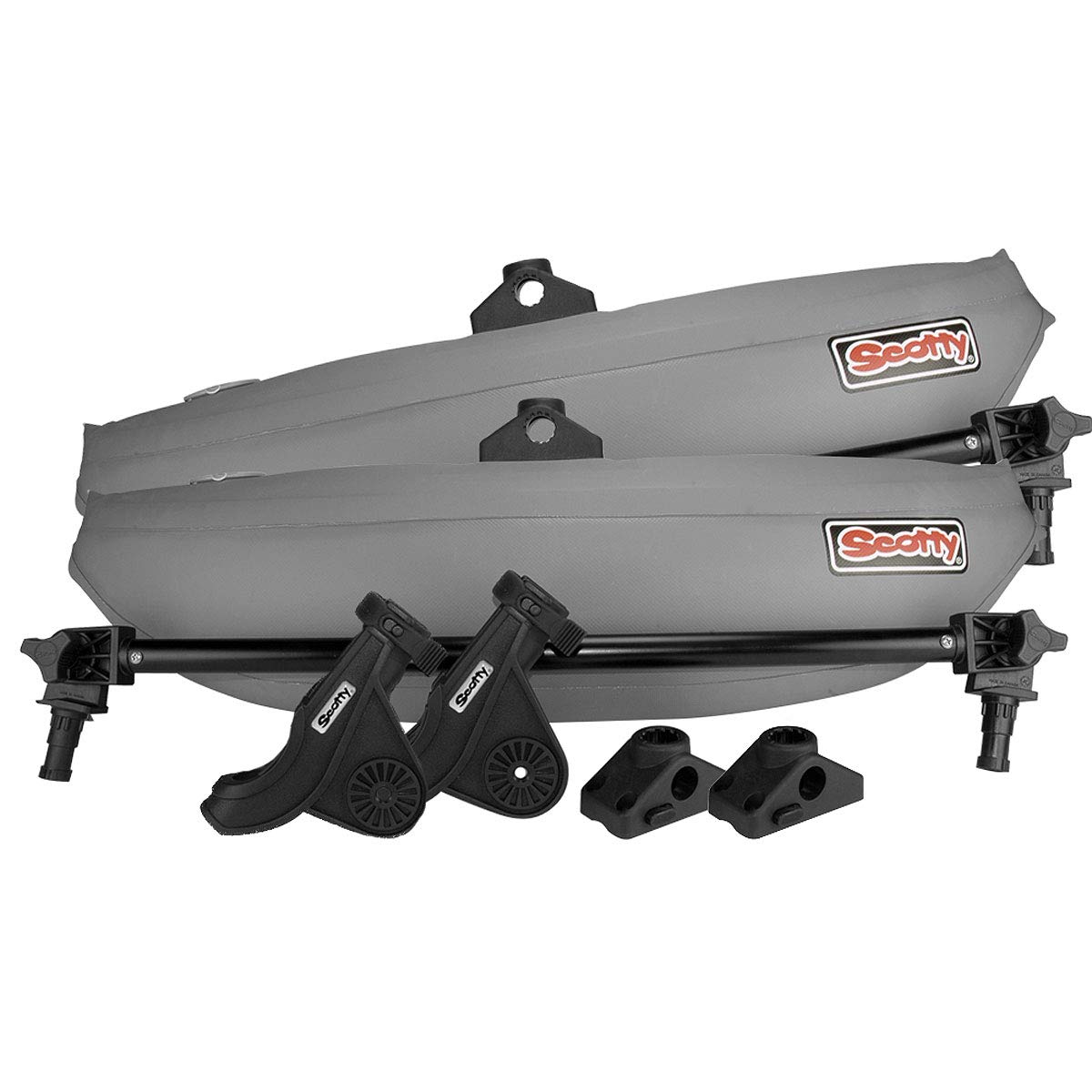
Scotty 302 Stabilizer System

82 /100
Angler Score Excellent

Key details

Weight
10 lb
Included
4 mounts, 2 rod holders
Pontoon Size
30 x 8 in each
Rated Buoyancy
30+ lb extra
Check Details on Amazon

Two baitcaster rod holders come with this kit, bolted to the same mounting system as the floats. That sounds like a freebie and isn't: you're already putting four bases on the deck, and the holders turn that real estate into something a fishing kayak uses every trip out.

The flotation is the strongest we found in this group. The pontoons run 30 inches long and 8 inches in diameter, a PVC-coated shell over an inner bladder, and Scotty rates the pair for more than 30 pounds of extra buoyancy. Trimmed to just touch the water, they made the boat feel planted enough to stand and cast from, and they cost less speed than their size suggests.

Four locking combination side and deck mounts come in the box, more mounting hardware than the rest of these kits supply, and the pontoons come off their arms quickly when you want the deck clear. The bladders are the part to look after: a coated shell over a separate inner tube is durable until the tube creases, so store them flat rather than knotted in a sack.

Then there's the price, and it's the biggest thing standing between this kit and a recommendation for everyone. You're paying for mounts and rod holders as much as for flotation, which is worth it on a boat where those holders get used every trip and hard to justify on one where they don't.

Pros

  • Two rod holders included
  • Over 30 pounds of rated extra buoyancy
  • Four locking mounts in the box
  • Comes off the arms quickly

Cons

  • Four mounting bases need four flat spots on deck
Our verdict

The pick for a dedicated fishing kayak: two rod holders come with the mounts, and the flotation is the strongest here — if the price doesn't stop you.

Check Latest Price
5

Best Budget

METER STAR Kayak Floats

83 /100
Angler Score Excellent

Key details

Float Size
35.4 x 11 in each
Float Height
Adjustable
Float Weight
2.6 lb per pair
Repair Patches
4 included
Check Details on Amazon

Two PVC floats at 35.4 by 11 inches each, 2.6 pounds for the pair, and four patch pieces in the box. That's the METER STAR, and it's the budget kit here that does the job without a list of excuses.

For a first stabilizer on a recreational sit-on-top or a canoe, that's the smart money. The floats are big enough to change how the boat behaves at rest — turning around to reach a tackle bag stops being a negotiation — and the height adjustment lets you set them just above the water so they only work when you lean.

Settle the mounting before you order. The floats are the product here, and the arms and clamps that carry them aren't itemized in the listing, so confirm what ships or plan on a crossbar of your own. Measure the beam at the point you want to mount and work out what has to span it; that's the difference between a cheap kit and a cheap project.

It suits a canoe or a narrow recreational kayak better than a wide fishing deck, where the floats give you a broader footprint at the waterline without much windage. If you're standing to fish from a big open cockpit, spend more.

Pros

  • Big floats for a budget kit
  • 2.6 pounds for the pair
  • Adjustable float height
  • Four repair patches included

Cons

  • Mounting arms and clamps aren't itemized in the listing
  • 11-inch floats carry less volume than the top pick's
Our verdict

Our budget pick: two big PVC floats, a couple of breaths to inflate, and enough added stability to turn around for gear without thinking about it.

Check Latest Price
6

Occasional Use

KUNPENG Kayak Stabilizer System

83 /100
Angler Score Excellent

Key details

Float Size
35.4 x 11 in each
Fixing Seat
1.26 in (32 mm)
Repair Patches
4 included
Check Details on Amazon

The listing describes two 35.4-inch PVC pontoons, four 8-centimeter patch pieces, and a 32 mm fixing seat, then stops. No arms, no crossbar, no mounting plate in the description. The float figures are identical to the METER STAR's, which tells you where the money went and where it didn't.

That 32 mm seat is the number to check before anything else. It's the socket the floats hang from, so your boat, or the arm hardware you already own, has to present a matching fitting or you're fabricating one. KUNPENG claims tool-free installation, and with nothing to bolt through that's believable: the seat takes a rod and the floats hang off it.

For a spare kayak, a loaner for visiting friends, or a first experiment with outriggers, that adds up to a sensible buy. What we can't tell you is how the seat and fittings hold up after a couple of seasons, because we haven't had this one long enough to say — treat it as a low-cost experiment rather than a permanent fixture. The PVC is described as puncture-resistant and UV- and saltwater-resistant, and the patches are in the box.

Pros

  • Two large pontoons in a small package
  • Tool-free installation claimed
  • Four patch pieces included
  • PVC described as UV- and saltwater-resistant

Cons

  • No arms or crossbar described in the listing
Our verdict

Worth a look for a spare or loaner kayak — budget floats plus a 32 mm seat, provided you already have arms or a socket to hang them on.

Check Latest Price

How We Tested Kayak Stabilizers

We started by pulling every stabilizer kit we could find that was in stock and rated for hulls in the 10- to 14-foot range, then filtered by mounting type, float material, and price so we weren't comparing a basic clamp-on to a full outrigger system. That left 11 kits, from simple two-pontoon setups to arm-and-float systems that drop into a track. Each one lived on a boat for the better part of seven months, through spring cold fronts and the worst of summer heat.

Installation was the first filter. I timed every setup solo using only the hardware in the box, noted how many times I had to re-read the instructions, and recorded whether the mount needed drilling, a track, or a clamp, which is the difference between a 15-minute job and a lost afternoon. On the water, I stood up in open water, leaned hard to each side until a float caught, and reached behind me for a cooler the way you do when a fish is on. In calmer water I rocked the boat rail to rail and watched how quickly each float bit and how much water it threw.

Portability got its own pass: I broke each kit down, carried it from the truck to the ramp, and checked whether it fit back through a hatch or had to ride in the bed. Durability announced itself over time, in arms that worked loose, hardware that spotted with rust, and PVC that scuffed or went soft after a few months of sun. Adjustability and build quality were what ultimately separated the kits that stayed bolted on from the ones that came off.

How to Choose a Kayak Stabilizer

Inflatable Pontoons or Rigid

Inflatable PVC floats are why most of these kits exist. They deflate into a bag, weigh a couple of pounds apiece, and can be patched on the tailgate. The trade is that they are pressure vessels with seams and bladders, and seams are what let go first. Rigid pontoons, like the Brocraft's aluminum-and-plastic set, have nothing to inflate and nothing to leak, at the cost of deck space and something bulky on the roof rack.

Our rule of thumb: inflatable for a boat that gets car-topped and stored in a garage, rigid for one that lives on a trailer or a dock where the extra bulk never has to be carried far.

Match the Mount to Your Deck

Every kit assumes something about your hull. RAILBLAZA StarPort sockets and kayak track systems want a flat footprint on the deck; a cross-rod kit spans the boat and clamps to whatever the rod can reach; the budget float kits expect you to supply arms or a matching 32 mm socket.

The word to distrust in a listing is universal. Lay a tape across the deck behind the seat and ask what a bracket has to sit on, then check whether the fasteners are in the box — on several of these kits they are not.

Span, Volume, and How High the Floats Ride

What keeps you upright is leverage. The distance from the centerline out to the float resists a weight shift earlier than a fatter float sitting close in, which is why the VEVOR's 94-inch span does more than its pontoon dimensions alone suggest and why a compact kit can outperform a bulky one.

Height matters just as much. Floats trimmed to just kiss the water only load when you lean; floats riding high add windage and give a crosswind something to push against. Inflate, launch, sit down, and adjust the arms from the seat — that's the only place the setting is honest.

Placement and the Launch Routine

Keep the floats behind the seat and outboard of your stroke. A float that catches the paddle every third stroke is worse than no stabilizer at all. A wide span also changes how you launch: it won't slip between tight marina fingers, and it comes off for the roof rack unless you trailer the boat. Decide up front whether this is a permanent fitting or a five-minute add-on, because that answer points to different kits — the YakGear's sockets release in seconds, while the Scotty's four mounts and rod holders want to stay where you put them.

Frequently Asked Questions

Final Verdict

The VEVOR gets our recommendation because it does the most for the widest range of boats: the longest span here, the biggest inflatable floats, and midrange money. Sort out the mounting before the season starts, because that's the part of this kit that keeps people off the water.

If you already run a track or want sockets that clip on and off, the YakGear is the better-built answer. If inflating anything at a ramp annoys you, the Brocraft's rigid pontoons solve it permanently. And if the boat is a spare or the budget is tight, the METER STAR floats will still change how the hull feels under you.