Best Livewell Pumps of 2026

Bait doesn't die of old age in a livewell — it dies when the water stops moving. A pump that quits at first light, or one that moves half the water its box promises, costs you a day of fishing and a tank of dead shiners. I've had both happen. What a good livewell pump actually fixes is quieter than that: it keeps bait lively from the ramp to the last cast without you thinking about it, which means the one you install has to work with the hull you already have and the wiring you already ran.

We've just spent a full boating season with 12 pumps, and the pattern is that the specs on the box tell you very little about which ones hold up. A rated 800 gallons per hour means little once a pump has to push water up three feet of hose, and a long inlet only helps if it clears your transom. Thread size is where installations go sideways most often, so measure before you order. The picks below ran quiet, moved the water they claimed, and came apart for cleaning without a fight — and none of them needed replacing mid-season.

1

Best Overall

Attwood Tsunami T800

93 /100
Angler Score Outstanding

Key details

Motor
Locking cartridge
Outlet
Threaded ¾ in
Max Head
3.3 ft
Flow Rate
800 GPH at 13.6V (750 GPH at 12V)
Check Details on Amazon

The part of the Tsunami T800 we keep coming back to is the motor cartridge. It locks into the housing while the pump runs and twists out for cleaning or replacement, leaving the base plumbed into the boat — no hose clamps in a blind corner, no sealant to redo, no hauling the boat. On a thru-hull aerator, that is the single most useful thing a manufacturer can give you.

The rest is honest workhorse material. Attwood rates it at 800 GPH at the 13.6-volt design voltage and 750 GPH at a nominal 12 volts, with a 3½-inch inlet, a threaded ¾-inch outlet, and a 29-inch wire lead that reaches most factory harnesses without a splice. There's also a 90° adapter in the box, which matters more than it sounds: it's the fitting people buy separately and then discover they didn't need.

Motor life is where this pump gets murky. Some of them run for years; others start squealing after a few outings and lock up soon after. The squeal is the tell — once the bearing starts singing, that cartridge is on its way out. The saving grace is that swapping it takes minutes and touches nothing else, so a failure costs you a cartridge rather than a day of boat work.

Head height is the limit to know about: 3.3 feet of maximum lift is fine for a deck-level well and not enough for a long, high run of hose. Past that, this is the pump we hand to most people — the most established aerator design in this group, a flow rate that suits a standard bass-boat livewell, and service access that doesn't require a contortionist.

Pros

  • 800 GPH with a locking, removable motor cartridge
  • Includes a 90° outlet adapter in the box
  • Most established aerator design in this group
  • 29-inch wire lead reaches most harnesses

Cons

  • 3.3 ft maximum head limits long hose runs
Our verdict

We recommend the Tsunami T800 as the default: 800 GPH, a cartridge motor that comes out without touching the plumbing, and a 90° adapter in the box for hull-side runs.

Check Latest Price
2

Best Value

SEAFLO 04 Series 800 GPH

88 /100
Angler Score Excellent

Key details

Outlet
¾ in NPT
Max Head
12 ft
Warranty
4 years
Flow Rate
800 GPH
Check Details on Amazon

If the number you care about is flow per dollar, the SEAFLO 04 Series is the value pick here. It's a straight-intake 800 GPH pump with a replaceable cartridge motor and a four-year warranty — the longest stated coverage in this group, and worth something on a part that lives underwater.

We like it for a plain reason: it does the same job as the top pick for a lot less money, and the corrosion-resistant housing shrugs off saltwater duty. What it doesn't buy you is a frictionless install. The intake thread runs slightly larger than a standard ¾-inch fitting, so it won't screw straight into every thru-hull valve, and an adapter between pump and valve is the usual fix.

Everything else is quiet, efficient work: 4.0 amps at 12 volts, 12 feet of maximum head, and a three-foot wire lead. If your valve is brass NPT, order the adapter with the pump — that one fitting is the difference between an evening's work and a second order. The head rating is the highest of the 800s here, so this is also the one for an outlet that sits well above the waterline.

Pros

  • 800 GPH flow at the budget end of this group
  • Four-year warranty, the longest stated here
  • 12 ft of head handles high outlet runs
  • Replaceable cartridge motor

Cons

  • Intake thread needs an adapter on some ¾ in valves
Our verdict

Buy the SEAFLO 04 if you want 800 GPH for the least money of any full-size pump here, and measure your thru-hull thread before it ships.

Check Latest Price
3

Best for Mid-Trip Motor Swaps

Rule 403FC Tournament

89 /100
Angler Score Excellent

Key details

Motor
Tool-free cartridge
Pickup
Tapered ¾ in NPT
Warranty
3 years
Flow Rate
800 GPH
Check Details on Amazon

The argument for the Rule 403FC turns up on a bad afternoon: a motor quits with a well full of bait, and you have to decide whether to run in or write the day off. Rule's cartridge pulls out by hand, no tools, while the fittings and hose stay exactly where they are. Swap it on the water and keep fishing.

Otherwise the numbers are solid. 800 GPH, a tapered ¾-inch NPT pickup tube built for thru-hull mounting, and a three-year warranty. The body is compact enough to go back into the hole the old pump came out of, which is not nothing: getting a seized pump out of a crowded bilge is usually harder than fitting the new one.

It's the most expensive 800 GPH pump here, and the premium only pays off if you'll actually use that no-tool cartridge — the boater who services their own gear, keeps a spare motor aboard, and fishes water where a dead aerator ends the trip. If you'll never pull the cartridge yourself, that premium buys you very little.

Pros

  • Cartridge pulls by hand without tools
  • Tapered ¾ in NPT pickup for thru-hull mounting
  • Three-year warranty on a wear part

Cons

  • Most expensive 800 GPH pump in this group
  • Tapered pickup suits thru-hull mounting only
Our verdict

The Rule earns its price for the boater who repairs their own gear: the motor pulls by hand on the water, and the three-year warranty covers the part most likely to fail.

Check Latest Price
4

Best for Small Livewells

Johnson 500 GPH Cartridge

87 /100
Angler Score Excellent

Key details

Motor
Replaceable cartridge
Voltage
12V DC
Flow Rate
500 GPH
Check Details on Amazon

Five hundred gallons an hour is well short of the 800 GPH pumps that dominate this guide, and for plenty of boats that's the right number. An oversized pump can push water in faster than the overflow drains it, and the surplus becomes spray and noise. Johnson's cartridge pump circulates a compact or shallow well without the drama.

It's also the least fussy pump here. The straight body measures about 4 by 6 by 10 inches, which drops into compartments the longer angled pumps won't, and the cartridge comes out with the housing and hose left in place. There's a limited warranty behind it and a simple design with very little to go wrong.

The trade-off is plain. It's the highest-priced pump in this group and it moves 500 gallons an hour, so you're paying for a compact, quiet, serviceable design rather than for flow. If your well runs 30 gallons or more, or your outlet sits high above the waterline, one of the 800s will serve you better.

Pros

  • 500 GPH suits small and shallow wells
  • Cartridge swap keeps the housing and hose
  • Compact straight body fits tight compartments

Cons

  • Highest price here for a 500 GPH pump
Our verdict

Choose the Johnson when 800 GPH is more than your well needs; it's the most compact, least fussy pump here, and you pay for that in flow.

Check Latest Price
5

Best for Tight Installations

Attwood Tsunami MK2

0 /100
Angler Score Fair

Key details

Inlet
360° rotatable elbow
Outlets
90° and straight
Warranty
3 years
Flow Rate
500 GPH
Check Details on Amazon

Attwood rebuilt the Tsunami around the install rather than the impeller. The MK2's inlet elbow rotates a full 360 degrees so you can aim it at the hull, the outlet arrives as both a 90-degree and a straight fitting, and the cartridge release is a one-hand button — no sealant, no tools.

That combination is worth real money on a boat where the pump lives in a pocket you can't get two hands into. We think it's the easiest of these to fit for the first time, and the three-year warranty backs the part you're most likely to need replaced. What it doesn't have is flow: 500 GPH, which suits a small-to-mid well rather than a tournament tank.

There's also less to go on. It's the newest design here by a wide margin, so long-term motor life is unproven in a way the older Tsunami's isn't. If you're replacing like for like in a tight compartment and 500 GPH is enough, the fit is worth the trade; if you need 800, the T800 is the same brand's answer.

Pros

  • 360° rotatable inlet fits awkward mounting angles
  • Tool-free cartridge release in tight spaces
  • 90° and straight outlets both included

Cons

  • 500 GPH limits it to smaller wells
  • Newest design here, so motor life is unproven
Our verdict

The Tsunami MK2 is the one to fit where access is tight: rotate the inlet to suit the hull, pop the cartridge out one-handed, skip the sealant.

Check Latest Price
6

Thick Transoms

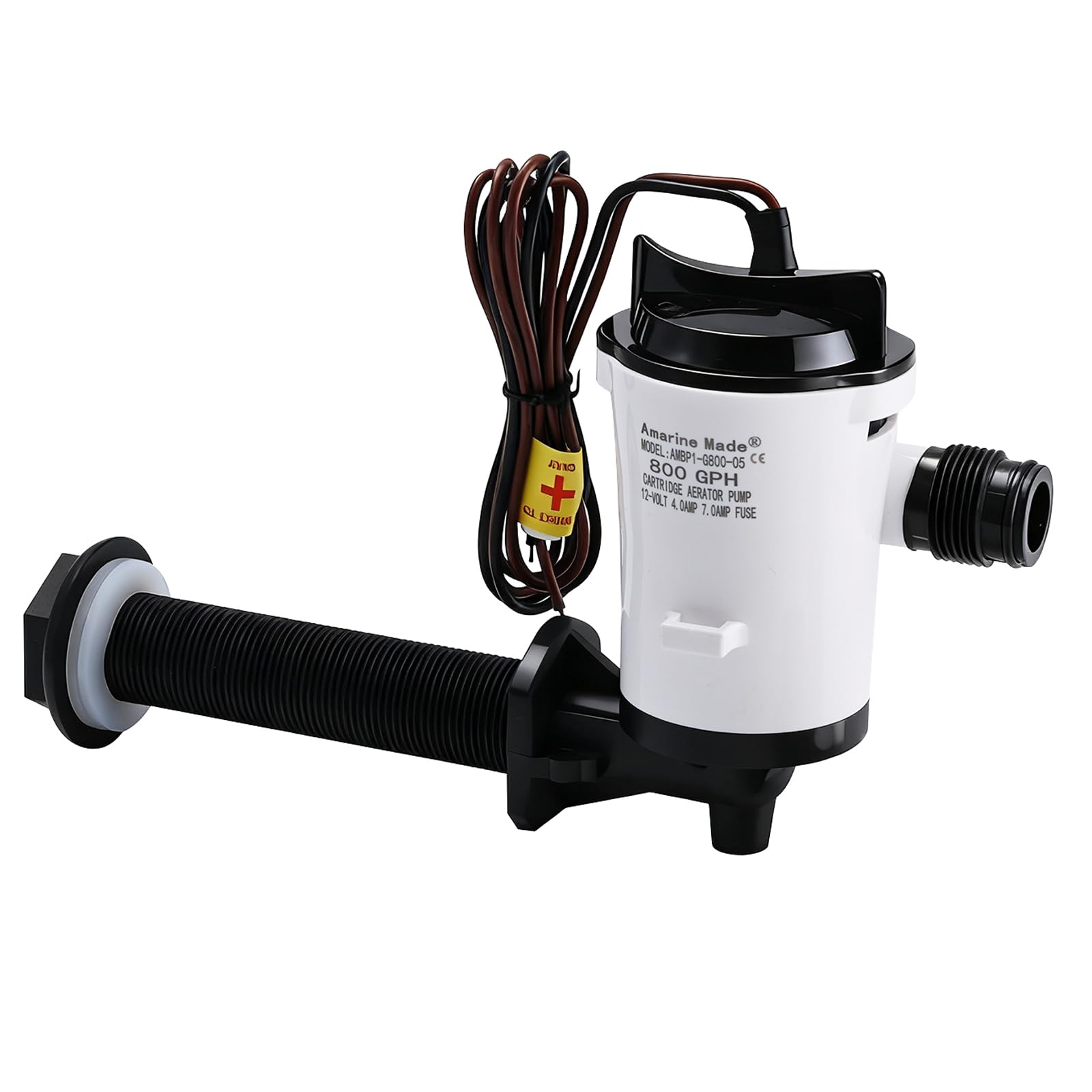
Amarine Made 800 GPH

86 /100
Angler Score Excellent

Key details

Intake
90° threaded, 125mm
Outlets
Straight and 90° tails
Max Head
3.5 m
Flow Rate
800 GPH
Check Details on Amazon

The Amarine's 90-degree threaded intake runs 125mm long, and that extra reach is the reason to pick it. On a thick transom, or in a compartment where the pump has to sit sideways, a short straight inlet won't pass through the hull and seat; this one will. The 2.7-inch-wide body slips into gaps the fuller pumps won't.

The rest is the familiar 800 GPH package: replaceable cartridge, anti-airlock fins, stainless shafts, 18-gauge tinned wire, and both straight and 90-degree outlet tails in the box, with 3.5 meters of rated lift. At the budget end of this group the money goes into the moulding rather than the paperwork — no warranty is stated — so buy it as a part you'll service yourself rather than one you'll claim on.

Pros

  • Long 90° intake reaches through thick transoms
  • 800 GPH with anti-airlock fins
  • Straight and 90° outlet tails included

Cons

  • 90° intake only, with no straight option
Our verdict

Amarine is the budget answer for a thick transom or cramped compartment, with a long 90° intake the rest of this group doesn't offer.

Check Latest Price
7

Budget Bait Pumps

Yaegoo 800 GPH

87 /100
Angler Score Excellent

Key details

Wire
16-gauge tinned
Intake
90° threaded, 125mm
Outlets
Straight and 90° tails
Flow Rate
800 GPH
Check Details on Amazon

Anti-airlock fins are the sort of detail nobody shops for until a pump cavitates at the ramp. The idea is simple enough: when the intake lifts out of the water for a moment, trapped air can stall the impeller, and the fins keep water moving through the housing so the pump picks its prime back up instead of humming uselessly.

Otherwise the Yaegoo is the standard 800 GPH cartridge pump — 90-degree threaded intake, straight and 90-degree outlet tails, a water-cooled motor on a stainless shaft, and 16-gauge tin-coated wire, a gauge heavier than one of the other budget pumps here. It's also the least expensive pump in this guide.

Which is how we treat it: as the spare. Keep one in the boat or the garage and a seized pump costs you an evening rather than a weekend. The plastic hose tails are the part to watch — check the straight fitting before you head out, and keep a spare tail in the toolbox next to the pump.

Pros

  • Cheapest 800 GPH pump in this group
  • Anti-airlock fins keep prime
  • 16-gauge tinned wire

Cons

  • Plastic hose tails are the weak point
Our verdict

Keep the Yaegoo as the spare: 800 GPH, anti-airlock fins, and the lowest price in this group, with hose tails worth treating gently.

Check Latest Price
8

Small Bait Tanks

Marine Metal Fish Saver FS-4

90 /100
Angler Score Outstanding

Key details

Mount
Bottom or side elbow
Filter
Foam debris filter
Flow Rate
6 GPM
Tank Size
Up to 30 gal
Check Details on Amazon

Not every bait tank has a thru-hull fitting behind it. The Fish Saver FS-4 is built for the other kind of livewell: a 30-gallon tank, a cooler conversion, a big bait bucket — anything where you'd rather drop a pump in and clip it to the side than drill the hull.

It mounts inside the well on an adjustable elbow that lets it sit on the bottom or the side, and a foam filter over the intake keeps scales and debris out of the impeller. Marine Metal rates it to aerate 30 gallons and claims 99.5 percent dissolved-oxygen saturation; at 6 gallons a minute it recirculates a small well briskly rather than filling anything.

What it isn't is a replacement for a thru-hull aerator. There's no ¾-inch outlet to plumb into a deck hose, no 800 GPH, and nothing here that fills a well from outside the boat. That's a different job, and it's the job everything else in this guide does.

For a kayak tank, a dock tank, or a cooler in the truck bed, though, it solves the problem without drilling anything. A pump you can clip in at the ramp and rinse at the end of the day beats a plumbed system you have to winterize — and for a bait bucket, that's most of the appeal.

Pros

  • Mounts inside wells with no thru-hull fitting
  • Foam intake filter keeps debris out
  • Adjustable elbow for bottom or side mounting

Cons

  • 6 GPM is modest for larger wells
  • No thru-hull plumbing option
Our verdict

For a bait bucket, cooler tank, or a well with no thru-hull fitting, the Fish Saver is the pump that fits — just don't expect it to fill a big livewell.

Check Latest Price

How We Tested Livewell Pumps on the Water

We started with about 30 models from the marine brands that turn up on tackle shop shelves and in owner forums, then narrowed by the numbers that decide whether a swap is a ten-minute job or an afternoon with a hole saw: inlet length and diameter, outlet thread, amp draw against a typical accessory circuit, and whether the motor cartridge comes out without pulling the thru-hull. That left 12 pumps, each getting a full season on a center console and on a 30-gallon bait tank at the dock.

Each pump was installed by one person with a wrench, and we timed it from the first turn to water flowing. We noted whether the existing hose barb threaded on by hand or needed an adapter, measured every inlet with a caliper against the opening already in the hull, and checked each outlet against a standard 3/4-inch fitting. Cartridges that swapped in place without unbolting the housing earned a mark in the plus column.

On the water, we timed how long each pump took to fill a marked tank, then repeated the run with three feet of head on the discharge to see how much of the rated 500 or 800 gallons per hour actually arrived. Pumps ran eight-hour days, and we counted bait at the end of every trip. Noise was judged from the helm at idle and at cruise — anything audible over the outboard got written down.

At the end of the season we pulled each one apart to look at impeller wear, corrosion on the housing, and salt creep around the cartridge seal. We also set what came in the box against the price — barb, fuse, screws, warranty — since a pump that needs fifteen dollars of fittings before it will run isn't the value it appears to be.

How to Choose a Livewell Pump

Match the flow to the well, then stop

An 800 GPH pump turns a standard bass-boat livewell over quickly, which is why it dominates this group. It is also more than a small tank needs: an oversized pump can push water in faster than the overflow drains it, and the surplus leaves as spray and noise. Below about 20 gallons, 500 GPH is plenty, and the Johnson is the quieter answer. Above that, buy the 800 and throttle the inflow at the aerator valve if the well starts to overflow.

Head height is the spec that gets skipped

Maximum head is how far above itself a pump can push water. The Attwood T800 lists 3.3 feet; the SEAFLO 04 lists 12. On a deck-level well with a short hose run, either works. If the outlet sits high on the console, or the hose takes a long detour around the tank, the low-head pump fills slowly or not at all. Measure the vertical rise from pump to outlet before you choose — that figure, not the gallon-per-hour rating, decides whether the installation works.

Threads are where installs go wrong

Marine fittings look standardized and aren't. The SEAFLO 04's intake runs slightly larger than a standard ¾-inch fitting and won't thread into every thru-hull valve; the Rule uses a tapered ¾-inch NPT pickup built for thru-hull work. Take your old pump's fitting with you when you shop, or test-fit an adapter before you commit. A 90-degree threaded intake suits a hull-side mount; a straight body suits a vertical bilge, so match the shape to the space you actually have.

Pay for the cartridge, not the badge

A cartridge motor locks into a base that stays plumbed into the boat. When the motor dies you release the cartridge, seat a new one, and every hose clamp stays exactly where it was. All but one of the pumps here work that way, and it is the feature worth paying for first — the alternative is cutting into a livewell hose in a bilge you can barely reach with both arms.

Noise, airlock, and where the pump sits

A pump that hums is normal; a pump that squeals is telling you the bearing is going, and cleaning won't bring it back. Most noise traces to air rather than the motor — an intake drawing partly air, or a hose run that traps a bubble. The anti-airlock fins on the Amarine and Yaegoo help here, and so does mounting the pump as low as the plumbing allows. Before you replace a noisy pump, check that the intake is fully submerged.

Frequently Asked Questions

Final Verdict

The Attwood Tsunami T800 is the pump we point most people to, because 800 GPH covers a standard bass-boat well and the motor comes out without disturbing a single hose clamp. If the budget is tighter, the SEAFLO 04 Series delivers the same flow and a four-year warranty — measure your valve thread first. And if your bait's survival depends on fixing the pump mid-run, the Rule's tool-free cartridge is worth the extra money.