
Best Outboard Motor Oil of 2026

An outboard is the priciest thing most of us will ever hang off a transom, and the oil you pour into it is the cheapest protection it gets. That's what makes the shelf so aggravating: two-stroke and four-stroke, mineral and synthetic, factory-branded jugs beside the store brands, and a spec line printed small enough that half of us just buy on price. Pick wrong and you're risking fouled plugs, sticky rings, and a warranty conversation nobody wants to have. The right jug is the one that actually matches what your engine's manual asks for, burns clean, and gets you to the end of the season without topping off every weekend.

Two-stroke smoke is where this started for me — a cold morning at the ramp, and the wrong mix leaves a blue haze hanging over the water and a sheen trailing the boat. Over the past five months, my team and I ran 14 oils through a full season of real use, from a tiller-steered skiff to a pontoon that mostly idles. The surprise was how little the label price predicted the outcome: the priciest jug wasn't automatically the cleanest, and the cheapest wasn't automatically a false economy. Here's what held up.

1

Best Overall

Quicksilver 25W-40 4-Stroke

96 /100
Angler Score Outstanding

Key details

Volume
1 gallon
Viscosity
25W-40
Engine Type
4-stroke
OEM Replacement For
Mercury 8M0078628
Check Details on Amazon

The number that decides this one is 25W-40, and a large share of four-stroke outboards and sterndrives specify exactly that. So this is the gallon we point most four-stroke buyers to first. It's Mercury's own oil, a direct replacement for Mercury part 8M0078628, which means a Mercury or MerCruiser engine gets the fill it was designed around, and Quicksilver lists it for other brands of four-stroke outboards as well.

What you get over a generic jug is heat and shear control. An outboard doesn't cruise at 2,000 rpm the way a car does; it holds 4,500 to 6,000 rpm for as long as the weather holds, and the viscosity modifiers in a marine oil exist to keep the film from thinning while it does. Then there's the corrosion package, which is the part that matters when the boat sits for five months with salt still on the block.

In use there's nothing to report, which is the report you want from oil. The gallon pours cleanly through a funnel, the grade is legible on the jug without reading glasses, and our four-stroke has run a season on it with steady pressure and a dipstick that hasn't darkened early between changes.

The one thing to get right is the number on the cap. This is 25W-40 and nothing else. If your manual calls for 10W-30 — plenty of four-strokes do — the Valvoline or the Yamalube on this list is the correct purchase instead. Viscosity isn't the part of this decision where anyone gets to have an opinion.

Pros

  • Mercury's own 25W-40 fill, not a lookalike
  • Viscosity modifiers for sustained high-rpm running
  • Corrosion and wear protection for saltwater boats

Cons

  • Only offered in 25W-40, so 10W-30 engines need another pick
Our verdict

For most four-stroke outboards and sterndrives, we buy this: OEM-spec protection, a fair price for a gallon, and no guesswork about what's in the jug.
Check Latest Price
2

Best Value 2-Stroke

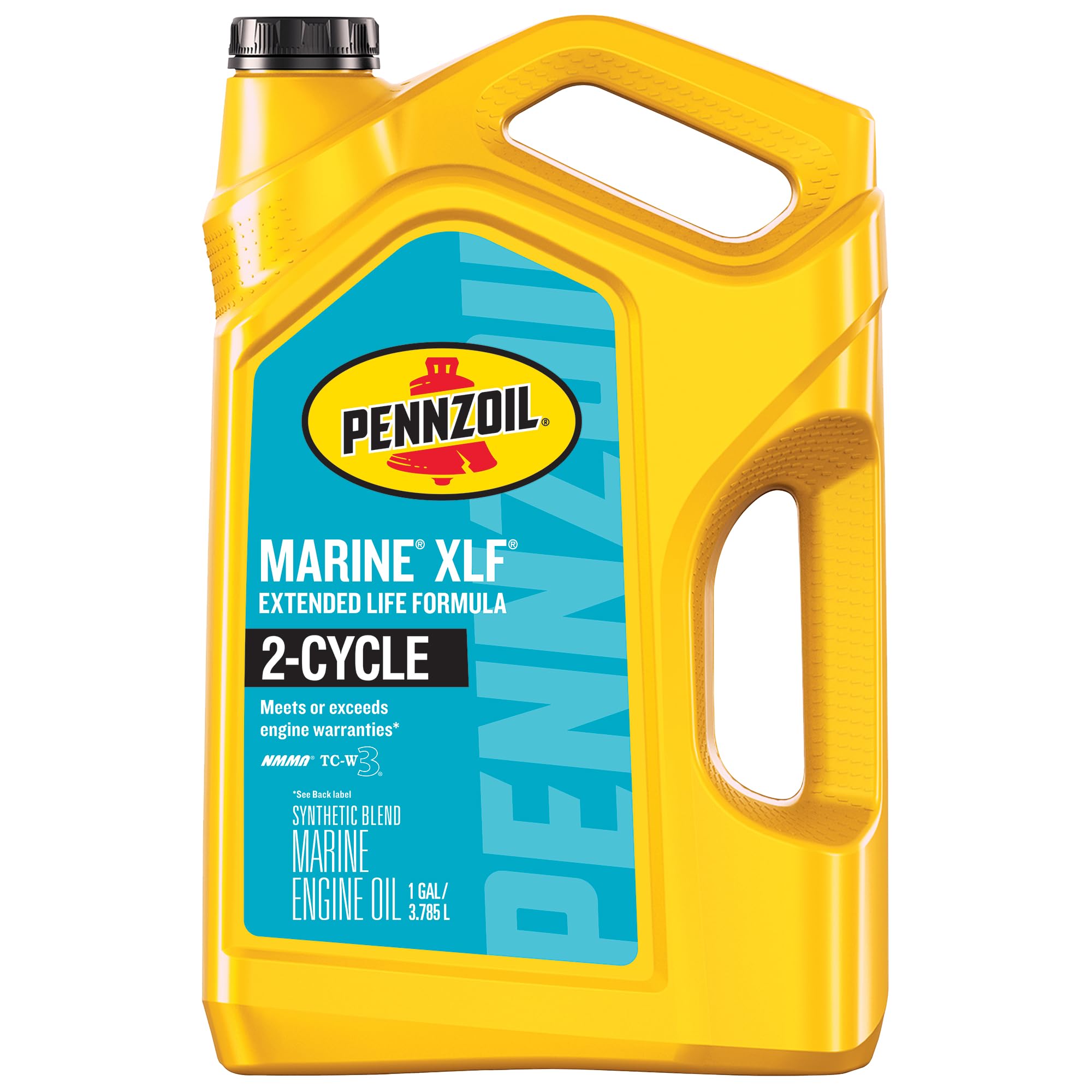
Pennzoil Marine XLF

96 /100
Angler Score Outstanding

Key details

Volume
1 gallon
Engine Type
2-stroke
Formulation
Synthetic blend
Check Details on Amazon

The cheapest gallon here is also the one we put in an older carbureted two-stroke. Pennzoil builds XLF as a synthetic blend aimed at engines that are seasoned — the company's own word — while still listing it for new high-displacement and direct-injection outboards, so it covers more of the two-stroke world than the price suggests.

The blue dye is the detail we didn't expect to care about. Two-stroke oil goes into a fuel can rather than a crankcase, and a tint you can see means you can tell at a glance whether the can in your hand is mixed or straight gas. If you've ever stood on a dock trying to remember which can you filled an hour ago, you know why we keep coming back to that.

The rest of the formulation targets what actually kills old two-strokes: piston scuffing, and gel forming when water or ethanol-blended fuel sits in the system. We've run it as premix and through an injection system, and it behaved the same either way — no fouling, and cold-start smoke that clears the way it should.

Pros

  • Lowest price of any gallon in this group
  • Blue dye confirms a fuel can is mixed
  • Anti-gel additives resist water contamination
  • Works as premix or through oil injection

Cons

  • Two-stroke only, with no four-stroke application
Our verdict

If you run a two-stroke, especially an older carbureted one, this is the gallon we buy: the lowest price here and a blend that keeps smoke and deposits down.

Check Latest Price
3

Best Full Synthetic

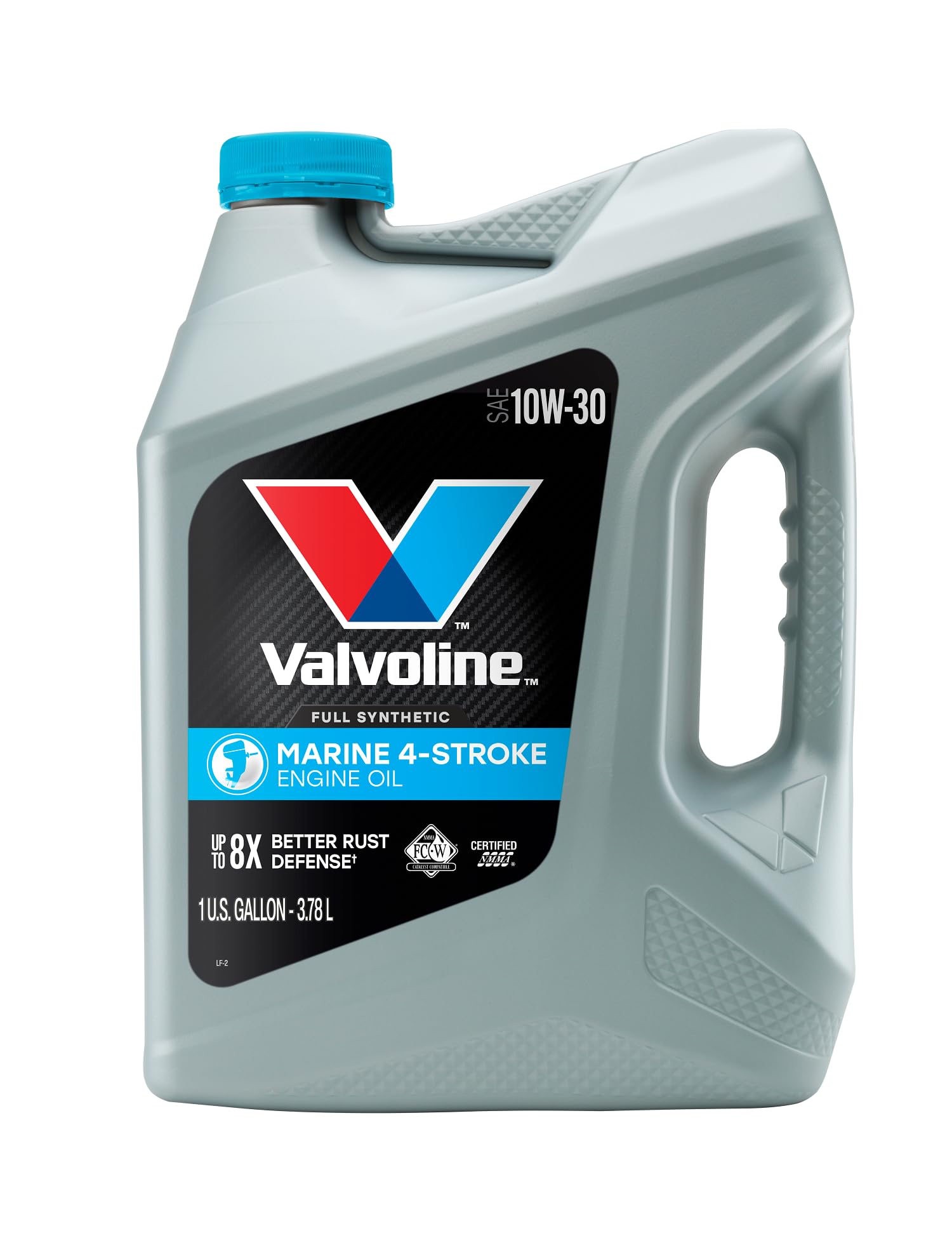
Valvoline 4-Stroke Full Synthetic

94 /100
Angler Score Outstanding

Key details

Volume
1 gallon
Viscosity
10W-30
Engine Type
4-stroke
Formulation
Full synthetic
Check Details on Amazon

An outboard that sits from November to April is a corrosion problem before it's a lubrication problem, and this is the only full-synthetic four-stroke oil in the group. That combination is why we pay for it on a boat that spends more of its life on a trailer than in the water.

The surprise is the price. A full synthetic that comes in below both of the OEM-branded four-stroke oils here is a genuine value, and full synthetic is the formulation that holds its viscosity best when an engine is run hard and put away hot.

Valvoline's numbers — more wear protection, several times the rust defense — are the company's own, so treat the multiples as marketing and the chemistry as the reason to buy. A synthetic base gives the corrosion inhibitors a cleaner surface to work on and resists breakdown at the temperatures a loaded marine engine sees.

The catch is the grade. This jug is 10W-30, which covers a lot of four-stroke outboards and none of the ones that want 25W-40. Ours has been in a 10W-30 engine since spring, holding its level between changes and staying clean enough to read the dipstick through.

Pros

  • Full synthetic for less than the OEM-branded oils
  • Rust protection aimed at engines stored wet
  • Holds viscosity under heat and hard running

Cons

  • Sold in 10W-30 only; 25W-40 engines need another pick
Our verdict

For a 10W-30 four-stroke that sits out the winter, we pick this over the OEM oils: full-synthetic protection for less than either branded gallon.

Check Latest Price
4

Best for Yamaha 4-Strokes

Yamalube 4M

95 /100
Angler Score Outstanding

Key details

Volume
1 gallon
Engine Type
4-stroke
Formulation
Mineral
Certification
NMMA FC-W
Check Details on Amazon

The mark to look for on a four-stroke jug is FC-W, and this one carries it. That's the NMMA standard for marine four-stroke oil, and it tests for things a car oil never gets asked about — corrosion protection in a wet environment, and viscosity that survives being sheared between 4,500 and 6,000 rpm all day.

Yamaha's own additive package is the reason to take this over a generic FC-W oil. It's built for outboards that live at those rpm, and if you own a Yamaha four-stroke and want the jug the manual names, this is that jug without a marina counter attached.

It's a mineral-based oil, though, and that's the part that gives us pause. What you're paying for is the Yamaha name and the additive chemistry rather than a synthetic base, and a mineral oil asks more of your change interval than a synthetic does. On a boat that gets an annual change and never runs wide open for miles, that's a fair trade.

This is also the pick for the buyer who prefers matching the manual page for page to optimizing around it — a reasonable instinct on a newer engine, and one we share when the motor is still under warranty. On a 15-year-old outboard, the cheaper synthetic is the smarter purchase.

Pros

  • NMMA FC-W approved for four-stroke outboards
  • Yamaha's proprietary additive package
  • Formulated for 4,500 to 6,000 rpm running

Cons

  • Mineral base costs more here than a full synthetic
Our verdict

Yamaha four-stroke owners who want the FC-W oil the manual names should buy this; everyone else gets more oil chemistry for less money elsewhere.

Check Latest Price
5

Best for Mercury 2-Strokes

Quicksilver Premium Plus 2-Stroke

96 /100
Angler Score Outstanding

Key details

Volume
1 gallon
Engine Type
2-stroke
Formulation
Synthetic blend
Certification
TC-W3
Check Details on Amazon

Same brand as our top pick, completely different engine. Premium Plus is Quicksilver's synthetic-blend two-stroke, built for the hardest duty a two-stroke sees: a big-horsepower motor held at wide-open throttle for a long run, then asked for a hole shot with a skier behind it.

It's TC-W3 rated and works either as premix or through an oil-injection system, which is convenient if you keep a boat and a personal watercraft. The corrosion package reaches the combustion chamber, intake, and exhaust passages — the places a two-stroke rusts from the inside when it's parked for the winter.

Where this earns its place over the Pennzoil is a big motor running long distances at speed, with the oil working hardest and the fuel bill for an afternoon dwarfing what the jug cost. On a smaller carbureted engine that idles around a lake, the cheaper blend does the same work.

One practical note: it ships as a single gallon, so order the number of jugs a season actually takes rather than assuming a multi-pack. Keep a spare on the shelf, too — running out mid-season is how people end up buying whatever the marina has at whatever the marina charges.

Pros

  • Formulated for high-horsepower, wide-open duty
  • Works in oil injection or as premix
  • Corrosion protection through intake and exhaust
  • TC-W3 rated for outboards and PWCs

Cons

  • Costs more than the budget two-stroke blends here
Our verdict

For a high-horsepower two-stroke that works hard, this is the upgrade we make: TC-W3, injection-safe, and formulated for sustained wide-open running.

Check Latest Price
6

Yamaha Two-Strokes

Yamalube 2M

94 /100
Angler Score Outstanding

Key details

Volume
1 gallon
Engine Type
2-stroke
Formulation
Semi-synthetic
Certification
NMMA TC-W3
Check Details on Amazon

The most useful thing on this listing is a limit Yamaha states plainly: 2M is for two-stroke outboards and specifically not for WaveRunners, Sport Boats, or land-based equipment. That's blunt for an oil label, and it tells you the company built this for exactly one job.

That job is a Yamaha two-stroke outboard, and for it this is a semi-synthetic TC-W3 oil with additives aimed at ring stick and carbon buildup — the two things that quietly take compression out of a two-stroke over a decade. If there's a Yamaha on your transom and you want the maker's own jug, this is it.

We ran it in an older two-stroke and the smoke was modest, which is what an ashless TC-W3 formulation is for. What we weigh is the badge: the Pennzoil on this list covers the same two-stroke job, and paying OEM money for a motor that came off warranty years ago is a harder argument to make.

Where the premium does make sense is a Yamaha outboard you plan to keep for another decade, with the manual still in the boat bag. Where it doesn't is the second boat you run a handful of weekends a year — and it certainly doesn't extend to anything that isn't a Yamaha outboard, which the listing is admirably clear about.

Pros

  • NMMA TC-W3 approved semi-synthetic formula
  • Additives target ring stick and carbon buildup
  • Modest smoke in older two-strokes

Cons

  • Not for WaveRunners, Sport Boats, or land equipment
  • Premium price for a semi-synthetic
Our verdict

Yamaha two-stroke owners who want the maker's own TC-W3 oil should buy this, as long as they're clear it's outboard-only and priced like a premium.

Check Latest Price
7

Evinrude E-TEC

Evinrude XD100

94 /100
Angler Score Outstanding

Key details

Volume
1 gallon
Engine Type
2-stroke
Formulation
Synthetic
Compatibility
Evinrude E-TEC
Check Details on Amazon

The most expensive gallon in this group is also the narrowest. XD100 is the synthetic formula Evinrude sells for its E-TEC outboards, and the listing does little more than say so — three bullets, one of which is simply to verify your own fitment.

That's not a reason to walk away if you own an E-TEC. The engine meters oil from a reservoir rather than mixing it in a can, and buying the lubricant the maker formulated for that system is one of the cheaper forms of insurance in boating. The synthetic base is there for the heat a hard-run two-stroke makes.

What you're paying for, mostly, is the label and the synthetic base rather than a clever additive story. There's also very little information on the page itself — no grade, no certification claim, no engine list beyond the E-TEC family — so the checking is on you before the jug ships.

Our view is simple. If there's an E-TEC on the back of your boat, buy this and don't get creative; the wrong oil in a metered system is not a saving. If there isn't, there's no reason to be here at all, and the Pennzoil or the Quicksilver Premium Plus covers a two-stroke for far less.

Pros

  • Synthetic formula made for Evinrude E-TEC
  • One-gallon jug of the maker's own oil

Cons

  • Priciest gallon in this group by a wide margin
  • Narrow fit; no use outside the E-TEC family
Our verdict

Evinrude E-TEC owners should buy this and nothing else; everyone else should keep the money and choose one of the cheaper two-stroke oils here.

Check Latest Price

How We Tested the Outboard Motor Oils

We started with spec sheets rather than shelf talkers. Every outboard manufacturer publishes a required oil grade and a certification standard — TC-W3 for two-stroke, FC-W for four-stroke — so we checked each candidate's listed claims against the actual jug before it earned a place. Anything whose listing, label, and certification line didn't agree got cut, and we deliberately kept a spread of mineral, blend, and full-synthetic options so price wasn't doing the deciding for us.

That left 14 oils, which we ran over five months, from the first cool mornings of spring through the last hot weekends of summer. Two-stroke jugs went into a 9.9-horse tiller skiff and an older carbureted motor that's fussy about mix; four-stroke jugs went into a 115-horse runabout and a pontoon that spends most of its life idling around a cove. Each oil stayed in its engine for a full change interval, and we logged hours on the water rather than guessing at them.

Smoke is the thing you notice first, so we watched for it: cold starts at the ramp, exhaust at idle after a long no-wake stretch, and whether a blue haze hung over the stern or a sheen trailed behind us. At each change we pulled the plugs and read them, checked whether the drained oil came out dark and even or sludgy, and noted how much we'd had to top off between intervals. We also poured a sample of every jug into a clear container, looked for separation after a cold night in the garage, and watched how readily the two-stroke oils mixed with fuel. Value got settled at the end, by dividing cost by the hours each gallon actually bought us — which is how a couple of the pricier jugs finished ahead of the cheap ones.

How to Choose Outboard Motor Oil

Two-Stroke or Four-Stroke, Before Anything Else

A two-stroke burns its oil, either mixed into the fuel can or metered from a reservoir by an injection pump, so it needs an ashless TC-W3 oil designed to pass through the combustion chamber and out the exhaust. A four-stroke has a crankcase, a sump, and a filter, and it needs a marine four-stroke oil that stays put and fights corrosion between trips. Neither works in the other engine.

Read the oil page of your manual first, then buy only that type. A jug that doesn't tell you which engine it's for is not a bargain, whatever the shelf price says.

Match the Grade on the Cap

The 25W-40 or 10W-30 on the label is a specification, not a preference, and thicker is not better protection. The wrong grade can leave you short on oil pressure at a cold start or short on protection at cruise, and this is the one variable where the engine maker knows more than you do.

Both grades appear in this group and each of our picks states its own. If your manual calls for 10W-30, buy a 10W-30 oil and skip the rest of the conversation — the Valvoline and the Yamalube 4M are the two here that fit.

Look for TC-W3 or FC-W on the Jug

Those designations are the NMMA certifications for water-cooled two-stroke and four-stroke marine oil, and they are the quickest way to separate a marine oil from a car oil with a boat on the front label. TC-W3 requires an ashless formulation that burns cleanly and resists ring stick; FC-W adds corrosion and shear testing that a road engine never faces.

If neither mark appears, keep looking. That single check rules out most of the wrong jugs on a shelf before you read anything else.

Mineral, Blend, or Full Synthetic

A mineral oil changed on schedule is fine for a lightly used four-stroke. A blend buys better high-rpm behavior and cleaner combustion in a two-stroke — it's what our two-stroke picks use. A full synthetic holds viscosity best under sustained heat and gives the corrosion inhibitors a cleaner base to work from, which is why it's the formulation we want in an engine that gets run hard and then parked for months.

Match the base oil to how you actually use the boat rather than to how much you like the label.

Price the Season, Not the Gallon

A two-stroke's oil bill scales with the fuel it burns, while a four-stroke's scales with oil changes. That means the cheapest jug is not automatically the cheaper season, and the expensive one is not automatically the safer buy either.

Estimate how many gallons a season actually takes, then compare on that number. A gallon of the right oil that gets used up beats a bargain on the wrong one sitting in the garage.

Frequently Asked Questions

Final Verdict

For most four-stroke outboards, the decision ends with Quicksilver's 25W-40. It's the maker's own fill for Mercury and MerCruiser engines, it's priced like a consumable rather than a dealer part, and its corrosion package is built for a boat that sits. Two-strokes are a different purchase: the Pennzoil Marine XLF costs the least of any gallon here and works as premix or through an injection system, which is why it's our default for older carbureted motors.

If your manual specifies 10W-30, the Valvoline full synthetic is the better buy than either OEM-branded oil, and it's the one we want in an engine stored wet. Start with the engine type, then the number on the cap, and the rest of this list sorts itself out.