
Best Paddle Board Paddles of 2026

A paddle that feels fine for ten minutes on flat water can turn a two-hour tour into a wrist workout. The wrong one shudders at the joint, slips when your hands are wet, and can sink just far enough that you spend the rest of the day squinting into the lake. A good paddle fixes the small annoyances that add up: it locks together without wobble, adjusts to the person using it, and moves water without making you fight it. I’ve borrowed plenty over the years, and over the past six months our team tested 12 paddles, from budget aluminum shafts to lighter composite designs.

Weight gets the attention, but balance matters more. A very light paddle with a small blade can mean extra strokes, while a slightly heavier one with a better-shaped blade may feel calmer over a long afternoon. Wet hands expose a cheap grip in seconds, and a paddle that won’t float is a genuine heart-stopper the first time you drop it in deep water. The picks below are the ones we reached for again and again.

1

Best Overall

Abahub 3-Piece Adjustable SUP Paddle

88 /100
Angler Score Excellent

Key details

Pieces
3
Packed Length
35 in
Shaft Material
Aluminum alloy
Adjustment Range
68 to 84 in
Check Details on Amazon

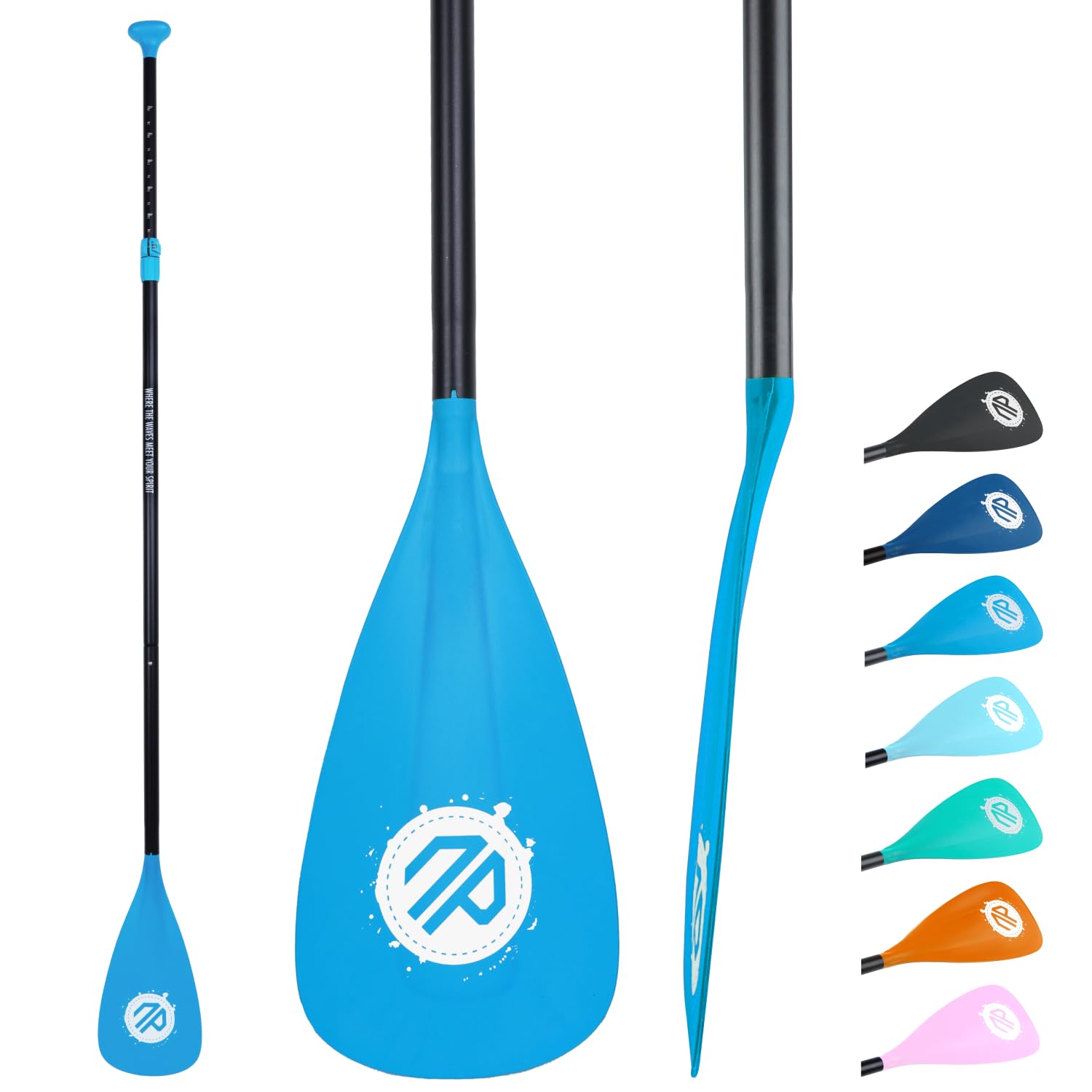
A three-piece paddle is only as good as the joint that holds its length, and Abahub's answer is a compression clamp with a locking pin pushed through it. The pin is the part we care about. It indexes the shaft so the blade cannot rotate away from you mid-stroke, which is the specific failure that turns an inexpensive paddle into an infuriating one. Close the clamp, seat the pin, and the top section stays where you put it.

The adjustment range runs from 68 to 84 inches, enough to cover a teenager kneeling on a board and a tall adult standing on one. That spread is why we recommend this one for a household rather than a single paddler: one purchase that suits everyone who borrows the board, from a flatwater cruise to a kneeling paddle back into the wind. An anti-twist groove keeps the blade square to the handle while you slide the sections.

Broken down, the longest section is 35 inches, so it slides into the backpack that came with an inflatable board alongside the pump and the leash. Assembly is three sections pushed together and the clamps closed — nothing to thread, inflate, or adjust with a tool at the launch.

The blade carries concave grooves down its face, a shape aimed at beginners who want the catch to feel planted rather than slippery. It is a flatwater blade and honest about it: quick, solid strokes on a lake or bay, less bite when the wind picks up and you are digging hard. For surfing or racing, a stiffer composite blade earns its cost; for the other ninety percent of paddling, this one is plenty.

Pros

  • Adjusts from 68 to 84 inches for a shared board
  • Locking pin backs up the compression clamp
  • Packs to 35 inches for a board backpack
  • Light enough for smaller paddlers

Cons

  • Compression clamp can loosen and let the top section rotate
Our verdict

Buy this one for a shared board: 68 to 84 inches of adjustment, a locking pin that holds the length, and a 35-inch pack that drops into the board bag.
Check Latest Price
3

Best Value

Under two pounds, three sections, 32 inches packed. The Niphean is the paddle that disappears into a trunk, a duffel, or the footwell of a small car, and it is the one we take when the board is coming along on a trip rather than out for a quick local lap.

It is built to float, with a sealed aluminum shaft, and that is a claim worth testing yourself in knee-deep water before you trust it a mile offshore. What we do trust is the warranty: a full year of manufacturer replacement coverage is the standout specification on this paddle and the reason it suits a board that gets loaned to friends and family.

Length adjustment is the one place the listing leaves a gap, since no numeric range is published — if you are near six-foot-four, confirm the top of the extension before ordering rather than assuming it matches the Abahub's 84 inches. Everything else is straightforward. The handle is shaped to sit in the palm instead of a bare T-bar, and the blade is a bright turquoise that stands out on the sand when it is lying among everyone else's gear.

Pros

  • Just under two pounds in hand
  • One-year manufacturer replacement warranty
  • Breaks down to 32 inches
  • Bright turquoise blade is easy to spot

Cons

  • No published length range to size against
Our verdict

Light, short-packed, and covered for a year — the pick for a board that travels or gets handed around.

Check Latest Price

How We Tested Paddle Board Paddles

We started by reading through dozens of listings and owner reviews, then narrowed the field to 12 paddles sold at different price points. We filtered out anything with vague sizing, a short adjustment range, or a construction that seemed hard to break down and dry. Over six months, we assembled and paddled each one at a local lake, on calm morning water and in afternoon chop, and on a few breezy coastal runs where the wind picked up mid-session.

Every paddle was weighed on a kitchen scale, then put together from scratch in a parking lot to see how long solo assembly took and whether the joints locked without play. We adjusted each one for two paddlers, one around 5-foot-2 and one around 6-foot-4, and noted where the handle sat, how much length range we had, and whether a mid-length setting felt secure. On the water, we paid attention to blade size and shape during 30-minute paddling blocks: did the paddle catch cleanly, track straight, or flutter when we picked up speed? We also dunked our hands before gripping to see whether the shaft or handle turned slippery, and checked the blade edges and locking hardware for wear after each session.

Floatability got its own test. In waist-deep water, we let each paddle go and watched whether it stayed on the surface, tipped up, or began to sink; then we repeated it in deeper water and noted how easy it was to retrieve. At the end, we packed each paddle down into its bag or the back of a car, carried it to the water, and checked whether the breakdown size and weight made it a hassle on a normal beach day. The paddles that made the list were the ones that stayed comfortable and solid through all of that.

How to Choose a Paddle Board Paddle

Start With Length, Then Look at the Joint

On flatwater, a common starting point is a paddle that reaches roughly 8 to 10 inches above your head when you stand it beside you; drop toward head height for surfing and add a couple of inches for touring. That puts a 5-foot-6 paddler near 74 to 76 inches and a 6-foot-4 paddler near 84, so a range like the Abahub's 68 to 84 inches covers most of a household.

Then look at how the shaft locks. A clamp alone relies on friction and will let the top section rotate once it works loose; a clamp with a locking pin through it holds the length regardless. Set the paddle near the middle of its range rather than at the very top, where the sections overlap least and the joint flexes most.

Three Pieces, Two Pieces, or One

This is stiffness against portability. A one-piece is the stiffest and the most awkward to carry; a three-piece breaks down to about 32 to 35 inches, short enough to slide inside the backpack that came with an inflatable board or into a checked board bag.

Every joint is a place the shaft can flex under a hard stroke. If the paddle lives in the car and only ever travels to the same launch, a two-piece or one-piece gives a cleaner feel for the same money. If you fly, hike in, or store everything in a closet, packability wins.

What the Shaft Material Buys

Aluminum is the budget standard: tough, corrosion-resistant, and light enough to carry all day, but flexier than composite. Both paddles we recommend here are aluminum, and neither pretends to be a race blade — they are built for occasional paddling rather than a hundred days a season.

If you get out weekly, fiberglass or carbon is the upgrade that changes how a stroke feels, because a stiffer shaft loses less of your effort. Buy the inexpensive aluminum one while you are still deciding whether paddleboarding is your sport, and spend on composite when you know it is.

Assume It Will Sink

Floating is the claim most likely to disappoint on an inexpensive paddle. A sealed shaft traps air and usually comes back up, but a joint that takes on water or a blade that fills can send it down regardless of what the listing said.

Test yours in knee-deep water before you trust it: push it under and let go. On deep water, keep a hand on the paddle when you are not stroking, or run a short tether from the shaft to the board so a dropped paddle does not end the session.

Frequently Asked Questions

Final Verdict

The Abahub is the paddle we point most people to, and the reason is unglamorous: it holds the length you set. The 68-to-84-inch range covers a household, the locking pin backs up the clamp, and 35 inches packed means it rides in the board bag rather than the trunk.

If the board travels, gets loaned out, or you want a warranty standing behind the purchase, take the Niphean instead — shorter packed, lighter, and covered for a year. Neither will feel like a carbon race blade, but a paddle that stays where you set it is the whole game at this end of the market.