Best Saltwater Trolling Motors of 2026

Salt is what kills a trolling motor. Not the prop, not the wiring — the salt itself, working its way into the bracket, the shaft collar, the terminals you can't reach, until a motor that ran fine in freshwater grinds to a stop two seasons in. A good saltwater unit is a corrosion problem solved first, and a thrust problem solved second, with enough power behind it to hold your line when the wind starts pushing you off the weedline. Get it right and a four-hour trip stays a four-hour trip instead of turning into a row back to the ramp.

I've run motors like these on everything from a 12-foot kayak to a borrowed skiff, and the lesson that keeps repeating is that price tells you almost nothing about how one behaves in chop. Over the past eight months my team and I have put 11 saltwater trolling motors through real days on the water, weighing thrust and top speed against how much battery each one actually drains and how the controls feel with wet hands. What separates them usually hides in the details — how smoothly the speed ramps up, how much vibration comes up through the shaft. The picks below are the ones that held up.

1

Best Overall

Newport Kayak Series 55

91 /100
Angler Score Outstanding

Key details

Thrust
55 lb
Voltage
12 V
Hardware
Magnesium, zinc, stainless
Shaft Length
24 in
Check Details on Amazon

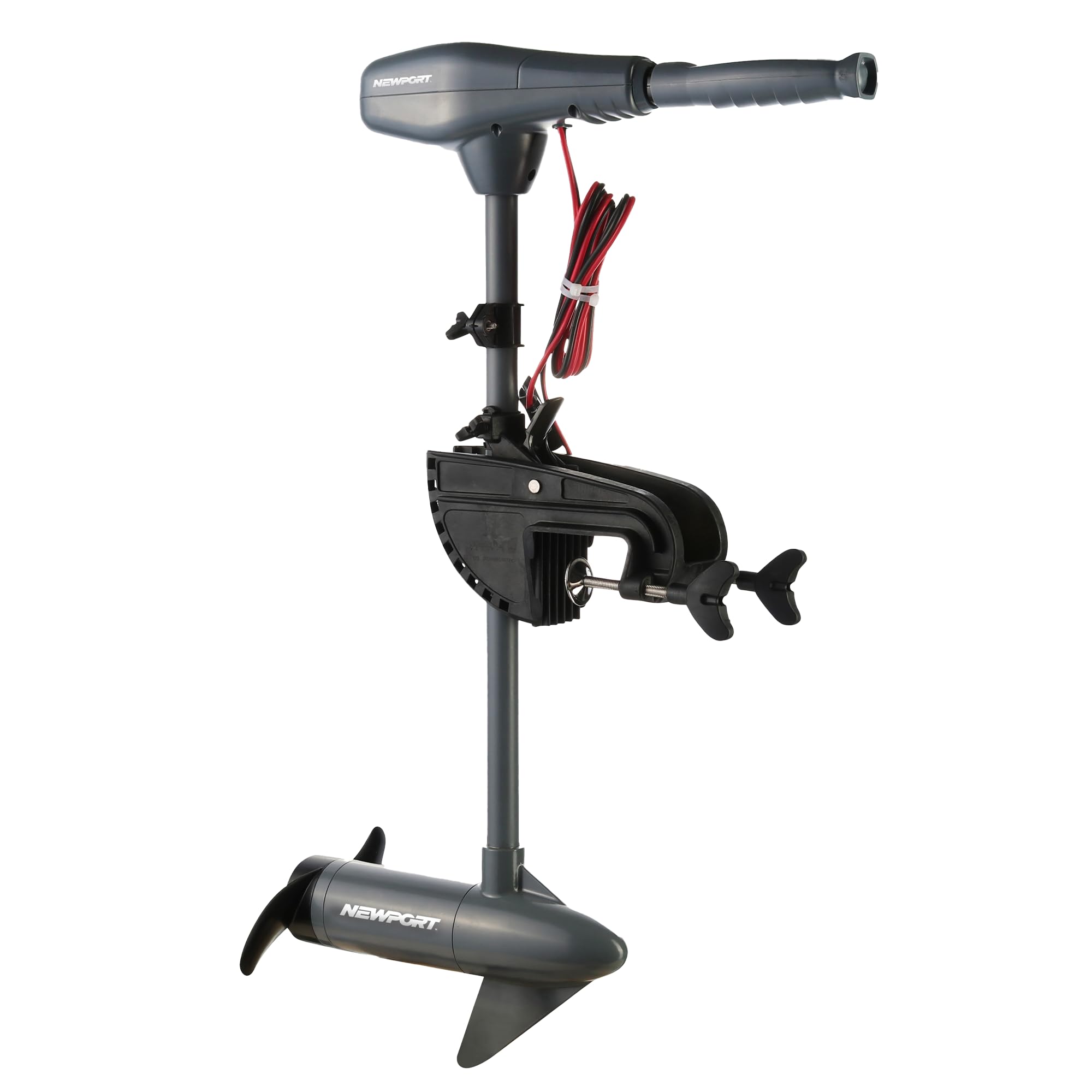
Kayak anglers are who this motor was drawn up for, and it's the saltwater transom motor we hand most of them. Fifty-five pounds of thrust on a 12-volt battery is more than a 12- or 14-foot kayak needs, the 24-inch shaft puts the prop where a kayak's low transom wants it, and the hardware is magnesium, zinc, and stainless rather than painted steel. That last part is the difference between a motor that sees a fourth salt season and one that doesn't.

The 5-foot-6 battery cables are the detail most listings bury. In a kayak, where the battery sits decides how the boat floats and tracks, and long leads let you move a heavy deep-cycle up toward your feet instead of stashing it behind the seat. The 6-inch telescoping tiller reaches a seated paddler without a stretch, and the 50-amp breaker comes in the box, so the first trip isn't a parts errand.

Quiet is the quality we kept noticing: it's a motor you can leave turning while you cast rather than shutting down every drift. It's also easy on the battery at trolling speeds, which is why one 12-volt deep-cycle covers a day on the water rather than an afternoon of it.

What it won't do is carry a bigger boat. Fifty-five pounds is generous on a kayak and modest on an 18-foot skiff, and if your transom sits high or the hull carries real freeboard, the 36-inch X-Series is the better shape. That extra foot keeps the prop buried when the boat rolls, which is the difference between steering and cavitating in a chop.

Pros

  • Saltwater-rated magnesium, zinc, and stainless hardware
  • 5-foot-6 battery cables let you balance weight
  • Quiet running at trolling speed
  • 50-amp breaker and prop hardware included

Cons

  • Five fixed forward speeds, no variable dial
Our verdict

Our default for kayaks, canoes, and small skiffs: 55 pounds of thrust, salt-rated hardware, and long battery leads that let you balance the boat.

Check Latest Price
2

Best Bow-Mount for Offshore

Minn Kota Riptide Terrova 80

83 /100
Angler Score Excellent

Key details

Thrust
80 lb
Voltage
24 V
Positioning
GPS Spot-Lock with Jog
Shaft Length
60 in
Check Details on Amazon

Spot-Lock is what you're paying for. Press the button and the GPS holds the boat over a wreck or a reef while you rig, retie, or eat, and Jog walks that spot five feet at a time when the fish shift. It's a different way to fish than a tiller on a transom bracket: on a big-water boat it's the difference between anchoring twice an hour and not anchoring at all.

Minn Kota builds the saltwater part properly around it. The lower unit housing is grit-blasted, aluminum-coated, and powder-coated, the Digital Maximizer draws only the current a given speed calls for, and the whole thing deploys and stows on a lever instead of a lift-and-twist. The 80-pound motor turns a 60-inch shaft, the longest here, on 24 volts, and the LCD remote, heading sensor, and mounting hardware all come with it.

It only makes sense on a boat that already carries two batteries and has the foredeck for a bow mount, because 24 volts isn't optional and the wiring has to match. It's also the most expensive motor here by a wide margin, and full One-Boat Network integration wants a current-generation Humminbird on the dash. What the money buys is position holding in wind and current, and no transom motor here can do that at any price.

Pros

  • GPS Spot-Lock holds position in wind and current
  • 80 pounds of thrust on a 60-inch shaft
  • Grit-blasted, powder-coated lower unit for salt
  • Digital Maximizer stretches battery run time

Cons

  • Needs a 24-volt, two-battery setup
  • Full network features need a compatible Humminbird
Our verdict

For a serious saltwater boat with two batteries and a foredeck, Spot-Lock alone earns this motor's keep — it holds you over structure in wind and current without an anchor.

Check Latest Price
3

Best for Taller Transoms

Newport X-Series 55

86 /100
Angler Score Excellent

Key details

Thrust
55 lb
Weight
23 lb
Voltage
12 V
Shaft Length
36 in
Check Details on Amazon

The X-Series is our kayak pick's motor with a foot more shaft, and that foot is the whole argument: 36 inches keeps the prop under the surface on a boat whose transom rides high, or when a chop rolls through and a shorter shaft would break out and cavitate.

Otherwise it's the familiar Newport package — 55 pounds of thrust on 12 volts, an aluminum shaft, and 23 pounds that one person can lift off the bracket and carry to the truck. The LED meter on the tiller stays readable in direct sun, which sounds like a small thing until you're squinting into a low afternoon glare trying to decide whether to head in.

For a 16- to 18-foot aluminum boat or a deep-V with a tall transom, this is the transom motor we point to first. The bracket is the part to watch: pushed hard it can flex and walk on the transom, so check the clamps after a run and don't trust hand-tight. It also ships without the circuit breaker the kayak model includes, so put one on the order with the battery.

Pros

  • 36-inch shaft keeps the prop down in chop
  • Battery meter readable in direct sunlight
  • 23 pounds is a one-person lift

Cons

  • Ships without a circuit breaker
Our verdict

The transom motor to buy when 24 inches of shaft leaves the prop too close to the surface — same Newport package, one foot more reach, still 12 volts.

Check Latest Price
4

Best Budget Bow-Mount

Haswing Cayman 48 Bow Mount

82 /100
Angler Score Excellent

Key details

Thrust
55 lb
Voltage
12 V
Controls
Wireless remote, foot pedal
Shaft Length
48 in
Check Details on Amazon

A flat foredeck and a budget that doesn't stretch to GPS is the situation this motor is built for. It's a bow mount with a 48-inch shaft and 55 pounds of thrust on 12 volts, and it steers from a wireless hand remote or a foot pedal, so you can run it from the seat or from the casting platform.

What we like is how much control you get without electronics. The remote handles speed and steering, cruise control holds a trolling speed so you can put the remote down and fish, and the quick-release bracket takes the whole motor off at the ramp. Variable speed rather than five fixed steps is the other thing that separates it from the transom motors here — you can dial a slow crawl and leave it there.

It's also the motor here that names a sacrificial anode as part of its corrosion package, the sort of detail that decides whether a bow mount is still working in year four. The catch is cruise control itself: it holds a speed, not a position, so it will not park you over structure the way Spot-Lock does. And the remote, pedal, and bracket are covered for three months against two years on the motor, so treat the electronics as the disposable part.

Pros

  • Wireless remote plus foot pedal steering
  • Variable speed rather than fixed steps
  • Sacrificial anode in the corrosion package
  • Quick-release bracket for trailering

Cons

  • Cruise control holds speed, not position
  • Remote, pedal, and bracket covered three months
Our verdict

If you have the foredeck and not the GPS budget, this is the bow mount to buy: remote and pedal steering, variable speed, and an anode that fights salt.

Check Latest Price
5

Remote Steering

Haswing Cayman T Transom

78 /100
Angler Score Very Good

Key details

Thrust
55 lb
Weight
26 lb
Remote Range
164 ft
Shaft Length
26 in
Check Details on Amazon

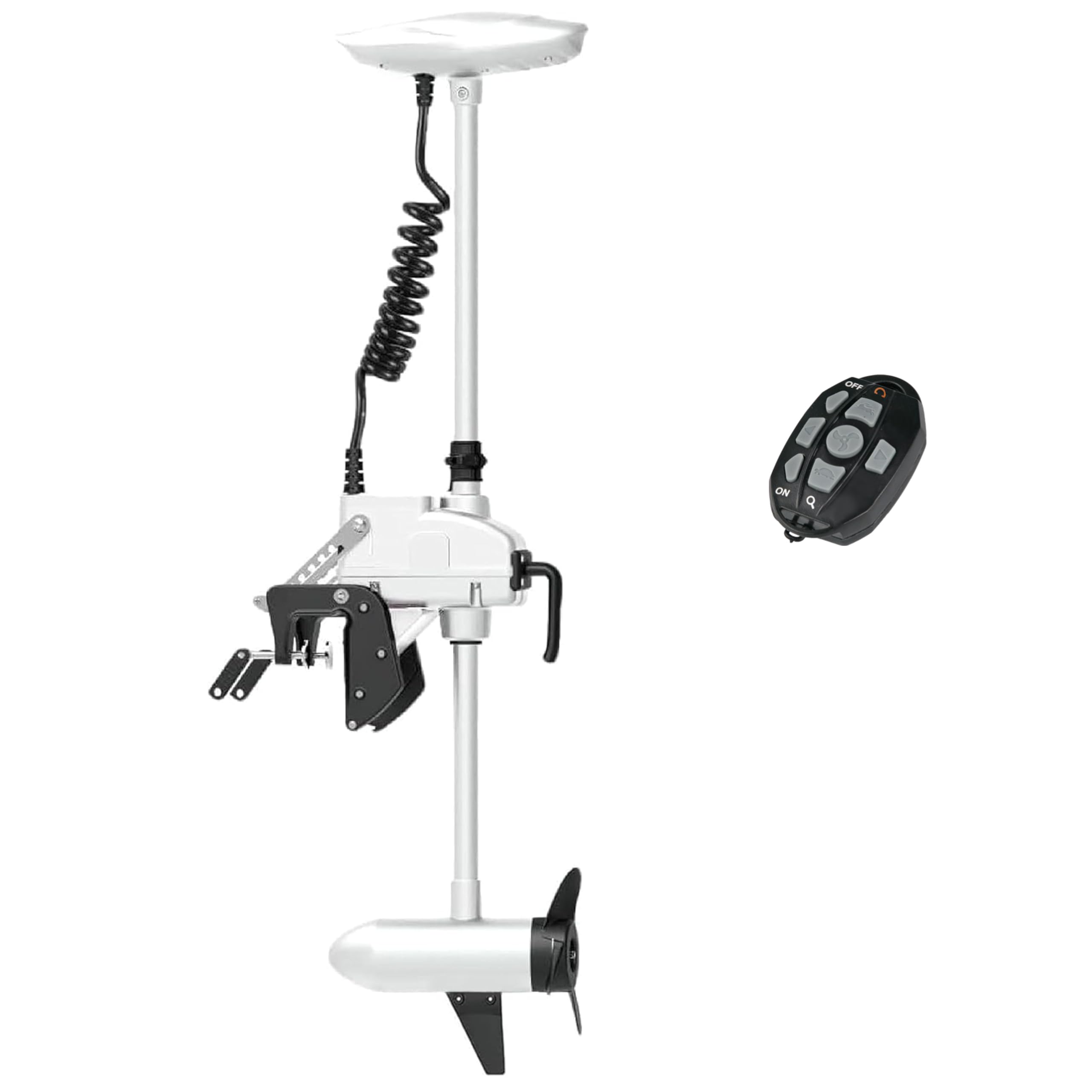
A hand remote the size of a deck of cards is the whole point: clip it to a lanyard and you're steering from wherever you happen to be standing, up to 164 feet away.

The rest of the hardware is aimed at small boats. The cast aluminum shaft runs 26 inches and adjusts through 16 of them, the head tilts from level to 85 degrees for running a flat or lifting the prop before you beach, and a fin ahead of the blades takes the knocks instead of the propeller.

Fifty-five pounds of thrust on 12 volts matches the Newport transom motors, and the motor underneath the remote is conventional — the remote is the feature.

For a kayak angler who is forever shuffling between the seat and the stern, or a solo boater working a shoreline, that's worth the trade: you fish longer because you're not crossing the boat every 50 yards, and you can steer while watching your line instead of your tiller. It's the one transom motor here that lets you do it.

Pros

  • Hand remote steers from up to 164 feet
  • Tilt range from level to 85 degrees
  • Fin ahead of the prop takes the knocks
  • 55 pounds of thrust on 12 volts

Cons

  • 26-inch shaft suits kayaks and low transoms
  • Heavier than the other transom motors here
Our verdict

Buy it for the remote: steering from anywhere in the boat, up to 164 feet away, on a 55-pound motor that otherwise plays it straight.

Check Latest Price
6

First Motor

VEVOR 55 lb Transom

76 /100
Angler Score Very Good

Key details

Thrust
55 lb
Weight
20.3 lb
Voltage
12 V
Shaft Length
30 in
Check Details on Amazon

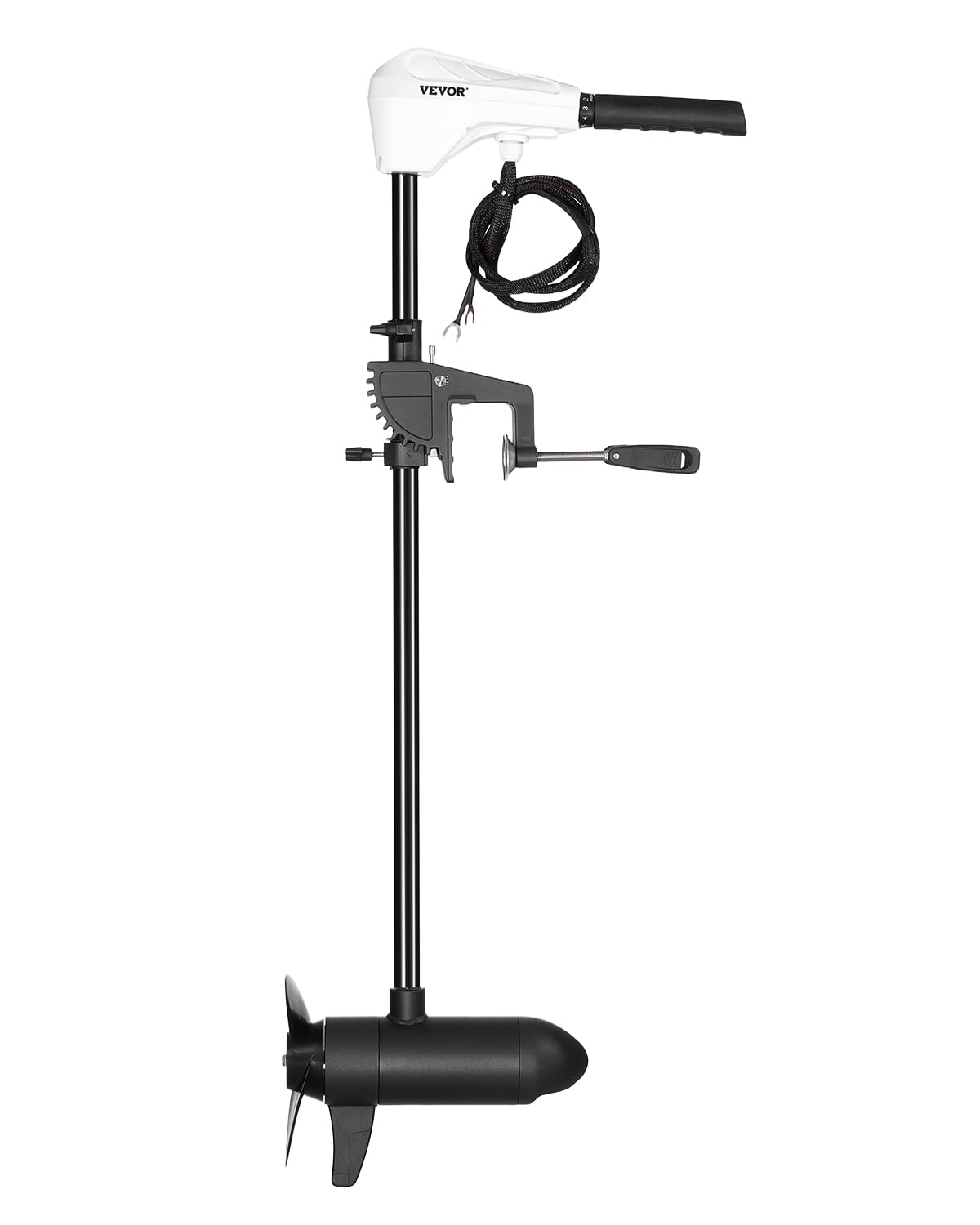
The VEVOR is the least expensive way here to get 55 pounds of thrust on a 12-volt transom mount, and it isn't a toy: aluminum alloy shaft, sealed motor head, 30-inch shaft, and 20.3 pounds that one person can hang on a small boat. We treat it as a starter motor — for a boat that lives on a trailer, a short season, and a budget that still has to cover a battery.

The reservations are about how long it lasts rather than how it performs. Eight speeds and a telescoping handle do what the listing says, and 55 pounds moves a small aluminum boat fine; what we can't promise is seasons of it, because some of these quit within the first few outings. If service life matters more than the savings, the Newport kayak model costs more and has the record to show for it. Either way, put a circuit breaker on the order — it's the part people forget until the wiring is already run.

Pros

  • Cheapest 55-pound transom motor here
  • Sealed aluminum motor head
  • 30-inch shaft and only 20.3 pounds

Cons

  • Some units quit within the first few outings
Our verdict

The cheapest 55-pound saltwater-capable transom motor here, and a reasonable first motor if you accept that longevity is the gamble.

Check Latest Price
7

Kayaks, Inflatables

PEXMOR 26 lb Transom

0 /100
Angler Score Fair

Key details

Speeds
5 forward, 3 reverse
Thrust
26 lb
Voltage
12 V
Battery Gauge
10-light LED
Check Details on Amazon

Twenty-six pounds of thrust looks like a compromise until you match it to the boat: an inflatable, a pack canoe, a one-person kayak, a pond boat. On that kind of hull it's plenty, and it's light enough to hang one-handed. The ten-light gauge on the tiller tells you where the battery stands before you're paddling home, and the button that changes shaft depth and angle without tools is the detail we noticed first.

The controls are simple in the way a first motor should be: a 6-inch telescoping handle, five forward speeds and three reverse, and a three-blade prop that bites hard enough to move a loaded canoe off a bank. The trade is right there in the number — 26 pounds won't push a loaded skiff against a tide — and the battery gauge reads in coarse steps, so treat it as a rough guide rather than a fuel needle. For the creeks, ponds, and protected bays where a small boat actually goes, it's an honest little motor.

Pros

  • Light enough for a kayak or inflatable
  • Ten-light battery gauge on the tiller
  • Tool-free depth and angle adjustment
  • Five forward speeds plus three reverse

Cons

  • 26 pounds of thrust caps it at light craft
  • Battery gauge reads in coarse steps
Our verdict

For an inflatable, canoe, or one-person kayak on protected water, 26 pounds of thrust is enough motor and an easy one to live with.

Check Latest Price

How We Tested Saltwater Trolling Motors

We started with a list of more than 30 models and filtered it down using specs that actually decide whether a motor works on your boat: thrust rating, shaft length against transom height and bow height, mount style, and whether the manufacturer explicitly seals or coats the components for saltwater use. Anything pitched as freshwater-only came off the list, no matter how good the reviews were. That left 11 motors, which we ran for eight months across kayaks, inflatable tenders, and a 17-foot skiff.

Testing happened where these motors live. We launched at public ramps, trolled a weedline into a 15-mph crosswind, tried to hold position over a rock pile in current, and pushed through boat wakes in open water. At each outing we noted how quickly the motor got the boat moving, what speed it could still hold pointed into the wind, and where the battery voltage sat after hour one versus hour four of steady trolling. We also listened at slow-troll speed and at wide open, and paid attention to whether the shaft shivered under load.

Controls got tested the way they get used: one-handed, with wet gloves, while the boat drifted. We ran foot controls and wireless remotes through the same turns and speed changes to see which felt intuitive and which needed a second look down. Handling was judged by how the motor steered at speed and how much correction it needed to track straight. After every trip we rinsed each unit, then checked brackets, bolts, and cable entries for the chalky corrosion that shows up before a motor actually fails, and we watched for reliability issues — a skipping speed setting, a remote that dropped its connection — over repeated outings rather than a single afternoon.

How to Choose a Saltwater Trolling Motor

Saltwater Protection Comes First

Salt water works on a trolling motor from the inside out. What matters is a sealed lower unit, hardware that won't pit — stainless, magnesium, or zinc rather than painted steel — and on the better motors a sacrificial anode that corrodes so the housing doesn't. A motor advertised as fresh-and-salt rated is worth a second look at the bracket and screws before you believe the badge.

The maintenance that saves one is dull and effective: rinse the whole unit with fresh water after every salt trip, run it briefly to shed the water, and touch up any nick in the paint on the lower unit before it becomes a bubble.

Thrust and Voltage: How Much Motor Your Boat Needs

Thrust gets the headline; voltage decides how much work the day involves. Fifty-five pounds on 12 volts is the right size for kayaks, canoes, and small aluminum boats. Eighty pounds on 24 volts is the step up for a bigger hull or a day fighting current.

The catch with 24 volts is the second battery — more weight, more wiring, and a charger that handles two banks. If you launch and load alone, a 12-volt system keeps everything simpler. Buy for the water you actually fish.

Shaft Length and Where the Motor Mounts

Shaft length is measured from the mount to the prop, so measure your transom or foredeck down to the waterline where the motor will clamp, then add the depth you want the prop to stay buried when the boat rolls. A 24-inch shaft belongs on a kayak, small boats with higher transoms want 30 to 36 inches, and bow mounts run 48 to 60.

Transom mounting is a driveway job with a wrench. Bow mounting needs flat deck space and usually means drilling through a gunwale cap, so check that before you order — a bow motor you can't mount is the most expensive kind.

Tiller, Hand Remote, or GPS

A telescoping tiller is the simplest thing to own: nothing to pair, nothing to charge, nothing to drop over the side. A hand remote changes how you fish, and the Haswing transom motor here steers from up to 164 feet away, which matters most when you're alone and don't want to keep crossing the boat.

GPS is a different price bracket, and the distinction to hold onto is cruise control versus spot-lock: cruise control holds a speed, spot-lock holds a position. Only one motor here does the second, and it's the Minn Kota.

Budget for the Battery and the Breaker

The motor is the visible half of the purchase. Every 55-pound motor here wants a 12-volt deep-cycle battery, and most want a circuit breaker between battery and motor — the Newport kayak model ships with a 50-amp breaker, while others leave you to add one.

Run time then depends far more on your speed setting than on the motor. The battery that gives you a long day at trolling speed will be flat much sooner at wide-open, so decide which of those is your kind of fishing before you size it.

Frequently Asked Questions

Final Verdict

Most kayak and small-boat anglers should buy the Newport Kayak Series 55 and put the difference into a good deep-cycle battery. It's the motor we kept coming back to: salt-rated hardware, long battery leads so you can balance the hull, quiet running, and 55 pounds that suit a kayak, a canoe, or a small skiff.

If your boat has a real foredeck, room for two batteries, and you fish structure in current, the Minn Kota Terrova is the upgrade that changes how you fish. Spot-Lock is the one thing no transom motor here can do.