Best Snowshoes of 2026

Snowshoes do one job: spread your weight over a wider footprint so a walk in deep snow stays a walk instead of a knee-deep wallow. What separates one pair from another is in the details — a binding that cinches in one pull versus one that fights you for ten minutes in the cold, crampon teeth that bite a refrozen slope, a frame that stays stiff after a season of rocks and roots. Get those right and the walk is shorter and easier. Get them wrong and you're carrying the things.

My team and I spent last winter and the shoulder seasons around it in 12 pairs, and the pattern was clear: the ones we reached for were the ones we could strap on without pulling a glove off — not the ones that cost the most. Something a first-timer won't know: the longest deck isn't the best all-rounder. Extra length floats better but drags on the packed trails most of us actually walk, so buy for the snow you'll really be on. Below are the pairs that earned their place.

1

Best Overall

MSR Lightning Ascent

90 /100
Angler Score Outstanding

Key details

Binding
Paragon contouring strap
Max Load
220 lb
Deck Size
25 x 8 in
Weight (pair)
4.33 lb
Check Details on Amazon

Most snowshoes here are built to keep you on top of the snow. The Lightning Ascent is built to keep you on top of it while you're crossing a slope of ice, and that is why it's the pair we recommend first. The traction frame runs the full perimeter of the deck, so the edges bite on sidehills where a deck without rails skids, and the steel DTX crampons underneath are the most aggressive teeth in this set.

The Paragon binding is a single contouring strap that wraps the whole boot instead of clamping it at three points, and the listed fit runs men's 4.5 to 15 — a range that covers most adults in a household. We also like the Ergo Televator bar: flip it up on a long climb and your calf stops doing all the work. At 4.33 pounds for the pair, it swings easily for a full day.

What it gives up is float. An 8-inch-wide deck rated to 220 pounds is a hardpack and steeps shoe, not a powder shoe; in deep, unconsolidated snow a longer deck like the Sherpa's stays higher. It also costs more than anything else in this guide, and that money buys grip and a three-year warranty rather than comfort features.

Where the trade pays off is anywhere a slip has consequences: a frozen logging road, a traverse across a spring slope, a climb where the trail disappears under ice. On a flat rail trail it is more shoe than the day needs, and the cheaper picks below cover that ground comfortably.

Pros

  • Perimeter traction frame grips on traverses
  • Steel crampons bite hardpack and ice
  • Paragon binding fits men's 4.5 to 15
  • Televator heel lift eases steep climbs

Cons

  • Narrow deck gives up float in powder
  • Most expensive pair in this set
Our verdict

For ice, traverses, and steep ground, this is the pair we point to: steel teeth, edge-to-edge rails, and a binding that fits a wide range of boots.

Check Latest Price
2

Best All-In Value

G2 Snowshoes with Poles

89 /100
Angler Score Excellent

Key details

Size
21 in, up to 150 lb
Weight
6 lb
Binding
EVA-padded ratchet
Included
Trekking poles and tote bag
Check Details on Amazon

The detail that separates the G2 from the other kits here sits under your boot: a slab of EVA foam padded into the binding, which is the difference between a warm foot and a cold one on a long morning. The rest is familiar ground — an HDPE deck, aluminum crampons, a flex pivot at the toe, and a heel lift for the climbs.

What we keep coming back to is how much arrives in the box. Trekking poles, a tote bag, and a one-pull ratchet you can fasten with a single finger in gloves, for roughly what the bare pairs here cost. For a first set that has to cover a rail trail, a sled hill, and a borrowed friend, that's the value. The padded binding also beats the bare plastic straps on the cheaper picks for comfort.

The caveats are real. The ratchet can let a heel drift toward the center of the deck, so recheck the straps after the first few minutes and again at the top of a climb. And buy the deck for your weight rather than a size up — these are rated by load, not by boot length, and a small deck under a heavier hiker will sink in anything soft.

Pros

  • EVA-padded binding stays comfortable in cold
  • Poles, tote bag, and heel lift included
  • One-finger ratchet works in gloves

Cons

  • Plastic binding hardware is the first thing to fail
  • Deck rated only to 150 pounds
Our verdict

The set we hand a first-timer: padded bindings, poles, and a bag in one box, provided you're under the deck's 150-pound rating.

Check Latest Price
3

Best Budget

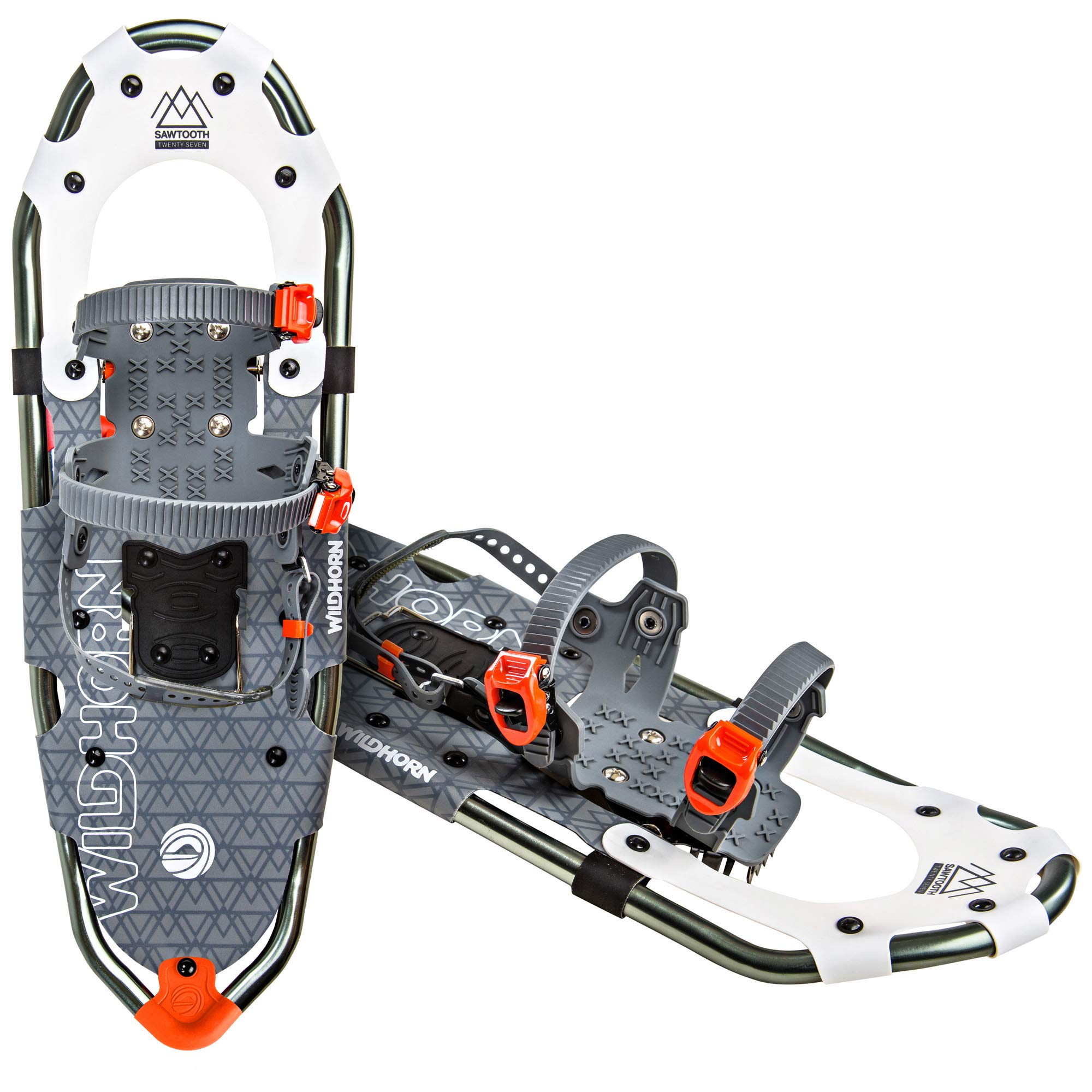
Wildhorn Sawtooth

89 /100
Angler Score Excellent

Key details

Weight
5 lb
Traction
Two crampon sets per shoe
Deck Size
27 in
Heel Lift
Steep-incline riser
Check Details on Amazon

The Sawtooth is the least expensive route into snowshoeing in this set, and it doesn't feel like a penalty box: a 27-inch aluminum-framed deck, two sets of crampons per shoe, and a heel lift riser that plenty of pricier shoes skip. For a family buying three pairs at once, we think that math is hard to argue with.

The 27-inch deck is the useful part. It's long enough to keep an average adult on top of packed snow and short enough to turn around in the trees, and the ratchet binding cinches over a bulky winter boot in a couple of pulls. Textured no-slip pads under the ball of the foot stop the boot from skating on the frame when the straps aren't perfect.

The rear crampon rivets are the part we check before each season; a rivet that lets go takes the crampon with it. Beyond that, the shoe asks very little. A casual snowshoer out a handful of times a winter will get years from a pair at this money, while someone going weekly is better served by one of the pricier picks, where the hardware is built for the pace.

Pros

  • Lowest-priced pair in this set
  • 27-inch deck suits most adults
  • Heel lift riser for sustained climbs
  • Two crampon sets per shoe

Cons

  • Ratchet straps work loose on long descents
Our verdict

The cheapest way into snowshoeing here, with a 27-inch deck and a heel lift riser that most shoes at this money leave off.

Check Latest Price
4

Best for Groomed Trails

Tubbs Wayfinder

88 /100
Angler Score Excellent

Key details

Frame
Fit-Step 2.0
Binding
CustomWrap 2.0
Traction
Toe and heel crampons
Deck Size
21 in
Check Details on Amazon

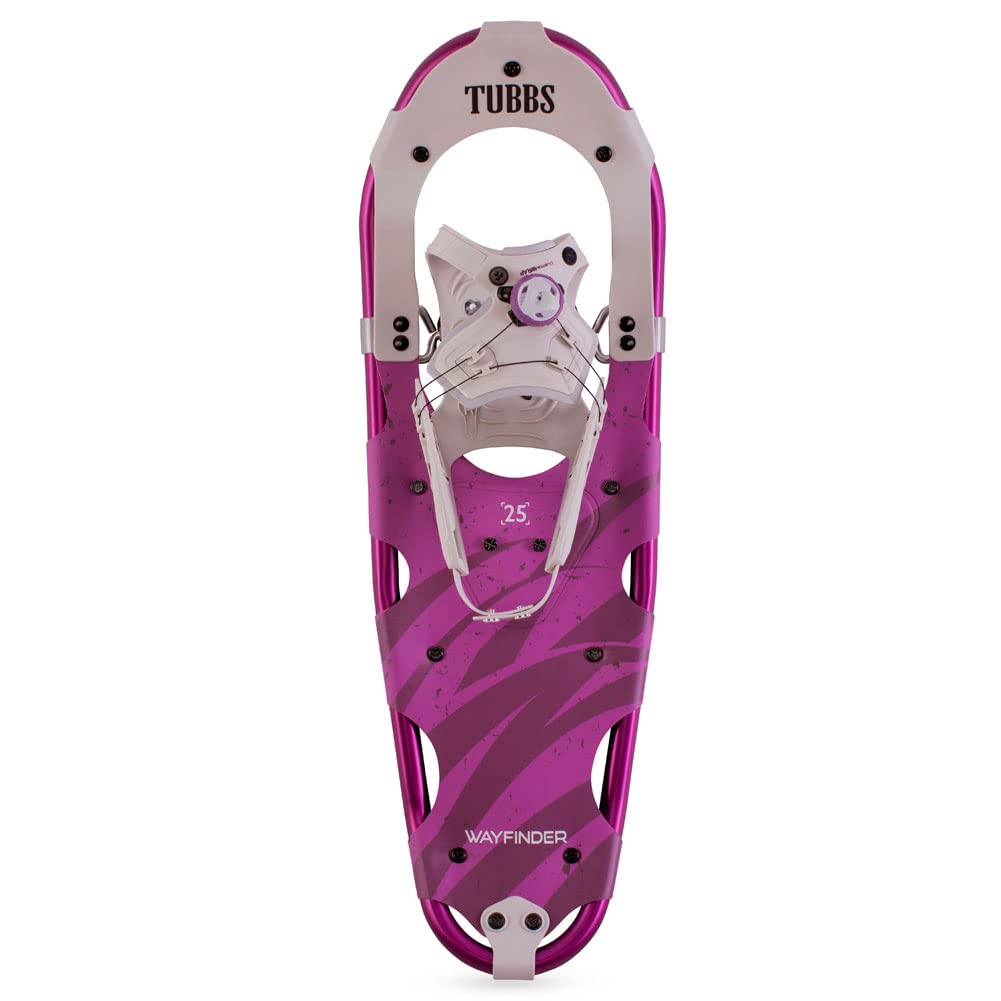
At 21 inches, the Wayfinder is one of the two shortest adult decks we cover, and that's the whole argument for it. Tubbs builds this one for packed, groomed, tracked-out snow, where maneuverability beats flotation. Take it into thigh-deep powder and it will sink.

The CustomWrap 2.0 binding cinches with a dial, and the difference shows up at the trailhead in January: one hand, gloves on, a couple of clicks and you're in, then the same at the car when you're done. The rotating toe cord lets the tail of the deck drop as you step instead of fighting your stride, and the toe and heel crampons are enough for icy parking lots and refrozen tracks.

Where it earns its keep for us is the low-drama morning — a rail trail, a fire road with the dog, no fuss at either end. It's priced like the premium shoe it is, and you're paying for the binding and the fit more than for the deck. If your winter involves climbing or breaking trail, this isn't the pair; the MSR above or the Sherpa below cover that ground.

Pros

  • Dial binding tightens with gloves on
  • Maneuvers easily on packed, tracked snow
  • Toe and heel crampons for icy patches

Cons

  • Short deck sinks in deep powder
Our verdict

The pair for groomed trails and quick walks: a dial binding you can work one-handed and a short deck that turns easily in packed snow.

Check Latest Price
5

Best Kit for Bigger Hikers

Odoland Snowshoes with Gaiters

85 /100
Angler Score Excellent

Key details

Size
30 in, 160-250 lb
Weight
7.61 lb
Included
Poles, gaiters, carry bag
Heel Lift
Yes
Check Details on Amazon

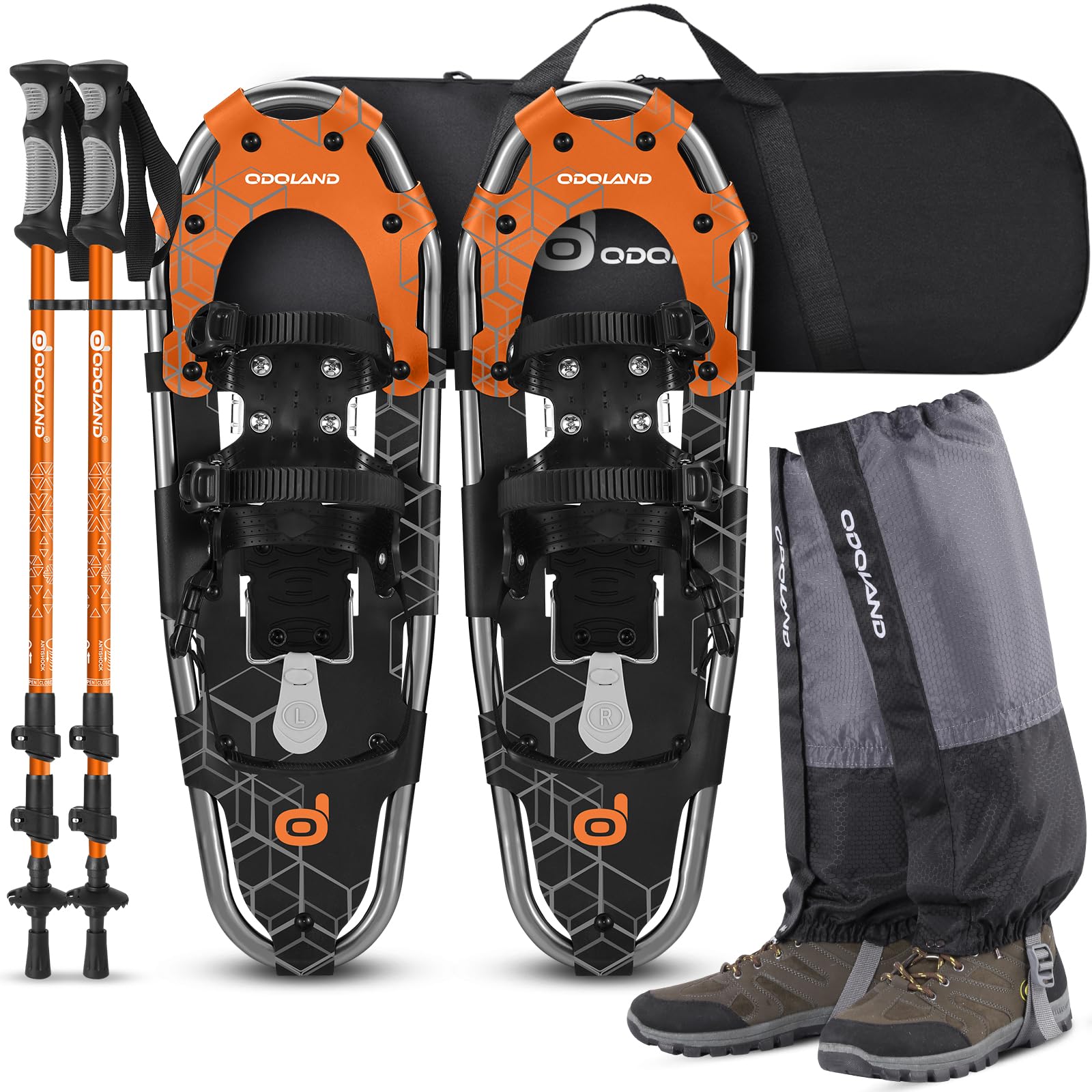
The Odoland box holds more than most: a 30-inch deck rated for 160 to 250 pounds, telescoping poles that run from 25.5 to 54 inches, a pair of waterproof gaiters, and a carry bag. The gaiters are the piece other kits skip, and they're the piece that keeps powder out of your boots on a soft day.

For a bigger hiker who wants a single order to cover everything, this is the pick. The 30-inch deck gives real float under a heavier load, the heel lift takes strain out of a climb, and we were glad to see basketed poles in the box — they're worth having the moment the trail turns slick.

The buckles are what we watch. They need a firm push to seat, which is no fun with cold hands, and a buckle that doesn't seat is a shoe that comes loose halfway up a hill. Give each one a hard look at the trailhead, before the gloves get wet, and check the heel again at the top of anything steep.

Pros

  • 30-inch deck rated 160 to 250 pounds
  • Poles, gaiters, and bag included
  • Heel lift eases long climbs
  • Basketed poles help on slick ground

Cons

  • Heel strap works loose over a hike
Our verdict

One order that covers a bigger hiker head to toe — 30-inch deck, poles, gaiters, and a bag — with buckles that need watching.

Check Latest Price
6

Best for Heavier Hikers

Yukon Charlie's Sherpa

85 /100
Angler Score Excellent

Key details

Weight
5 lb
Binding
Quick Click II ratchet
Max Load
300 lb
Deck Size
36 x 10 in
Check Details on Amazon

A 10-by-36-inch deck rated from 251 to 300 pounds is a narrow brief, and no other pair here is rated that high. A heavier hiker on a 25-inch deck spends the day postholing; the Sherpa's stiff HDPE deck spreads that load instead of folding under it.

The Quick Click II ratchet gets you in and out in seconds, and the forefoot area is roomy enough for a full pac boot — a real consideration if your winter boot is the size of a shoebox. The Rapid-Lite Flex heel strap flexes with your stride rather than sawing at your Achilles on a long flat.

Thirty-six inches is a lot of deck, and it shows in tight trees and on narrow singletrack, where you end up thinking about your feet instead of the view. On open ground, fire roads, and the deep stuff it's the pair that keeps a big hiker floating, which is the whole point. We noticed the length first, and it's the honest trade for the load it carries.

Pros

  • Rated to 300 pounds
  • Roomy binding takes pac boots
  • Ratchet binding goes on in seconds
  • Stiff HDPE deck floats in deep snow

Cons

  • Long deck is clumsy in tight trees
Our verdict

If you're over 250 pounds, this is the pair that keeps you on top of the snow — long, stiff, and rated where the others stop.

Check Latest Price
7

Best for Young Kids

Tubbs SnowGlow

87 /100
Angler Score Excellent

Key details

Ages
4 to 8 years
Binding
QuickLock2
Deck Size
16 in
Boot Range
Kids 11 to adult 6
Check Details on Amazon

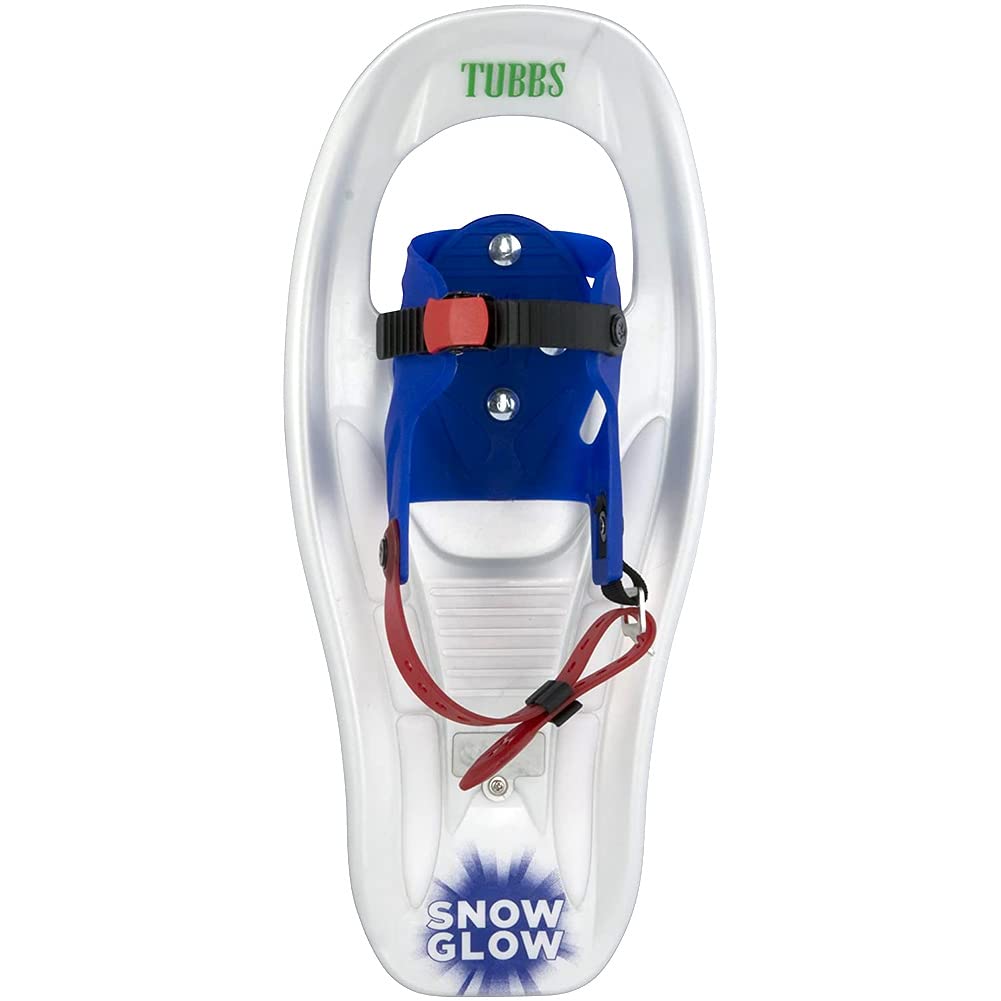
The lights are the point. Molded into the deck, they flash with every step, and a four-year-old who won't put on a jacket will put these on to make them blink. That sounds like a gimmick until you've spent twenty minutes negotiating with a preschooler at the trailhead.

Underneath the LED show is a real snowshoe: a 16-inch deck with molded traction rails, an aluminum frame, and the QuickLock2 binding, which locks with one pull and stays snug around the boot. The rails are molded rather than steel, which is right for the yard, the sledding hill, and a flat park path — this is not a mountain shoe and it doesn't pretend to be.

Sizing is where you'll do the most thinking. It's built for ages roughly four to eight and for kids' shoe size 11 up to an adult 6, and a 40-pound five-year-old is the sweet spot. Bulky snow boots are the squeeze point, so check the fit at home rather than at the bottom of the hill.

For a first pair, this is the one we hand over: the lights get a reluctant kid out the door, the binding is simple enough to manage with a parent's help, and the frame takes hours of tumbling in the yard. What it teaches is the part that matters — by the time they've outgrown it, they already know how to walk on snow.

Pros

  • Flashing LEDs get reluctant kids outside
  • QuickLock2 binding locks with one pull
  • Molded rails are enough for packed snow
  • Aluminum frame survives hard play

Cons

  • Straps strain over bulky snow boots
Our verdict

For ages four to eight on flat ground and sledding hills, the lights plus a one-pull binding make this the easiest first pair to say yes to.

Check Latest Price
8

Growing Kids

Yukon Charlie's Youth

86 /100
Angler Score Excellent

Key details

Weight
2.2 lb
Binding
Ripcord Easy-Pull
Deck Size
7 x 16 in
Load Range
25-100 lb
Check Details on Amazon

One pull on the cord and the binding is closed, which is the whole reason this pair works for a small child. The Ripcord Easy-Pull takes any boot, has no ratchet to thread and no dial to twist, and there's nothing for snow to jam. A kid who can pull a zipper can get into these alone, and that independence is worth more on a cold morning than any spec.

The number that matters is the range: 25 to 100 pounds. That covers a small preschooler through a child well into elementary school, so one pair can survive a couple of growth spurts instead of a single season. For something a child wears four or five times a winter, that runway is the value.

At 2.2 pounds on a 7-by-16-inch deck, it's light enough for a five-year-old to carry to the car. The Energy Flex axle lets the deck follow a natural stride rather than slapping flat, and the 6000-series aluminum rocker frame is the same material story as the adult shoes — worth having when the snowshoe spends as much time being dragged as worn.

Where it stops is 100 pounds and 16 inches: past that a child needs an adult-length shoe, and this one becomes a hand-me-down for a younger sibling. We're comfortable with that. Until they hit the ceiling, it's the most forgiving pair in this guide for a kid still figuring out the walking part.

Pros

  • 25-to-100-pound range lasts several winters
  • Pull-cord binding takes any boot
  • Light enough for a small kid to carry
  • Aluminum rocker frame handles rough play

Cons

  • Deck tops out at 100 pounds
Our verdict

The pair to buy when you want one set to carry a kid from preschool into grade school — light, simple, and useful for several winters.

Check Latest Price

How We Tested Snowshoes in Powder, Crust, and Ice

We started with every snowshoe we could get our hands on, then narrowed it by deck size, stance width, binding type, claimed weight, and price until 12 pairs were left. Testers ranged from a women's 6 boot to a men's 13, and we mixed boot bulk on purpose — bulky pacs, low hikers, one pair of insulated clunkers — because a binding that swallows a big boot can still rattle around a small one.

Testing ran from the first storm in December through the last rotten crust in April, then picked up again the following fall — about 10 months. Most of it happened close to home: weekday mornings on the packed trails at a local reservation, weekend pushes through unpacked powder off-trail, and one memorably bad afternoon traversing a refrozen ravine sideways.

Bindings and straps got the most attention, since that's where a good day goes bad. We strapped in and out at the car in thin liners and again in heavy mittens, counting the seconds and noting whether webbing iced up and went stiff by the second lap. Fit and adjustability we checked by passing the same pair between testers of different sizes mid-walk, and by actually flipping up the heel lift on the climb instead of leaving it down.

Weight went on a kitchen scale, then got judged again at mile three, when half a pound stops being a number. Traction we read on the sidehill and in the ravine, where we wanted to know whether the teeth bit or skated. Durability showed up on rocky sections and in spring melt, when we looked at deck wear and whether frames had lost their snap. Value came down to the box: poles, bag, gaiters, or nothing at all.

How to Choose Snowshoes

Start With the Load, Then the Deck

Snowshoe sizes are weight ratings, not measurements of your foot. The G2's 21-inch deck is built for up to 150 pounds; the Yukon Charlie's Sherpa's 36-inch deck carries 251 to 300. In between, the rule is to match the deck to your loaded weight, then drop a size if you'll spend the winter on packed trails and add one if you're breaking trail in powder.

The trap is buying long for flotation and then discovering that a big deck clips your own calf on a narrow track. A long shoe is a tool for soft snow; on a groomed rail trail it just makes you walk wider than you need to.

Bindings Are What You'll Actually Fight With

Three systems show up here: ratchets, dials, and pull-cords. Ratchets are fast and adjustable but can loosen over a descent. A dial is the easiest to work one-handed in gloves. A pull-cord is the simplest of all and the right choice for a child who wants to do it alone.

Try them on with the boots you'll wear. A binding that closes sweetly over a sneaker can balk at a full pac boot, and the difference only shows up at the trailhead in January.

Traction Is a Design, Not a Tooth Count

Teeth underneath are only half the story. Perimeter rails — the full frame of teeth around the MSR's deck — put grip on the edges, which is what keeps you upright when you cross a slope sideways. Underfoot crampons bite when you're going straight up or down. Molded plastic rails, like the ones on the kids' Tubbs, are fine on packed snow and give you nothing on ice.

If your winter includes refrozen creeks, shaded creek crossings, or a boot-packed fire road, buy for the edges rather than the tooth count.

Decide Whether You Want a Kit

Poles, gaiters, and a carry bag add real money to a bare pair and real convenience to a first season. A kit like the G2 or the Odoland means one order and nothing missing on the first cold morning; buying separately means you pick the poles and gaiters you actually want.

Poles earn their place on ice and descents, gaiters on soft snow, and the bag matters more than it sounds if the shoes live in a car all winter.

Check the Parts That Fail

The wear items are consistent: plastic heel straps, rivets at the crampons, and the deck itself. Look at what the deck is made of before you buy — HDPE and aluminum frames are the more durable recipe here — and check what the warranty covers. MSR backs the Lightning Ascent for three years; most of the others here list one.

Then adopt one habit: a two-minute check of every rivet and strap before the season starts. It's the cheapest maintenance in winter sports.

Frequently Asked Questions

Final Verdict

Weigh the decision by the ground you actually walk on. If it's ice, traverses, and steep climbs, the MSR Lightning Ascent is the pair to buy: steel teeth, edge-to-edge rails, a binding that fits a wide range of boots, and a three-year warranty behind it.

If your winter is flatter or your budget tighter, the G2 packs poles, a padded binding, and a heel lift into one box, and the Wildhorn Sawtooth does the basic job for less than anything else here. For a child, start with the Tubbs SnowGlow and let the lights do the persuading.