Best Spotting Scopes of 2026

A spotting scope is one of those purchases that looks simple until you start comparing numbers: more magnification sounds better, a bigger objective lens sounds brighter, and a lower price sounds like a steal. Then you get it outside and discover that a shaky tripod, a stiff focus wheel, or a narrow field of view can make all that power useless. What you're really buying is a clear, stable view—one you can hold on a bird, a target, or a distant ridge long enough to actually see something.

Over the past eight months, my team and I have tested 12 spotting scopes across a mix of real-world settings—backyard feeders, a windy ridge, and a shooting bench—and the differences came down to more than specs. We paid close attention to how quickly the image sharpened, how much weight we were willing to carry, whether the included tripod felt sturdy or like an afterthought, and whether the price bought real optical quality or just extra magnification. If you want a scope that works for birding, wildlife, and range days without fuss, the right pick is in this list.

1

Best Overall

Gosky 20-60x85

89 /100
Angler Score Excellent

Key details

Field Of View
101-48 ft/1,000 yd
Magnification
20-60x
Objective Lens
85mm
Included Tripod
13.3-63 in adjustable
Check Details on Amazon

A scope is only as useful as the thing holding it up, and this Gosky arrives with a tripod you can stand behind: legs that run from about 13 inches to 63, a bubble level on the head, and enough height to put the eyepiece at your face instead of your knees. The rest of the kit follows the same logic, with a padded carry bag, a phone adapter, lens covers and a cleaning cloth in the box.

That completeness is why we make it the default recommendation here. At 20x it shows a stated 101 feet of ground at 1,000 yards, which is the number that decides whether you can get on a moving bird before it moves again — you find it wide, then zoom in. The 85mm objective matches the Viper's and beats everything else in this group, and that is what buys you usable light at the front and back ends of the day.

At 60x the view narrows to 48 feet and softens, as it will on any scope in this class, so we spent most of our sessions between 20x and 40x and pushed to the top only to read a target face or settle an identification. Focus and zoom fall where your hand expects them, and the zoom ring turns smoothly enough to work without taking your eye off the subject.

The tripod head is where kits at this price save money, and if you plan to glass for hours in wind, a sturdier head is the first upgrade worth making. For a couple of hours on a ridge or a morning at the bench, the included one does what the scope needs it to do.

Pros

  • Full-size tripod reaches standing height
  • 85mm objective pulls in low light
  • Wide 101-foot field at 20x
  • Bag, phone adapter and cleaning kit included

Cons

  • One-year warranty, where rivals offer lifetime
Our verdict

We recommend it as the most complete first scope here: a full-size tripod, 85mm glass and a wide low-power view that makes finding subjects easy.

Check Latest Price
2

Best Glass for the Money

Vortex Crossfire HD 20-60x80

88 /100
Angler Score Excellent

Key details

Weight
3.3 lb
Warranty
Unlimited lifetime
Magnification
20-60x
Objective Lens
80mm
Check Details on Amazon

The Crossfire is what you buy when the glass matters more than the goodies. Vortex puts its HD optical system, fully multi-coated surfaces, a helical focus and a pull-out sunshade into an 80mm body, then backs it with an unlimited, unconditional lifetime warranty that outlasts every other guarantee in this group.

Arca-Swiss compatibility is the detail we appreciated most. The foot clamps straight into a standard head or a window mount with no adapter plate, and at 3.3 pounds the scope settles quickly once you take your hand away — which matters more than it sounds, because a scope that shifts when you touch the focus ring is one you stop using.

Where it gives ground is the top of the zoom. Past about 40x the image dims and a purple fringe creeps onto high-contrast edges, so 60x is for confirming what you already found at 30x rather than for watching. Between 20x and 40x it's as clean as anything here, and the eyecups twist up far enough to use with glasses.

Pros

  • HD glass stays sharp past 300 yards
  • Unlimited, unconditional lifetime warranty
  • Arca-Swiss foot clamps without an adapter
  • 3.3 pounds carries easily on a pack

Cons

  • No tripod in the box
Our verdict

We think it's the best glass per dollar here: HD optics, a lifetime warranty and Arca-Swiss mounting, provided you already own a tripod.

Check Latest Price
3

Best Value

Athlon Talos 20-60x80

90 /100
Angler Score Outstanding

Key details

Weight
2.4 lb
Warranty
Lifetime, transferable
Magnification
20-60x
Objective Lens
80mm
Check Details on Amazon

The tripod in the box is a table-top model, which tells you what this scope is for: a bench at the range, the hood of a truck, a windowsill. Set it up anywhere you can't put it at table height and you'll be crouching behind it. That's the compromise, and it's how Athlon keeps the cost down while spending on glass.

The glass earns the trade. An 80mm objective behind a fully multi-coated Porro prism is crisp out to 200 yards and still readable past 300, which covers sighting in at 100 and checking groups at 200 without a walk downrange. Coatings, purging and sealing are all present, and the aluminum body under rubber armor doesn't feel like a budget scope in the hand.

We rate it the best value for a range bag. Two and a half pounds, a body that shrugs off truck life, and a lifetime warranty that transfers if the scope changes hands — that's a lot of instrument to leave in a vehicle without worrying about it, and the clarity at 300 yards is the part we kept coming back to.

Pros

  • Sharp and clear out to 200 yards, readable past 300
  • 2.4 pounds is easy to pack and carry
  • Lifetime transferable warranty
  • Nitrogen-purged, armored body resists hard use

Cons

  • Dim at 60x with a 1.33mm exit pupil
Our verdict

With a lifetime warranty, 2.4 pounds of armored body and sharp glass at 200 yards, we think it's the best value here for a range bag.

Check Latest Price
4

Best Premium

Vortex Viper HD 20-60x85

92 /100
Angler Score Outstanding

Key details

Body
Magnesium, argon purged
Weight
4.85 lb
Magnification
20-60x
Objective Lens
85mm
Check Details on Amazon

The last twenty minutes of light are when good glass shows itself, and this is the scope in the group that keeps color and detail after the cheaper ones have gone gray. An 85mm HD objective, XR anti-reflective coatings and a magnesium body explain what you're paying for; the view at dusk explains why people pay it.

The working end is sorted. Helical focus moves from coarse to fine in one motion and stays where you leave it, the multi-position eyecup gives a full view with or without glasses, the sunshade pulls out to kill glare off water and snow, and the Arca-Swiss foot goes onto a real head without a plate.

Weight is the trade. At 2.2 kilograms before you add a head, it's the heaviest scope here, and it's built to be carried to a vantage and left set up rather than hiked with all day. Pack it in, glass for three hours, pack it out — that's the job it does better than anything else on this page.

We think it's the one to buy if you glass seriously and want the best image of the group: birds resolve into field marks instead of silhouettes, and a bedded animal stays an animal rather than a rock. The unlimited lifetime warranty means the scope you buy is the one you keep.

Pros

  • Keeps color and detail in low light
  • Helical focus is fast and precise
  • Argon-purged, armored magnesium body
  • Unlimited lifetime VIP warranty

Cons

  • Sold without a tripod or mount
Our verdict

If you want the best image in this group and will glass from a fixed vantage, the Viper is worth both the weight and the money.

Check Latest Price
5

Best Budget

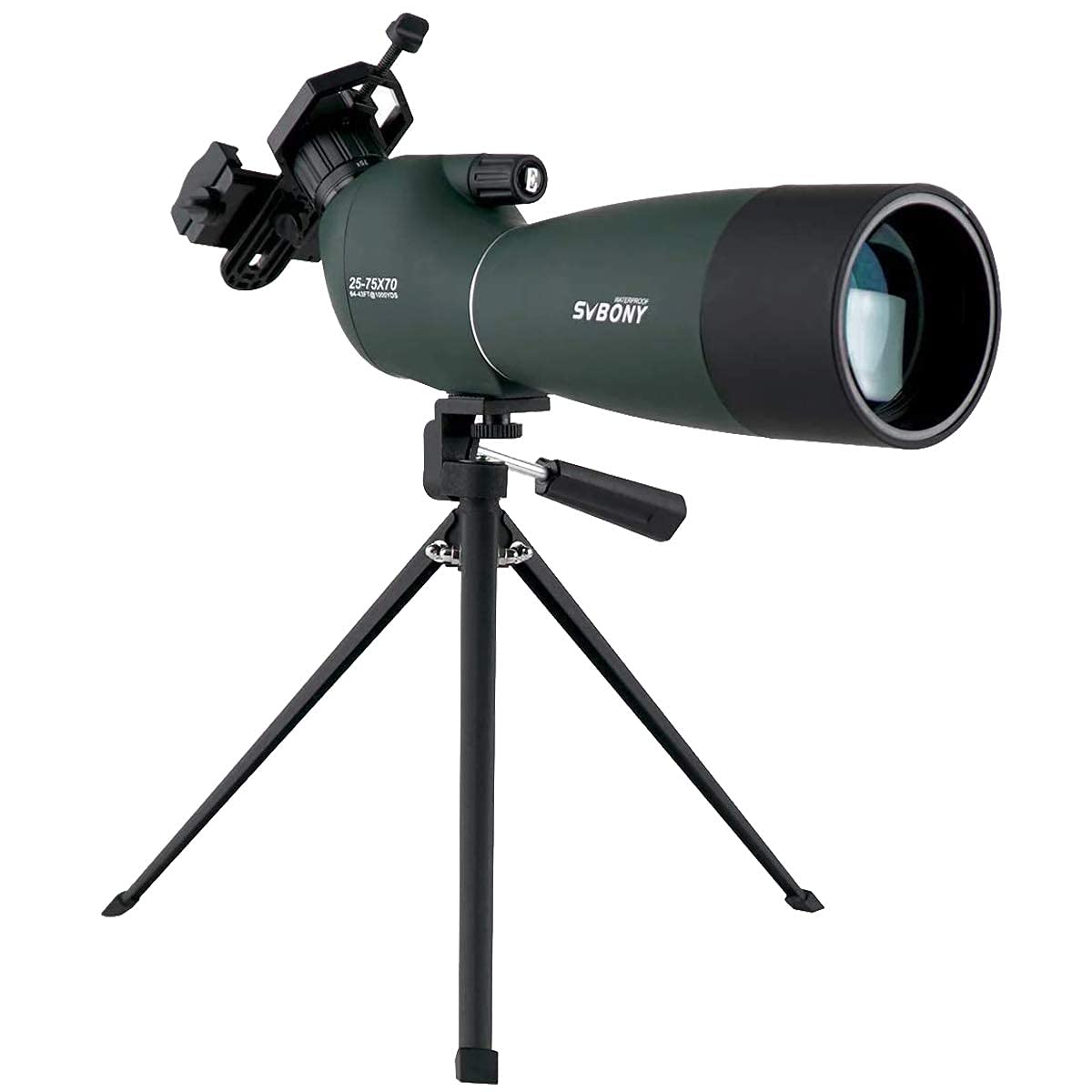
SVBONY SV28 25-75x70

89 /100
Angler Score Excellent

Key details

Weight
2.01 lb
Field Of View
64 ft/1,000 yd
Magnification
25-75x
Objective Lens
70mm
Check Details on Amazon

This is the cheapest way into a proper spotting scope, and it's a fair one if you know where the ceiling is. Twenty-five to seventy-five power from a 70mm lens, sealed against rain with a sunshade built into the barrel, plus a phone adapter and a desktop tripod in the box — a complete first kit for a beginner, a kid, or a spare that lives behind the truck seat.

The ceiling is the top of the zoom. From 25x to about 40x the view is bright and the focus comes in easily; push toward 75x and the image softens, the field narrows to the 64 feet at 1,000 yards it lists, and the focus wheel turns into a negotiation. We treat 40x as the working limit and 75x as a number on the box.

The accessories follow the same pattern. The desktop tripod is short and light — fine on a bench or a car hood, not something you stand behind — and the phone clamp takes patience to center over the eyepiece. The scope itself is 910 grams and 38 centimeters long, though, so it disappears into a pack, and the 45-degree eyepiece lets you sit behind it instead of crouching.

Pros

  • Complete kit with case, adapter and tripod
  • 910 g body packs easily
  • Sealed body with built-in sunshade

Cons

  • 60-day warranty is the shortest here
Our verdict

We recommend it as the budget entry: a light, sealed 25-75x kit that's sharp to about 40x, as long as you accept a short warranty.

Check Latest Price
6

Best for Backpacking

Emarth 20-60x60

89 /100
Angler Score Excellent

Key details

Weight
1.31 lb
Magnification
20-60x
Objective Lens
60mm
Included Tripod
14 in tabletop
Check Details on Amazon

The scope that gets used is the one that's already in the pack. At about 1.3 pounds and 13 inches long, this Emarth disappears into a daypack, rides in a shoulder-strap case, and mounts on any tripod you already own through the standard 1/4-inch-20 thread underneath.

We like it as a second scope, a first scope for someone who isn't sure how much they'll glass, and the one that stays in the boat locker. The 20-60x zoom does what the label says in good light, the multi-coated BAK-4 optics are clear enough to sort birds at distance, and the kit — case, tabletop tripod, covers — arrives ready to use.

Sixty millimetres of objective is the smallest here, and that sets the ceiling. At dawn, dusk or under heavy overcast it dims earlier than the 80mm scopes, so plan your glassing for the middle of the day or accept a softer image at first and last light. For hiking, scouting and picking apart a hillside at noon, that's a fair trade.

One detail worth knowing: the 14-inch tabletop tripod has wider legs than most and sits steady on a bench, but it isn't a standing tripod. Put the scope on a full-size one and it behaves like a larger instrument than it is.

Pros

  • About 1.3 pounds, so it goes in a daypack
  • Standard 1/4-20 thread takes any tripod
  • Complete kit with case and tabletop tripod

Cons

  • Focus stiffens as you approach 60x
Our verdict

At about 1.3 pounds with a case and tripod, we think it's the best scope here for hiking, as long as most of your glassing happens in daylight.

Check Latest Price
7

Backyard and Range

Celestron Ultima 80

87 /100
Angler Score Excellent

Key details

Weight
3.6 lb
Warranty
Limited lifetime
Magnification
20-60x
Objective Lens
80mm
Check Details on Amazon

Celestron has been building this scope long enough that the design has settled: an 80mm objective, a 45-degree eyepiece in a rotating collar, and a body that's sealed and purged against weather. The collar is the underrated part — you can turn the eyepiece to the side and look through it comfortably while sitting, kneeling or lying prone behind a rifle.

Range work is where it's happiest. Out to 300 yards the image is bright and sharp enough to read a target face, and further out you can still separate an animal from a rock, though detail thins. The zoom eyepiece has a T-adapter built in, so a camera body or a phone mount threads straight on without a separate ring.

We still rate it a solid buy, with one real caveat: color. Past about 20x, high-contrast edges pick up a purple-blue fringe that strengthens as you zoom — a hawk against a white sky, a black bullseye — which is a nuisance for counting holes and a genuine limit for judging plumage.

Build is the other argument in its favor: 3.6 pounds of solid body, a focus dial big enough to find with gloves on, and a limited lifetime warranty. It's a scope that has earned its long run.

Pros

  • Bright, sharp image out to 300 yards
  • Rotating 45-degree collar works from any position
  • Built-in T-adapter for cameras and phones
  • Limited lifetime warranty

Cons

  • Sold without a tripod
  • Focus dial turns coarse above 30x
Our verdict

A well-built 80mm range scope with a lifetime warranty; we still recommend it for targets, with color fringing above 20x as the catch.

Check Latest Price
8

Standing Glassing

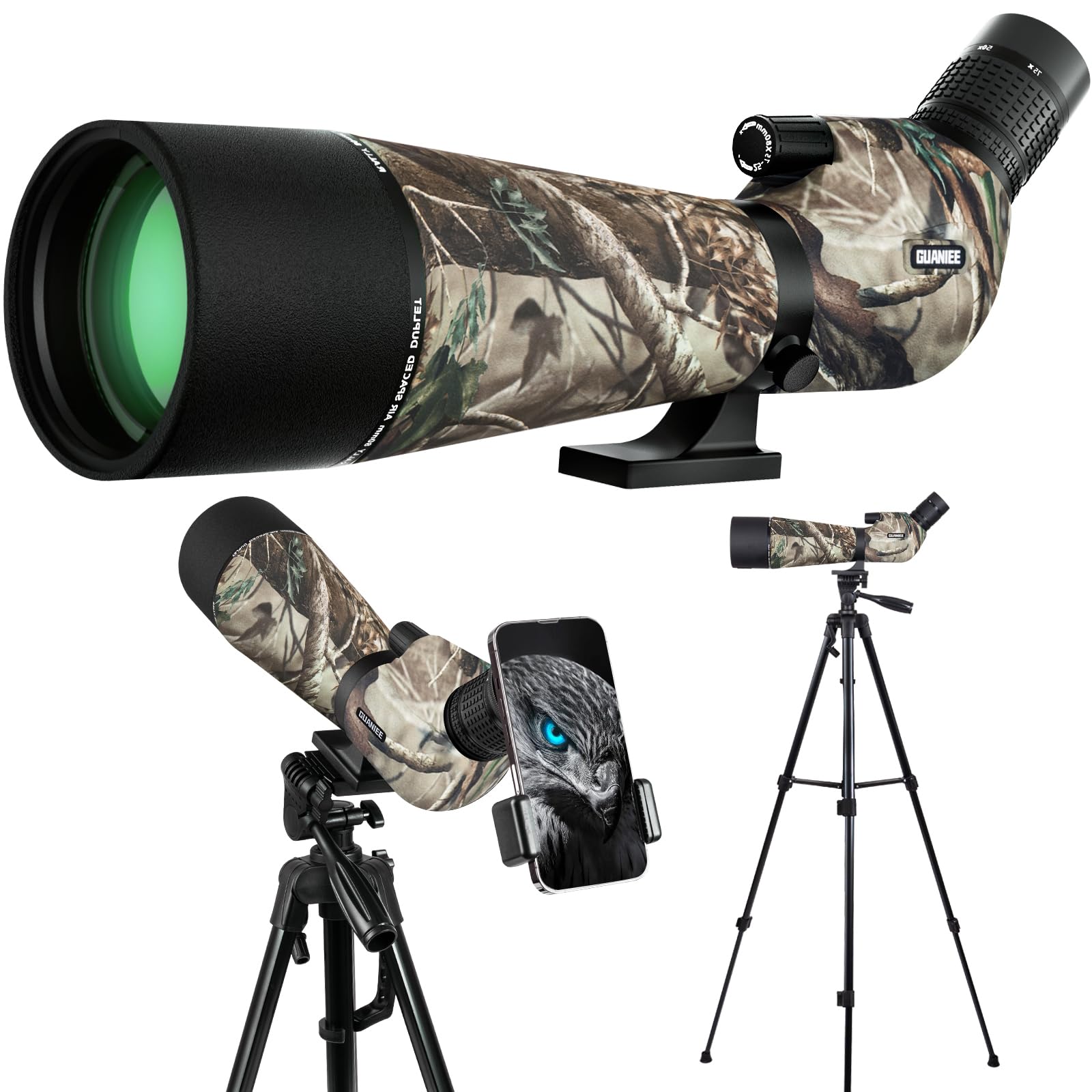
GUANIEE 25-75x80

85 /100
Angler Score Excellent

Key details

Prism
BAK4 roof
Magnification
25-75x
Objective Lens
80mm
Included Tripod
18.3-59.3 in
Check Details on Amazon

Everything about this kit is sized up for the money: an 80mm lens, magnification that runs to 75x, and a tripod that goes from about 18 inches to 59 so you can stand at the bench instead of folding over it. Full height plus that much zoom is unusual at the affordable end of this group.

The glass holds up better than the price suggests. At 50x the image is still bright and readable, with enough detail to sort small birds at distance and to count points on a target face, and the fully multi-coated BAK-4 prism keeps color reasonable in good light.

Handling is where the budget shows. There's a single focus wheel rather than a coarse-and-fine pair, so settling the image at 75x takes a light touch, and the long zoom amplifies any wobble that reaches the head. Set it up, then keep your hands off it while you watch.

We think beginners and casual range shooters get the most from it — it's the least expensive way here to get a full-size tripod under a big lens, and the view at mid power is better than the price suggests. If you glass every weekend, step up to the Gosky or the Vortex for the finer focus and the warranty.

Pros

  • Full-size tripod adjusts 18.3 to 59.3 inches
  • Bright, readable image at 50x
  • Complete kit with bag, adapter and covers

Cons

  • 25x minimum makes close-in birds hard to find
Our verdict

We think it's the best of the affordable kits for standing glassing: a full-size tripod under a big lens for less than the step-up scopes.

Check Latest Price

How We Tested the Best Spotting Scopes in Real Conditions

We started by pulling together the spotting scopes that show up again and again in birder forums, hunter threads, and range-day recommendations, then narrowed the field by magnification range, objective lens size, eye relief, warranty, and price. That left us with 12 scopes to test over eight months. We didn't just set them on a bench and look at a chart—we took them to backyard feeders, a local wetland, and an outdoor shooting range, often in the same week, so each one got used the way a shopper would actually use it.

For image quality and clarity, we looked at feathers on a distant hawk, fine print on a target, and the edge of a sign at dusk, noting whether colors stayed true and whether the center stayed sharp when we zoomed in. We checked field of view by finding a bird or target at low power, then zooming up and seeing how much of the surrounding area disappeared. To judge focus, we timed how long it took to go from a blurry smear to a crisp image, then repeated it with a cold hand and a light glove. Ease of use got the same treatment: we carried each scope from the car, set it up solo, and worked the focus ring while keeping the eyepiece to our eye.

Tripod quality and sturdiness were the reality check. We set each scope up on uneven ground, bumped the tripod legs, and zoomed to the highest power to see how much the image shook. We also weighed each scope and tripod combination after packing it into its case, because a scope that never leaves the closet isn't much use. Value for money came last—we compared what each setup delivered against what it cost, not just which one had the biggest magnification number. The scopes that scored best were the ones that stayed clear, steady, and easy to live with, not the ones with the flashiest specs.

How to Choose a Spotting Scope

Start with the objective lens, not the zoom

Brightness comes from the front lens divided by the magnification, so a 60mm scope cranked to 60x is squeezing a 1mm exit pupil at your eye — dim, fussy and useless in shade. The same 60x through an 80mm lens leaves 1.33mm, and through an 85mm lens 1.42mm, which is the difference between a usable image at last light and a gray smear.

If you glass at dawn, dusk or under heavy overcast, buy the largest objective you're willing to carry: 80mm to 85mm covers a full day. If the scope only comes out at midday on a range, a 60mm or 70mm keeps the weight down without costing you much. This is why we don't chase the highest zoom number on the shelf.

Field of view is what finds the subject

A scope is only as good as your ability to get it on the bird, and that happens at the bottom of the zoom. The Gosky 20-60x85 shows a stated 101 feet of ground at 1,000 yards at 20x; the SVBONY opens at 25x with 64 feet. That narrower starting view is harder to steer onto something moving, which is why a 25-75x isn't automatically more scope than a 20-60x.

Birders and wildlife watchers should favor a 20x bottom end and look for a published field-of-view figure before ordering. Target shooters aiming at a fixed frame can live with 25x happily, and the extra top-end power on a 75x scope is a real advantage on paper and steel.

The tripod decides how much you use it

Here's the trap in almost every budget kit: a tripod is included, but it's a 14-inch table-top model that only works from a bench, a tailgate or a windowsill. Set one up on open ground and you're crouching behind it. Check the maximum height before you buy — standing eye level is around 63 inches, which is what the Gosky's legs reach and what the GUANIEE approaches at 59.

If the included support tops out short, plan on buying a tripod, and look for a scope with an Arca-Swiss foot so it clamps into a standard head without an adapter plate. Vortex fits that standard on both the Crossfire and the Viper. A steady support matters more than another 10x of power you can't hold still.

Warranty and sealing are part of the price

A spotting scope lives outdoors, gets rained on and gets knocked over. Nitrogen or argon purging with O-ring seals keeps fog out of the tube; every scope here claims it, and it's worth confirming rather than assuming. Coverage is where the picks separate sharply: the SVBONY carries 60 days, the Gosky a year, and the Vortex models an unlimited lifetime warranty.

For a scope you'll keep on a truck seat for a decade, that difference is worth paying for. For a first scope or a spare, a short warranty is a fair trade against a low price — just go in knowing which one you bought.

Frequently Asked Questions

Final Verdict

The Gosky 20-60x85 is the scope we point most people toward, because it's the one that arrives ready to use: a tripod that reaches standing height, a wide 20x view that makes finding a subject easy, and enough glass to keep going into the last light of the day.

If you already own a solid tripod, put the difference into the Vortex Crossfire HD instead. Its HD glass, Arca-Swiss mounting and unlimited lifetime warranty are the better long-term buy, and you'll have a support worth putting under it.