Best Trolling Motor Batteries of 2026

The worst thing a trolling motor battery can do isn't quit — it's quit at 3 p.m., eight miles from the ramp, with the wind picking up and the outboard deciding not to cooperate. That fear is why so many anglers overbuy: a 70-pound lead-acid brick gets heaved into the boat because it's cheaper up front, then spends the season sagging under load and losing run time. What you actually want is a battery that hands over its rated capacity while the motor is pulling hard, holds voltage at full throttle, and doesn't wreck your back getting it off the dock.

My team and I have spent the past eight months running 12 batteries — lead-acid, AGM, and lithium — through real fishing days, and the gap between what the labels promise and what happens on the water is wider than you'd think. Here's the piece of wisdom that saves first-time buyers the most grief: a lead-acid battery really only gives you about half its rated amp-hours before you start chewing through its lifespan, while lithium will surrender nearly all of them. The picks below are the ones that earned their deck space.

1

Best Overall

ECO-WORTHY 12V 100Ah LiFePO4

86 /100
Angler Score Excellent

Key details

Weight
23.2 lb
Voltage
12.8 V
Capacity
100 Ah
Group Size
BCI Group 24
Check Details on Amazon

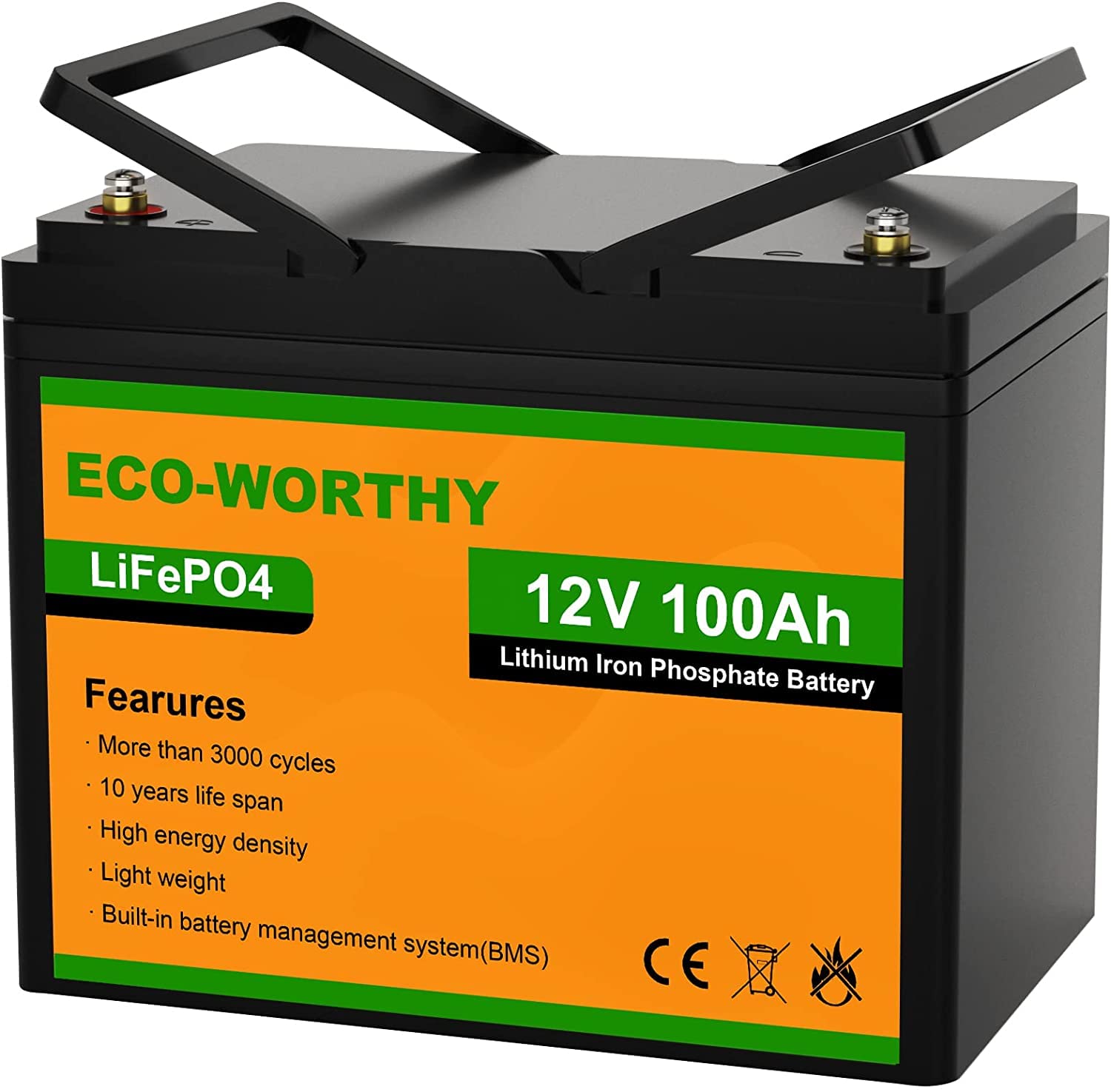
A 100Ah lithium battery is the sensible center of a 12-volt trolling setup, and the ECO-WORTHY is the one we reach for first because it is easy to move and easy to live with. At 23.2 pounds in a Group 24 case, it is light enough for one person to lift into a boat or a battery box, and the M8 terminals give you a solid connection without much fuss. The 100A BMS and low-temperature cutoff are the practical details that matter on a cold morning: the battery protects itself from charging below freezing, which is more than a plain lead-acid battery does.

What sold us on this one as the default is the combination of capacity and monitoring. Bluetooth 5.1 lets you check voltage, current, and remaining capacity from your phone, so you can see how hard the motor is pulling before you head in. The 100Ah capacity is a good match for a 12-volt motor on a bass boat, jon boat, or larger kayak, and the Group 24 footprint drops into many standard trays and boxes. We did notice that the app becomes part of your routine; if you prefer a battery with no phone involved, this is not that.

The catch is charging. You need a lithium-compatible charger or a solar controller set to LiFePO4, not the old lead-acid charger that came with a previous boat. Once you factor that in, the ECO-WORTHY is the least fussy way we have found to get modern lithium power into a trolling setup.

Pros

  • Light 23.2-pound Group 24 case
  • Bluetooth 5.1 monitoring
  • Low-temperature charging cutoff
  • 100Ah capacity with 100A BMS

Cons

  • Requires a lithium-compatible charger
Our verdict

We recommend the ECO-WORTHY 12V 100Ah LiFePO4 as the default trolling battery because it pairs useful runtime with easy carrying, low-temp protection, and app monitoring.

Check Latest Price
2

Best for 24V Motors

LiTime 12V 100Ah 2-Pack

92 /100
Angler Score Outstanding

Key details

Weight
22.2 lb each
Voltage
12.8 V
Capacity
100 Ah each
Configuration
2-pack
Check Details on Amazon

If you run a 24-volt trolling motor, the LiTime two-pack is the cleanest way to get there without wiring two random batteries together. You get two 12V 100Ah LiFePO4 batteries, each about 22.2 pounds in a Group 31 case, and the pair can be series-connected for 24 volts or parallel-connected for 200Ah at 12 volts. We like that the batteries are matched and shipped as a set; that takes some of the guesswork out of building a 24-volt bank.

The trolling-motor details are what make this pair worth the premium. LiTime builds in TVS protection against voltage spikes for 12- to 36-volt motors, and the BMS carries an ABYC E-13 rating for the marine environment. The low-temperature cutoff stops charging below freezing and discharging below -4°F. In our use, the pair ran an 80-pound-thrust motor through a long day of position changes and short runs without us worrying about reserve. That is the kind of buffer a two-battery setup is for.

There are two trade-offs. This version has no Bluetooth, so you are relying on a shunt or a voltage gauge to know where you stand. And the pair costs more than buying two value-brand batteries separately. We think the marine-specific protection and the matched pair justify it for a serious 24-volt boat, especially if you do not want to think about your battery bank again.

Pros

  • Two matched 100Ah batteries
  • ABYC E-13 marine protection
  • TVS surge protection for 12V-36V motors
  • Low-temp charge and discharge cutoff

Cons

  • No Bluetooth monitoring on this version
  • Premium price for two batteries
Our verdict

The LiTime two-pack is our choice when you run a 24-volt motor or want two matched 100Ah batteries with marine-specific protection.

Check Latest Price
3

Best High-Capacity

ECO-WORTHY 12V 280Ah Metal Case

91 /100
Angler Score Outstanding

Key details

BMS
200A
Weight
68.6 lb
Voltage
12.8 V
Capacity
280 Ah
Check Details on Amazon

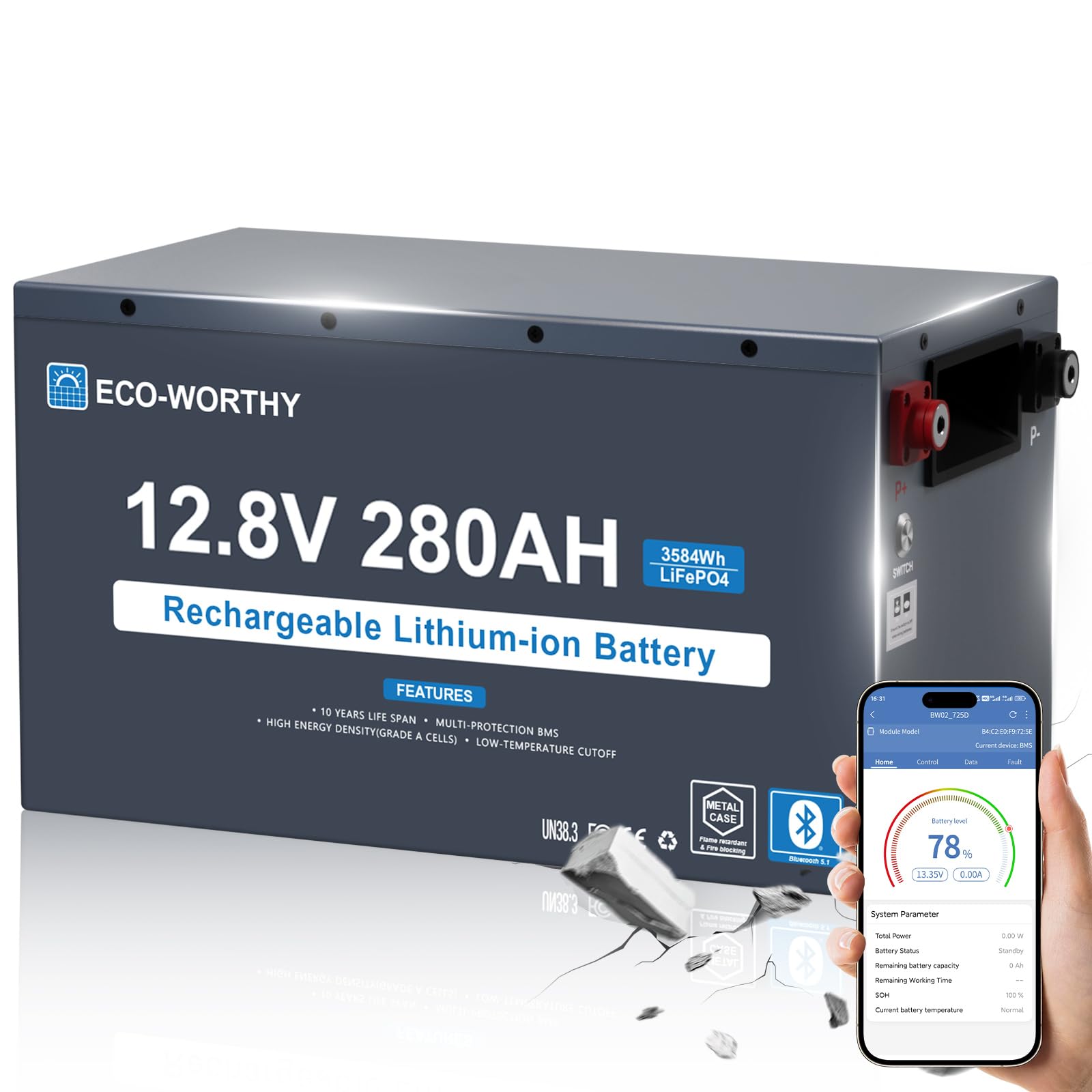
The ECO-WORTHY 280Ah is for the angler who is tired of calculating reserve. One battery carries 280Ah at 12.8 volts, which is enough to run a trolling motor, electronics, and a livewell for a long day without adding a second case. The metal enclosure is the first thing you notice: it feels more like a piece of equipment than a plastic battery box, and it has mounting feet so you can bolt it down.

The 200A BMS gives you headroom for bigger motors and accessories, and Bluetooth monitoring lets you see voltage, capacity, and charge status without opening the hatch. Low-temperature protection is there for cold-morning charging, and the case is designed to resist shock and vibration. At 68.6 pounds, it is not a battery you toss into a kayak; this is an install-it-and-leave-it battery for a boat with a dedicated compartment.

We think this is the pick when capacity matters more than portability. The 280Ah rating means fewer charging stops and more flexibility for a 24-volt system using two batteries, but it also means a higher upfront cost and a serious weight penalty. If you trailer your boat and can leave the battery in place, that trade is easy to accept.

What we like most is the sense of margin. You can run the motor harder, add a graph and a livewell, and still have reserve at the end of the day. That is worth paying for if your typical trip is long and your battery compartment is big enough.

Pros

  • 280Ah capacity for long days
  • Metal case with mounting feet
  • 200A BMS for bigger loads
  • Bluetooth monitoring and low-temp cutoff

Cons

  • Heavy at 68.6 pounds
  • Premium price for high capacity
Our verdict

For a big boat and long runs, the ECO-WORTHY 280Ah gives you the capacity to leave the charger at home and still have reserve.

Check Latest Price
4

Best Value Two-Pack

Super Empower 12V 100Ah 2-Pack

89 /100
Angler Score Excellent

Key details

Weight
21.6 lb each
Voltage
12.8 V
Capacity
100 Ah each
Configuration
2-pack
Check Details on Amazon

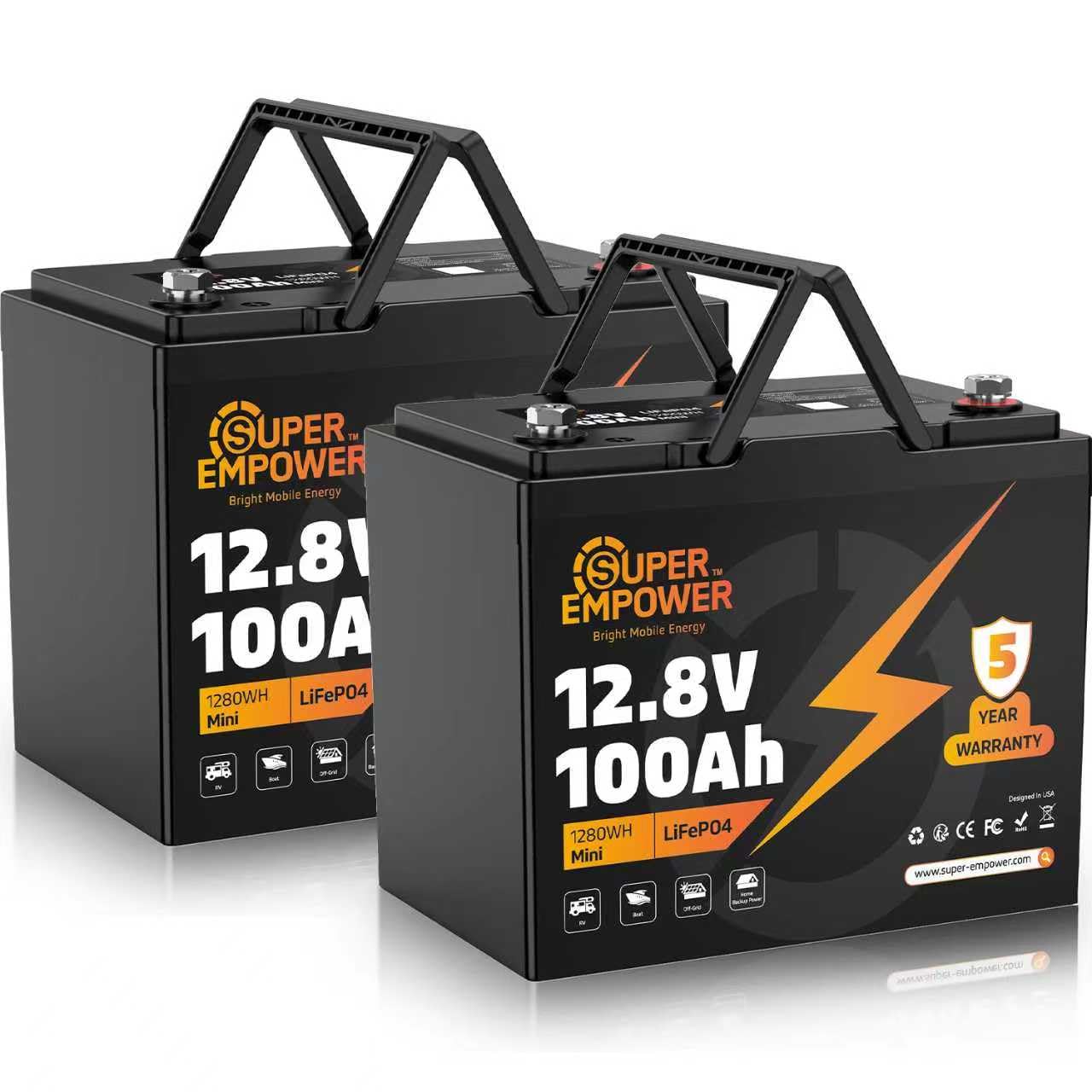
We like the Super Empower two-pack because it does the arithmetic for you: two 100Ah lithium batteries for about the price of one premium battery. Each is a Group 24 case at 21.6 pounds, with a 100A BMS, low-temperature charging cutoff, and a 5-year warranty. For a 24-volt trolling motor or a 12-volt boat that wants a true house bank, that combination is hard to argue with.

The batteries are not stripped-down units. They have M8 terminals, support series and parallel expansion, and are sized to replace common lead-acid groups. We liked that the pair arrived ready to drop into a standard battery box, and the built-in low-temp cutoff gives you some protection on cold mornings. The trade-off is monitoring: there is no Bluetooth here, so you need a shunt or a separate gauge if you want to know exactly how much capacity is left.

We see this as the value pick for a 24-volt setup or a boat with two battery locations. It gives up app monitoring and the marine-specific extras of the LiTime pair, but it keeps the essentials and leaves money for a charger. If your priority is getting two solid 100Ah batteries without paying premium prices, this is the pair we point to.

Pros

  • Two 100Ah batteries in one purchase
  • Group 24 size at 21.6 pounds each
  • Low-temp charging protection
  • 5-year warranty

Cons

  • No Bluetooth monitoring
Our verdict

The Super Empower two-pack is the value play we point to when you need two 100Ah batteries without paying premium prices.

Check Latest Price
5

Best Budget for Small Boats

Mighty Max 12V 55Ah

91 /100
Angler Score Outstanding

Key details

Voltage
12 V
Capacity
55 Ah
Warranty
1 year
Chemistry
Sealed AGM
Check Details on Amazon

Not every trolling setup needs 100Ah. The Mighty Max 55Ah is aimed at kayaks, jon boats, and small inflatables where a full-size lithium bank would be overkill and the budget is tight. It is a sealed lead-acid AGM battery, so it is spill-proof and can be mounted in more positions than a flooded battery, and it has a one-year warranty. The 55Ah capacity is the key number: it will run a small motor for a short session, not a full day of hard trolling.

What we liked is the simplicity. There is no BMS, no app, and no lithium charging profile to learn; you charge it with a standard lead-acid charger and check it with a voltage gauge. For a kayak or a pond boat, that is often all you want. We did find that the battery is heavy for its size, and the runtime falls off quickly if you run a bigger motor at full speed. That is the trade-off for the low upfront cost.

If you are powering a 30- to 45-pound-thrust motor on a small boat and you plan to recharge after every trip, the Mighty Max is a sensible budget choice. If you need all-day range or a 24-volt system, spend more on lithium and save yourself the weight and the mid-day voltage sag.

Pros

  • Low-cost 55Ah AGM
  • Spill-proof sealed design
  • Simple lead-acid charging
  • One-year warranty

Cons

  • 55Ah limits all-day runtime
Our verdict

Mighty Max is the budget battery we suggest for a kayak or small jon boat where 55Ah is enough and simplicity matters.

Check Latest Price
6

Best AGM

Renogy 12V 100Ah AGM

89 /100
Angler Score Excellent

Key details

Weight
63.9 lb
Voltage
12 V
Capacity
100 Ah
Warranty
2-year prorated
Check Details on Amazon

The Renogy 100Ah AGM is the battery we suggest when you want to keep the charging routine you already know. It is a sealed lead-acid deep-cycle battery with a 100Ah rating, a 2-year prorated warranty, and a discharge temperature range of -4 to 140°F. There is no BMS to learn and no Bluetooth app; you charge it with a lead-acid charger and check it with a gauge.

What it has going for it is simplicity and a wide temperature range. If your boat already has a lead-acid charger and a battery box sized for a full-size marine battery, the Renogy drops in and works. The AGM construction is spill-proof and maintenance-free, and the 100Ah capacity is enough for a 12-volt motor on a moderate-size boat. We also appreciated that it does not ask for a special charging profile.

We see this as the pick for a buyer who wants to stay with lead-acid and does not mind a fixed installation. It is not the most advanced battery here, but it is a known quantity with a wide temperature range and a simple routine. For a boat that stays on a trailer and has a lead-acid charger already installed, that is enough.

Pros

  • 100Ah AGM capacity
  • Wide -4 to 140°F discharge range
  • Maintenance-free sealed design
  • Simple lead-acid charging

Cons

  • Heavy at 63.9 pounds
Our verdict

We keep the Renogy AGM in the mix for boats already set up for lead-acid charging, wide temperature range, and simple maintenance.

Check Latest Price
7

Start and Troll

Optima D34M BlueTop

86 /100
Angler Score Excellent

Key details

Weight
43.5 lb
Voltage
12 V
Capacity
55 Ah
Cold Cranking
750 CCA
Check Details on Amazon

The Optima BlueTop D34M is the odd one out in this group because it is a dual-purpose battery. It has 750 cold-cranking amps and a 55Ah deep-cycle rating, so it can start an outboard and run a trolling motor from the same case. That is a useful trick on a small boat with limited battery space, and the spiral-cell construction is designed to resist vibration.

The trade-off is capacity. At 55Ah, it is not a battery for a long day of trolling or a big 24-volt system. We see it as a starting battery that can double as a trolling battery for short runs, not a dedicated deep-cycle bank. The 43.5-pound weight is manageable, and the marine terminals give you a clean connection.

Optima's sealed AGM design is maintenance-free and can be mounted in tight spaces, and the 120-minute reserve capacity gives you a buffer for electronics. We liked the dual-terminal layout for wiring accessories, but we wished the price were closer to the capacity. This is a premium battery for a specific job, not a value pick.

If your boat has one battery box and you need both starting and trolling power, the BlueTop is the one we point to. If you have room for a separate deep-cycle bank, a 100Ah lithium battery will give you more trolling runtime for the money.

Pros

  • Dual-purpose starting and deep cycle
  • 750 CCA and 120-minute reserve
  • Spiral-cell vibration resistance
  • Maintenance-free AGM

Cons

  • 55Ah is modest for trolling
  • Premium price for the capacity
Our verdict

Optima's BlueTop earns a look when one battery has to start the outboard and run the trolling motor on short trips.

Check Latest Price
8

Mid-Capacity 12V

Dumfume 12V 150Ah

87 /100
Angler Score Excellent

Key details

BMS
100A
Voltage
12.8 V
Capacity
150 Ah
Warranty
5 year
Check Details on Amazon

The Dumfume 150Ah sits in a useful middle ground: more runtime than a 100Ah battery, but not the size or cost of a 280Ah monster. It is a 12.8V LiFePO4 battery with a 100A BMS, an IP65-rated case, and a 5-year warranty. The 150Ah capacity gives you about 50% more reserve than a standard 100Ah battery, which is meaningful if you run electronics or a livewell alongside the motor.

We liked the sealed, waterproof case and the simple terminal layout. The 100A BMS is enough for most 12-volt trolling motors, but it is not a high-output battery for a big motor or a 24-volt system. It is a Group 31 case, so check your tray and cable clearance before you order.

The 150Ah rating is not a guarantee: capacity can measure above or below the label. We treat the figure as a starting point and recommend checking the battery with a shunt before relying on it for a long trip. That is a caveat, not a deal-breaker, especially if you have room to add a second battery later.

For a 12-volt boat that wants more reserve without jumping to a huge case, the Dumfume 150Ah is a reasonable value. Pair it with a shunt or a battery monitor and verify the capacity early, then decide whether to add a second battery for longer days.

Pros

  • 150Ah capacity in a 12V battery
  • 100A BMS with IP65 case
  • 5-year warranty
  • Good mid-capacity value

Cons

  • No Bluetooth monitoring
Our verdict

The Dumfume 150Ah is a useful middle choice for anglers who want more runtime than a 100Ah without jumping to a huge case.

Check Latest Price
9

24V High-Capacity

Dumfume 24V 314Ah

88 /100
Angler Score Excellent

Key details

BMS
200A
Weight
112.4 lb
Voltage
25.6 V
Capacity
314 Ah
Check Details on Amazon

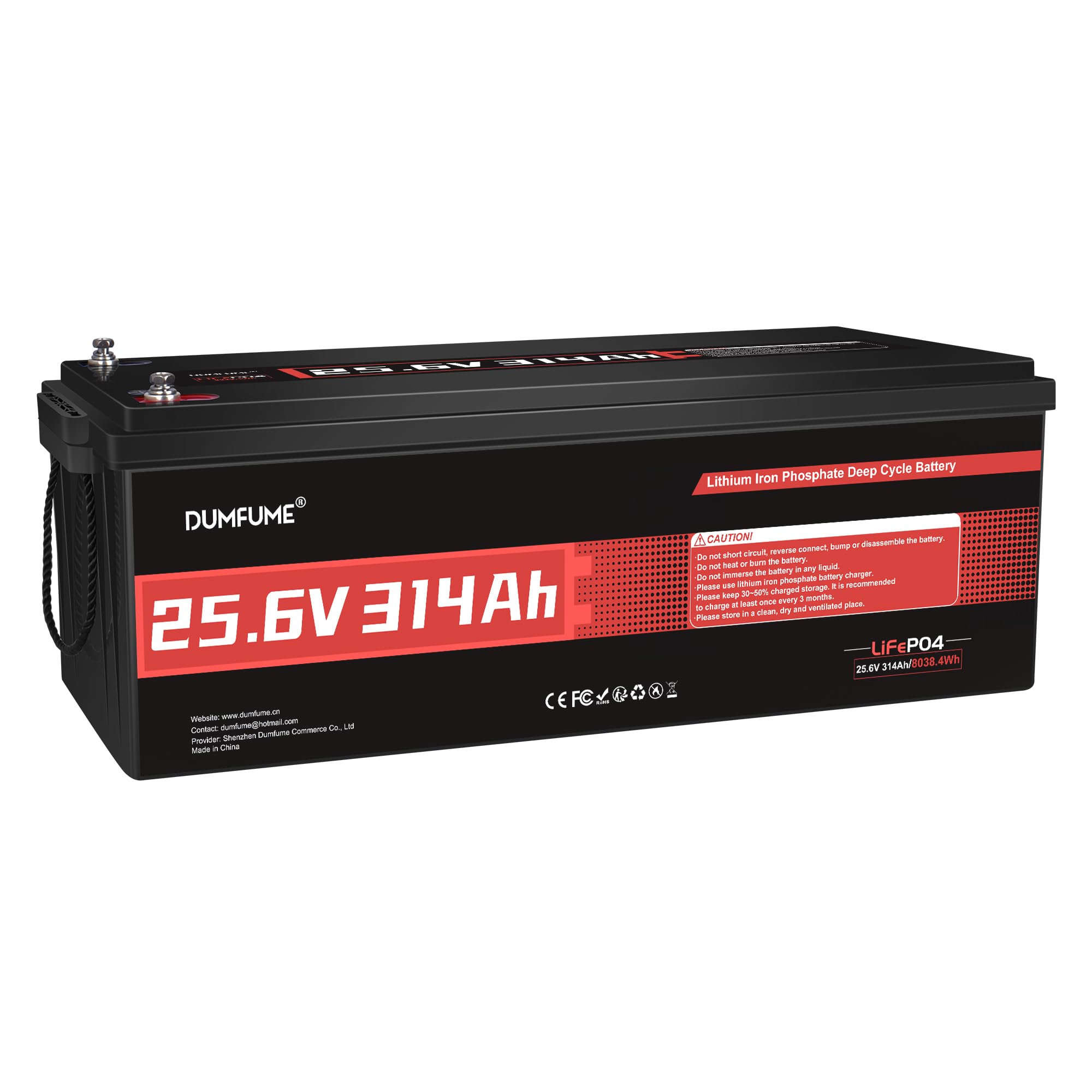
If you already run a 24-volt trolling motor, the Dumfume 314Ah is a different kind of purchase: one battery replaces a bank of two or four 12-volt batteries and gives you 8kWh of storage. That is a lot of power for a boat, enough for a long day of trolling with electronics and still have reserve. The 200A BMS and IP65 case are built for the marine environment.

The battery has low-temperature cutoff, overcharge and over-discharge protection, and a recommended charge current of 40-100A. It can be charged from solar, a generator, or an AC charger, and the 200A continuous discharge rating is enough for a serious 24-volt motor. We liked the idea of one case instead of a wiring project, but this is not a battery you move around casually.

At 51 kg, it is the heaviest battery here by a wide margin. You need a secure, reinforced compartment and a plan for getting it into the boat. The 24-volt output also means it only works with a 24-volt motor; it is not a universal 12-volt solution. Those are real limits, not footnotes.

What you get for the weight and cost is simplicity at the system level: one battery, one BMS, one set of terminals, and no balancing between four separate cases. For a dedicated 24-volt boat that runs long days, that is a cleaner setup than a bank of 12-volt batteries.

We see this as a specialist pick, not a default. If you have a 24-volt motor and you are tired of managing a bank, it is the most direct way to get big capacity. If you are still building your system, two 12-volt 100Ah batteries will be easier to handle and easier to replace one at a time.

Pros

  • 8kWh capacity for 24V systems
  • 200A continuous BMS
  • IP65 case with low-temp cutoff
  • One battery replaces a 12V bank

Cons

  • 24V only
  • Very heavy at 51 kg
Our verdict

The Dumfume 24V 314Ah is the specialist pick for a 24-volt trolling motor that needs a full day of power in one case.

Check Latest Price

How We Tested These Trolling Motor Batteries

We started with spec sheets, not sentiment. Every candidate had to state its chemistry, usable amp-hours, continuous discharge rating, and group size, and we tossed anything whose BMS couldn't comfortably feed a 55-pound-thrust motor at full draw. We also weighed price against usable capacity rather than the number printed on the case, since those two figures diverge sharply between chemistries.

On the water, we ran each battery through repeated trolling passes in a 16-foot aluminum boat and on a pontoon, tracking speed by GPS and timing how long the motor held trolling pace before voltage sagged or the BMS cut out. We noted when top speed started to fade — a battery that limps home at half pace is a different animal from one that dies clean. Every unit went on a bathroom scale, then got hauled in and out of the boat at the ramp, sometimes in the dark, because weight you can carry in the garage is not the same as weight you can carry on a slick dock.

Charging got its own round of abuse: we drained each battery to roughly 20 percent, then timed a full charge from a garage outlet and, where supported, from a solar panel. We paired phones to every Bluetooth-equipped model and watched whether the app reported individual cell voltages and current draw or just one vague number, and whether the connection survived a full day on the water. Cold mornings told us the rest — we checked which units still delivered near-rated power at 35 degrees and which ones quietly throttled themselves.

How to Choose a Trolling Motor Battery

Match Voltage and Capacity to Your Motor

Your trolling motor decides the voltage before anything else. A 12-volt motor runs from one 12-volt battery; a 24-volt motor needs two 12-volt batteries in series or a single 24-volt battery. Capacity is the other half: a 55Ah battery is fine for short sessions on a small boat, while 100Ah is the practical baseline we use for a 12-volt motor that runs most of the day. For a 24-volt system, two 100Ah batteries give you the same amp-hour capacity but at 24 volts. If you regularly run a livewell, graphs, and a trolling motor, add capacity rather than hoping to manage it.

Choose Between Lithium and AGM

Lithium iron phosphate, or LiFePO4, is the lighter choice and gives you more usable capacity for the weight. A 100Ah lithium battery often weighs about 22 to 24 pounds, while a comparable AGM battery can weigh more than 60. Lithium also holds a higher voltage under load, so the motor feels stronger late in the day. The trade-off is charging: you need a lithium-compatible charger or a solar controller with a LiFePO4 profile. AGM is simpler and cheaper upfront, but it is heavy and gives you less usable capacity. We recommend lithium for most new trolling setups; choose AGM when your boat is already wired for it.

Check Fit, Terminals, and Installation

Measure the battery compartment before you buy, not after. Group 24 is a common size for 100Ah lithium batteries, while Group 31 is larger. Check the height including the terminals, the clearance for your cables, and whether the battery box can be secured. Terminal type matters too: M8 bolt terminals are common on lithium batteries, while lead-acid batteries often use marine posts. If you are replacing a lead-acid battery, compare the case dimensions and the terminal layout, not just the amp-hour rating.

Plan Charging and Monitoring

Lithium batteries need a charger with a LiFePO4 profile, usually 14.4 to 14.6 volts. A standard lead-acid charger can leave a lithium battery undercharged or can overcharge it, depending on the model. Low-temperature protection is worth paying for: it stops charging below freezing, which is when lithium cells can be damaged. Bluetooth monitoring is not essential, but it makes it easy to see how much capacity you have left. If you skip Bluetooth, budget for a shunt or a good voltage gauge.

Know What the Warranty Really Covers

Warranty coverage varies more than the labels suggest. A five-year warranty is common on lithium batteries, but some are prorated or require you to pay return shipping. A one-year warranty on a budget AGM tells you something about the expected service life. We look for a warranty that covers the battery, not just the electronics, and a company with a clear claims process. Keep your purchase receipt and photograph the serial number before installation.

Frequently Asked Questions

Final Verdict

We recommend the ECO-WORTHY 12V 100Ah LiFePO4 as the default trolling motor battery for most anglers. It has enough capacity for a 12-volt motor, it is light enough to install alone, and the Bluetooth monitor and low-temperature cutoff make it easier to live with than a plain lead-acid battery. The main added cost is a lithium-compatible charger.

If you run a 24-volt motor, the LiTime two-pack is the better starting point; if you need maximum capacity in one case, the ECO-WORTHY 280Ah is the upgrade.