
Best Wood Burning Camp Stoves of 2026

A wood-burning camp stove is basically a chimney you can fold up: twigs drop in the top, air gets pulled through the bottom, and a handful of deadfall turns into a rolling boil. There's no canister to buy, none to haul home half full, and nothing to sputter out on a frosty morning. What the design doesn't do is sort itself out. The gap between a stove that boils water in six minutes and one that smolders while you keep shoving twigs at it comes down to the feed port, the door, and how much steel sits between the fire and your fingers.

Weight is the first thing I check, having once lugged a heavy stove up a ridge and regretted every ounce of it, but light means nothing if the legs fold the second weekend. The classic first-timer's mistake is blaming the stove for bad fuel, since wet twigs or logs too fat for the port will smoke out any design. We've spent eight months cooking on 14 of these, and the ones worth carrying are down below.

1

Best Overall

REDCAMP Wood Burning Folding Camp Stove

91 /100
Angler Score Outstanding

Key details

Fuel
Wood, twigs, leaves
Weight
1.9 lb
Material
Stainless steel
Folded Size
8.3 x 5.9 x 1.5 in
Check Details on Amazon

Folded, this stove is an inch and a half thick - roughly the depth of a paperback and narrow enough to slide behind a car seat. That flat pack is why it ends up on trips where cooking on wood was never the plan.

We think it's the best all-rounder here because it doesn't make you choose between carrying it and cooking on it. At 1.9 pounds it's light enough for a few miles of trail, and the boxy stainless frame gives a genuinely flat platform for a pot instead of three spindly arms to balance on. It unfolds from a flat bundle into a cuboid firebox, with a stainless grid holding the fuel off the base so air gets underneath.

The front door is generous enough to push sticks in without lifting the pot, and it burns twigs, leaves, or split wood with no insert or conversion. Two things to do before the first burn: peel off the protective film the panels ship with, and check the hinge pins, which can work loose and are the easiest part of the stove to lose.

What keeps it in the rotation for us is the fuel range. Pinecones and dead twigs on the trail, charcoal at a drive-in site, and the same stove handles both without complaint. It's the one we keep packed in the truck with a bag of briquettes sitting next to it.

Pros

  • Folds to 1.5 inches with its own bag
  • Boxy frame steadies a full pot
  • Burns twigs and leaves, no fuel to carry
  • Inexpensive enough to keep as a spare

Cons

  • 1.9 lb is more than an ultralight kit wants
Our verdict

If you want one wood stove for weekends and overnights, this is the one we hand people: light enough to carry, steady enough for a full pot, and cheap enough to leave in the car.
Check Latest Price
2

Best Ultralight

Kuvik Titanium Wood Stove

90 /100
Angler Score Outstanding

Key details

Weight
6.88 oz
Material
Grade-1 titanium
Open Size
6.25 x 5 x 5 in
Packed Thickness
0.2 in
Check Details on Amazon

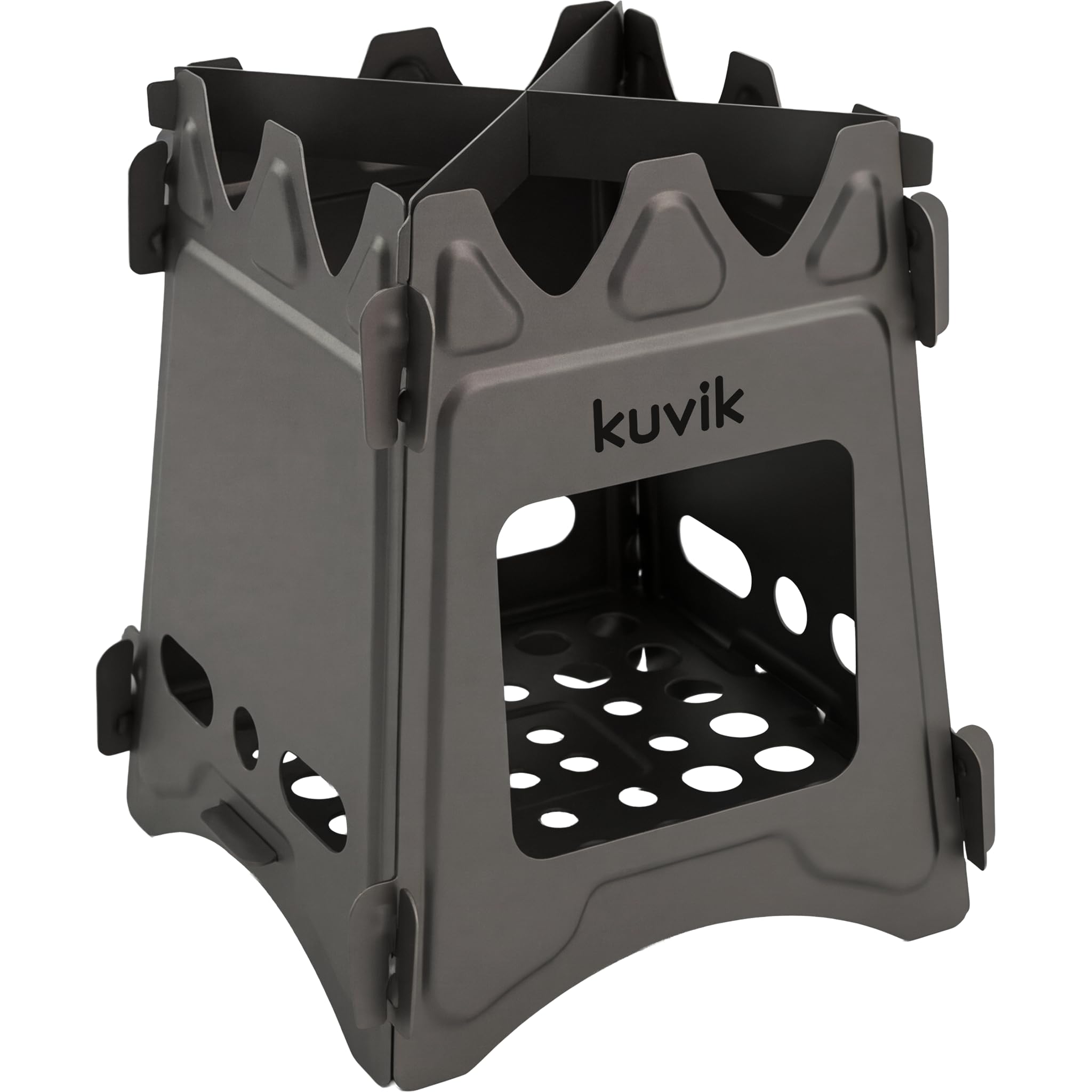
Six point eight eight ounces. That number decides the whole review: lighter than most water bottles, collapsing to a fifth of an inch, which is thinner than the phone in your pocket. If you're counting grams on a long trail or building a bug-out bag, this is where we'd start - except we don't have to hedge, because the titanium build backs the figure up.

Grade-1 titanium panels are stiff enough to hold a pot without feeling like foil, and titanium doesn't corrode if the stove goes away damp. Setup is tabs into slots: no tools, no hinges, nothing to lose in the dark. It becomes a small freestanding fire pit with an opening on one side for feeding.

The firebox is small and that is the trade. You feed pencil-thin twigs every few minutes rather than loading branches, and a one-liter pot or a kettle suits it better than a wide skillet. What you get back is a stove that vanishes into a pack and lets you cook dinner without carrying any fuel at all.

Pros

  • 6.88 oz and packs to 0.2 in
  • Grade-1 titanium resists corrosion
  • Tabs into slots, no tools or hinges
  • Carry pouch included

Cons

  • Small firebox needs near-constant feeding
  • Suits small pots better than wide pans
Our verdict

We recommend this to anyone counting ounces - under seven of them buys a stove that disappears into a pack and still holds a pot of water.

Check Latest Price
3

Best Rocket Stove

GODSAX Rocket Stove

89 /100
Angler Score Excellent

Key details

Body
1.8 mm steel
Weight
5.62 lb
Included
Bag, gloves, ash shovel
Top Load Rating
130 lb
Check Details on Amazon

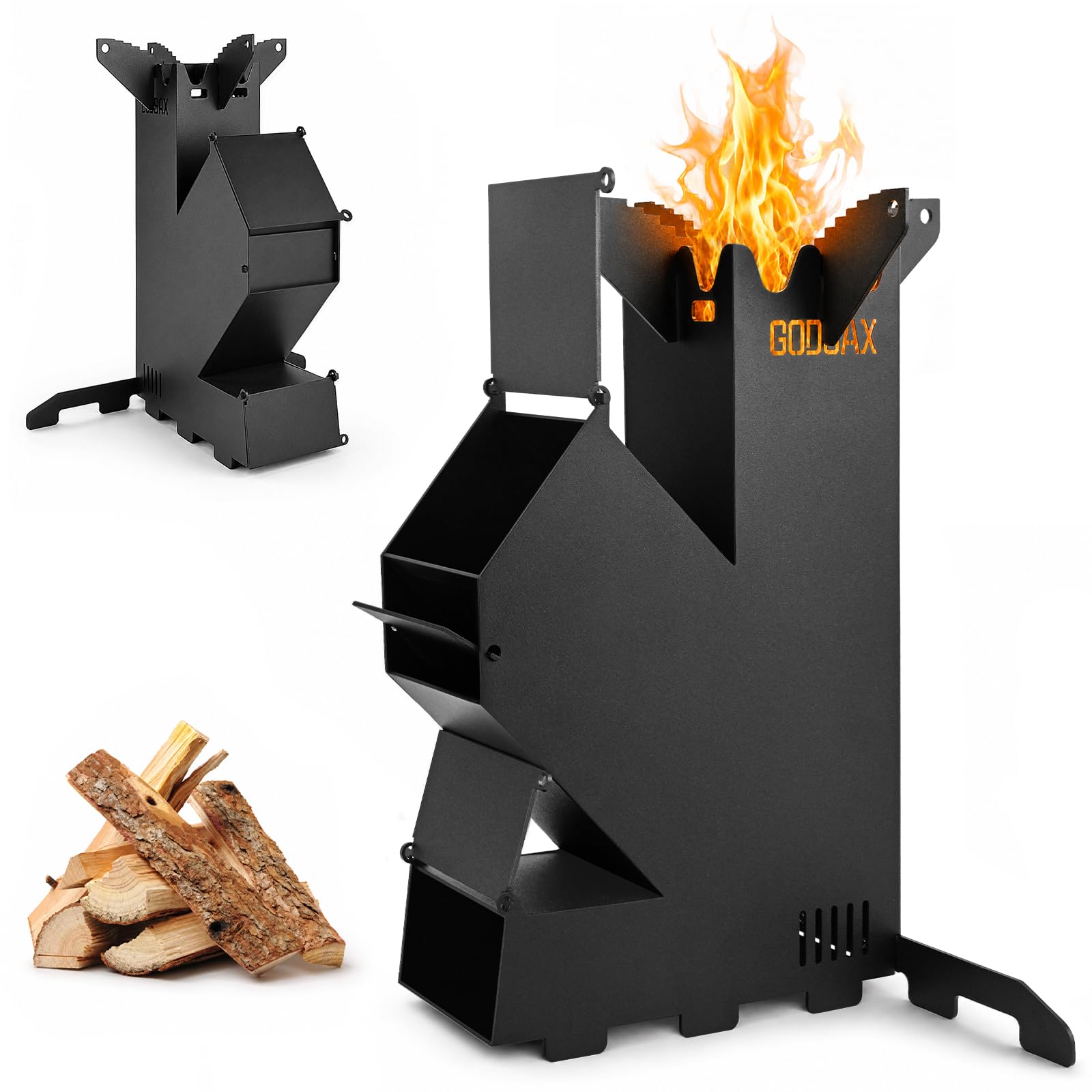
A rocket stove does the job a bellows used to. The chimney effect pulls cold air in at the base, drives it up through the burning twigs, and concentrates the flame right under the pot instead of letting heat wander off sideways. That's the difference between a stove that boils on two handfuls of sticks and one that needs a proper fire.

The body is 1.8 mm steel rated to take 130 pounds on top, with an anti-tip stabilizer that keeps the cooking platform level on lumpy ground. The chamber is sloped so ash drops clear of the burning fuel, and the kit includes a small ash shovel, gloves, and a storage bag that measures roughly ten by fifteen inches.

We think this is the rocket stove for a car-camping kitchen - a basecamp tool rather than a backpacking one. In exchange for the weight you get a wide, steady top that will hold a skillet and a coffee pot at once, and enough output to feed three or four people. The coating gives off a faint smell on the first burn or two, which is normal and passes.

Pros

  • Chimney draft burns twigs hot and fast
  • Rated for 130 lb on the cooktop
  • Sloped chamber sheds ash as it burns
  • Ships with gloves, ash shovel, and bag

Cons

  • Paint can flake around the firebox
  • Coating smells on the first few burns
Our verdict

Our pick for a car-camping kitchen: a wide, stable top, a hard-drafting firebox, and enough heat to cook for four without babysitting the flame.

Check Latest Price
4

Best for Group Cooking

EcoZoom Rocket Stove

91 /100
Angler Score Outstanding

Key details

Fuel
Charcoal or wood
Size
12 x 11 x 12.5 in
Weight
14.5 lb
Cooktop
Three-prong cast iron
Check Details on Amazon

This is the stove for the person who ends up cooking for everyone. The three-prong cast iron top takes flat and round-bottomed cookware - a Dutch oven, a big skillet, a stock pot - and the insulated body keeps the heat in the firebox instead of radiating it onto your shins.

We'd take it over the lighter rockets whenever the stove is staying close to the car, and the insulation is the reason. It holds temperature between feedings, so a pot keeps simmering while you gather more wood, and the stainless handles wear silicone grips that stay cool enough to shift the stove mid-cook.

At 14.5 pounds of stainless steel and refractory lining, this is a tailgate and basecamp stove, and it will burn charcoal as readily as twigs - the combination we'd want in a storm kit. There's no gas, no canister, and nothing electronic to fail.

Where it earns its keep is the second hour. A canister runs out; this one keeps cooking as long as there's dry wood within walking distance, which is the whole argument for keeping a wood stove around when the power goes.

Pros

  • Insulated body holds heat between feedings
  • Cast iron trivet takes heavy cookware
  • Silicone grips stay cool to the touch
  • Burns charcoal or wood with no fuel canisters

Cons

  • Needs to cool before it can be packed away
  • Wide 12-inch footprint on a small site
Our verdict

Spend the money if the stove stays near the vehicle - nothing else here holds heat through a long cook or takes a Dutch oven as comfortably.

Check Latest Price
5

Best Cast Iron Build

Lineslife Wood Burning Camp Stove

87 /100
Angler Score Excellent

Key details

Weight
7 lb
Material
Cast iron
Open Size
8.7 x 8.7 x 13.8 in
Folded Size
9.4 x 9.4 x 4 in
Check Details on Amazon

Seven pounds of cast iron is the wrong answer for a backpack and close to ideal for a truck bed. We like this one for the camper who wants a firebox that feels like a firebox: no flex in the panels, no wobble under a heavy pot, and a body that keeps giving off heat after the flame drops.

It's a folding box stove with sixteen air vents feeding the combustion chamber, and the pot holders adjust so a small kettle and a wide pan both sit level. The legs rotate and fold, and the whole thing comes apart into a package about four inches deep, with a carry bag included.

Cast iron buys stability and heat retention and charges you weight and a slower warm-up in return. This is a stove you set up for a weekend rather than one you unpack at every lunch stop, and it runs just as happily on charcoal as on deadfall - a good match for a site with a fire ring and a bag of briquettes.

Pros

  • Cast iron body stays rigid under heavy pots
  • Sixteen air vents feed a hot fire
  • Adjustable pot holders fit mixed cookware
  • Folds to a 4-inch-deep package with bag

Cons

  • Slower to come up to heat than steel stoves
Our verdict

Buy it for the weight: this is the folding stove that feels like a small wood range, and it is happiest left in the truck between trips.

Check Latest Price
6

Best Double-Wall Design

TOMSHOO Folding Wood Burning Stove

88 /100
Angler Score Excellent

Key details

Fuel
Wood or alcohol
Weight
1 lb
Material
Stainless steel
Packed Size
5.4 x 2.8 in
Check Details on Amazon

Double walls are the interesting part. Air drawn between the outer and inner shell gets preheated on its way to the fire, so the wood at the top of the chamber burns rather than smolders - gasifier logic in a pound of stainless steel. In practice that means flame instead of a column of smoke in your face.

It folds to 5.4 by 2.8 inches and rides in a mesh sack, and the wide front opening lets you push sticks in without taking anything apart. The serrated cross stand grips a billy can, there's a grill for skewers, and the same body is listed to run on alcohol as well as wood.

We think this is the best stove here for one or two people who want a real flame without building a fire pit. The catch is capacity: it burns through a load of twigs quickly, so you'll be feeding it while the water heats. Keep a pile of pencil-to-thumb-sized sticks within reach and it barely registers as work.

Pros

  • Double wall burns twigs with less smoke
  • 1 lb and folds into a mesh sack
  • Wide front opening for feeding sticks
  • Runs on wood or alcohol

Cons

  • Small cooktop lets a wide pan overhang
Our verdict

The best flame-per-ounce here - we like it for solo trips where a clean burn matters more than a big cooktop.

Check Latest Price
7

High-Heat Cooking

IronClad Supply Rocket Stove

91 /100
Angler Score Outstanding

Key details

Fuel
Twigs, branches, charcoal
Cooktop
Six-prong cast iron
Included
Canvas storage bag
Heat Output
Up to 23,000 BTU
Check Details on Amazon

Two rocket stoves here cost roughly the same, and the difference is what sits on top. IronClad fits a six-prong cast iron grate - more contact points than a three-arm trivet and more air under the pan, which is what you want for a wok or a Dutch oven that needs heat around the sides as well as underneath.

The burner is rated to 23,000 BTU, and heat-resistant silicone handles mean you can reposition the stove without waiting for it to cool. The canvas bag does double duty as a firewood carrier, a small thing that turns out to matter when you're gathering sticks.

The cast iron top is what makes it feel like a cooker rather than a camp gadget, and it's the part to look at on arrival: it's bolted to the base, so check those fasteners before the first fire. One unit turning up with a loose top is the kind of thing you fix in a minute and never think about again.

Our pick between the two premium rockets depends on how you cook. IronClad is the one for high heat and short work - steaks, stir-fries, a fast boil - while the EcoZoom's insulated cylinder does more for a pot that needs to sit and simmer. Buy this one for the grate and the wide flame.

Pros

  • Six-prong cast iron grate steadies big cookware
  • Up to 23,000 BTU of claimed output
  • Silicone handles stay cool to the touch
  • Canvas bag doubles as a wood carrier

Cons

  • Bag stitching can come apart
  • Too heavy to carry any distance
Our verdict

Worth the money if you want cast iron under a wok and a rocket that runs flat out - just accept that it stays near the truck.

Check Latest Price
8

Daypack Backup

CAMPMAX Folding Wood Stove

86 /100
Angler Score Excellent

Key details

Fuel
Twigs, coal, spirit burner
Weight
2 lb
Material
304 stainless steel
Folded Size
5.5 x 1.5 x 8.3 in
Check Details on Amazon

Packed, it's about the size of a thick paperback: 5.5 by 1.5 by 8.3 inches, two pounds, in its own bag. That's the sort of footprint that lets a stove live in a daypack instead of a garage shelf, and it's the reason this one gets taken along on trips that aren't really camping trips.

The cooking surface is a 304 stainless grill grid that spreads heat across the bottom of a pot, and the body opens like a book with a front-loading door. It takes twigs, branches, leaves, coal, or a spirit burner, so it keeps working when there's no dry wood within reach.

Two pounds is pack weight, not basecamp weight, and the firebox is sized to match: a six-inch pan covers the entire cooking surface, so plan on a billy can or a small skillet rather than dinner for four. Set up is seconds - open it out, drop the grid in, close the door.

There's nothing to adjust and nothing electronic, which is most of the appeal. We think it makes a good first wood stove, or a spare to keep in the car for the evening the canister runs out halfway through dinner.

Pros

  • Folds to paperback size in its own bag
  • 304 stainless grill grid spreads heat
  • Burns twigs, coal, or a spirit burner
  • Two pounds packed

Cons

  • Door handle feels flimsy
Our verdict

A sensible first wood stove: it folds to paperback size, lights easily, and asks nothing of you beyond dry twigs and a small pot.

Check Latest Price

How We Tested Wood-Burning Camp Stoves

We started with every folding, wood-burning stove we could find that a person could reasonably carry, from thin titanium models to rocket stoves with built-in fans to a couple of cast iron units meant for base camp rather than the trail. We cut the list by packed size, stated weight, and whether a real carry bag and replacement parts came standard, then bought 14 of them. Testing ran eight months.

Most of it happened where these stoves actually live: a gravel pad behind the house on weeknights, three car-camping weekends, two overnight backpacking trips, and one gusty weekend when the wind never dropped below 15 mph. We weighed each stove on a kitchen scale, then weighed it again in its bag, and packed every one into a 30-liter pack beside a sleeping bag and two days of food to see what it crowded out. Boil tests used two cups of water with the lid on; we timed the climb to a rolling boil and counted how many times we had to feed twigs to get there.

Build quality got the least glamorous work. We tipped each stove over on packed dirt, dropped the folded ones from waist height onto rock, and after every trip checked hinges for wobble, welds for hairline cracks, and legs for bends. Wearing gloves, we opened doors and adjusted feed ports one-handed, because that's how you'll do it at 7 a.m. with cold fingers. Value came down to whether the cheapest stoves needed extra accessories before they worked at all, and size was the sleeper issue: a stove that folds flat but won't slide into a pack's side pocket ends up strapped outside, snagging every branch on the way in.

How to Choose a Wood Burning Camp Stove

Start With How Far You're Carrying It

Weight and packed size narrow the field before anything else matters. Under a pound gets carried without a second thought; the two-pound folding boxes are easy in a daypack and noticeable on a long climb; past five pounds you're looking at a stove that lives in a vehicle, not on your back. We put more stock in folded thickness than in the last ounce, because a stove that packs to 1.5 inches slides into a laptop sleeve while a four-inch box has to be built around. Measure both before you commit to anything.

Match the Cooktop to the Pots You Actually Use

A wood stove is only as good as the pot it holds. A flat stainless grid gives the widest contact under a skillet; three or four prongs take a round-bottomed pot or kettle; a small serrated cross stand is perfect for a billy can and marginal under a wide pan. If you cook real meals rather than boiling water, look at the size of the platform and what it's rated to carry - the cast iron tops here will sit a Dutch oven, while the sub-two-pound stoves are sized for one or two people. A pan that overhangs the firebox loses heat and tips.

Know How the Firebox Burns

Three designs cover this group. Straight box stoves are the simplest: fuel sits on a grid, air comes in through the sides, and you feed by hand. Rocket stoves add a chimney that pulls a hard draft through the fuel, which burns thin sticks hotter and faster. Double-wall gasifiers route preheated air above the fire so the smoke itself burns, which is the idea behind the TOMSHOO. The everyday difference is feeding frequency and smoke: a rocket wants a steady handful of thin sticks, a box takes chunkier pieces, and a gasifier is kinder to your eyes.

Setup and Takedown With Cold Hands

Most of these go together without tools, but the routine differs. Hinged panels unfold in one movement; tab-and-slot titanium needs the tabs lined up in the right order; bolted bodies take longer and hold together better once they're up. Practice once at home in good light, then count the parts - hinge pins and small pins vanish in leaf litter, and a stove that can't be assembled is a heavy thing to carry. Gloves protect you from hot metal but cost you dexterity, so favor a design you can work bare-handed.

Build Quality and What Wears Out

Thin steel is light and warps; cast iron is heavy and doesn't. Between those extremes, the parts that fail first are the ones that move - hinge pins work loose, painted finishes flake around the firebox after repeated hot burns, and carry bags give out before stoves do. Buy for the number of burns you'll actually do. A handful of weekends a year suits a budget stainless folder; a stove that gets lit most weeks in the same truck bed earns the extra weight of thicker steel or cast iron.

Frequently Asked Questions

Final Verdict

Buy the REDCAMP if you want one stove that covers both a short backpacking trip and a car-camping weekend. It's the one here that's genuinely light enough to carry, steady enough for a full pot, and inexpensive enough to keep packed in the trunk without a second thought.

Change the requirement and the answer changes with it: the Kuvik takes over whenever every ounce counts, and the GODSAX or the EcoZoom is the better buy once the stove stops traveling on your back and starts living in the truck.