Best Boat Cleats of 2026

A cleat is a deceptively simple piece of hardware: a horn, a base, and a few holes. It only earns its keep in the ten seconds before a squall, when the line comes tight, the boat surges against the dock, and a fitting that's undersized or badly bedded lets go. The rest of the time it just sits there looking nautical, which is the strange split in this category — looks sell a cleat, but holding power is what saves your gelcoat, and those two things rarely come from the same material or finish.

I spent the better part of eight months with 12 different cleats, bolting them to a lake dock, a pontoon, and a pair of small aluminum skiffs, and the ones that held weren't always the ones I wanted to look at. One piece of advice before you buy: size up. Going a step larger than your rope strictly requires costs a few dollars and saves you a re-drill two seasons later, and it makes the line easier to sweat off under load. The picks below are the ones that stayed tight, weathered without bleeding rust down the dock, and felt honest for what they cost.

1

Best Overall

CIPA 02100 Retractable Cleat

93 /100
Angler Score Outstanding

Key details

Type
Retractable, folds flat
Weight
16 oz
Pack Size
1 cleat
Listed Size
2 x 7 x 11 in
Check Details on Amazon

A cleat that lies flat when nothing is tied to it changes the way people move along a dock. The CIPA 02100 folds its arm down into the body until the top sits nearly flush, so you cross it instead of stepping around it. That is what won us over, not the tidiness of it but the fact that a dock or swim platform covered in these stops being a place where a guest catches a toe.

A hinge is the obvious place for a folding cleat to go wrong, so it is the part we paid closest attention to. This is the best-liked cleat in the group, and the failure that usually sinks a fold-down design, an arm that rocks or a lock that lets go under load, is not what turns up here. It takes weather as well: the record on sun, rain and repeated flooding is the strongest of anything in this set.

The listing gives it 11 inches in its longest dimension and a pound in weight, so this is full-size hardware rather than a compact cleat. That is right for a pontoon, a ski boat or a floating dock and wrong for a kayak deck. The length buys room for a second wrap and a locking hitch on top, which is the difference between a line that holds and a line that works loose overnight.

It is sold one at a time, so four corners of a dock is four orders, and the per-cleat arithmetic runs higher than the multipacks here. Where it earns that back is on the stretch everyone walks: the swim step, the fuel dock, the corner people cut on the way to the cooler. One thing to settle first: the listing never names the material, so if the cleat will live in salt water year-round, ask before you drill.

Pros

  • Folds flat, so no stubbed toes
  • Strongest durability record in this set
  • Full-size body suits docks and bigger boats
  • Straightforward to install

Cons

  • Sold singly, so a full dock adds up
Our verdict

For a dock or a boat deck where people walk barefoot, this is the cleat we point you to: it holds a line properly and then gets out of the way.

Check Latest Price
2

Best Stainless Value

ZOMCHAIN 316 Stainless Cleat, 4 in

91 /100
Angler Score Outstanding

Key details

Weight
About 80 g per cleat
Included
2 cleats, 8 screws
Material
316 stainless steel
Overall Length
3.89 in (4-inch model)
Check Details on Amazon

Open the box and you get two cleats, eight matching screws and a polish that looks more expensive than it is. The 4-inch ZOMCHAIN is the shape most people are actually shopping for: an open-base horn cleat in 316 stainless, small enough for a skiff or a kayak deck and light enough at about 80 grams that adding two more is no decision at all.

The mirror finish is what we expected to suffer at this price, and it doesn't. The fasteners are the letdown: the included screws are soft enough to strip before they are properly snug, especially if you are pulling them into a lock nut. Buy a sleeve of good stainless fasteners, treat the ones in the box as a template, and the stainless body underneath gives you very little to think about.

Check the size against your deck before ordering. Treat this as a compact cleat, a skiff, a canoe or a kayak rather than a pontoon, and if you are replacing an old one, measure the hole centers already in the boat. A compact cleat will not drop onto the holes a 6-inch cleat left behind, and a second set of holes in a gunwale is a job nobody wants twice.

Pros

  • 316 stainless at an easy price
  • Screws included, so no hardware run
  • Open base is easy to bolt through

Cons

  • Runs small at 3.89 in overall
Our verdict

The stainless cleat we hand most people: 316 grade, hardware in the box, and a compact size that suits skiffs and kayaks rather than cruisers.

Check Latest Price
3

Best Folding Cleat

YUSOVE Folding Cleat, 4.5 in

90 /100
Angler Score Outstanding

Key details

Included
2 cleats, 2 backing plates, bolts and screws
Material
316 stainless steel
Folded Height
0.5 in
Overall Length
4.5 in
Check Details on Amazon

Most folding cleats arrive as two hinges and a shrug: no backing plates, one length of fastener, and a hardware run before the job can start. The YUSOVE pack is the exception, with two 316 stainless cleats, two backing plates, machine bolts, screws, washers and nylock nuts all in the box.

Folded height is the number that matters. Recessed, the arm sits 0.5 inches above the deck, low enough that you stop noticing it underfoot; raised, it stands 1.5 inches. At 4.5 inches overall this is a compact cleat, sized for a bass boat, a skiff or the rail of a pontoon rather than a bluewater cruiser.

The backing plate is what we appreciate most. A folding cleat puts its load on two hinge points and a small footprint, and a plate spreads that across the deck instead of letting the fasteners pull into gelcoat. It is the piece that decides whether the install is sound, and it is the piece easiest to leave out of a kit.

Two things to keep in mind. The pivot wants a freshwater rinse now and then, the way any folding hardware does, and the compact body means a 40-foot boat needs something longer. For a skiff, a pontoon or a runabout, this is the folding cleat we reach for.

Pros

  • Backing plates and both fastener types included
  • Folds to a 0.5 in profile
  • Polished 316 stainless body

Cons

  • Compact 4.5 in body, so big boats need longer
Our verdict

We reach for this folder on boat decks: 316 stainless, backing plates and both fastener types in the box, at a size that suits skiffs and pontoons.

Check Latest Price
4

Best for Heavy Mooring

Seachoice Open Base Dock Cleat, 10 in

88 /100
Angler Score Excellent

Key details

Weight
2 lb
Material
Galvanized cast iron
Fastener Size
7/16 in
Overall Length
9.9 in
Check Details on Amazon

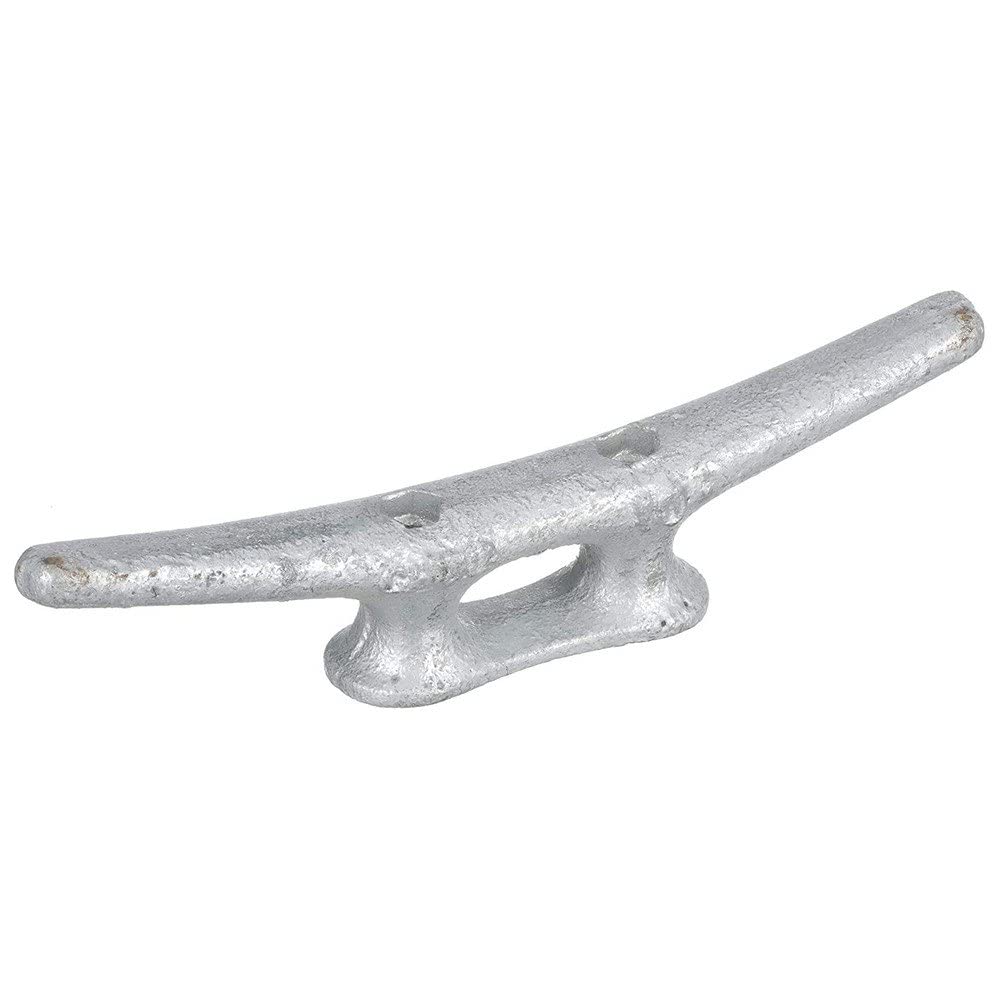
Ten inches of cast iron is a different category of hardware. The Seachoice open-base cleat is built for pilings, seawalls and big docks, where the line is heavier than anything a 4-inch cleat will take and the load is a boat that outweighs the structure it is tied to.

Galvanized iron is the right call for that job, and it is why this one costs less than stainless of the same size. The zinc is a coating rather than the material itself, so it sacrifices itself at scratches and edges: on a freshwater dock that is a slow process you will forget about, and in salt water it is an annual glance and a touch-up.

The length is what we like. A 10-inch horn gives you room for two full wraps of heavy line and a locking hitch on top, which is what keeps a boat from working the cleat loose overnight in a blow. It drills for 7/16-inch bolts and weighs 2 pounds, so through-bolt it with washers and nylock nuts, and back it with a plate if you can reach the underside.

Pros

  • 10 in horn takes heavy line and a hitch
  • Galvanized cast iron for dock duty
  • Substantial casting for the money

Cons

  • No mounting fasteners in the box
Our verdict

Our pick for a piling, seawall or heavy dock line: 10 inches of galvanized iron that takes two full wraps, with the bolts left for you to buy.

Check Latest Price
5

Best for a Whole Dock

Simplified Living Dock Cleats, 16-Pack

90 /100
Angler Score Outstanding

Key details

Material
Galvanized cast iron
Pack Size
16 cleats
Overall Length
4 in
Recommended Fastener
M5 x 2.75 in bolt or #8 x 2 in screw
Check Details on Amazon

Sixteen cleats in one box sounds excessive until you are standing on a dock with a dozen tie-off points. If the job is a long floating dock, a run of pilings or a rental with mooring rings every few feet, buying in bulk is the difference between finishing this season and finishing next one.

These are rough cast galvanized iron, and rough is literal: the casting has a texture you can see and feel. On an older timber dock it looks right; on a polished new boat it looks like what it is, a dock cleat. The texture is also harder on a rope than a polished stainless horn, which matters if you are tying off expensive line and not much if you are using whatever is in the locker.

The base is wide for a 4-inch cleat and the casting has real weight to it, which is why these hold up on a working dock. The listing calls for M5 bolts or #8 screws, and neither comes in the box. With sixteen cleats, price the stainless fasteners before you commit, because that is the hidden half of a bulk order.

Pros

  • Sixteen cleats cover a whole dock
  • Wide base for a 4 in casting
  • Heavy galvanized cast iron, not stamped

Cons

  • Hardware not included
Our verdict

For a dock with a dozen tie-off points, this is the efficient buy: sixteen galvanized cleats in one box, with the fasteners left on your list.

Check Latest Price
6

Best Budget Light-Duty

Seachoice Nylon Dock Cleat, 8 in

91 /100
Angler Score Outstanding

Key details

Weight
4 oz
Material
High-impact nylon
Rope Capacity
Up to 5/8 in
Overall Length
8 in
Check Details on Amazon

Plastic is the right answer more often than boat people admit. The Seachoice 8-inch nylon cleat costs less than any metal cleat in this group, takes line up to 5/8 inch, and will not corrode: not in salt, not in sun, not after a few seasons on a kayak that lives outdoors.

Two things keep it in the roundup. The first is feet: nylon has some give, so catching a shin on a low dock hurts less than a metal horn does, and that is not a small thing on a swim raft or a jet-ski lift. The second is that it never asks for attention: no rinse, no touch-up, no rust bleeding onto the deck.

Load is where it stops. Nylon flexes, and flex under a shock load is how plastic hardware eventually fatigues. For a kayak, a johnboat, a fender line or a personal watercraft this is plenty of cleat; for a heavy boat sitting in a slip all season, fit stainless or galvanized iron and stop thinking about it.

One detail before you drill: the pre-drilled holes can run tight against a chunky fastener, and opening them up with a drill bit is a two-minute job rather than a return, so test-fit your hardware before you settle on a mounting spot.

Pros

  • No corrosion and no maintenance
  • Easier on legs than metal
  • Takes line up to 5/8 in

Cons

  • Flexes under heavy shock loads
Our verdict

The cleat we put on kayaks, jet-ski lifts and swim rafts: eight inches of UV-stable nylon, line up to 5/8 inch, and nothing to corrode.

Check Latest Price
7

Best No-Knot Tie-Down

Attwood Zip Zag Cleat, 3 in

89 /100
Angler Score Excellent

Key details

Material
Zinc-plated steel
Pack Size
2 cleats
Rope Capacity
Up to 3/8 in
Overall Length
3 in
Check Details on Amazon

The Zip Zag is not a horn cleat, and that is the entire point. Instead of wrapping a line and finishing with a hitch, you feed it through a zig-zag channel and the geometry does the holding: no knot, no fumbling, and one hand still free to keep the boat off the pilings.

That makes it the fastest cleat here for the jobs you do over and over. A kayak anchor trolley, a bimini strap, a trailer tie-down, the tarp over the woodpile: a few seconds saved sounds trivial until you have done it forty times in an afternoon.

Three inches and a 3/8-inch line limit is where it stops. Zinc-plated steel is protected, but it is not 316 stainless, and the grip is built around light line, so this is a tie-down cleat rather than a mooring cleat. Fit it wherever you would otherwise tie a knot in a hurry, and the horn cleat starts to feel like the slow option.

Pros

  • Grips line without a knot
  • Fast one-handed tie-off
  • Two in the pack

Cons

  • Not a mooring cleat; 3/8 in line limit
Our verdict

For lines you tie and untie all day, anchor trolleys, biminis, trailer straps, this no-knot cleat is faster than a horn cleat and takes up to 3/8-inch rope.

Check Latest Price
8

Brass-Trimmed Boats

VEITHI Gold Stainless Cleat, 6 in

89 /100
Angler Score Excellent

Key details

Finish
Polished gold
Material
316 stainless steel
Pack Size
4 cleats
Overall Length
6 in
Check Details on Amazon

Gold deck hardware is a commitment, and the VEITHI 6-inch cleat makes the case for it: a polished finish that reads closer to brass than to bright stainless, on a body the listing gives as 316 stainless steel.

Six inches is a useful length, enough horn for two wraps and a locking hitch without turning a gunwale into a hardware display. The base sits on four solid mounting points and stainless screws come in the box, so it goes on like any other open-base cleat.

The finish is the whole proposition and also the limitation. Against varnished mahogany, teak or existing brass it looks deliberate; against bright stainless rails and a white deck it looks like a mistake. Order one before you order four if you are not certain which boat you own.

What we did not expect was the quality of the polish itself. It is even, the casting is clean, and the color turns out to be a cosmetic choice rather than a durability compromise, which is not a given with colored marine hardware. Half the pleasure of a cleat like this is that it is the one piece of deck gear a guest notices.

Pros

  • Gold finish matches brass and wood trim
  • 6 in length suits bigger decks
  • 316 stainless underneath the finish

Cons

  • Clashes with bright stainless and white decks
Our verdict

For a boat with brass fittings or a varnished deck, this is the cleat that matches: 316 stainless in a gold finish, six inches long, four to a pack.

Check Latest Price

How We Tested Boat Cleats

We started by pulling together every cleat we could find in the common sizes — 4, 5, 6, 8, and 10 inch — across 316 stainless, galvanized cast iron, zinc-plated steel, and nylon, then narrowed the field by base length, fastener hole spacing, whether hardware was included, and price per cleat. Folding and retractable designs stayed in the mix because they solve a real problem on decks where toes and line both need clearance. That left 12 cleats, which we mounted and used for eight months.

Every cleat was installed for real, not clamped to a bench. We bolted each one to a scrap of dock plank and to a working pier, timing the job solo and noting whether we could reach underneath to add a backing plate. We watched how the included screws seated, whether the countersinks sat flush instead of proud, and whether the base footprint actually covered the old holes when replacing an existing fitting. A cleat that fits the rope but not the deck is still the wrong cleat, so we checked each base against the space available beside a fender and a mooring line.

Under load, we tied both 3/8-inch and 1/2-inch double-braided line and watched how quickly the rope bit and stopped creeping, then pulled hard by hand to see if it slipped or jammed against the horn. The cleats stayed outdoors through rain, sun, and dock splash; we checked every few weeks for pitting, rust bleeding onto the plank, chalky or sun-yellowed nylon, and finish that dulled or flaked. Folding models got flipped up and down repeatedly to see whether the spring stayed stiff or started to rattle. At the end of the season we weighed all of it against the price, because a cheap cleat that needs replacing in two years is not the bargain it looks like.

How to Choose Boat Cleats

Start with length, not looks

Every cleat here is sold by overall length, and that length sets both the line you can use and how many wraps you get before you finish with a hitch. A 4-inch cleat is small hardware: right for a skiff, a canoe or a kayak deck, and out of its depth on a pontoon. Our 10-inch pick sits at the other end, built for pilings and heavy dock line.

Watch the gap between the name and the measurement. One 4-inch cleat in this set is listed at 3.89 inches overall, which is refreshingly honest, and no product photo gives you a true sense of scale. If the cleat is going on a boat you already own, measure the length of the one coming off.

Stainless, galvanized or nylon

316 stainless is what you want wherever salt water lives: it resists pitting and it never needs recoating, which is why it costs more. Galvanized cast iron costs less and suits docks and pilings, where the zinc sacrifices itself at scratches and you accept a touch-up now and then. Nylon is the light-duty answer: it cannot corrode and it is gentler on bare legs, but it flexes, and flex under a shock load is how plastic hardware eventually fatigues.

Match the material to the load rather than to the budget. A nylon cleat is a sensible purchase for a kayak or a jet-ski lift and a poor one for a boat that sits in a slip all season.

Fixed, folding or retractable

A fixed horn cleat is the simplest, strongest thing you can bolt down, and on an open boat deck it is usually the right answer. Folding and retractable cleats trade a hinge for a flush deck: nothing to catch a bare foot, a fishing line or a dock cart. If you go that way, rinse the pivot occasionally and check it still locks hard before you trust a boat to it.

The hinge is the whole difference in maintenance. A fixed cleat asks nothing of you after installation, while a folding one needs the grit washed out of its pivot once in a while, especially on a saltwater dock.

Hardware and hole spacing

The fasteners in the box are the weak point of this category: soft screws that strip before they are snug, short screws that never reach good timber, or nothing at all. Buy stainless, through-bolt wherever you can reach the underside, and back anything taking a real load with a plate.

If you are replacing existing cleats, measure the hole centers already in the deck before you order. A new pattern means drilling a finished deck, sealing the old holes and hoping the new base covers the evidence.

Pack math and price per cleat

A single premium cleat and a sixteen-pack of galvanized ones are both good value in the right place. Count the tie-off points you actually need, then divide: a small boat wants four, a long floating dock wants a dozen or more, and the pack sizes here reflect that spread.

Price the fasteners with the cleats rather than after. Several packs here leave hardware out, and the stainless bolts for a sixteen-cleat dock are a real line item that the sticker price does not include.

Frequently Asked Questions

Final Verdict

For most boats and docks, the CIPA retractable is the cleat to buy. It holds a line as well as anything in this group and then lies flat, which is the part you notice every time you cross the dock with an armful of gear.

If you are fitting several cleats to a small boat and want 316 stainless without the per-unit price, the ZOMCHAIN two-pack is the practical answer, with better fasteners bought separately. And if the craft is a kayak or a jet ski, the nylon Seachoice does the same job for less and never corrodes.