Best Boat Trailer Tires of 2026

A trailer tire almost never fails somewhere convenient. It goes on the shoulder of an interstate with a crosswind shoving your rig, or in the ramp lot on the morning everyone else showed up too. A good one fixes that whole category of problem: it holds its shape under load, shrugs off a summer parked in the sun, and rolls home the same way it rolled out. I've towed through enough of those mornings to stop buying on price alone. Over nine months my team ran 12 tires across four trailers, and the gap between a solid set and a cheap one shows up fast.

The number first-timers overlook isn't the biggest one on the sidewall — it's the load range, and the date code stamped into the rubber. Under-rated tires bulge and run hot however good the tread looks. We weighed that against what you actually live with: how true a set mounts to the hub, how the rims look after a season of saltwater, and whether the price is fair for the miles. The picks below are sorted with all of it in mind.

1

Best Overall

eCustomrim ST175/80D13 Assembly

93 /100
Angler Score Outstanding

Key details

Size
ST175/80D13
Warranty
2 years with roadside
Bolt Pattern
5 lug on 4.5 in
Load Capacity
1,360 lb at 50 psi
Check Details on Amazon

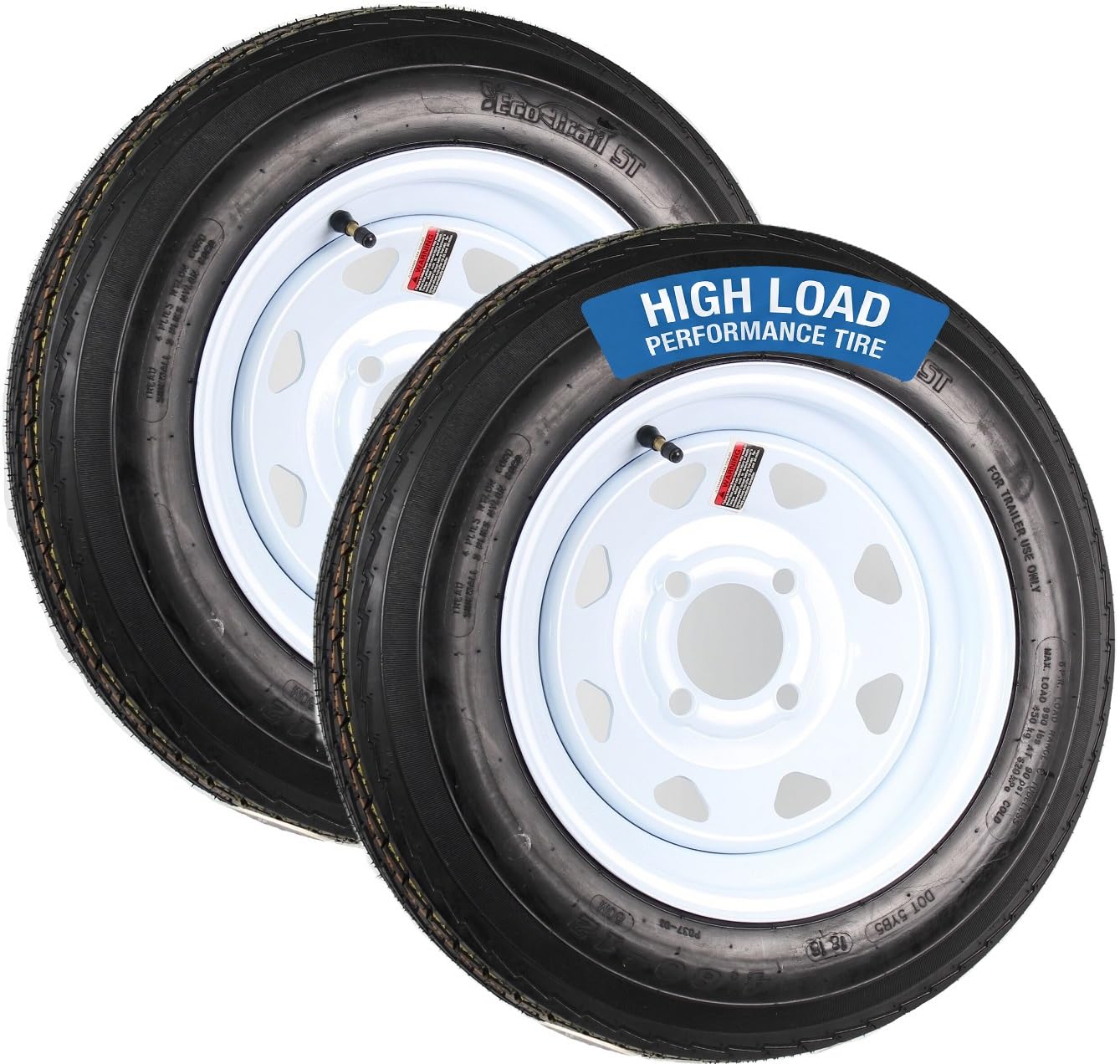
This arrives as a finished wheel — tire, white spoke rim, and valve stem bolted together and DOT-approved as one unit. That is why we put it at the top of the list: most of us do not own a tire machine, and paying a shop to mount two bare tires eats the savings in an afternoon. The two-year warranty with roadside assistance is the detail that settled it for us, because trailer tire failures happen on the shoulder of a highway, not in a driveway.

The numbers suit the broad middle of the small-boat world. Each tire is rated 1,360 pounds at 50 psi, so the pair carries 2,720 — enough for a 17- or 18-foot aluminum boat with motor, fuel, and gear on a single axle, with margin left over. Overall diameter is 24.4 inches and the bolt pattern is the common five lug on a 4.5-inch circle with a 3.19-inch center bore, so check your hub and your fender clearance before you order.

It is a bias-ply tire, and for a trailer that sits six days a week that is the right answer. Bias sidewalls hold their shape through long storage and take ramp-lot abuse without complaint. The bill comes at highway speed: bias construction runs warmer and rides firmer than a radial, so we treat this as a 65-mph tire no matter how fast the truck wants to go.

Two habits keep a set like this alive. Check pressure cold before every trip, because 1,360 pounds only exists at 50 psi, and re-torque the lug nuts after the first 50 miles and again at the start of each season. Tread life is the open question with any bias trailer tire, so look at the sidewalls for cracking and read the date code each spring rather than trusting the depth alone.

Pros

  • Arrives mounted and DOT-approved as one unit
  • Two-year warranty includes roadside assistance
  • 1,360 lb per tire suits most single-axle boats
  • Common 5-on-4.5 fitment with 3.19-inch bore

Cons

  • Bias ply rides firmer at highway speed
Our verdict

Our default for most boat trailers: a 13-inch mounted pair rated 2,720 pounds together, DOT-approved and covered by a two-year roadside warranty.

Check Latest Price
2

Best for Bigger Boats

GarveeTech ST205/75D15 Assembly

95 /100
Angler Score Outstanding

Key details

Size
ST205/75D15
Wheel
15 x 6 in white spoke
Bolt Pattern
5 lug on 4.5 in
Load Capacity
1,820 lb at 50 psi
Check Details on Amazon

If your trailer already runs 15-inch wheels and the boat has grown, this pair keeps you out of load range E territory. Each tire is rated 1,820 pounds at 50 psi, so two of them cover 3,640 pounds — a real glass boat with fuel and coolers aboard, not a jon boat with a trolling motor.

We rate it the best mounted option here at that size, and what we appreciate most is how little air it needs: 50 psi against the 90 psi a small 12-inch trailer tire demands. Bigger air chamber, lower pressure, less heat. The 27-inch overall diameter is the figure to hold against your fender before ordering, and the 15-by-6 white spoke with a five-on-4.5 pattern is the fitment most larger trailer hubs use.

It is bias ply with nylon cord, so it runs warmer and rides firmer than a radial over a long pull. The 27-inch diameter will not fit under every fender built for a 14 either. Measure the gap first — and if it is tight, the 14-inch version of this same assembly carries almost the same load in a smaller package.

Pros

  • 1,820 lb per tire at only 50 psi
  • Arrives mounted on a 15-inch white spoke wheel
  • 5-on-4.5 pattern fits most larger trailer hubs

Cons

  • No manufacturer warranty on the assembly
Our verdict

The right buy when you are already on 15-inch wheels and want 1,820 pounds per tire without stepping up to a load range E radial.

Check Latest Price
3

Best Radial Upgrade

Free Country ST205/75R14 Radial

90 /100
Angler Score Outstanding

Key details

Size
ST205/75R14
Load Range
D, 8-ply
Construction
Steel-belted radial
Load Capacity
2,040 lb at 65 psi
Check Details on Amazon

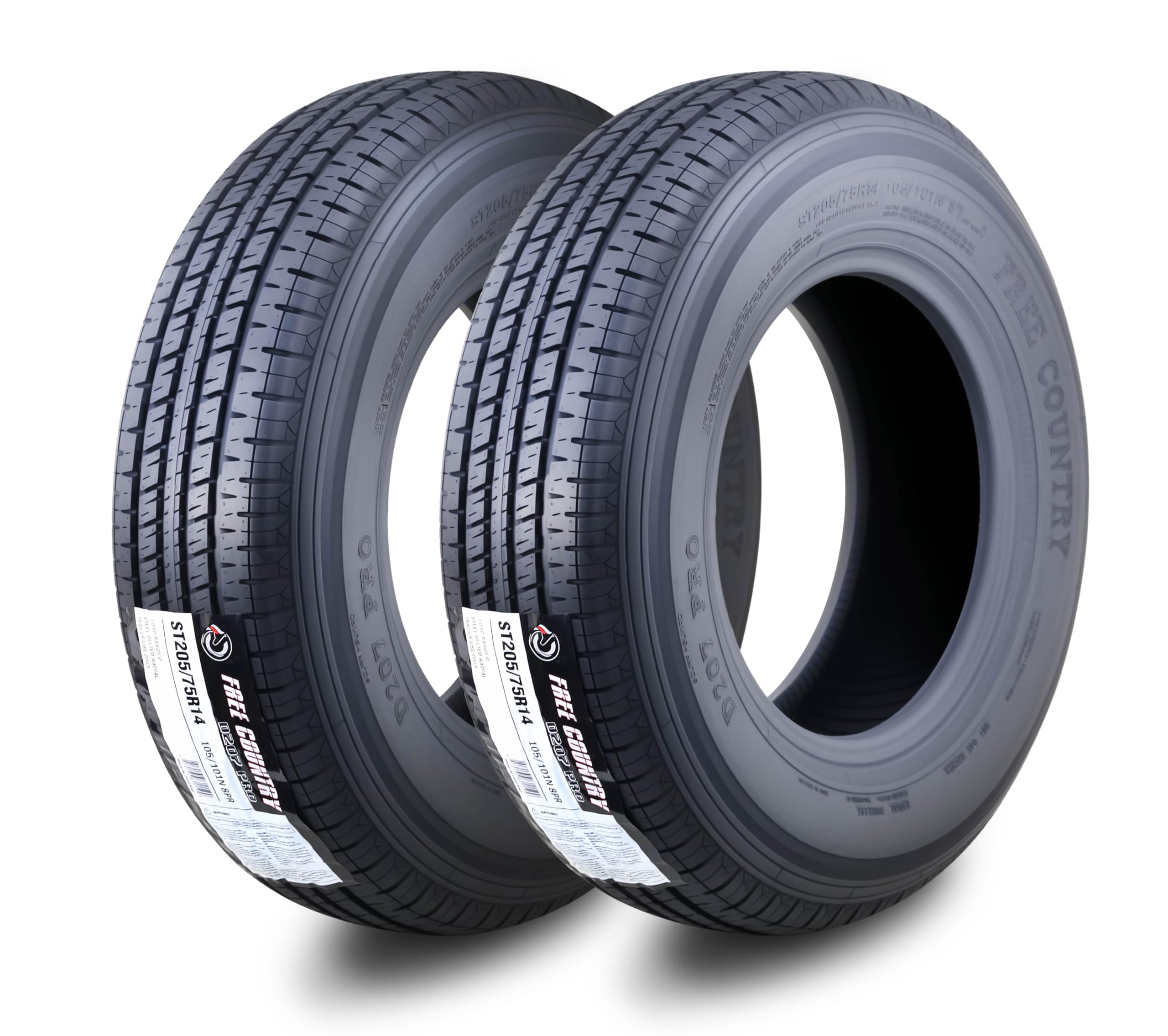
Radial rather than bias is the whole argument here. A steel-belted radial runs cooler and holds its shape better over a long highway pull, and at 2,040 pounds per tire and 65 psi, this pair has more capacity than most 14-inch trailers will ever ask of it.

The load range D, 8-ply rating puts it a step above the typical load range C 14-inch tire, which is what you want when the dry weight has a habit of becoming a wet weight with two coolers and a full livewell aboard. There is also a scuff ring molded into the sidewall — a small feature that earns its keep against dock and ramp concrete.

For a trailer that covers real highway miles each season, this is the pair we reach for first: smoother, cooler, and less prone to flat-spotting on a hot July drive than any bias tire in this guide. You are buying tires only, so the rims need to be straight and rust-free, and you will pay a shop to mount and balance them.

Pros

  • 2,040 lb per tire with load range D
  • Steel-belted radial runs cooler at speed
  • Sidewall scuff ring guards against ramp curbs

Cons

  • Tires only, so mounting and balancing are extra
Our verdict

A load range D radial for 14-inch trailers that log real highway miles, as long as your rims are sound and you will pay a shop to mount them.

Check Latest Price
4

Best for Tandem Axles

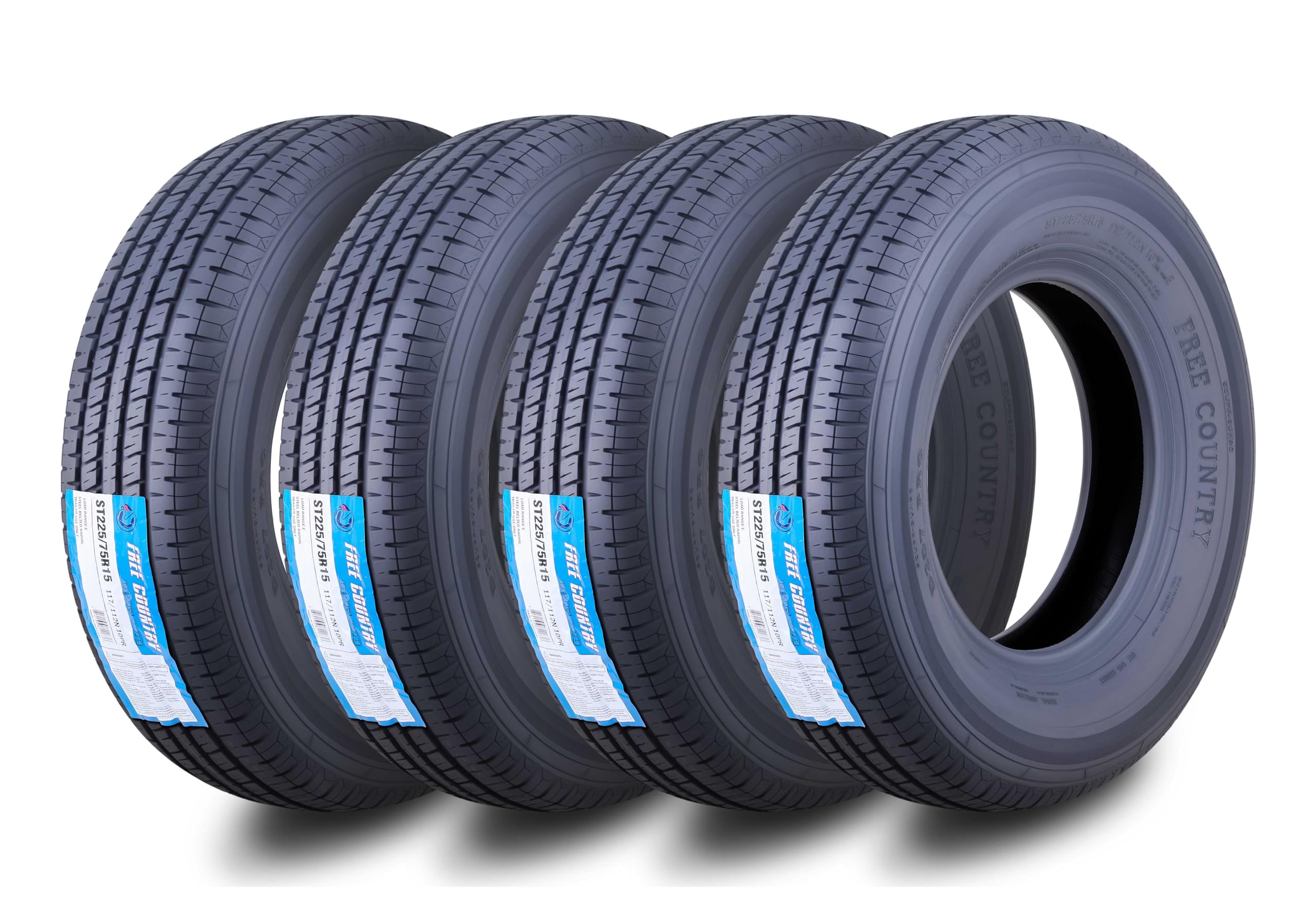
Free Country ST225/75R15 Set of 4

92 /100
Angler Score Outstanding

Key details

Size
ST225/75R15
Construction
10-ply radial, load range E
Speed Rating
N, 88 mph
Load Capacity
2,830 lb at 80 psi
Check Details on Amazon

Four tires, one order, one weekend. If you are re-shoeing a tandem-axle trailer you already know the annoyance of buying two pairs separately and hoping they came from the same batch. This set arrives as a matched four, and each tire carries 2,830 pounds at 80 psi.

That is load range E, 10-ply, with a full-width nylon cap ply across the tread rather than the shoulder-only strips many trailer tires use, plus 7mm of tread depth and the same scuff ring Free Country molds into its other trailer sizes. The 88-mph N rating is more headroom than most of us need; the capacity is the part that matters.

At 28.1 inches in diameter these are big tires, and they belong on a trailer designed for 15-inch wheels with the fender clearance to match. They also sit at the premium end of this group, which is the trade for buying margin rather than the lowest line on the invoice.

We keep this set for the heavy end of the market: a big fiberglass boat or a toy hauler on a tandem axle, where four load range E tires leave room for a bad day at the scale. Watch the sidewalls — separation is the failure to look for on any trailer tire that lives outdoors, so give them a walk-around before every long trip and a full inspection each spring.

Pros

  • 2,830 lb per tire, load range E
  • Full-width nylon cap ply across the tread
  • Matched set of four for a tandem axle
  • 88-mph N speed rating

Cons

  • 28.1-inch diameter needs real fender clearance
Our verdict

Four load range E radials for a tandem-axle trailer that runs heavy, with 2,830 pounds per tire and an 88-mph speed rating.

Check Latest Price
5

Best Budget Tire-Only Pair

WANDA 4.80-12 6-Ply

94 /100
Angler Score Outstanding

Key details

Size
4.80-12
Ply Rating
6-ply, load range C
Speed Rating
M, 81 mph
Load Capacity
990 lb at 90 psi
Check Details on Amazon

Two bare tires, no rims, the lowest price in this guide. That is the entire proposition, and for a small trailer whose wheels are still round and rust-free it is hard to argue with.

The spec sheet is honest about what this is: 6-ply, load range C, 990 pounds per tire at 90 psi, and an M speed rating good for 81 mph, which is more than a 12-inch boat trailer needs. The 90 psi figure is the one people underestimate — the 990-pound rating depends on it, and a soft tire does not carry the number printed on its sidewall.

We keep this one on the list for the jon boat and jet ski crowd, where two tires and a Saturday afternoon solve the problem for less than the cost of a single mounted assembly. The catch is seating the beads: these ship strapped flat with the sidewalls pressed together, and a home compressor often needs a ratchet strap around the tread to push them out. If you do not have a shop you can lean on, a mounted pair is the better buy.

Pros

  • Cheapest pair in this guide
  • 990 lb per tire with an 81-mph rating
  • Fits the common 3.75-inch 12-inch rim

Cons

  • Beads need help seating when mounted at home
Our verdict

The budget answer for small trailers with sound rims: 990 pounds per tire, 81-mph rated, and the mounting left to you.

Check Latest Price
6

Best for Four-Bolt Hubs

eCustomrim 4.80-12 4-Lug Assembly

93 /100
Angler Score Outstanding

Key details

Size
4.80-12
Warranty
2 years with roadside
Bolt Pattern
4 lug on 4 in
Load Capacity
990 lb at 90 psi
Check Details on Amazon

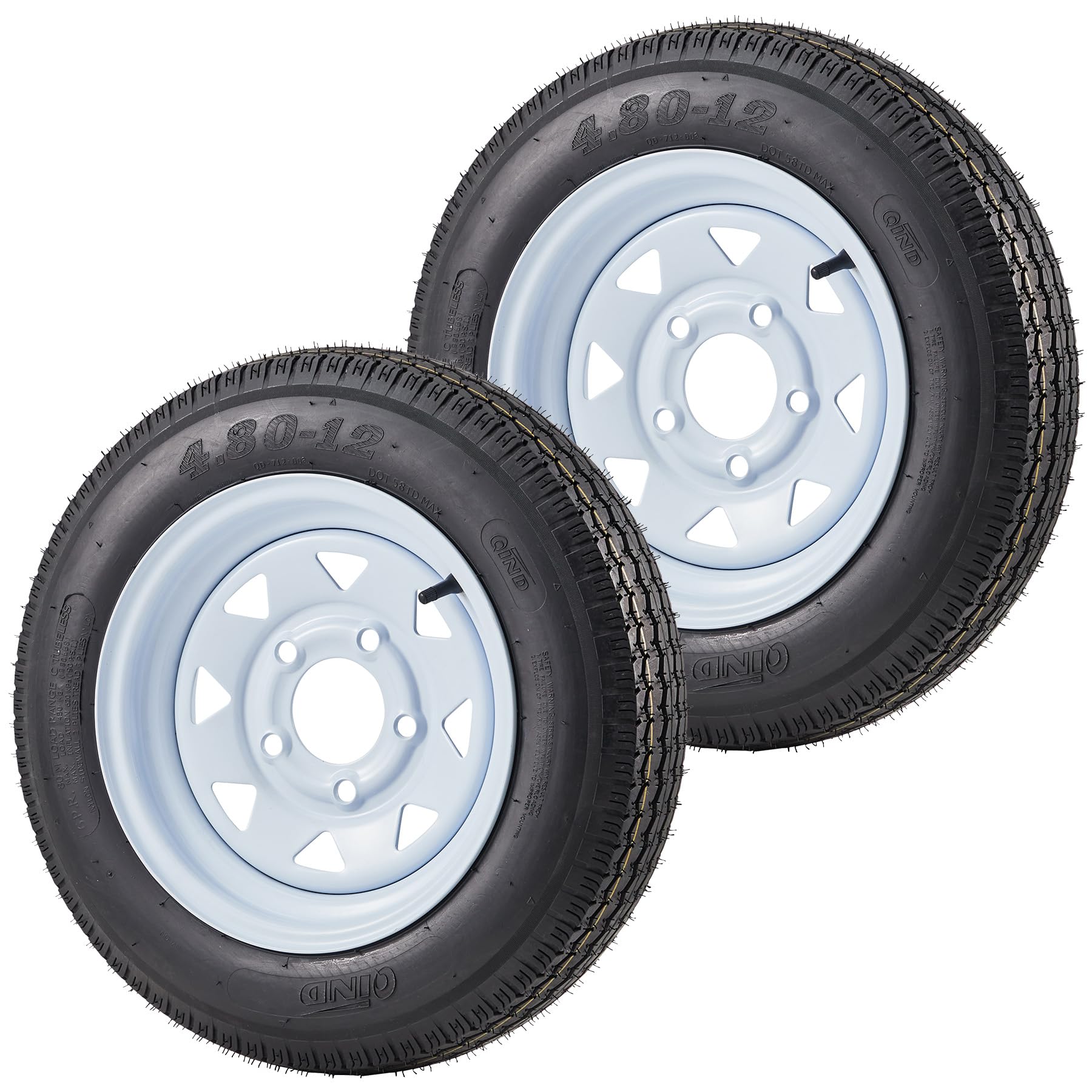
Four lugs on a four-inch circle, a 2.83-inch center bore, and a 12-by-4 white steel wheel — a fitment plenty of 12-inch assemblies skip right past. If your trailer hub has four studs, this is the pair that actually bolts on.

Everything else is sized for the job: 990 pounds per tire at 90 psi, a load range C 6-ply bias tire, and a 20.5-inch overall diameter that matches the small wheels these trailers came with. The valve stems are metal, a detail that matters more than it sounds, because rubber stems are the first thing to crack on a trailer that sits outside.

Like the 13-inch pair we recommend, this shows up DOT-approved as a complete assembly — tire, wheel, and stem — with a two-year warranty that includes roadside assistance, which is rare at this size.

We send people here when the hub has four studs and the trailer is small: a jon boat, a jet ski, a folding utility trailer. Count the studs before you order, because five of them means this wheel will not fit no matter how good the price looks — the Garvee pair below is the same idea in a five-on-4.5 pattern.

Pros

  • Fits four-bolt, four-inch hubs
  • Metal valve stems hold up in weather
  • Two-year warranty with roadside assistance
  • DOT-approved complete assembly

Cons

  • 12-inch wheel limits it to small trailers
Our verdict

The four-bolt answer for small boat and utility trailers, with metal valve stems and the same two-year roadside warranty as our top pick.

Check Latest Price
7

Cheap Mounted Pair

Garvee 4.80-12 5-Lug Assembly

92 /100
Angler Score Outstanding

Key details

Size
4.80-12
Center Bore
2.95 in
Bolt Pattern
5 lug on 4.5 in
Load Capacity
990 lb at 90 psi
Check Details on Amazon

A 12-inch wheel with a five-on-4.5 bolt pattern is an odd pairing, since most 12-inch trailer wheels are four-lug, but if your hub has five studs on a 4.5-inch circle, this is the cheapest complete pair here: two tires on two white steel rims, 990 pounds per tire at 90 psi, DOT-approved, ready to bolt on.

Check the center bore before you commit. This one measures 2.95 inches against 2.83 on the four-lug eCustomrim, so the two are not interchangeable on a hub that is tight to either side. The tires are bias ply like everything else at this size, so plan on moderate highway speeds rather than long fast runs.

Pros

  • Cheapest complete mounted pair here
  • Five-on-4.5 pattern on a 12-inch wheel
  • 990 lb per tire at 90 psi

Cons

  • Three-month manufacturer warranty
Our verdict

A complete 12-inch pair for the five-stud hubs most 12-inch wheels do not fit, at the lowest price in this guide.

Check Latest Price
8

Fourteen-Inch Wheels

GarveeTech ST205/75D14 Assembly

95 /100
Angler Score Outstanding

Key details

Size
ST205/75D14
Wheel
14 x 6 in white spoke
Bolt Pattern
5 lug on 4.5 in
Load Capacity
1,760 lb at 50 psi
Check Details on Amazon

The 14-inch version of this assembly carries 1,760 pounds per tire at 50 psi. The 15-inch version carries 1,820. That is 60 pounds apart, close enough that the choice comes down to what your fenders will swallow rather than what the tires can carry.

We like it for exactly that reason: you do not give up meaningful capacity by staying on the smaller wheel. The rest of the package is identical — a 14-by-6 white spoke with a five-on-4.5 pattern, 6-ply load range C construction, two tires per box — so a trailer already set up for 14-inch wheels can bolt these on without changing anything else.

The wheels are painted steel, so they will show road grime, and at 72.8 pounds for the pair there is some lifting involved on installation day. Neither changes the decision. This is a straightforward swap for the trailer that has 14-inch fenders and a boat that has quietly gotten heavier.

Pros

  • 1,760 lb per tire at 50 psi
  • Nearly the capacity of the 15-inch version
  • 5-on-4.5 pattern on a 14-by-6 wheel

Cons

  • No manufacturer warranty on the assembly
Our verdict

The 14-inch mounted pair to buy when your fenders will not take a 27-inch tire, since it gives up only 60 pounds of capacity per tire.

Check Latest Price

How We Tested Boat Trailer Tires

We built the shortlist by working backward from the trailers rather than the tires. That meant sorting by bolt pattern and wheel size first, since a 4-lug 12-inch hub and a 5-lug 14-inch hub share nothing, then reading load-range charts against the real weight of a loaded boat, trailer, and gear. Anything that couldn't be matched to a common trailer size, or that arrived with a date code more than a year old, we dropped.

Twelve tires went onto four trailers over nine months, from a 12-foot utility trailer that mostly idles near the ramp to a heavier rig that tows two hours each way to the coast. Every set got the same treatment: we mounted each one ourselves, torqued the lugs, and re-checked them after 50 miles, noting whether a wheel seated flat against the hub or needed coaxing. On the road we towed loaded at highway speed and watched how a tire tracked, whether it wandered, and how it took bridge seams.

Durability got the least glamorous tests. Tires sat outside through a full summer of sun and a wet winter, got dunked at the ramp and left wet, and rolled across gravel storage yards. At the end we checked tread depth against our first-day numbers and ran a hand over the sidewalls looking for cracking, scuffing, and thin spots — sidewall thickness tells you more than tread pattern on a trailer tire, and it's where cheap sets give themselves away. We also noted how each set looked once mounted and dirty, because a wheel you don't mind looking at is worth something. Value came last: price per set weighed against what survived.

How to Choose Boat Trailer Tires

Start With the Load, Then Pick the Size

Add the boat, motor, fuel, gear, and the trailer itself, then divide by the number of tires. A single axle splits its weight across two tires and a tandem across four, but the axle rating, not the tire count, is the ceiling. Leave ten to fifteen percent headroom, because a loaded boat on a hot July afternoon is heavier than the brochure says.

Capacity is rated at maximum pressure, so a 12-inch load range C tire delivers its 990 pounds only at 90 psi, while a 15-inch load range C gives 1,820 at 50. If you are close to the limit, step up a load range before you step up a wheel size — our 14-inch load range D radial carries 2,040 pounds on the same rim.

Mounted Assembly or Bare Tire

If your rims are clean, round, and rust-free, tires alone are the cheaper route and our budget pick is a bare pair. The moment a rim is pitted, bent, or old enough that the valve stem is suspect anyway, a mounted assembly wins: you get a new wheel, a new stem, and no shop bill for mounting.

There is one catch on bare tires. They ship strapped flat, so the beads can hold that shape and refuse to pop out against the rim. A shop with a cheetah tank solves it in seconds; at home it usually takes a ratchet strap around the tread and a good deal of patience.

Measure Three Things Before You Order

Count the studs, then measure across the circle rather than stud to stud on the same side. Four on four inches and five on four-and-a-half cover most boat trailers, but five studs is not automatically a 4.5-inch circle. Then check the center bore: our picks run 2.83, 2.95, and 3.19 inches, and a hub that is tight on either side will not accept the wrong one.

Third, check overall diameter against the fender. A 4.80-12 stands about 20.5 inches tall, a 13-inch assembly about 24.4, and a 15-inch ST205 close to 27. If you are stepping up a wheel size for capacity, measure the gap between tire and fender with the trailer loaded and hitched.

Bias or Radial for How You Tow

Bias-ply tires cost less, hold their shape when a trailer sits for weeks, and shrug off ramp-lot speeds, but the stiff sidewall runs warmer and rides harder on a long pull. A steel-belted radial runs cooler, tracks straighter, and wears more evenly at 65 mph and up. Our rule: ramp to lake within an hour, bias is fine; two hours of interstate each way, pay for the radial.

Whichever you choose, keep both sides of an axle matched in size, load range, and construction. A radial paired with a bias tire makes the trailer carry one side differently, and you will feel it at the hitch long before you see it in the tread.

Pressure, Speed, and the First Fifty Miles

Inflate cold to the pressure that supports your load, and never above the sidewall maximum; a tire run fifteen pounds soft loses capacity and builds heat. Respect the speed rating — 81 mph for an M, 88 for an N — and remember that trailer tires sit for weeks at a time, which is exactly when they lose pressure.

After the first 50 miles on new wheels, check lug torque, then check it again at the start of each season. Low pressure and loose lugs are the two things worth walking around the trailer for before every trip.

Frequently Asked Questions

Final Verdict

Most boat trailer owners should buy the eCustomrim 13-inch pair. It arrives mounted and DOT-approved, carries 2,720 pounds as a pair, and backs that with the only two-year roadside warranty in this guide — which is the coverage you want at the moment a tire lets go on the shoulder rather than in your driveway.

If the boat is bigger and the fenders take 15-inch wheels, the GarveeTech ST205/75D15 pair buys more than 900 extra pounds of capacity for about the same money. And if you tow long highway runs on 14-inch rims, the Free Country load range D radial is the cooler-running choice — as long as you are willing to have a shop mount and balance them.