Best Boat Rod Holders of 2026

A rod holder does one job that pulls two ways at once: it has to lock a rod down hard enough to survive a strike, a snag, or somebody else's wake, and still let you pull that rod free with one hand when the bite comes. Get the balance wrong and you're either wrestling the holder every trip or watching a rod disappear over the side. The right one also keeps rods out of the walkway and within reach, which is really the whole point.

Most of the questions I hear are about fit and hardware: will the base match the track or gunwale you actually have, are the bolts in the box, and are they stainless or the kind that rusts solid by August. Stability under load and value for money come right behind. We've had 13 holders mounted on everything from a tiller skiff to a friend's offshore boat for the past six months, and the differences come down to the base far more than the cradle. The picks below are the ones I'd drill into my own boat again.

1

Best Overall

Scotty 230 Powerlock

92 /100
Angler Score Outstanding

Key details

Mount
Side or deck mount, 241 base included
Rod Fit
Universal cradle
Material
Fiber-reinforced nylon
Rotation
360 degrees horizontal, full tilt
Check Details on Amazon

The base is the part we came to care about. The Powerlock body twists off its 241 mount, leaving a low, rounded plate on the gunwale, and a different Scotty holder drops onto the same two screws. That matters more than it sounds, because the base is the piece you drill and seal once. We mounted ours on the side of the gunwale rather than the top, which keeps the walkway clear and puts the rod butt where your hand naturally falls.

Fiber-reinforced nylon is the right material for this job. The walls are thick enough that the cradle doesn't flex when a fish loads the rod, and unlike an aluminum socket it won't corrode itself into place after a season of saltwater. The front locking ring does real work too: it sits over the reel stem so the rod can't bounce out on the run out, while a straight lift still frees it when you set the hook.

The one thing to plan around is the cradle's size. It's built to swallow a big spinning reel or a baitcast reel with a trigger grip, which means a slim 7-foot casting rod or a fly rod sits loose in it. If that's all you throw, a tighter cradle suits you better; if your deck carries mixed tackle, that roominess is exactly what lets one holder cover everything.

Where this holder earns its keep is the switch from drifting to trolling. One hand on the body, a quarter turn, and the tip goes from trailing straight back to reaching out over the side. That's the kind of adjustment you actually make on the water, as opposed to the ones you dial in once at the dock and forget.

Pros

  • Universal cradle takes spinning and baitcast reels
  • 360-degree base with full tilt
  • Holder lifts off the base for storage
  • Thick nylon won't corrode or seize

Cons

  • Mounting screws not included
  • Cradle is roomy for slim and fly rods
Our verdict

The holder we hand most anglers first: a universal cradle that takes spinning and baitcast setups, a base that mounts on top of or beside the gunwale, and full 360-degree aim.

Check Latest Price
2

Best for Trolling and Downriggers

Cannon Three-Position

93 /100
Angler Score Outstanding

Key details

Tension
Spring-loaded, tool-free knob
Mounting
Cannon track, deck, rail, or gunwale
Rotation
360-degree rotating base
Positions
Three tilt positions
Check Details on Amazon

Three positions sounds like a limitation until you troll with it. The Cannon indexes at three rod angles that cover a flatline, a downrigger release, and a bow-up presentation, and the notches are deep enough to find by feel while you're watching the rods instead of the holder. The spring-loaded knob takes two fingers, so you can drop a tip when a fish comes up on the surface without lifting the rod out.

What we didn't expect was how snug the body sits in its socket. That's deliberate, because nothing rattles when the boat comes off a wave, but a new one is stiff to swivel and takes some use to free up. The 360-degree base gives you the big sweep, the tilt gives you the fine angle on top of it, and the whole head lifts off a Cannon track or a screwed-down base when you want it stowed.

The grip runs large. A long surf rod or a muskie stick sits fine in it, while a light freshwater handle rattles around unless you seat the butt deep, which is worth knowing if your rods are 7-foot mediums. Fasteners are the other item: the base needs screws and the box doesn't always have them, so sort stainless before you drill.

Pros

  • Three indexed tilt positions
  • Tool-free spring-loaded tension knob
  • 360-degree base for track or deck
  • Head lifts out of the base for storage

Cons

  • Grip runs large for light rod handles
Our verdict

The trolling holder we reach for when downriggers are on board: three indexed positions, a spring-loaded knob you can work with gloves on, and a 360-degree base that takes a track or four screws.

Check Latest Price
3

Best Clamp-On for Rails and Pontoons

PLUSINNO Clamp-On 2-Pack

90 /100
Angler Score Outstanding

Key details

Material
Die-cast aluminum, stainless steel
Clamp Fit
Round tube, square tube, flat surfaces
Rod Strap
Included, secures rod to holder
Adjustment
360 degrees plus 10-degree micro-adjust
Check Details on Amazon

Most clamp-on holders are a plastic C-clamp with a plastic cradle, and you can feel them flex every time a fish loads the rod. This one is die-cast aluminum with stainless through the joint, and the difference shows the first time you tighten it onto a pontoon rail: the jaws bite and stay where you put them instead of creeping around the tube.

The dual V-shaped jaws with silicone pads are what make it adaptable, because a round rail, a square tube, and a flat gunwale top all seat properly without a separate fitting. We were also impressed by the 10-degree micro-adjust at each joint: you can fine-tune the tip without loosening everything, which is more control than most holders at this level give you. The strap across the rod is the last piece, and it's the one that keeps a rod seated when you cross a wake.

The clamp is the part to respect. Over-tighten it and the clamp material can crack, where snug by hand is all a rail mount needs, since the jaws hold by friction rather than torque. Set that way, a pair of these turns a bare pontoon or jon boat into a rod-holding boat without a single hole to seal, which is the whole appeal.

Pros

  • Die-cast aluminum body with stainless hardware
  • Dual-V jaws fit round, square, and flat
  • 10-degree micro-adjust at each angle
  • Rod strap keeps it seated across a wake

Cons

  • Clamp can crack if over-tightened
Our verdict

The answer for a boat you don't want to drill: aluminum clamp jaws that grip round tube, square tube, or flat rail, and a cradle that stays put when you cross a wake.

Check Latest Price
4

Best for Track-Equipped Boats

Brocraft Track Rod Holder

89 /100
Angler Score Excellent

Key details

Install
No-drill, slides along the track
Release
Push-button quick release
Material
UV-stabilized, fiberglass-reinforced polymer
Track Fit
Tracker Versatrack, Lund Sport Track, 90-degree gunnel tracks
Check Details on Amazon

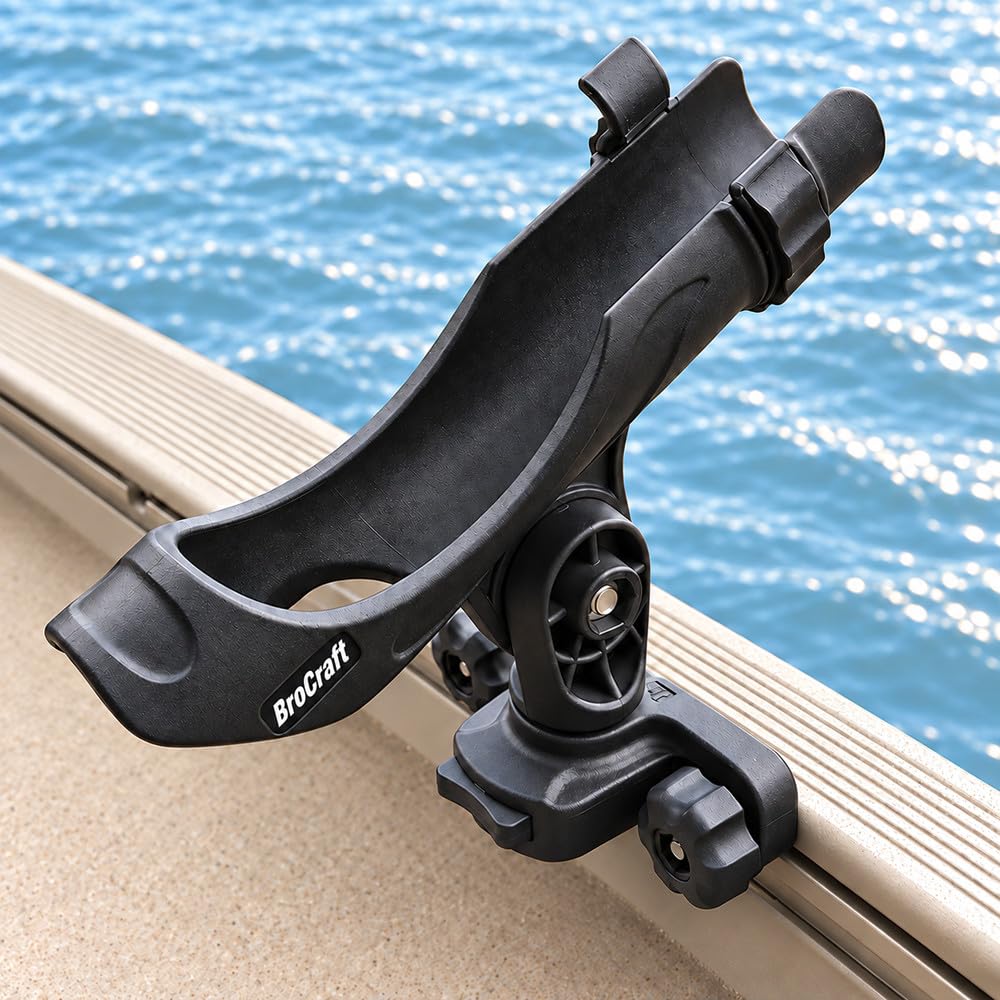
Track boats get the easiest install of anything in this group, and this is the holder we recommend for them. Two knobs clamp the base to a 90-degree gunnel track, whether that's Tracker Versatrack, Lund Sport Track, or the Ranger and Lowe equivalents, so there's no drilling, no sealant, and no backing plate to reach behind. Slide the base to a new spot, tighten the knobs, and the holder drops in and locks. Press the button and it lifts out for the ride home.

The catch is the track, not the holder. It's cut for 90-degree profiles only and there's no adapter, so a round rail or a flat gunwale needs one of the other picks. The body is UV-stabilized, fiberglass-reinforced polymer, and the ones we handled felt solid at the joint, though it's still plastic sitting in the sun all season. Match the profile to your track before you order, because the fit is exact and the wrong track means a return.

Pros

  • No-drill base clamps to 90-degree track
  • Slides along the track to reposition
  • Push-button release leaves the base in place
  • UV-stabilized, fiberglass-reinforced body

Cons

  • Fits 90-degree gunnel tracks only
  • Pricier than a plain screw-down base
Our verdict

If your boat already carries a 90-degree gunnel track, this is the cleanest install here: no holes, a base that slides, and a holder that lifts out with a button press.

Check Latest Price
5

Best Budget Multi-Rod Set

Haida Steel 20-Degree 4-Pack

91 /100
Angler Score Outstanding

Key details

Angle
Fixed 20 degrees
Included
4 holders and 4 deck bases
Material
Stainless steel, PVC dipped
Cradle Width
1-3/4 inches
Check Details on Amazon

Four holders, four deck bases, one box. That's the pitch, and for anyone building a trolling spread from scratch it's the least expensive way in this group to get rods in the water: screw the bases down once, then lift each holder off for storage or move it to another base around the boat.

The 20-degree angle is the whole design. It holds the tip high enough that a long rod doesn't dunk when the boat rocks, which is the difference between fishing and re-rigging when you're running 9- and 10-foot rods straight down. The V-shaped front gives you a hookset to either side, the extended cradle keeps the butt from sliding back, and at 1-3/4 inches wide it takes a big handle. What you don't get is adjustment.

We came away liking the finish more than the price suggests. PVC over 3/8-inch steel does two jobs at once: it keeps a wet rod from sliding in the cradle and it stops a bare metal edge from marking a cork or EVA handle. Steel rather than plastic is also why these feel like the least disposable thing in the group. The limitation is directional, since no swivel means you point the boat rather than the rod, so they suit a spread off a 20-footer better than a jon boat you cast from.

Pros

  • Four holders and four bases in one box
  • 20-degree angle keeps long tips clear of the water
  • PVC-dipped steel protects rods and resists rust
  • Holders lift off the bases for storage

Cons

  • Fixed angle with no swivel or tilt
Our verdict

Four stainless holders, four deck bases, and a fixed 20-degree angle that keeps long tips out of the water, which makes this the value pick for building a trolling spread.

Check Latest Price
6

Best for Trailering and Rough Water

BoatBuckle RodBuckle 24-Inch

94 /100
Angler Score Outstanding

Key details

Pack
2 straps
Mount
Gunwale or deck, template and hardware included
Strap
24-inch self-retracting
Strap Material
PVC extrusion-coated
Check Details on Amazon

A retracting strap looks like an odd excuse for a rod holder until you watch a rod try to leave the boat at speed. The RodBuckle mounts a spring-loaded reel of PVC-coated webbing to the gunwale or deck; pull the strap over a bundle of rods and it clicks into a ratchet stop the way a seatbelt does, then retracts flat when you let it go.

What it does well is volume. One strap pins a whole spread of rods across the deck without tangling them or letting a tip wander, and because the webbing retracts into the housing there's nothing loose to trip over or flap in the wind. If your rods ride laid out on the deck between spots, that's a better use of the space than a row of cradles.

Installation is the part to think through. The kit includes a template and the hardware for a surface mount, which sits proud of the gunwale; the optional concealed kit recesses it flush and means cutting a bigger hole. Start with the surface mount unless you're sure about the hole, and check what's behind the panel before the drill comes out.

Our take is that this belongs on the boat alongside a holder, not instead of one. It won't present a rod for a strike and it gives you no trolling angle, but for holding rods still while the boat is moving, nothing else in this group does the job. Keep an eye on the retractor as it ages, since a strap that stops locking is the failure to catch while it's still under warranty.

Pros

  • Retracting strap locks a spread of rods
  • PVC-coated webbing shrugs off hooks
  • Retracts flat, so nothing loose on deck
  • Template and hardware included

Cons

  • Ties rods down but offers no fishing angle
Our verdict

A seatbelt for the rod spread: two retracting straps lock rods to the deck for the run out and the ride home, though they won't fish a rod for you.

Check Latest Price
7

Rod Storage Afloat

Marinebaby 4-Tube Rack

91 /100
Angler Score Outstanding

Key details

Mount
Deck, side, or wall
Capacity
4 tubes
Material
Aluminum with rubber liners
Dimensions
1.5"D x 12"W x 8.5"H
Check Details on Amazon

Four aluminum tubes instead of a cradle, and that's the appeal: a rack does a different job from a holder. It keeps rigged rods vertical and out of the walking path, and because it's aluminum it weighs very little for its size, which makes it easy to lift off a boat, drop in a truck bed, or screw to a garage wall when the season ends.

The small details are what protect the rods. Each tube carries a black liner so a graphite blank isn't riding on bare metal, and the top and bottom edges are rolled rather than cut square, which keeps a guide frame or a line from catching on the way in. Mounted on the side of a console, four rigged rods sit in about a foot of width.

Installing it is a two-person job. It's a wide plate with several fasteners, and holding it level on a curved surface while you start the first screw is where the language gets colorful. Once it's up, we found it the tidiest way in this group to keep four rods off the deck, and unlike every cradle here, nothing about it needs adjusting, which is rather the point of a rack.

Pros

  • Light aluminum won't go brittle in the sun
  • Rubber liners protect graphite blanks
  • Rolled edges spare guides and line
  • Four rigged rods in about a foot of width

Cons

  • Needs a helper to hold it level
  • Storage only, so rods don't fish from it
Our verdict

A light aluminum rack that keeps four rigged rods vertical and off the deck, with liners and rolled edges that protect the blanks, though it's a storage piece rather than a fishing holder.

Check Latest Price
8

Big Game Trolling

Scotty Orca 0400

89 /100
Angler Score Excellent

Key details

Build
Plastic with lock-down bracket
Mount
Side or deck mount, 241 base included
Adjustment
Tilts up and down, locks upright
Designed For
Big game fish species
Check Details on Amazon

Big game changes what you want from a holder: a deeper body, a lock-down bracket, and something that won't let a loaded rod rotate when a fish makes a run. The Orca is the heaviest Scotty body here, and it sits on the same 241 side or deck base as the Powerlock, so the mounting decision doesn't change when you move up to it.

It tilts up and down and locks upright, which is the feature that matters between spots: the rod rides vertical for the run and drops back to trolling angle at the set. The push-button release on the mount means the holder lifts off and stows, and one base can serve both this and a lighter holder.

The release is the part to know about. A new Orca can be stiff enough that pulling a rod takes a real yank, and the latch can open under a hard strike, so a rod leash on big fish is cheap insurance. Both settle with use and with the butt seated properly, but neither disappears entirely.

Our read is that this is a specialist's holder. For bass and walleye, the Powerlock is easier to live with and costs less; for live bait for stripers or kings on a downrigger, the deeper body and the lock-down bracket are worth the fussier release.

Pros

  • Deep body for big-game loads
  • Tilts upright and locks for travel
  • Shares the 241 side or deck base
  • Lock-down bracket holds the angle

Cons

  • Stiff release when new
  • Latch can open under a hard strike
Our verdict

The big-game holder of the group: a deep body, a lock-down bracket, and an upright travel position, paired with a release that's stiff when new and a latch worth leashing.

Check Latest Price

How We Tested Boat Rod Holders

We started with a few dozen rod holders sold for boats — side-mount, track-mount, clamp-on, tube racks — and cut the list by checking what each one actually includes: the hole pattern on the base, whether the bolts are stainless, the tube diameter it accepts, and whether the mount is sold separately from the holder.

Thirteen made it onto boats for six months: a tiller skiff on a reservoir, a center console on the bay, a trailered boat that logged two hours each way, and one week of hard saltwater use. They trolled, drifted, and sat loaded in the sun between trips.

At the rail I pulled rods out one-handed mid-strike and watched for a holder that spun, tilted, or let go, then left a rod in and leaned on the butt to see how much the base flexed against the gunwale. We hosed everything down after each trip and checked bolt heads, springs, and adjustment collars for rust and for grit that made them stiff to turn with gloves on. We counted every box against its parts list (a couple arrived short a bolt or a backing plate) and measured each tube against rods with fat cork grips and conventional reels. Value came down to what shipped in the box against what the holder cost.

How to Choose a Boat Rod Holder

Start With the Mount, Not the Holder

A screw-down base is the most secure and fits almost any flat gunwale or deck, but it means drilling, sealing, and reaching behind the panel for a nut or a backing plate. Clamp-on jaws skip all that and suit round rails, square tube, and pontoon furniture, as long as you can get your hand right around the tube.

A track base is the tidiest of the three and the fussiest to buy. Our track pick fits 90-degree Tracker and Lund profiles only, and no adapter spans the different systems. Measure the tube diameter, or match the track profile to the base, before you order. Neither is a universal fit whatever the box says.

Decide Whether the Rod Is Fishing or Just Riding

Holders do two different jobs, and mixing them up is the most common way to waste money here. A fishing holder presents the rod at an angle you can set a hook from: a cradle, a tube set at 20 degrees, a clamp-on with a swivel. A rack or a retracting strap just keeps rods from bouncing around, which is what you want for the run out and the ramp.

If your rods mostly need to be out of the walking path, a four-tube rack or a set of tie-down straps does more for less than a row of cradles. If you troll or drift with baits out, buy the holder first and add the tie-down second.

Cradle Size and Handle Fit

A universal cradle is universal the way a rental car is full-size: it takes most things and fits none of them perfectly. A generous cradle swallows a big spinning reel or a trigger-grip baitcaster and lets a slim casting handle or a fly rod rattle around in it.

The front locking ring or strap matters more than the opening size, because it's what keeps the reel stem seated in chop while still letting the rod lift free on a strike. Know which of your handles is the slimmest and pick a holder that one won't swim in.

Adjustment You'll Actually Use

Every holder in this group rotates somewhere; the question is whether the adjustment earns its place. A 360-degree base is the useful one, because it lets you swing a rod from straight off the stern to out over the quarter without touching the screws.

Tilt usually comes in notches rather than a stepless slide, so a very specific angle may fall between stops. That's fine if you set the rod once at the dock. A tool-free tension knob earns its keep when you change presentations through the day, and a fixed 20-degree tube is all the angle a trolling spread needs.

Frequently Asked Questions

Final Verdict

For most boats, the Scotty 230 Powerlock is the holder we hand people first. The 241 base mounts on top of or beside the gunwale, the cradle takes spinning and baitcast tackle, and 360 degrees of aim covers drifting and trolling with the same piece of gear.

If you troll with downriggers, the Cannon's three indexed positions are worth the switch. If you can't bring yourself to drill the boat, the PLUSINNO clamp-on gets you fishing without a hole to seal.