Best Fishing Rod Holders of 2026

The worst fishing rod holders fail in slow motion: a little sag at the wall, a loose collar, a reel that slowly rotates until the tip is resting on the concrete. A good one disappears into the garage wall or boat deck and keeps rods straight, separated, and easy to grab. Over the past six months, I’ve lived with 14 rod holders—wall-mounted racks, ceiling mounts, round garage stands, and deck-mounted cradles—loading them with everything from ultralight panfish rods to heavier baitcasters. The difference between a rack that feels solid and one that makes you nervous comes down to how it mounts, how it grips, and how much room it really takes up.

What matters most isn’t rod count—it’s whether the holder still feels solid after assembly and a full load. I check the mounting plate, the grip material, and the footprint before trusting any rack with a favorite rod. These picks held up in real garages and on real boats, with no rattles, no drooping, and no midnight rod rescues.

1

Best Overall

PLUSINNO V9 Rod Rack

96 /100
Angler Score Outstanding

Key details

Mount
Wall
Rod Fit
0.12–0.75 in. diameter
Capacity
Up to 9 rods or combos
Mounting Holes
5
Check Details on Amazon

The grip is what earned this one the top spot, and it isn't a foam cradle. Each slot closes on the rod blank, so a rod hangs where you put it whether the rack sits on a vertical wall, a ceiling, or a diagonal, and nine combos fit in under 16 inches of width. That is a strip of wall barely wider than a stud bay holding more rods than most of us own.

Fit is the detail worth checking before you order. The rack takes rods and handles from 0.12 to 0.75 inch, which covers everything from an ultralight panfish rod to a stout salmon setup, and the grip pads are soft enough that a graphite blank hanging in one for months didn't worry us. A heavy offshore handle wider than three-quarters of an inch won't seat, so measure that one rod before you buy.

Installation is a five-hole job with the hardware in the box, and the extra holes matter more than they sound: you have room to find solid material instead of committing to whatever the first hole hit.

What you give up next to the fifteen-slot rack below is six slots; what you get is a grip that doesn't depend on a groove cut to one size. For a garage, a shed, or a closet wall, this is the one we reach for first.

Pros

  • Nine combos in under 16 inches of wall
  • Grip closes on the blank instead of cradling it
  • Holds rods vertically, horizontally, or diagonally
  • Hardware included, five mounting holes

Cons

  • Slots sit close together for bulky reels
Our verdict

We recommend the V9 to anyone hanging rods on a garage wall: nine combos in under 16 inches, with a grip that actually closes on the blank.

Check Latest Price
2

Best Value

KastKing V15 Rod Rack

91 /100
Angler Score Outstanding

Key details

Grooves
Large and small V-grooves
Capacity
Up to 15 rods or combos
Wall Space
Under 18 in.
Stud Spacing
16 in. on center
Check Details on Amazon

Fifteen combos in under 18 inches of wall is the number this rack leads with, and it does it for less money than anything else here. If you have a pile of rods and one free stud bay, that combination is hard to argue with.

Two sizes of V-groove are molded into the body, so a light ice rod and a heavy flipping stick each get a slot that pinches them, and the grips are co-injected to stay tacky instead of hardening in a cold garage. The outer mounting holes sit 16 inches on center, which means they land on standard studs — the simplest install of the wall racks here.

Plan the layout before you drill. With reels attached, combos need more room than bare blanks, so leave a gap between the bulky baitcasters rather than packing all fifteen slots tight. It is also the rack we point at when the collection is a mix of lengths and weights, since the two groove sizes take both without swapping anything out.

Pros

  • Fifteen slots in under 18 inches
  • Two groove sizes fit light and heavy rods
  • Mounting holes line up with 16-inch studs
  • The least expensive holder here

Cons

  • Rods in the smaller grooves can work their way loose
Our verdict

Buy the V15 if the goal is the most rods on the smallest patch of wall for the least money; it is the volume pick of this group.

Check Latest Price
3

Best for Garage Doors

Cobra Garage Door Rack

92 /100
Angler Score Outstanding

Key details

Mount
Garage door panels, no tools
Width
21 in.
Capacity
Up to 6 rods
Material
ABS plastic
Check Details on Amazon

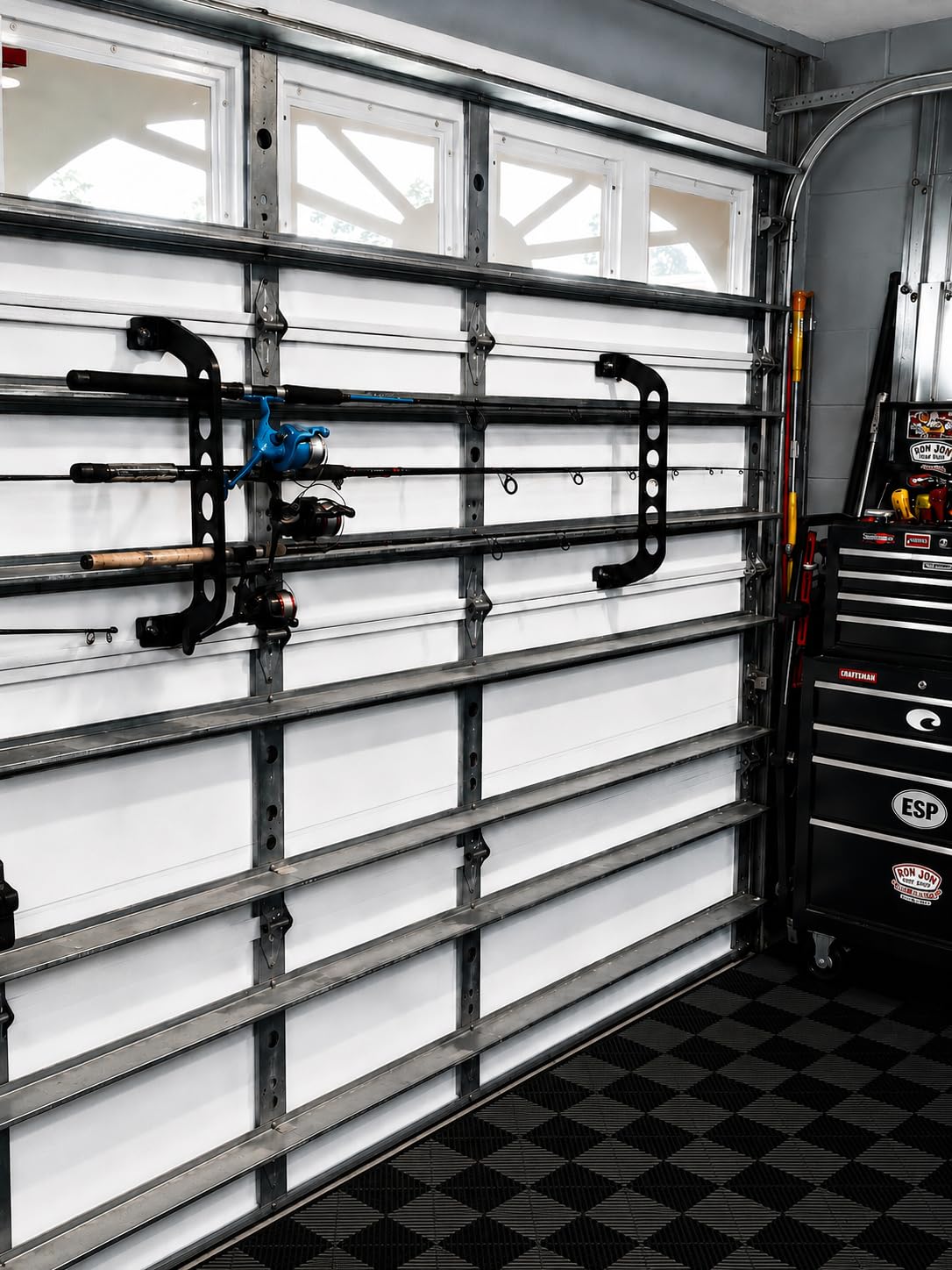
Most rod storage starts with a wall. This one starts with the garage door, usually the widest empty surface in the room, and it clips onto the panels without tools. For a garage where every wall is already spoken for, that is the cleverest use of space in this guide.

What you get is a molded ABS bracket with an adjustable width, so the two halves can be spaced to suit your rods instead of a fixed span, and it holds six combos clear of the floor. Check the roll-up clearance before you commit: the door carries the rods up to the header, and a tall reel or a long butt section can foul the ceiling on the way up.

Pros

  • Turns unused door panels into rod storage
  • No tools for the standard install
  • Adjustable width suits different rod lengths

Cons

  • Won't fit insulated or nonstandard door panels
  • Six combos is the smallest capacity here
Our verdict

For a garage with no spare wall, we think the Cobra is the smartest square foot of storage here — provided your door panels are standard.

Check Latest Price
4

Best Horizontal Mount

PLUSINNO H5 Rod Rack

91 /100
Angler Score Outstanding

Key details

Mount
Wall or ceiling
Opening
1.77 in. (45 mm)
Capacity
Up to 10 rods or combos (2 racks)
Material
Anodized aluminum
Check Details on Amazon

Aluminum is the reason to look at this one. Most racks in this guide are molded polymer; the H5 is extruded and anodized, so the rails stay straight under a full load and a damp garage doesn't touch them. The two-pack covers ten combos, on a wall or overhead.

The 15-degree inclined opening is the detail we noticed first. A rod drops into the mouth of the holder and settles instead of threading through a slot, and the opening is 1.77 inches (45 mm) across, wide enough for most handle and butt sections. The mounting holes at 16 inches on center line up with joists, which is what makes a ceiling install realistic rather than improvised.

Horizontal storage is the answer for long rods and low ceilings, and this is the best-built horizontal rack of the ones here. It suits a joist bay in a garage or a wall run above a workbench, where a rod can sit level and stay out of the way.

Pros

  • Anodized aluminum rails hold their shape
  • Inclined opening makes loading a rod quick
  • Wall or ceiling, on 16-inch centers
  • Two racks hold ten combos

Cons

  • Supplied anchors can crush in drywall
Our verdict

If your rods need to live overhead or along a long wall, the H5 is the horizontal rack we would fit, and the aluminum is why.

Check Latest Price
5

Best for Kayaks

YakAttack Omega Pro

93 /100
Angler Score Outstanding

Key details

Mount
LockNLoad kayak track
Material
Marine-grade polymer
Rotation
360° collar
Rod Types
Spinning, casting, conventional, fly
Check Details on Amazon

The reel rides higher on the Omega Pro than on a flush-mounted holder, and that changes the reach: the reel sits where your hand expects it and a long butt section clears the deck instead of tangling with your legs.

The LockNLoad base is what kayak anglers are paying for. Three modes — locked, adjustment, and removal — let the holder click into a track, swivel where you want it, and come off for the drive home without tools. It fits GearTrac, MightyMount, and most factory-installed tracks.

The 360-degree collar does the work on the water. Set the angle, drop the rod in, twist the collar, and the reel is captured so the rod doesn't rotate while you paddle or troll. Spinning, casting, conventional, and fly reels all sit in it, which is more range than most holders here offer.

For a kayak that already runs track, this is the first holder on our list, and it is the most adjustable one here — that is what the premium buys. It is the difference between a holder you fight with all day and one you forget is there.

Pros

  • Locks into kayak track in three modes
  • 360-degree collar sets any rod angle
  • Takes spinning, casting, conventional, and fly reels
  • Raised arm keeps the reel within reach

Cons

  • Needs a kayak track system, sold separately
Our verdict

For a fishing kayak that already runs track, the Omega Pro is the holder we would fit first; the adjustability is worth the premium.

Check Latest Price
6

Best Boat-Mounted

Scotty Powerlock 230

92 /100
Angler Score Outstanding

Key details

Mount
241 side/deck mount included
Cradle
Universal
Material
Fiber-reinforced nylon
Adjustment
360° rotation, up/down tilt
Check Details on Amazon

The YakAttack above is a kayak accessory. This is a boat fitting: a universal cradle on a post mount that screws to the top or the side of a gunwale, then rotates and tilts wherever you point it.

The front locking ring is the part we care about. It closes across the cradle so a rod can't lift out when you run between spots, and the holder turns a full 360 degrees on its post with an up-and-down tilt on top of that. The fiber-reinforced nylon is thick enough that the cradle has no flex in it, and it doesn't mind salt water.

One practical note before the weekend: the mount is in the box but the screws are not, so plan a hardware run. It suits a boat with a flat gunwale and medium to heavy rods, and it is the holder to fit when you want to change the angle without unshipping the rod.

Pros

  • Front locking ring keeps a rod in while running
  • 360-degree rotation plus up-and-down tilt
  • Thick fiber-reinforced nylon, no flex
  • Side or deck mount included

Cons

  • Cradle runs large for light fly and casting rods
  • Elevation adjusts in coarse steps
Our verdict

We recommend the Powerlock to boat owners who troll: the front locking ring and full rotation do more for a day on the water than any wall rack can.

Check Latest Price
7

Floor and Corner Storage

Rush Creek 16-Rod Rack

91 /100
Angler Score Outstanding

Key details

Height
30 in.
Assembly
No tools
Capacity
Up to 16 combos
Footprint
13.4 in. diameter
Check Details on Amazon

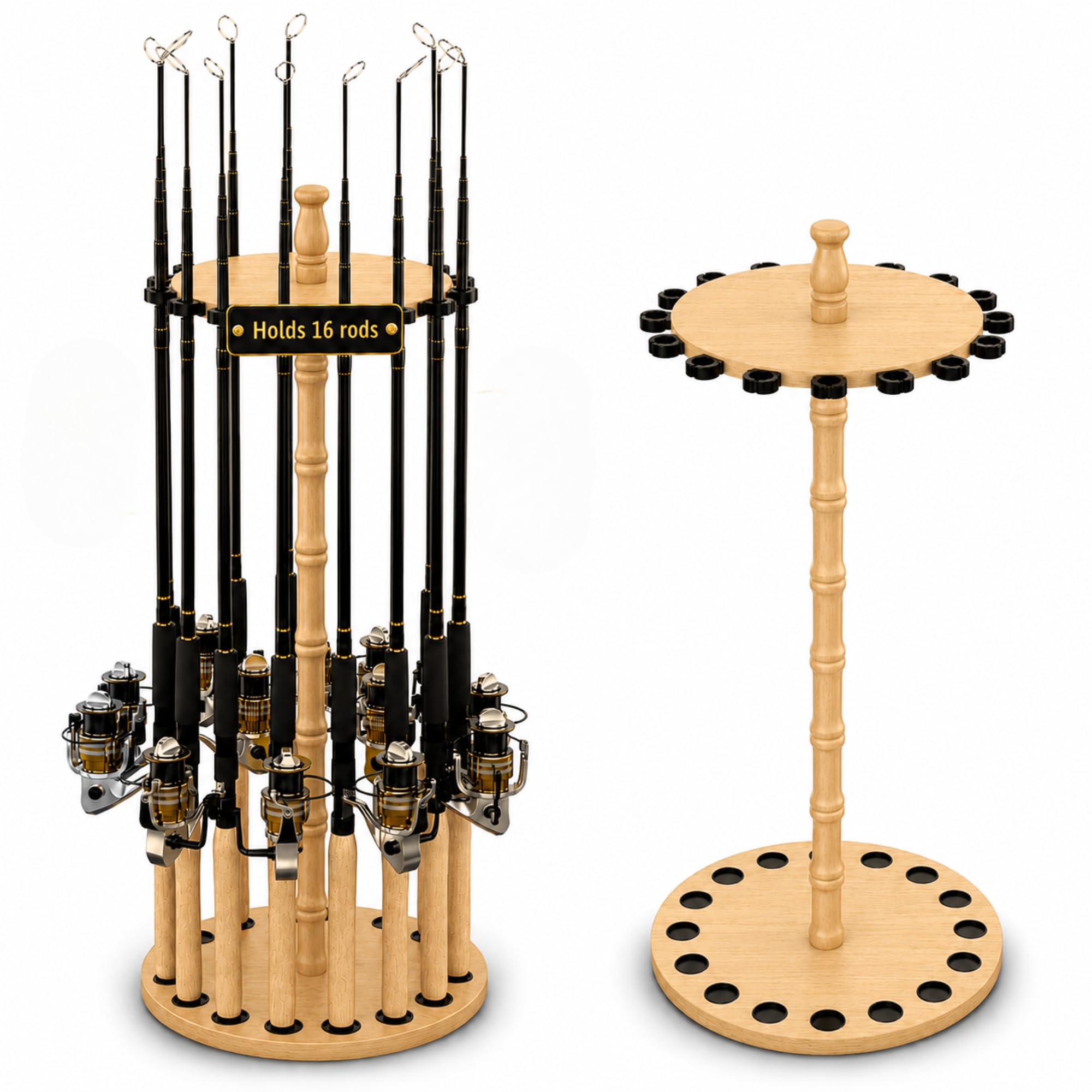
Not every garage has a wall to spare, and that is the case a floor rack makes. This one is a round wooden post on a 13.5-inch base, 30 inches tall, with sixteen combos leaning into cutouts around the outside and every handle visible from any angle.

It goes together without tools, and the light wood-grain finish looks better in a den than molded plastic does in a garage. At four pounds it moves where you need it, which matters if the rods live in a shed over the winter and on a porch in summer.

We rank it below the wall racks on one thing: holding rods exactly where you set them. The top section works loose with use and combos with reels push each other out of their cutouts when the rack is full, so space them out and expect to snug the top bolt now and then. With that bit of attention it does a job nothing else here does — sixteen combos off the wall entirely.

Pros

  • Sixteen combos in a 13.5-inch footprint
  • Assembles without tools
  • Wood finish suits a den or cabin
  • Four pounds, so it moves easily

Cons

  • 90-day manufacturer warranty
Our verdict

It is the pick when there is no wall left to use: sixteen combos off the floor in a corner, as long as you don't mind the occasional snug-up.

Check Latest Price
8

Small Boats

SeaSense 3-Rack

94 /100
Angler Score Outstanding

Key details

Mount
Screw-mounted, hardware included
Weight
16 oz
Capacity
3 rods plus tool slots
Material
UV-stabilized polypropylene
Check Details on Amazon

Three rods, a pair of pliers, and a filet knife, all in one molded piece that screws to a console or a gunwale — this is the small-boat holder that does the unglamorous work and never asks for attention.

It snaps together into a single piece and mounts with four screws, and the polypropylene is UV-stabilized so it lives outdoors without chalking. Soap and water is the whole maintenance routine.

The dedicated tool slots are the difference between this and a plain three-rod rack. On a small boat, that is a knife and a hook remover off the deck and out of a pocket, which is worth more than it sounds when something is thrashing at your feet.

For the money it is the easiest way to get three rods and a couple of tools off a small deck, and it is the holder we point first-time boat owners toward before they start drilling.

Pros

  • Three rod slots plus pliers and knife slots
  • One-piece molded body resists cracking
  • UV-stabilized for permanent outdoor mounting
  • Screws included and four holes to mount

Cons

  • Mounting flange can pull through if screws are overtightened
Our verdict

A cheap, tough way to get three rods and your tools off a small deck — we point first-time boat owners here before they start drilling.

Check Latest Price

How We Tested Fishing Rod Holders

We began by comparing wall-mounted racks, ceiling mounts, round garage stands, and deck-mounted cradles, filtering the shortlist by stated capacity, mounting type, footprint, hardware included, and price. From there, we tested 14 holders over six months in garages, on a boat deck and a pontoon, and along a dock, loading each with a mix of ultralight, spinning, and baitcasting setups. Every holder was installed the way a normal buyer would install it—following the instructions, using the included hardware, and noting whether the job demanded a stud finder, a second set of hands, or a trip to the hardware store.

During installation, we timed solo assembly and mounting, then gave each loaded rack a firm nudge to see whether it shifted at the bracket or flexed in the middle. On boats, we rechecked the same racks after trailering and after a few hours of chop; on garage walls, we watched for sag once the heaviest rods went on. We also practiced pulling a rod out and returning it one-handed to see whether the holder worked smoothly or fought back, and noted whether the grips held rod butts and reel stems securely or let rods rotate and slide forward.

Capacity got tested honestly: we loaded each holder to its stated limit with reels attached, then measured the real footprint and checked clearance for ceiling-mounted models and tight garage corners. We looked at plastic thickness, welds, rubber inserts, and hardware for signs of flex or rust after repeated use, and we paid attention to whether odd rod lengths or larger reels fit without crowding. The holders that stayed on our walls and decks were the ones that felt solid after a full load, not just empty.

How to Choose a Fishing Rod Holder

Start With the Surface, Not the Rack

Wall studs, ceiling joists, garage door panels, a gunwale, and a kayak track are five different mounting problems, and they don't take the same product. A vertical rack wants about 16 inches of clear wall and one stud. A horizontal rack wants a joist bay and the length of your longest rod. A boat holder wants flat, solid material you can drill into.

Settle the surface first, then shop by the hardware that fits it. The Cobra rack exists only because a garage door is a surface nothing else on this list uses.

Count Combos, Then Subtract for Reels

Every capacity figure here counts rods, and manufacturers count bare blanks. Hang a baitcaster with a wide reel and it takes noticeably more room than the blank alone, so a nine-slot rack may hold seven rigged combos comfortably and a fifteen-slot rack will not hold fifteen once reels are in play.

If you keep reels on, leave a gap between the bulky ones instead of packing every slot. The number on the box is a ceiling, not a promise.

The Grip Decides Whether a Rod Stays Put

Foam cradles feel gentle and they compress; a notch cut to one diameter grips one diameter. The designs that hold up pinch the blank or clamp the reel: spring-loaded pads, co-injected V-grooves, rubber rings, or a locking cradle on the water.

Check the stated fit range against your heaviest handle. The PLUSINNO V9 runs 0.12 to 0.75 inch, which covers most freshwater gear and stops short of a thick offshore handle.

Hardware Is Where Cheap Racks Fail

The rack is rarely the problem; the anchors are. Most kits ship with drywall plugs that crush or pull, and a loaded rod rack is a lever working straight out of the wall.

Land at least one screw in a stud or joist, use the holes spaced 16 inches on center where the rack has them, and swap the supplied anchors for decent ones if the wall is anything other than fresh drywall.

Fixed Rack or Adjustable Holder?

If the rods only need to be out of the way, a fixed rack is cheaper and holds more of them. If you fish from the holder — trolling, drifting bait, or paddling with a second rod rigged — pay for rotation and a locking ring.

The Scotty cradle rotates and tilts; the SeaSense's three slots don't move at all, and on a small boat that is often all you need.

Frequently Asked Questions

Final Verdict

On a garage wall, the PLUSINNO V9 is the holder we point people to first: nine combos in under 16 inches, a grip that closes on the rod instead of cradling it, and an install one person can finish. If you have more rods than wall, the KastKing V15 hangs fifteen for less.

And if the rods ride on a boat rather than a wall, look at the Scotty Powerlock instead — its locking cradle is built for the water, not the garage.