Best Boot Dryers of 2026

Heat is the whole argument in boot dryers. Crank it up and a soaked work boot is dry by morning coffee; overdo it and you cook the adhesives holding the sole on and stiffen the leather at the flex point. Dial it back and you get a gentle, silent box that takes all night — which is fine, since your boots are sleeping anyway. Either way, you're done stuffing newspaper in the toes and pulling on cold, damp boots at 6 a.m.

I've lived with twelve dryers over the past six months — in a mudroom, a garage, and on a couple of ski trips where the boot bag smelled like a locker room by day three. The pattern was hard to miss: a unit that only warms a boot without moving air mostly gives you a warm wet boot, and forced air is what actually carries the moisture out. None of this is expensive gear, but the gap between a dryer you rely on and one you quit bothering with shows up within a week. The ones below earned a permanent spot by the door.

1

Best Overall

PEET Original Boot Dryer

95 /100
Angler Score Outstanding

Key details

Model
M97-FSB
Weight
2.7 lb
Dimensions
9.5 x 9.5 x 22 inches
Drying Style
Silent convection
Check Details on Amazon

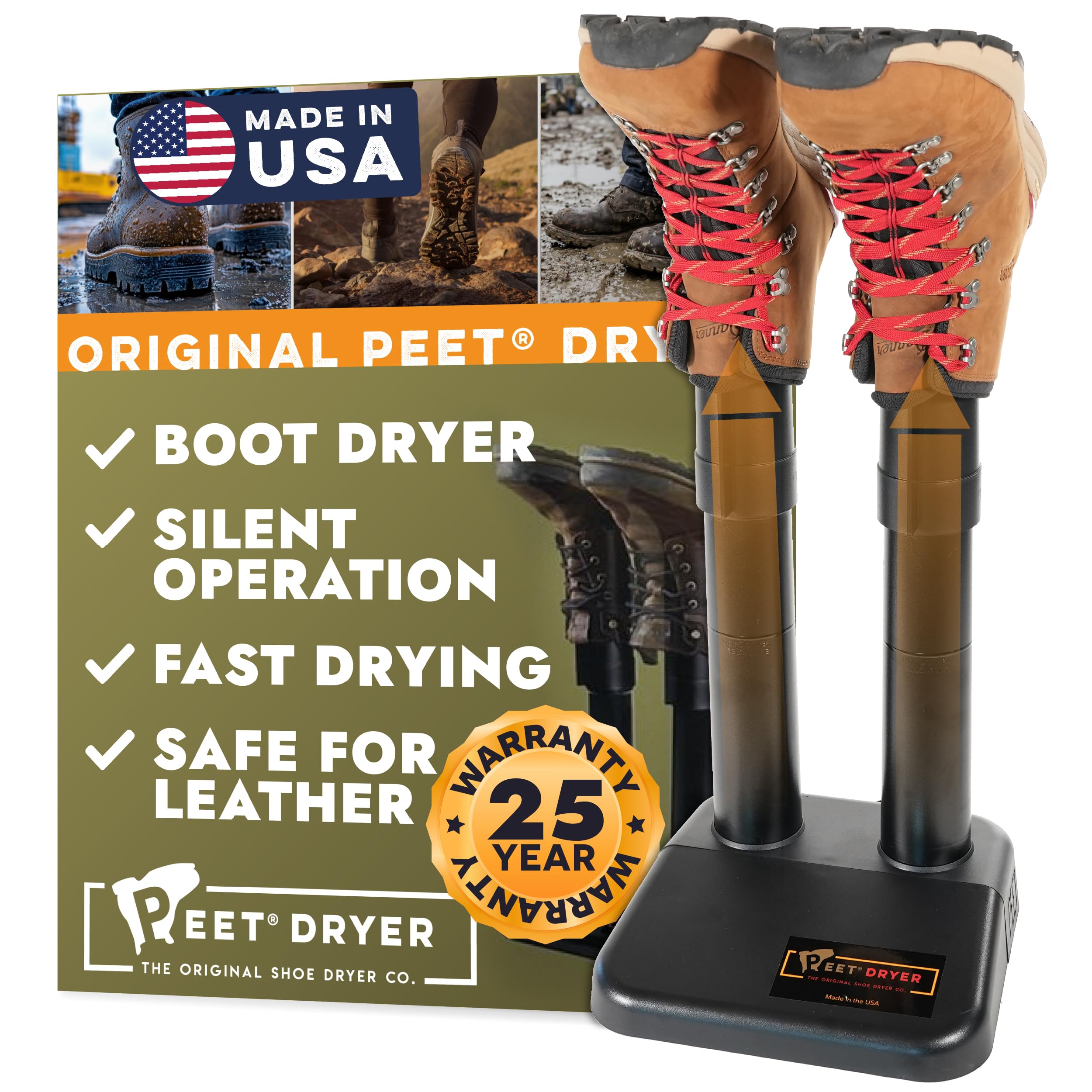
The PEET Original is the boot dryer we reach for when the goal is simply to wake up to dry boots. The design is deliberately simple: warm air rises through two posts, drying a pair overnight while making essentially no sound. That silence is the feature we valued most. In a mudroom or beside a bed, it disappears into the background, and you can leave wet work boots on it without hearing a motor all evening.

The trade-off is speed. Without forced air, the PEET is an overnight tool rather than a quick-turnaround one. For soaked leather work boots, that's the right rhythm; for a kid's cleats needed in an hour, it isn't. The fixed posts are easy to load, and the height accommodates tall boots. We also liked that it warms the boots gently rather than blasting hot air, which is reassuring with leather and glued soles.

With no fan, there's no airflow path to clog with dust or pet hair, which matters in a garage or mudroom. The dryer is happiest when you give it that overnight window and let it do its quiet work. We didn't find a reason to overcomplicate it.

Pros

  • Silent enough for any room
  • Dries a pair overnight
  • Gentle warmth suits leather
  • Simple two-post loading

Cons

  • Plastic fittings feel less substantial than the price
Our verdict

We recommend the PEET Original as the default boot dryer for anyone who wants dry, warm work boots by morning without fan noise.

Check Latest Price
2

Best for Families

DryGuy DX Force Dry

93 /100
Angler Score Outstanding

Key details

Ports
4
Timer
3 hours
Capacity
15 lb
Heat Settings
Heat or no heat
Check Details on Amazon

Four ports are the reason to step up to the DryGuy DX. The central blower pushes air through all of them, so you can dry two pairs of boots at once or one pair while a set of gloves rides on the spare ports. We found the three-hour timer the most useful part: load the boots, turn the dial, and walk away. The heat/no-heat switch is a nice touch for materials that don't need warmth.

This is a more mechanical dryer than the PEET. You'll hear the blower, though it's a soft rotary hum rather than a shop-vac roar, and the unit takes up a real footprint on the floor. We liked it for a garage or mudroom where two pairs of wet boots are a normal evening. For a single pair, the extra capacity is harder to justify.

The controls feel simple enough for daily use, and the spare ports give wet gloves somewhere to go, which is more useful than it sounds on a snowy school morning. We did notice that the heat is gentle rather than hot; that's fine for leather and synthetic boots, but don't expect a blast of warmth.

Pros

  • Dries two pairs at once
  • Three-hour automatic shutoff
  • Heat or no-heat switch
  • Quiet rotary blower

Cons

  • Bulky footprint
  • Premium price for the capacity
Our verdict

The DryGuy DX is the one we choose when two people come home wet, with four ports and a timer that make family boot duty much easier.

Check Latest Price
3

Best for Ski Boots

DryGuy Force Dry

91 /100
Angler Score Outstanding

Key details

Ports
Articulating
Weight
3 lb
Capacity
15 lb
Dimensions
8.5 x 3.5 x 8 inches
Check Details on Amazon

Ski boots and gloves are awkward shapes, and the DryGuy Force is built around that problem. Its two ports articulate, so you can angle one into a ski-boot heel and the other into a glove without fighting the stand. The body is compact enough to tuck under a bench or store on a shelf, and the forced-air blower moves warmth into places a fixed post can't reach. That's the reason it earns a place here.

The Force is not a high-capacity family dryer. It handles one pair at a time, and the compact footprint means you need to be deliberate about loading tall boots so the stand stays balanced. We liked it for a ski trip or a garage shelf where space is tight. The forced-air fan is the part that makes it useful for gloves, and it's also the part you'll hear.

For ski gear, we think the trade-off is worth it; the compact body stores more easily than any full-size dryer here. It's a focused tool, and that focus is why it stays in the ski-bag conversation.

Pros

  • Articulating ports fit ski boots and gloves
  • Compact body stores easily
  • Forced air dries gloves faster
  • Simple top-load design

Cons

  • Heating can fail after a few months
Our verdict

The DryGuy Force is our pick for ski boots and gloves, where articulating ports and a compact body matter more than raw capacity.

Check Latest Price
4

Best Portable

Snowpea Portable Boot Dryer

91 /100
Angler Score Outstanding

Key details

Timer
3, 6, or 9 hours
Weight
7.05 oz
Hose Reach
11.8 inches
Packed Size
6.6 x 4.3 x 2.4 inches
Check Details on Amazon

Packed size is the reason the Snowpea makes the cut. It folds down to roughly the size of a paperback, and the two hoses extend to 11.8 inches so you can push warm air toward the toe of a shoe or a glove. We liked that it doesn't need a dedicated stand; you set it on the floor and let the hoses do the work. For a ski bag or a small apartment, that's a useful shape.

The 140°F airflow is warm rather than scorching, and the three timer settings are genuinely useful: three hours for a quick shoe refresh, six or nine for heavier boots. We found the three-hour setting the easiest to live with on a trip. The trade-off is reach; in a tall ski boot, the hoses may not get all the way to the toe, so you need to position them carefully.

The first few uses bring a faint plastic smell that fades. We noticed it mostly on the first cycle and not after that. The compact body also means you should check that it sits stable before you walk away.

Pros

  • Folds down for travel
  • Hoses extend to 11.8 inches
  • Three timer settings
  • Warm 140°F airflow

Cons

  • Hoses can fall short in tall ski boots
Our verdict

The Snowpea is the travel boot dryer we pack for ski trips, with a compact body, extendable hoses, and a timer that fits a hotel room.

Check Latest Price
5

Best Budget Silent

JobSite Silent Boot Dryer

91 /100
Angler Score Outstanding

Key details

Model
54091
Wattage
36W
Drying Style
Fanless
Check Details on Amazon

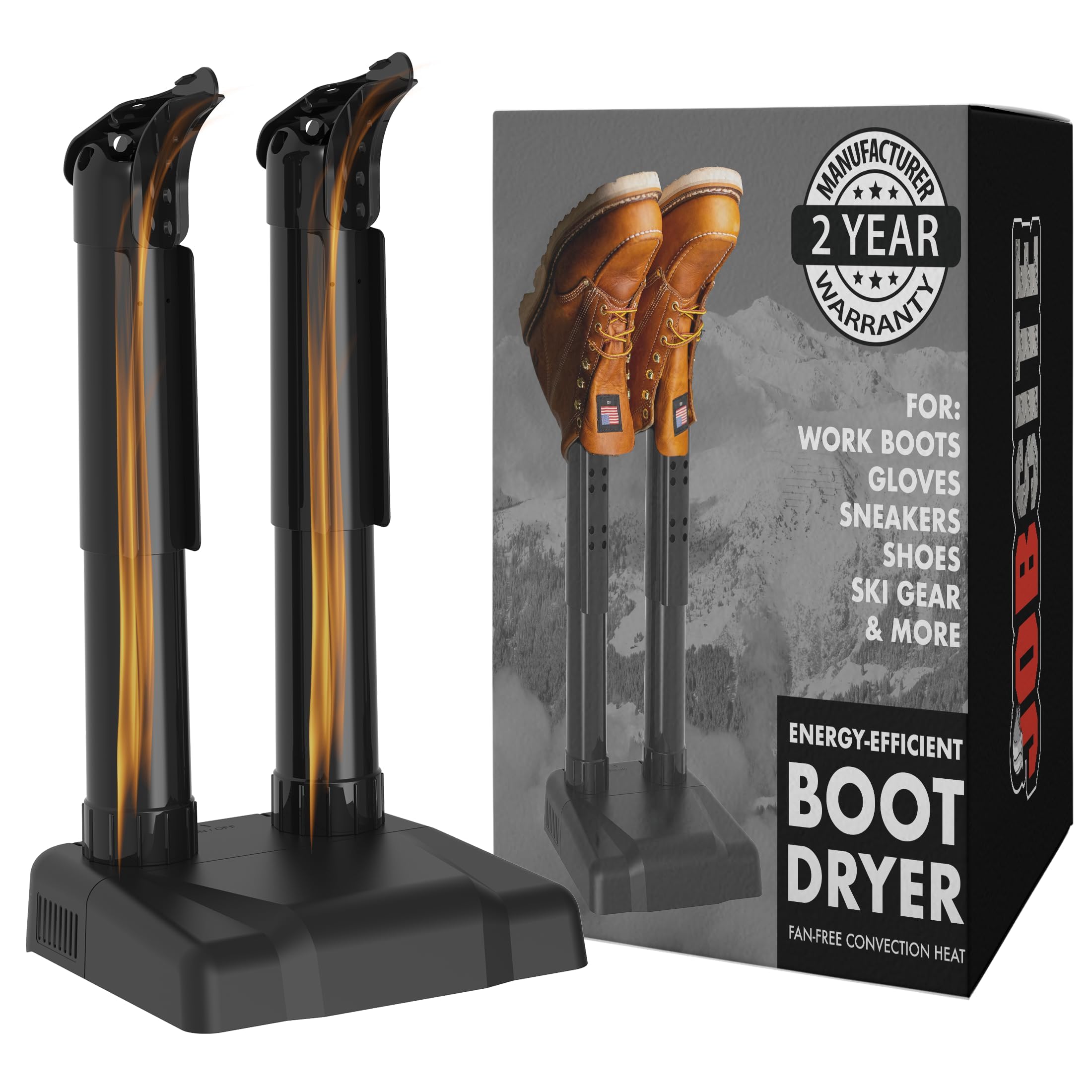
The JobSite 54091 is the quietest way to spend a little on a boot dryer. It's a 36-watt fanless unit, so there's no motor, no fan, and no sound beyond the click of the outlet. We found it best for overnight drying: put wet boots on the posts, go to bed, and deal with them in the morning. The blue light is the only sign it's running, which can make you double-check that it's actually on.

The drying pace is slower than a forced-air unit, which is the price of the silence. For a garage or a mudroom where the dryer can work overnight, that trade-off is easy to accept. It's not the unit for a soaked boot needed in an hour. We liked it for hunting boots and everyday shoes that just need a dry-out, not a rescue.

The 36-watt draw is modest enough to leave on overnight without thinking about it. There's nothing to adjust, which is the appeal. With no fan, there's also no airflow path to clog with dust or pet hair. For a second dryer or a quiet backup, it does the core job without drawing attention to itself.

Pros

  • Silent fanless operation
  • Low 36W draw
  • Simple overnight drying
  • Blue light shows it's on

Cons

  • No on/off switch
  • Base can feel flimsy with heavy boots
Our verdict

The JobSite 54091 is our budget silent pick, a fanless overnight dryer that costs little and makes no sound.

Check Latest Price
6

Silent Drying

LAVIEAIR Silent Boot Dryer

89 /100
Angler Score Excellent

Key details

Noise
0 dB
Warranty
2 years
Dimensions
9.29 x 10.23 x 21.06 inches
Certification
ETL
Check Details on Amazon

The ETL listing and two-year warranty are what set this fanless dryer apart. It has no fan, no motor, and no moving parts, so it lives up to the zero-noise claim in a way that forced-air units can't. Warm air moves through two tubes by convection, and the overheat and overcurrent protection are the kind of details we like to see in a unit that may run unattended. The housing is plain white and unobtrusive, which helps it disappear in a guest room.

It's an overnight dryer, not a quick-turnaround one. We liked it for a guest room, cabin, or mudroom where silence matters and the boots can stay on until morning. The tubes warm up but don't get hot to the touch, which is reassuring with leather and synthetic liners. The two tubes are simple to position, though tall boots need the shaft to stay upright rather than flopping over. You won't get the blast of heat that a forced-air model delivers.

The two-year warranty is the backstop that makes the quiet design easier to recommend, especially for a dryer that may run overnight in a cabin or guest room. We think it's the right silent choice when the outlet is nowhere near a garage.

Pros

  • ETL certified with overheat protection
  • Zero-noise fanless design
  • Two-year warranty
  • Warm but not hot to the touch

Cons

  • No on/off switch
  • Durability record is mixed
Our verdict

The LAVIEAIR SL-1000 is the silent dryer we suggest when safety certification and a warranty matter more than speed.

Check Latest Price
7

Light Shoes

FORLIM Shoe & Boot Dryer

87 /100
Angler Score Excellent

Key details

Timer
0-120 minutes
Weight
2.3 lb
Wattage
200W
Port Reach
21 cm
Check Details on Amazon

The FORLIM has a stability problem we noticed right away: with a heavy pair of work boots on the rack, the base wants to tip. The articulating ports rotate 180 degrees and extend, which is handy for sneakers and short boots, but the stand is happier with lighter footwear. We used it for gym shoes and kids' cleats, where it makes more sense.

The 200W forced-air heater moves warm air through two ports, and the 0-120 minute timer shuts it off. The listed drying window is one to two hours, which is quick enough for a morning routine. The ETL listing and two-year warranty are reassuring at this end of the market.

The fan is audible, more so than the fanless picks, so it's not a bedroom appliance. If you're drying tall work boots, look at a taller fixed-post or articulating model instead.

For light shoes, cleats, and short work boots, we think it's a useful compact forced-air option. The mechanical timer dial is simple to set with wet hands, which matters more than it sounds after a rainy walk.

Pros

  • 200W forced air speeds drying
  • Articulating ports reach toe boxes
  • Two-hour timer
  • ETL listed with two-year warranty

Cons

  • Ports suit shorter boots only
Our verdict

The FORLIM is a compact forced-air dryer for light shoes and short boots, not for heavy soaked work boots.

Check Latest Price
8

Wading Boots

JobSite Mighty Dry Boot Dryer

89 /100
Angler Score Excellent

Key details

Type
Heat blower fan
Model
54172
Weight
1 lb
Dimensions
13.74 x 9.25 x 8.07 inches
Check Details on Amazon

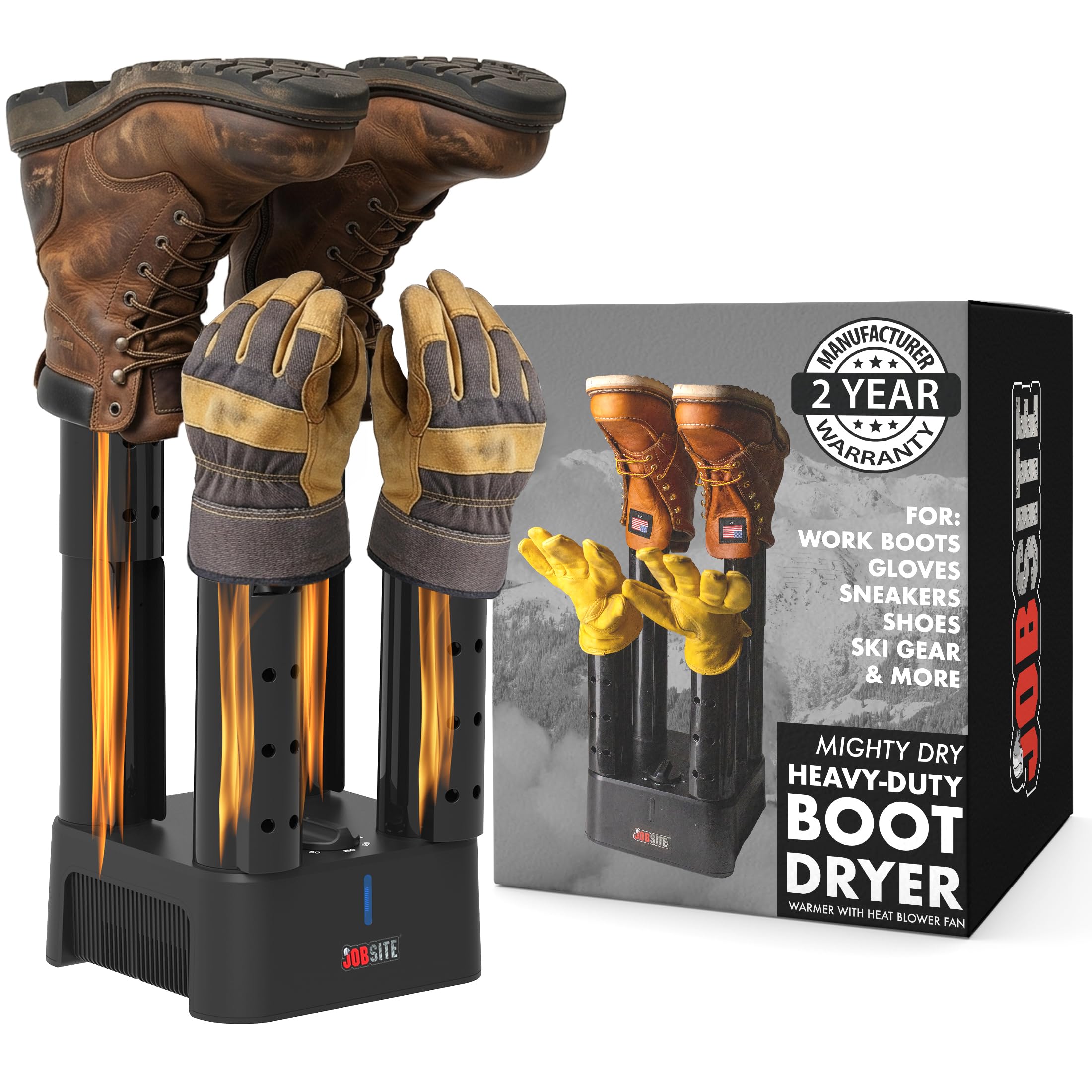
The Mighty Dry makes the most sense for fishing gear. Its heat blower pushes air into a wading boot, and the forced-air design is the right shape for a tall, saturated boot that would sit on a fanless post all night. We liked it for the day-after-a-wet-wade problem, where you want the boot dry before the next trip.

The timer is the feature that makes it easy to live with: load the boots, set the dial, and leave the garage. The unit is compact enough for a shelf, and the top-load design is simple. The timer dial is easy to set with wet hands, and the corded design means you need an outlet near the gear. It's not a two-pair family dryer, and the heat is aimed at one pair at a time.

Noise is the first thing you notice. This is the loudest pick here, so we kept it in the garage rather than the mudroom. The forced-air blast is the reason it dries fast, and also the reason it doesn't belong in a bedroom.

For a wet wading boot, the shape of the airflow matters more than the number of ports. We think that's the case here: the blower is aimed at the boot, not at a family's worth of footwear.

Pros

  • Forced air suits wet wading boots
  • Simple timer
  • Compact shelf footprint
  • Top-load design is easy to load

Cons

  • Fan and heat can fail
Our verdict

The JobSite Mighty Dry is a focused fast dryer for wet wading boots, with a timer and heat blower that suit a fishing routine.

Check Latest Price

What Six Months of Wet Boots Taught Us

We started with every dryer we could get our hands on, then cut the list using the specs that actually decide whether you'll use the thing: how many ports, whether it moves air or only radiates heat, whether there's a timer, how much shelf space the footprint eats in a mudroom, and how far the cord reaches. Units that only warmed a boot without a fan got flagged for extra scrutiny rather than dropped, since plenty of people want something silent for a bedroom. We also weighed price against port count and airflow — a cheap two-port dryer with a real fan beat a pricier cabinet with none. That left 12 models, from a packable travel unit to a four-port garage setup.

Each one went into rotation for six months. The core test was simple: we soaked a pair of leather work boots and a pair of mesh kids' sneakers in a bucket for ten minutes, shook them out, and recorded the starting weight. Then we started the clock. Every hour we pressed a dry paper towel into the toe box and noted whether it came back damp, and we re-weighed each boot to see how much water had actually left. Ski boots and heavy work gloves got the same treatment, since a liner pressed tight against a port dries on a different schedule than a loose sneaker.

Noise got measured with a decibel app at three feet, then a full night in a bedroom to hear whether the fan whined or clicked. For heat, we parked a thermometer in the toe box, checked the leather at the flex point afterward for stiffness or hairline cracking, and watched for softened plastic and warm cords as the weeks added up. We also knocked each unit over, dropped loaded ski boots onto the articulating ports, and left the timers running unattended overnight — reliability, to us, meant nothing smelled hot at 2 a.m. The dryers that earned a spot pulled a soaked boot dry overnight without asking anything of you; the rest left a damp toe box and warm plastic.

How to Choose a Boot Dryer

Start With Drying Style

Fanless dryers like the PEET Original and JobSite 54091 use rising warm air and no moving parts. They're the quietest route and the easiest to live with in a mudroom, bedroom, or RV, but they're overnight tools. Forced-air models such as the DryGuy DX and Snowpea push heat into the boot and cut drying time, at the cost of some fan noise. If you need dry boots before the next shift, choose forced air; if you load boots at night and wear them in the morning, fanless is the calmer choice.

Match Ports to Your Household

For one person with one pair of work boots, two posts are enough. If two people come in wet, or you routinely dry gloves alongside boots, four ports or articulating arms earn their footprint. The DryGuy DX can run two pairs at once, while the DryGuy Force and Snowpea angle air into ski boots and gloves. Count the items you actually dry on a wet evening, not the maximum the box claims.

Check the Fit for Tall Boots and Gloves

Tall work boots, ski boots, and waders need ports that reach deep into the toe box. Articulating or extendable ports help; fixed posts rely on the boot sitting high enough. The Snowpea's hoses extend to 11.8 inches, and the DryGuy Force's ports rotate, but neither is a guarantee for every tall boot. If you're drying waders or tall ski boots, check the port reach and the stand's stability before you buy.

Decide How Much Automation You Want

A timer is the difference between a dryer you can leave and one you have to remember. Three hours is enough for most forced-air cycles; fanless models often run overnight. A heat/no-heat switch matters for leather, glued soles, and synthetic gloves. If a model has no on/off switch, plan on a switched outlet or unplugging it. Automatic shutoff is worth paying for if the dryer lives in a garage or cabin.

Plan for Noise, Space, and Longevity

Where the dryer lives should decide the noise question. A forced-air unit in a garage is fine; the same unit in a bedroom is not. Fanless models are silent but slower, and their plastic bases can feel less sturdy with heavy boots. Look for a stable footprint, a warranty, and a design that keeps the boots from tipping the stand. A dryer that falls over with wet work boots is not saving you time.

Frequently Asked Questions

Final Verdict

If you want one boot dryer to handle wet work boots, sneakers, and the occasional pair of gloves, the PEET Original is the one we recommend first. Its silent overnight drying is the easiest routine to live with, and it has the strongest record here for the core job. For two pairs at once, the DryGuy DX is the better family machine; for a ski bag or a small apartment, the Snowpea is the travel pick.