Best Camping Dutch Ovens of 2026

Campfire cooking has a way of making people dramatic about cast iron, and honestly, the pot earns it. A good camping Dutch oven is a heavy lidded vessel that holds heat like a brick oven, so coals piled on the lid and underneath turn a tough chuck roast into something that falls apart at the touch of a spoon. What it actually fixes is the sameness of camp food — the third night of hot dogs and dehydrated rice. I've eaten plenty of both, and I'd rather haul eight pounds of iron. Over the past several months my team cooked in 11 of these pots, from two-quart weekend models to big ten-quart feeders, and the differences that mattered weren't the ones I expected up front.

Most shoppers I talk to worry about two things before anything else: whether the thing will crack or warp on the first real fire, and whether they'll regret carrying it. Those are fair. Cast iron is genuinely heavy, and the rough, pebbly texture on cheaper pieces is a real annoyance until it seasons over — it grabs paper towels and eggs alike. But the pots that held up best all had a similar feel: thick walls, a lid that seated without wobble, and legs spaced wide enough to sit steady in a bed of coals. Value, size, and versatility sorted themselves out once we started cooking, and the ones that survived a season of ash and rain are the ones below.

1

Best Overall

Uno Casa 6 Qt Camp Dutch Oven

94 /100
Angler Score Outstanding

Key details

Weight
17 lb
Capacity
6 quarts
Included
Lid lifter, tote bag, recipe e-book
Feet And Handle
Three legs, steel bail
Check Details on Amazon

Open the box and there is more than a pot inside: a 6-quart cast iron oven with three feet and a bail handle, a 12-inch lid that flips into a skillet, a lid lifter, a canvas tote, and a small recipe book. The lifter is the piece most camp ovens make you buy separately, and it is the one that keeps a hot lid off your knuckles.

That kit is why this is the pot we point people to first. Camp cooking goes wrong for unglamorous reasons — a lid with nowhere to go, a sooty oven riding loose in the truck bed — and Uno Casa has answered both before you leave the driveway. Six quarts is the size most families actually need: a chicken with vegetables fits, a stew for four leaves a little over, and at 17 pounds the pot is still light enough for one person to move. The feet hold it steady in a coal bed, and the bail lets you hang it from a tripod when the flames run taller than the coals.

The tote is the weak spot. Pointed feet and canvas are not friends, and the bag will wear long before the iron does. Six quarts is also a family size rather than a basecamp size, so a dozen people need the Lodge 10-quart below. For everyone else, arriving at the fire with everything you need in one hand is the whole argument.

Pros

  • Lid lifter, tote, and recipe book included
  • Three legs and a bail handle for coals or a tripod
  • Lid flips into a 12-inch skillet
  • Six quarts feeds four to six people

Cons

  • Tote fabric wears against the pointed feet
Our verdict

We think this is the camp oven to buy first: six quarts, real feet for coals, and a lifter and tote in the box, so the only thing between you and dinner is fire.

Check Latest Price
2

Best for Big Groups

Lodge Camp Dutch Oven, 10 Qt

96 /100
Angler Score Outstanding

Key details

Lid
Flanged rim holds coals, inverts as griddle
Weight
25.5 lb
Capacity
10 quarts
Feet And Handle
Three legs, bail handle
Check Details on Amazon

Twenty-five and a half pounds, 14 inches across, 10 quarts deep. Nothing about the Lodge camp oven is casual, and that is the point: it is a pot you carry from the truck to the fire ring with both hands and then leave there while it feeds a dozen people. If your campouts involve a vehicle and a crowd, the weight buys you something real.

The design is the classic camp oven arrangement, done properly. The lid carries a raised rim that holds a shovel of coals, and it inverts into a griddle for frying after the stew comes off. Heat from above and below is what lets a camp oven bake rather than just simmer, and this much iron holds temperature through a long, uneven fire. The bail handle is stout enough to hang the pot from a tripod, and three legs settle it into a coal bed without burying the base.

Two costs come with the size. Filled, it is a two-person lift, and this is the most expensive pot in the group. The seasoning also needs watching: metal utensils scratch through it, and those scratches are where a camp oven starts to spot if it goes away damp. Dry it over heat and oil it, and the next coat covers the marks.

Pros

  • Flanged lid holds coals and inverts as a griddle
  • Ten quarts feeds a whole campsite
  • Holds heat steadily for baking over fire

Cons

  • 25.5 pounds before anything goes in it
  • Metal utensils can scratch through the seasoning
Our verdict

For a basecamp crowd we recommend it without hesitation: 10 quarts, a rimmed lid that takes coals, and the thermal mass to bake over an open fire.

Check Latest Price
3

Best for the Fire Pit and the Kitchen

Lodge Dutch Oven with Bail Handle, 7 Qt

96 /100
Angler Score Outstanding

Key details

Handle
Steel bail
Capacity
7 quarts
Diameter
12.01 inches
Oven Safe
400 °F
Check Details on Amazon

The Lodge 7-quart with the steel bail handle is not a dedicated camp oven, and that is what makes it useful. Lodge lists it for stoves, ovens, grills, and campfires, so it can brown a roast on the kitchen range on Friday and sit in the fire pit on Saturday without either job feeling like a compromise.

Seven quarts is a genuinely flexible size: a whole chicken with root vegetables, chili for four with leftovers, a big loaf. At 12 inches across, two of them fit side by side in a standard home oven, a small detail that matters when you are cooking for a holiday and a campsite in the same week. The steel bail makes a hot pot easier to lift off a grate, and the pre-seasoned surface is ready the day it arrives.

If your cooking happens on coals rather than beside them, the ovens built around that — our top pick and the Lodge camp oven above — are the better tools, with lids made to carry heat on top. This one earns its place as the single pot that covers a stove, an oven, and a fire ring. A full seven quarts of stew is a two-hand lift, so clear a path before you pick it up.

Pros

  • Listed for stoves, ovens, grills, and campfires
  • Seven quarts fits a family with leftovers
  • Steel bail handle makes a hot pot easier to lift

Cons

  • A full pot needs two hands and a clear path
Our verdict

If you want one cast iron pot that works as hard in your kitchen as it does at the fire pit, this seven-quart Lodge is the one we point to.

Check Latest Price
4

Best Value Camp Oven

Overmont 6 Qt Camp Dutch Oven

94 /100
Angler Score Outstanding

Key details

Lid
Reversible, doubles as a skillet
Capacity
6 quarts
Diameter
11.81 inches
Included
Lid lifter
Check Details on Amazon

The 6-quart claim is the first thing to sort out. It appears to count the lid, and with the lid off you are cooking in something closer to 4 quarts, so read this as a pot for two to four people rather than the family-and-then-some the listing suggests.

Once the size is right, the value is obvious. Three legs, a bail handle, a reversible lid that fries bacon and eggs, and a lid lifter in the box, all for less than our top pick. The 500 °F rating covers anything you will do in a home oven as well as a coal bed, and an 11.8-inch pot is easy to manage on a two-burner camp stove. For a first camp oven or a spare for the second car, it is the sensible spend.

Two things to keep an eye on. The capacity claim means a larger group will run short. And the iron has cracked in some pots after only a few uses, so look over the base and walls before each trip — a crack over a fire is not something to discover mid-stew.

Pros

  • Legs, bail handle, and lid lifter included
  • Reversible lid doubles as a frying pan
  • Oven safe to 500 °F

Cons

  • Capacity claim includes the lid; closer to 4 quarts
  • Iron has cracked in some pots with little use
Our verdict

A real camp oven with the lifter included for less money — we recommend it for two to four people who want to try camp baking without a big outlay.

Check Latest Price
5

Best for Solo Campers

Stansport 2 Qt Dutch Oven

93 /100
Angler Score Outstanding

Key details

Finish
Pre-seasoned
Weight
5.5 lb
Capacity
2 quarts
Dimensions
8 x 8 x 3 inches
Check Details on Amazon

If your camping is one pack and one person, the Stansport is sized for you: 2 quarts, 5.5 pounds, 8 inches across and 3 inches deep. It is the pot that fits beside a stove in a backpack and still cooks a real meal at the end of the day.

Small iron heats fast, which is the practical advantage. A two-person stew or a pot of water for coffee does not eat a whole bed of coals, and two quarts is enough for a small loaf of bread or a pair of baked potatoes. The flat base sits on a grate or a shoveled bed of coals, the pre-seasoned finish is ready to cook on, and 5.5 pounds will never be the reason you leave it home.

What it will not do is feed a family. Two quarts is dinner for two or a side dish for four, and there is nothing else in the box beyond the pot and its lid. For something that lives in a pack and comes out twice a day, that trade is the point.

Pros

  • 2 quarts and 5.5 pounds, easy to pack
  • Heats fast on a small bed of coals
  • Pre-seasoned and ready to cook

Cons

  • Feeds one or two, not a family
Our verdict

For solo trips and two-person camps, buy this one: small, light enough to carry, and cheap enough to live in your pack between trips.

Check Latest Price
6

Budget Bread Pot

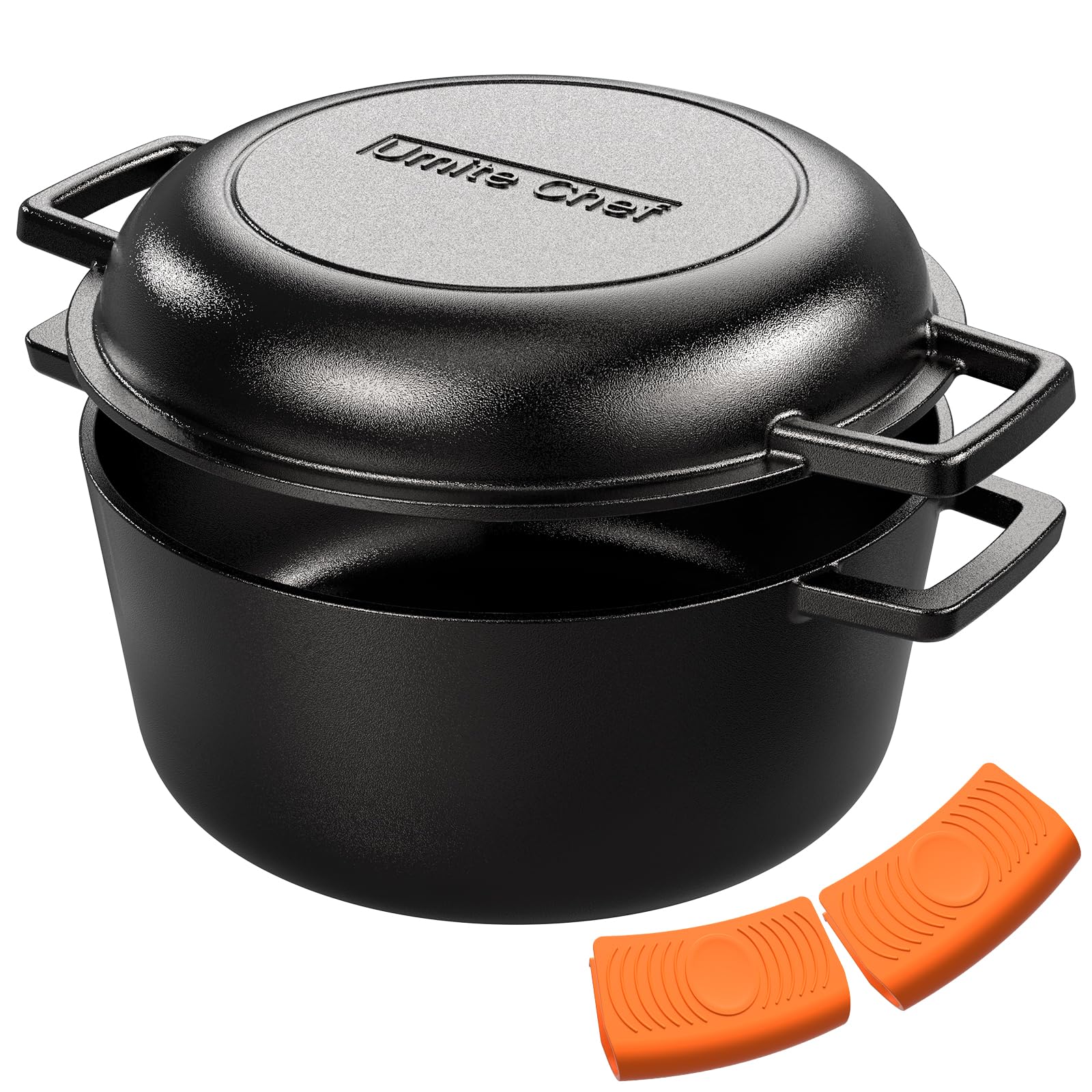
Umite Chef 5 Qt Dutch Oven

92 /100
Angler Score Outstanding

Key details

Lid
Ribbed, doubles as a skillet
Capacity
5 quarts
Diameter
10 inches
Oven Safe
500 °F
Check Details on Amazon

The lid is the interesting part of Umite Chef's 5-quart pot. Its underside is ribbed, a design meant to catch rising steam and drip it back onto the food — the same idea as a self-basting lid, executed in bare cast iron.

The rest is straightforward: a 10-inch pot with two loop handles, pre-seasoned, oven safe to 500 °F, and a lid that doubles as a skillet for eggs, steaks, or a grilled sandwich. Five quarts is a useful middle size, enough for a braise for four and small enough to heat quickly, and the wide base is a natural fit for a boule of sourdough.

It is the least expensive 5-quart pot in this group, and that is the honest reason it makes the list. Think of it as a kitchen pot you can take camping rather than one built around a fire ring; for a tripod hang and coals piled on the lid, the camp ovens above are the better tools. Set this one on a grate or in a bed of coals and it will braise, bake, and fry without fuss.

Pros

  • Ribbed lid sends steam back onto the food
  • Lid doubles as a 10-inch skillet
  • Oven safe to 500 °F at the lowest price here

Cons

No notable drawbacks to flag.

Our verdict

The least expensive 5-quart pot here, and a good one for bread and braises; we would start with it only if a tripod and coals on the lid are not part of your plan.

Check Latest Price

How We Tested the Best Camping Dutch Ovens

We started by pulling together every camp Dutch oven we could find that was actually sold as camp cookware — meaning legs, a rimmed lid for holding coals, and a bail handle or lifting lugs. From that pool we filtered hard: we dropped anything with a lid that didn't seat flush, any pot whose listed capacity seemed inflated by counting the lid, and anything priced so far above the rest that it would only make sense for a chuckwagon crew. That left 11 pots, spanning roughly two quarts to ten, in both flat-bottom and three-legged configurations.

Testing ran about seven months, roughly April through October, so the pots saw everything from cold-weather weekend trips to a stretch of dry, hot weeks when fire restrictions pushed us onto charcoal. Each pot got the same three cooks: a whole chicken with root vegetables as a first-run seasoning test, a pot of beans simmered low for hours to see how evenly the bottom held heat, and a bread or cobbler bake with coals shoveled onto the lid. We counted briquettes rather than guessing, and I kept a notebook of how many it took to hold a simmer in each pot — the thin-walled ones needed constant feeding and still ran hot in the center.

Size claims got checked with a measuring cup and a bag of rice, because a pot that says six quarts and won't hold a five-pound chicken is a pot you'll leave home. We weighed every one empty and again stuffed into its carry bag, then carried them the quarter mile from the car to camp, which is where the weight question stops being theoretical. Durability came down to inspection: we looked for cracks and spidering after every trip, checked whether the lid rim warped under direct coals, and noted how the factory seasoning held up to a wet, sandy weekend without rusting overnight. Value was a judgment call at the end — we asked whether the extras in the box, like a lid lifter or a tote, were things we'd actually have bought separately. We're still cooking in several of these, and anything that fails will come out of the list.

How to Choose a Camping Dutch Oven

Capacity First, Then What You Can Lift Full

A 2-quart oven is a meal for one or two people. Five to six quarts is the family size and where most campers should start: a chicken with vegetables, a stew for four with a little left over, a loaf of bread. Ten quarts is group territory and comes with group-sized iron.

The trap is buying the biggest pot you can afford. A full 10-quart oven is a two-person lift off a coal bed, and a pot you cannot move safely stops earning its place. Choose the size you can carry from the truck to the fire ring, then cook a second batch when the crowd outgrows the pot.

Coals on the Lid Are What Make It a Camp Oven

A dutch oven bakes because heat arrives from above and below at once. At a campfire that takes three pieces of hardware: feet that lift the base out of the flames and into the coals, a lid with a raised rim to hold a shovel of coals, and a bail handle so you can lift the pot or hang it from a tripod.

If you cook on a grate, a camp stove, or a home oven more often than in a coal bed, a flat-bottomed pot with two loop handles is easier to live with and stores flatter. A flanged lid is dead weight if you never put coals on it.

Handles, Lifters, and the Weight You Feel Every Trip

Bare iron runs from about 5 pounds at 2 quarts to 25 pounds at 10. That heft is what holds heat, so it is worth having, but it changes how you use the pot. A bail handle lets you lift a hot oven with a hook or a stick; two loop handles mean a glove in each hand and someone to help.

A lid lifter is the small piece that decides whether you check the stew or leave it alone, and a few ovens here include one. If yours does not, buy one before the first trip and keep it with your gloves.

Seasoning and Rust: Five Minutes After Every Meal

Everything here is bare, pre-seasoned cast iron, and pre-seasoned means ready to start, not finished. Steam, dishwater, and a damp night are what leave the rust spots that show up on cheaper iron. Scrape and rinse with hot water, dry the pot over a low burner or the coals until every trace of moisture is gone, then wipe on a thin coat of oil.

Skip the dishwasher and the overnight sink. Re-oil the underside of the lid, where condensation collects, and store the pot with a folded paper towel under the lid so air can move.

Frequently Asked Questions

Final Verdict

Buy the Uno Casa 6 Qt Camp Dutch Oven first. It is the only pot here that arrives with both a lid lifter and a tote, it has the feet and rimmed lid that coal cooking asks for, and six quarts suits most families.

When a dozen people are eating from one fire, the Lodge 10-quart earns its weight. When the trip is one pack and one person, the Stansport 2-quart is the pot that actually comes along.