Best Camping Fans of 2026

The first night in a tent usually goes fine. It's the second one, when the air goes dead still at 2 a.m. and your sleeping bag turns into a sauna, that sends people shopping for a fan. What you're really buying is sleep — something that keeps the air inside a tent from turning stale and runs quietly enough that you forget it's hanging over your head.

My team and I have spent the past six months camping and porch-sleeping with 13 battery-powered fans, from palm-size clip-ons to lantern hybrids, and the gap between them is mostly airflow, runtime, and how much whine you'll tolerate a foot from your ear. Here's what nobody tells a first-time buyer: the milliamp-hour figure on the box is measured on low speed with the light off, so the number that matters is how long a fan runs on medium with the lantern on. Durability and value sort themselves out fast once a fan has ridden in a duffel for a season, and the picks below are the ones that earned a permanent spot in my gear bin.

1

Best Overall

ADUST 20000mAh Camping Fan

93 /100
Angler Score Outstanding

Key details

Speeds
4
Weight
2.8 lb
Battery
20,000mAh
Runtime
12 to 58 hours
Check Details on Amazon

Press and hold the sleep button on the ADUST and two things happen: the button beeps stop and the indicator lights go dark. That sounds like a small thing until you have spent a night in a tent where every button press is a chirp and a bright green dot glows two feet from your face. It is the sort of detail a fan designed purely from a specification sheet never gets, and it is the reason this one sits at the top of our list.

As a fan, it backs that up. The 20,000mAh battery is quoted at 12 to 58 hours depending on speed, and the upper settings move enough air to reach across a two- or three-person tent rather than just stirring the pillow. What separates it from the fixed-head fans here is the oscillation: 45 or 90 degrees of sweep on the motor, plus 270 degrees of manual pivot, so the air circulates instead of drilling one hot stripe into your sleeping bag. The lantern has three brightness levels, and the low one is dim enough to leave on all night.

Hanging it is straightforward. The hook rotates a full 360 degrees, so the fan sits level from a tent loop or a branch, and the base is stable enough to stand on a cooler lid. The USB output makes it a power bank as well, which earns its keep on a trip where two phones and a headlamp are all chasing the same battery.

What it is not is a backpacking fan. At 2.8 pounds it is the second-heaviest pick here and takes up roughly the space of a hardcover book in a duffel. For car camping, an RV, or a cabin weekend, that is a fair trade for the runtime and the lantern.

Pros

  • Sleep mode silences the beeps and the display glow
  • Oscillates 45 or 90 degrees with a 270-degree pivot
  • 20,000mAh quoted at 12 to 58 hours
  • Power-bank output for phones and lights

Cons

  • 2.8 pounds is car-camping weight, not backpacking weight
Our verdict

Our pick for almost every tent: 58 hours on low, real oscillation, a lantern worth reading by, and a sleep mode that stops the beeping.

Check Latest Price
2

Best for Quiet Sleep

VOSFEEL 20000mAh Camping Fan

95 /100
Angler Score Outstanding

Key details

Light
3 brightness levels
Noise
23 dB
Battery
20,000mAh
Runtime
12 to 58 hours
Check Details on Amazon

Twenty-three decibels is the number VOSFEEL puts on this fan, and in a tent at two in the morning that is the only specification that matters. It ties for the lowest rating in this group and is the quietest of the high-capacity models, and on the low setting we heard a soft, even hum rather than a motor. Share a tent with a light sleeper and this is where to start.

It is not a one-trick fan. The battery is 20,000mAh with a quoted 12 to 58 hours, there are four speeds, and the remote works from across a tent, which matters more than it sounds when the fan is hung above your head and you want to drop a speed without standing up. Four preset timers let it stop after you have fallen asleep instead of running until dawn. The lantern has three brightness levels, the head rotates to aim the air, and the 360-degree hook hangs it level from a loop.

One thing to plan around: the lantern and the fan draw from the same battery, so a night with the light on is a shorter night of airflow. Charge it full before you leave and use the low light setting when you need the lantern rather than the top one. Treat the 58-hour figure as the low-speed, light-off number it is and the arithmetic works out for a long weekend.

Pros

  • Ties for the quietest rating in this group at 23 dB
  • Four preset timers for falling asleep
  • Remote control from inside a sleeping bag
  • 20,000mAh battery with a three-level lantern

Cons

  • A 4.6-inch-deep body takes real pack space
Our verdict

If your tentmate wakes at every click, buy this one: it ties for the quietest rating here and still moves serious air.

Check Latest Price
3

Best for Travel and RV

Warmco D3 Travel Fan

93 /100
Angler Score Outstanding

Key details

Noise
Under 40 dB
Battery
10,000mAh
Runtime
10 to 24 hours
Thickness
1.61 in
Check Details on Amazon

No lantern and no hook: the Warmco D3 is a fan and nothing else, and that is exactly why it earns a spot. At 1.61 inches thick it is the slimmest fan here, thin enough to slide into a backpack laptop sleeve, a suitcase, or an RV drawer without a fight. Of everything in this group it is the one we pack for a hotel room or a cruise without thinking about it.

The 10,000mAh battery is quoted at 24 hours on low and 10 on high, and the low setting runs under 40 dB, soft enough to sleep beside and quiet enough for a shared room. There are four speeds, a 5.1-inch blade in a 7-inch housing, and a small display that shows battery percentage and current speed, which we ended up checking more often than we expected. The USB-C port runs both ways, so it can top up a phone in a pinch, and the two-year warranty is the longest in this group.

Ten thousand milliamp-hours is half what the big tent fans carry, and the numbers show it: 10 hours on high is one night, not two. On speed 1 the airflow is a steady personal stream rather than tent-wide circulation, so treat this as a fan that cools the person in front of it. It also needs a flat surface, since there is no hook and no clip, though the head tilts to aim.

That combination makes it the fan that lives in the bag and comes out in the room. Point it at a bunk from a nightstand, set it on the counter while you cook in the RV, and leave the tent-ceiling duty to something with a hook.

Pros

  • Thinnest body here at 1.61 inches
  • Under 40 dB on the lowest speed
  • Display shows battery percentage and speed
  • Two-year warranty, the longest in this group

Cons

  • No hook or clip, so it needs a flat surface
Our verdict

We pack it for hotel rooms, RV counters, and cabin bunks: 1.61 inches thick, quiet on low, and no lantern adding bulk.

Check Latest Price
4

Best for Small Tents

AMACOOL Portable Camping Fan

93 /100
Angler Score Outstanding

Key details

Size
2.4 x 5.3 x 7.1 in
Light
12 LEDs
Battery
5,000mAh
Runtime
5.5 to 35 hours
Check Details on Amazon

The AMACOOL is 2.4 inches deep, it hangs from a hook on top, and there is a light behind the grille. It is also one of the least expensive fans here, which usually means something has been cut. In this case the cut is airflow and battery capacity rather than build, and for a small tent that is the right set of compromises.

Three speeds, a light with three brightness levels, and a head that turns by hand through 360 degrees are enough to point a breeze at a bunk from a tent loop. At a listed 25 dB it is one of the quieter fans in this group, and the low light is dim enough to read by without lighting up the whole campsite. We hung it from a loop and it did not drag the fabric down the way a heavier fan does, which is the whole argument for a fan this small.

The battery is the trade. The 5,000mAh cell is quoted at 5.5 to 35 hours, and 5.5 hours on high is one night if you are lucky; the low speeds are where this fan earns its place. It also runs from USB while connected, so a power bank carries you through a second night, and that is how we plan a weekend with it. The spill tray for aromatherapy oils is a curiosity rather than a feature, but it comes out for cleaning, which is more than some of these offer.

Pros

  • Light enough to hang without sagging a tent loop
  • Built-in light with three brightness levels
  • 25 dB rated, among the quietest here
  • Runs from USB when the internal battery is empty

Cons

  • Battery capacity fades with use
  • Plastic shell is the part that suffers in a pack
Our verdict

The fan we hand to two-person-tent campers: it hangs from a loop, lights the tent, and weighs less than a filled water bottle.

Check Latest Price
5

Best Non-Rechargeable

Gazeled F15 Battery Fan

91 /100
Angler Score Outstanding

Key details

Noise
50 dB
Power
4 D-cell batteries or USB
Speeds
3
Weight
1.2 lb
Check Details on Amazon

Four D cells, not included. That is the whole proposition: you buy a pack of batteries, drop them in, and the fan runs, with no charger, no cable, and no planning the night before. For a fan that lives in a car trunk or a hurricane tote and gets used twice a year, that is worth more than a bigger rechargeable battery.

It is a 5-inch fan with three speeds, 180 degrees of tilt, a carry handle, and a timer that shuts it off after a set interval. The timer is the feature that matters most, because a fan running all night on cells is a fan you are re-batterying on the second night. It also takes USB power, so a power bank or a car charger keeps it going once the cells fade. Noise is listed at 50 dB, which is loud enough that we would keep it off the pillow and across the tent.

Our advice is to buy it for the glovebox rather than the backpack. At 1.2 pounds and 9.8 inches tall it stands on a cooler lid or a picnic table, and with fresh alkalines it gets through a night on low. Run it for an hour with new cells before you stow it for the season, because the one failure that matters with a battery fan is a unit that will not run on batteries at all.

Pros

  • No charging routine, ever
  • Timer shuts it off after a set interval
  • Runs on USB as well as cells
  • 180-degree tilt and a carry handle

Cons

  • D cells are an ongoing cost
  • 50 dB is loud next to a sleeping bag
Our verdict

Keep one in the car with a pack of D cells and you have a fan and a light in a blackout without hunting for a charger.

Check Latest Price
6

Best for Long Trips

Odoland 30000mAh Camping Fan

92 /100
Angler Score Outstanding

Key details

Weight
3.66 lb
Battery
30,000mAh
Runtime
Up to 136 hours
Max Wind Speed
15 ft/s
Check Details on Amazon

A hundred and thirty-six hours is the number Odoland prints for this fan, and it is the lowest speed with the light off. Discount it heavily and the point stands: 30,000mAh is a serious amount of power, enough that the power-bank output is not a gimmick. You can top up a phone mid-trip and still have fan left over.

Around that battery is a properly equipped fan. Four speeds, a maximum airflow of 15 ft/s, a 35 dB rating, three light levels, and both 45- and 90-degree oscillation on a head that also swivels 270 degrees by hand. The remote means you can change speed from a sleeping bag, and the hook and flat base cover hanging or standing.

The weight is what you pay. At 1.66 kg it is the heaviest fan here, and the base does not detach from the head, so it takes up a slab of space in a duffel. The warranty is also the shortest in this group at 30 days, which is worth knowing before a long trip rather than after one.

Where it makes sense is a campsite you drive into: a hot tent at two in the afternoon, a week with no outlet at the other end, phones that need charging. Where it does not is a pack on your back. That is the whole decision, and it is a clear one.

Pros

  • 30,000mAh quoted at up to 136 hours
  • Oscillation plus a 270-degree swivel head
  • Strong 15 ft/s airflow for its size
  • Charges a phone from the same battery

Cons

  • 1.66 kg is car-camping weight only
  • 30-day warranty is the shortest here
Our verdict

For a week off-grid with a vehicle nearby, this is the fan we take: the runtime is enormous and the weight is the price.

Check Latest Price
7

Best Budget

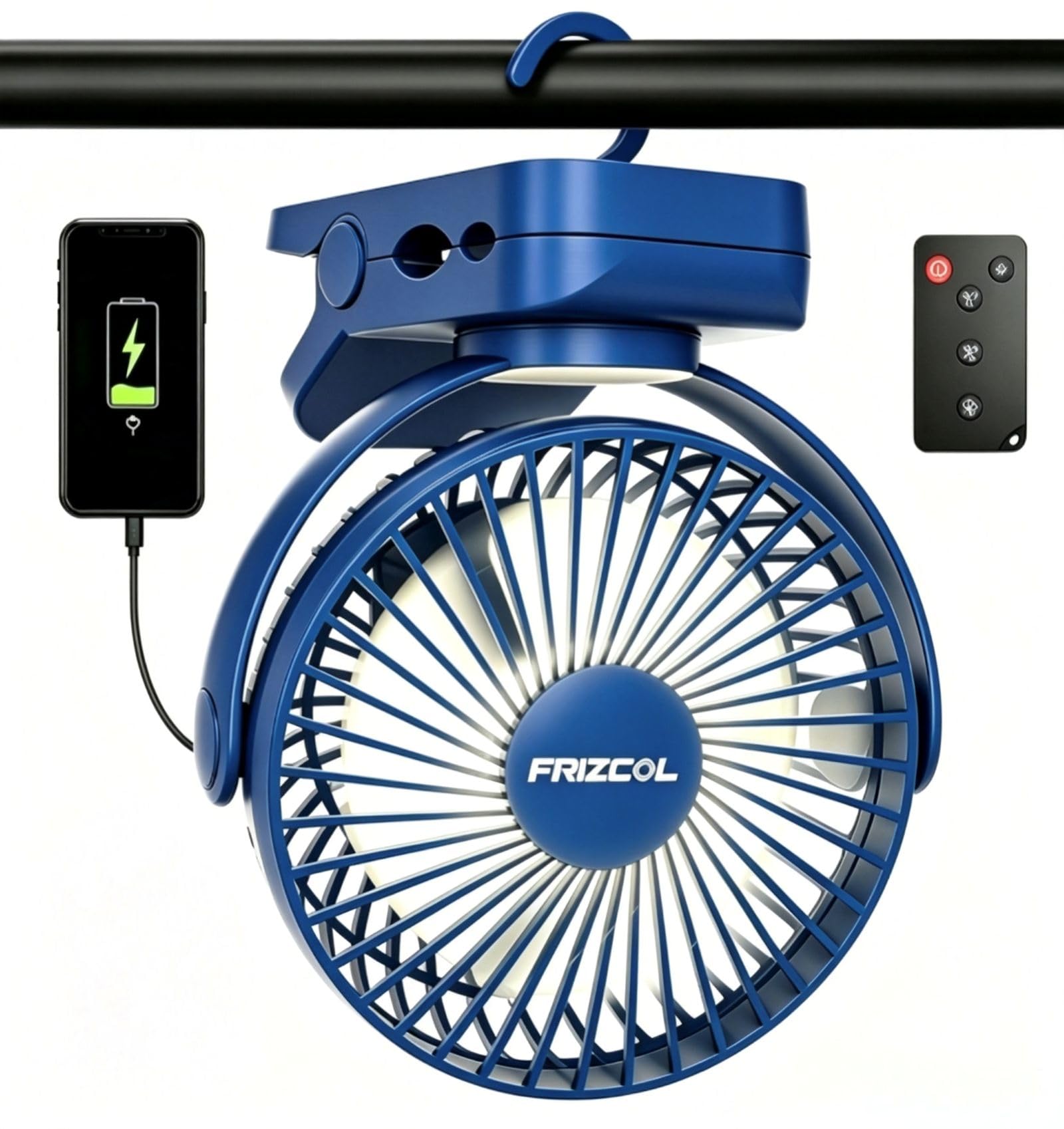
FRIZCOL Clip-On Fan

89 /100
Angler Score Excellent

Key details

Noise
23 dB
Battery
12,000mAh
Runtime
Up to 65 hours
Mounting
Clip, hook, or stand
Check Details on Amazon

A clip changes where a fan can live. The FRIZCOL grabs a tent pole, a bunk rail, a cooler handle, or the lip of an RV shelf, and it also stands on its base or hangs from its hook. That three-way mounting is the reason it is here, and it is the only fan in this group that does all three.

For the least money here you get 12,000mAh, three speeds, three LED lights with two brightness settings, a timer, and a remote that stores in the clamp so it does not vanish into a sleeping bag. The brushless motor is quiet at a listed 23 dB, and the USB-C port works both ways as a power bank.

The trade-offs are the right ones for the price. It is a small head, so the air arrives as a narrow stream you aim rather than circulation for a whole tent, and at the speeds that actually move air the 65-hour figure settles into a night and part of another. What makes it worth carrying anyway is the remote living in the clamp and the fact that a fan you can position anywhere gets used every night instead of staying in the bag.

The hook on top is the least useful of its three mounts; the clip is what you are buying. On a bunk bed or a hammock ridge line it does a job none of the bigger fans here can do at all.

Pros

  • Clips, hangs, or stands, unlike anything else here
  • Lowest price in this group
  • Remote stores in the clamp
  • 23 dB rated with a three-level light

Cons

  • The plastic clamp takes the abuse
Our verdict

The least expensive fan here, and the one we reach for when there is a pole or bunk rail to clip to instead of a ceiling loop.

Check Latest Price
8

Small Rooms

VENTY Portable Fan

91 /100
Angler Score Outstanding

Key details

Noise
30 dB
Battery
16,000mAh
Runtime
15 to 48 hours
Extended Height
42 in
Check Details on Amazon

The column extends to 42 inches, so the VENTY can stand on a tent floor and blow across a bunk instead of at your knees. That is the whole idea, and it works: the head oscillates, the remote detaches and stores in the base, and the fan folds down into its own carry case.

We rate it as the most flexible fan here for a small space, because it works as a pedestal, a tabletop fan, or an angled bedside fan without any of those being a compromise. Airflow is strong for a 3.5-inch blade, 30 dB is quiet enough to sleep beside, and the light is a warm three-level glow rather than the blue-white glare most of these put out.

The price and the charging are the sticking points. It is the most expensive fan in this group by a wide margin, and the charge is where this one gets shaky, with some units that will not accept a charge at all. If you buy it, run it for a full night at home before the trip that matters, while a return is still easy.

Pros

  • Telescopes to 42 inches for bunk-height airflow
  • Remote stores in the base, with a carry case
  • 30 dB with a warm three-level light

Cons

  • The most expensive fan in this group
Our verdict

Worth the premium if you want airflow at bunk height: it stands on the floor, telescopes to 42 inches, and packs into its own case.

Check Latest Price

How We Chose and Tested the Best Camping Fans

We started with a list of roughly 60 fans sold by big retailers and camping shops, then cut anything whose battery couldn't plausibly cover a full night on medium, anything heavier than it needed to be for the airflow it promised, and anything whose clamp or hook looked like it would snap the first time it caught on a tent seam. That left 13 fans, bought with our own money and used from early spring through the end of summer — tent nights, car-camping weekends, sticky backyard sleepovers, and one three-day power outage.

In the tent, we ran each fan on its middle speed with the lantern on and timed how long it took to die from a full charge, then repeated the run on low to see how far the claimed runtimes were from real ones. We measured airflow with a small anemometer at 3 feet and again at arm's length, and checked noise with a meter held a foot away, since a fan that seems quiet in an open room can be maddening clipped to a tent loop near your pillow. Portability got the duffel test: packed with a sleeping bag and a stove, carried a mile, then set up in the dark with cold hands.

Durability is where cheap fans give themselves away. We dropped each one off a picnic table onto gravel, left a couple out in a drizzle, and hauled them around in bags of dusty gear to see whether the buttons, clips, and charging ports still worked afterward. To judge value, we divided the price by the hours of medium-speed runtime we'd actually measured, not the ones printed on the box. The ones that held up through all of it are the fans below.

How to Choose a Camping Fan

Read the Runtime at the Speed You Will Use

Milliamp-hours are what shoppers compare, but hours at a given speed are what you feel at two in the morning. A 20,000mAh fan like the ADUST or the VOSFEEL is quoted at 12 to 58 hours, and the sensible planning number sits in the middle of that range, not at the top. A 5,000mAh model like the AMACOOL is a one-night fan unless a power bank comes along.

If the fan has a lantern, that light draws from the same battery, so a night with the light on is a shorter night of airflow. We prefer a lantern with a genuinely dim low setting over one with a single bright mode, because it lets you keep the light on without giving up the breeze.

Decide How It Will Hang Before Anything Else

A hook is the default and the one that matters in a tent: the fan hangs from a loop or a ridge line and blows down on you. Weight decides whether that works, since a heavy fan drags a lightweight loop down and ends up sitting on the floor anyway.

A clip buys you a pole, a bunk rail, or a cooler handle instead, which is why the FRIZCOL earns a place here, and a flat base is enough for an RV counter or a cabin nightstand. In a family tent, oscillation or a pivoting head is worth paying for, because one fixed stream leaves half the sleepers hot.

Noise, Beeps, and Glow Keep a Tent Awake

Decibel ratings are taken at the lowest speed, so treat 23 dB as a best case and 50 dB as genuinely loud beside a pillow. Anything in the twenties is sleepable; anything in the forties had better be across the tent.

The other half of quiet is what the fan does besides blow. A beep on every button press and a bright charging indicator wake people up, and the ADUST is the one here that addresses both with a sleep mode that mutes the beeps and darkens the display. In a shared tent, put that behavior ahead of a few cubic feet of airflow, and keep a scrap of tape handy for an LED you cannot switch off.

Rechargeable, D Cells, or Both

USB-C rechargeable is the right default for anyone camping more than a few nights a year: it charges from a car, a power bank, or a wall outlet, and several of these models also act as power banks for a phone. The catch is that a rechargeable fan left flat for months is a fan you have to remember to charge.

D-cell fans trade that for shelf life. The Gazeled runs on four cells you supply, sits in a drawer for a year, and works when you pick it up, at the cost of buying batteries and giving up some airflow. If the fan is really a blackout tool, buy the D-cell; if it is really a camping fan, buy rechargeable and add a power bank.

Frequently Asked Questions

Final Verdict

We buy the ADUST. It solves the problems you actually have in a tent: air that sweeps around instead of drilling one spot, a battery that lasts a weekend, a lantern bright enough to walk to the bathroom with, and a sleep mode so the thing does not beep at three in the morning. The weight only matters if you are carrying it.

If you share a tent with a light sleeper, the VOSFEEL is the quieter swap and worth making. If the fan lives in the trunk between hurricanes, skip the chargers entirely and put the Gazeled in with a pack of D cells.