Best Fishing Bobbers of 2026

A bobber is doing two jobs at once: holding your bait at the depth you picked and telling you the instant something down there changes its mind. Get the size or the clip wrong and both jobs fail — the float rides too low under a heavy bait, or the line slips free on the cast and your depth is gone. The right one keeps your bait where you put it, stays readable against glare and chop, and lets you change depth without re-rigging from scratch.

We've spent the last four months running 16 bobbers on farm ponds, off a lake dock, and down a slow river, and the pattern held: price barely predicted quality, but clip fit and buoyancy did. Here's the thing nobody tells a first-timer — match the float to the weight of your bait, not the size of the fish you're after. A bluegill-sized bobber with a big minnow under it just sinks. The picks below run that whole range, from panfish ponds to catfish water.

1

Best Overall

Big Worm 12-Pack Bobbers

90 /100
Angler Score Outstanding

Key details

Style
Snap-on round, red and white
Material
Plastic
Piece Count
12
Sizes Included
1, 1 1/4, 1 1/2, and 1 3/4 in
Check Details on Amazon

One bobber size never covers a whole season. The float that suits a garden worm on a small hook is not the one that holds a fathead minnow, and switching between them is exactly why a mixed bag beats a carded pair. This 12-pack is our top pick for that reason: three floats each in 1, 1 1/4, 1 1/2, and 1 3/4 inches, all in the round red-and-white snap-on style that has been in tackle boxes for decades.

The sizes do real work. The 1-inch and 1 1/4-inch floats are panfish tools, light enough that a bluegill can pull one under with a piece of worm, while the two larger sizes carry a bigger bait and stay readable when a chop is running. Each float takes the line at the top and the bottom, so changing depth is a squeeze and a slide. You can chase fish up and down the water column all afternoon without cutting the line once.

They are hollow plastic, which is the one thing to understand going in. A body that cracks takes on water and starts riding low instead of standing up, and no amount of squeezing brings it back. With twelve in the bag the answer is simply to swap in a fresh one, so treat the float as a consumable rather than an heirloom.

Sort them by size into a small compartment box the day they arrive. Digging for the right float while a bobber is sitting under a dock is the only genuinely annoying part of owning twelve of them, and a divided box solves it in about a minute.

Pros

  • Four sizes cover panfish through bass
  • Clips at both ends speed up depth changes
  • Twelve floats, so losing one does not sting

Cons

  • Snap-on only, so no slip fishing in deep water
Our verdict

The box we recommend first for general bait fishing: twelve snap-on floats in four sizes, so a change of bait never ends the trip.

Check Latest Price
2

Best for Ultralight Trout and Panfish

Trout Magnet E-Z Trout Floats

91 /100
Angler Score Outstanding

Key details

Style
Slotted foam float with peg
Pack Size
36
Target Species
Trout and panfish
Check Details on Amazon

The slot is the whole trick. You lay your line into the slit in the foam, push the peg in behind it, and the float is locked at whatever depth you set — no bobber stop, no bead, no knot to retie when the fish move. We slid these up and down a line repeatedly through an afternoon without opening a pair of nippers once.

They are built for a specific kind of fishing and they are excellent at it: a small jig or a bare hook with a scrap of worm, fished for trout, crappie, and bluegill on light line. The body is small enough that a bluegill's tap actually shows instead of being swallowed by the float's own bulk, and the color still reads against glare at the far end of a cast. Thirty-six in the tube means the one that finally gives out is not a loss worth mentioning.

What they will not do is act like a general-purpose bobber. This is a light-tackle float, and anything with real weight behind it pulls the body under rather than suspending it. Keep them on the ultralight rod with small jigs, and reach for a round float when the bait gets bigger.

Pros

  • Depth changes without retying or a stop
  • Sensitive enough for light jig bites
  • Bright color holds up at distance
  • 36 per tube, so spares cost little

Cons

  • Line can groove the foam slot and let the float slip
  • Only suits light jigs
Our verdict

Our pick for small jigs and light line: these slide to any depth without a knot and show the softest tap, as long as the bait stays light.

Check Latest Price
3

Best Slip Float for Deep Water

Thill America's Favorite Float

90 /100
Angler Score Outstanding

Key details

Body
Balsa wood
Style
Slip float, center slider
Pack Size
5, assorted sizes
Top Color
Orange and red
Check Details on Amazon

A snap-on float is pinned to one spot on the line, so the bait fishes at whatever depth you can still cast. In six feet of water that is fine. When the crappie are suspended at 12 feet and the only place to stand is the bank, it does not work at all.

A slip float fixes that. The line runs through the center of the float, a small stop is pinched on the mainline above it, and the float slides down toward the bait during the cast and then stops at the depth you set. You can reel the float right up to the rod tip, cast a fixed-depth bait 30 feet out, and the stop resets it every time.

This five-pack is the set we reach for when that is the program. The assorted sizes cover panfish up through bass, and the balsa body sits low and rides naturally in a light chop rather than bobbing on top of it. The orange-and-red top stays trackable when afternoon light goes flat, which is when most of us are still out there.

Two practical notes. The pack holds five floats, so plan accordingly if you are used to ten-packs. And the stop is the part that fails first: a rubber stop that creeps up the line quietly takes your depth with it, so pinch it tight and check it after every fish.

Pros

  • Slides to depths you cannot cast to
  • Five assorted sizes in one pack
  • Orange-and-red top tracks in flat light

Cons

  • Balsa body dents and chips if it is knocked around
Our verdict

Our choice when the fish are deep and the boat is not an option — a slip float set that fishes a fixed depth you could never cast to.

Check Latest Price
4

Best for Big Baits and Big Fish

Thill Gold Medal Big Fish Slider

88 /100
Angler Score Excellent

Key details

Body
Balsa wood
Size
5 in (3/4 oz)
Style
Slip slider with brass grommet
Top Color
Orange and yellow
Check Details on Amazon

Every other float here is built around a jig, a worm, or a minnow. This one is built around a bait the size of your palm: a five-inch balsa slider rated at 3/4 ounce, one of five sizes in the line covering half an ounce up to two and a quarter.

If you drift live or cut bait for catfish, pike, or musky, this is the float that makes the rig behave. The brass grommet lets line free-fall through the body, so the bait sinks on its own weight while the float holds at the depth your stop sets. The orange-and-yellow top is visible across a wide river, and the balsa body has enough displacement to keep a big bait up in current instead of being dragged under — which is the part we paid closest attention to.

One number trips people up. The figure on the package is what the float will carry, not what the float weighs. Match your bait and sinker to that number and the slider stands up and reads every take; overload it and it fishes like a brick.

Pros

  • Carries big live and cut bait
  • Brass grommet lets line run free
  • Orange-and-yellow top reads at distance

Cons

  • One float per card, with no spare
  • Five-inch body is more float than panfish need
Our verdict

The float we tie on when the bait is big: a five-inch balsa slider that carries heavy baits and sets depth with a stop.

Check Latest Price
5

Best for Catfish Rigs

Narcissus Foam Peg Floats

89 /100
Angler Score Excellent

Key details

Size
1 1/2 in
Colors
Red, yellow, and green
Material
EVA foam
Piece Count
18
Check Details on Amazon

Catfish rigs are what these are for. The line runs through the foam body, a peg pushed in behind it holds the depth, and the float sits above a circle hook on a Santee Cooper or drift rig — the setup most bank anglers build when they want bait off the bottom. This bag is our pick for that job: eighteen EVA foam floats in red, yellow, and green, in the 1 1/2-inch size.

Foam has two advantages over a hollow plastic bobber here. It does not crack and fill with water after a season of being banged against rocks, and it does not clatter on the cast. There is no slit in these, so the line has to be threaded through the body before you tie the hook on — worth knowing before you are standing on a bank with cold hands.

The 1 1/2-inch size is a small float, which suits panfish and eating-size catfish and gets overwhelmed by a bait the size of a fist. The line this comes from is listed in larger sizes too, so check the variant before ordering if you want the big-bait versions.

Pros

  • Foam will not crack or take on water
  • Three bright colors to sort by bait
  • Peg holds depth on a catfish rig

Cons

  • Peg can work loose and let the float ride up
  • 1 1/2-inch size is small for big baits
Our verdict

Our pick for catfish rigs: foam peg floats that will not crack, in colors you can see, with enough spares to fish a rocky bank.

Check Latest Price
6

Casting into Wind

Bombite Weighted Bobbers 10-Pack

90 /100
Angler Score Outstanding

Key details

Style
Weighted, double-clip
Diameters
1, 1.2, and 1.5 in
Piece Count
10
Check Details on Amazon

There is weight molded into the bottom of each of these, and that is the reason to buy them. A weighted float does the job of the split shot you would otherwise crimp above the knot, which means one less thing sliding on the line, one less weak point, and a light jig that suddenly casts like something heavier.

Ten floats in three diameters — 1, 1.2, and 1.5 inches — with a clip at each end, so a depth change is a squeeze rather than a retie. The 1-inch size is the one we used most, on a light jig for crappie; the larger two carry a bigger bait and punch further into wind.

Where these earn their place is a headwind cast with a bait too light to throw. The built-in weight is the difference between reaching the weed edge and landing at your feet. So while we reach for them on breezy afternoons, they are workhorses rather than delicate bite indicators — the body sits lower in the water than a plain round float, and what you hang under it decides how much of the float you actually see.

Pros

  • Casts a light jig without adding split shot
  • Clips at both ends make depth changes quick
  • Bright colors read at distance

Cons

  • Weighted body rides low and sinks under heavy bait
Our verdict

Our pick for windy days and light jigs: the built-in weight replaces split shot and adds distance you can feel on the cast.

Check Latest Price
7

Flies on Spinning Gear

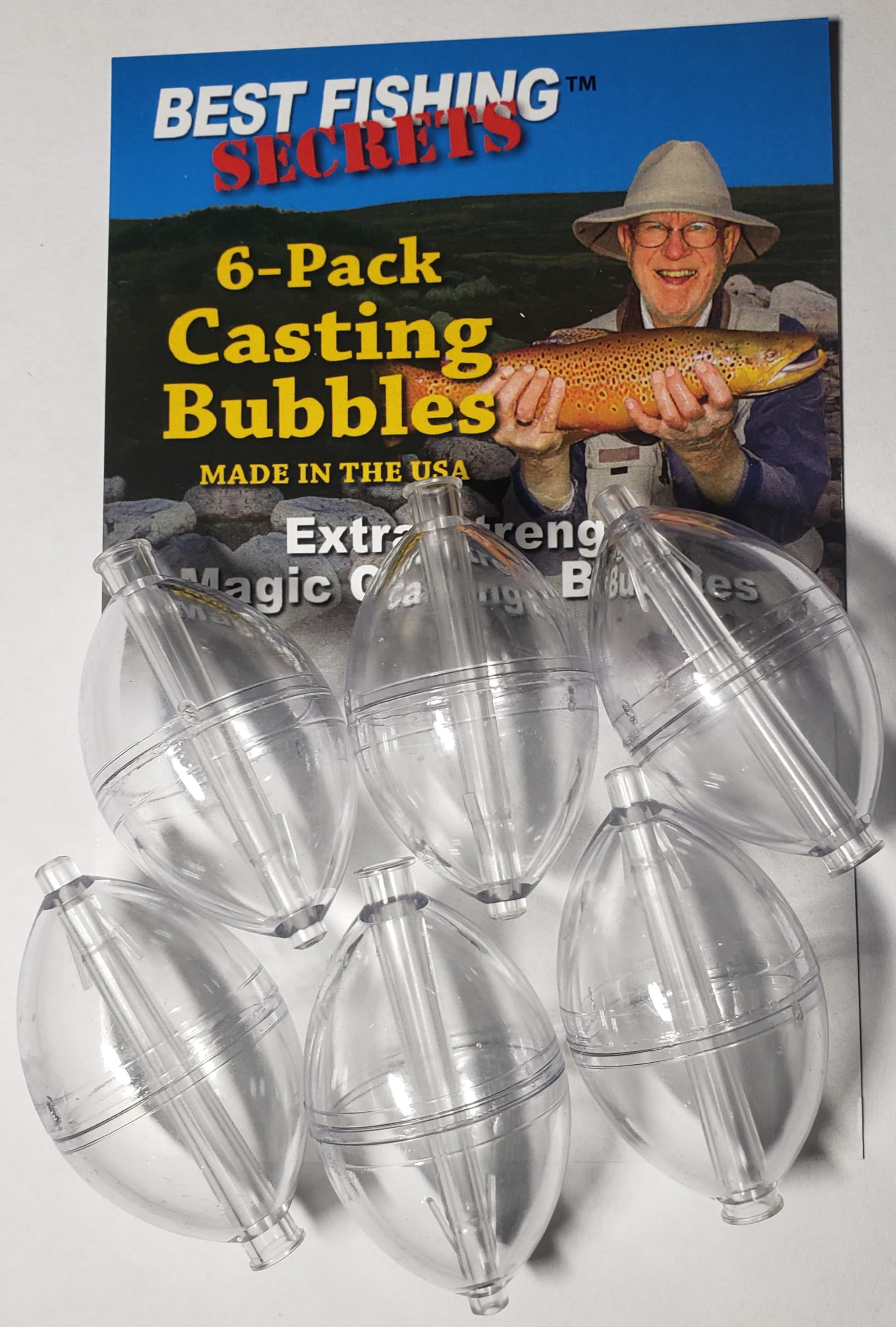
BestFishingSecrets Casting Bubbles 6-Pack

89 /100
Angler Score Excellent

Key details

Size
1 1/8 in x 1 3/4 in
Color
Clear
Material
Butyrate plastic
Piece Count
6
Check Details on Amazon

A casting bubble is what lets a spinning rod throw a fly. Fill the clear plastic bubble partway with water, seat the stopper, tie a couple of feet of leader to the far end, and the weight of the water carries a fly or a lure far too light to cast on its own.

The stopper seats with a tug on the rod rather than a hard push, which is easier with wet hands than it sounds, and you can drop BB-size split shot inside for a faster sink or leave the bubble empty to drift. Six to a pack at 1 1/8 by 1 3/4 inches, in clear butyrate that has held up better than we expected from a hollow plastic float.

It is not a set-and-forget bobber. There are more knots than a clip-on float, and you spend more time watching the line than a bright top standing in the water. The clear body is the point, though: in flat, clear water it lands with far less commotion than a red-and-white ball beside a rising fish.

These cost more than any other float here, and for a spinning-rod angler with a box of flies sitting in a drawer, it is money well spent. If you already own a fly rod, skip them.

Pros

  • Casts a fly on spinning tackle
  • Fill with water to tune the cast
  • Clear body stays unobtrusive on clear water

Cons

  • More knots and rigging than a clip-on float
  • Highest cost per float among these picks
Our verdict

Worth it if you want to fish flies or tiny lures on a spinning rod — a niche tool that does its one job cleanly.

Check Latest Price

How We Chose and Tested Fishing Bobbers

We built the shortlist from the styles anglers actually tie on — snap-ons, slip floats, foam pegs, and casting bubbles — then narrowed by size range, clip type, and price per usable float, since a cheap pack of twelve often turns out to be eight floats and some filler. That left 16 bobbers, which my team and I fished over four months on farm ponds, from a lake dock, and along a slow river, with a few evening sessions from a kayak where everything has to work one-handed.

For buoyancy, we loaded each float with split shot until it sat at the right waterline, then kept adding weight until it went under, noting where that line fell. Visibility got checked in flat glare, at dusk, and in a light chop — a float you can't read is just a weight on your line. We clipped and unclipped each one with wet, cold hands, slid the slip floats up and down both 4-pound and 10-pound line to feel for drag, and dropped them on the dock planks to see what cracked. Every pack was counted on arrival for missing parts and mismatched sizes.

What separated them was rarely price. The ones we kept reaching for held their buoyancy after a week of soaking, had clips sized for the line we were actually using, and kept their color above the surface in chop. A couple sank slowly over an afternoon, a few slipped on the cast, and one pack arrived short of what the label promised — worth knowing before you buy three of them sight unseen.

How to Choose Fishing Bobbers

Match the float to the weight below it

A float is a displacement tool. It has to hold up the hook, the bait, and any split shot and still leave enough body above the surface to show a take. The common mistake is sizing for the fish instead of the bait: the float that is perfect with a minnow lies flat under a nightcrawler and a split shot.

Bring the float to the bait rather than the other way around. Add or remove shot until the float sits at the waterline with the bait hanging below it, and move up a size when you switch to something heavier. Our top pick's four sizes exist so you can make that move without buying another card.

Choose the attachment to match your water

Snap-on floats clip to the line at a fixed point. They are quick, cheap, and fine in shallow water, but the depth can never exceed what you can cast. Slip floats run on a line through a center tube and slide down to a stop, so you can fish 15 or 20 feet down from the bank.

Foam peg floats thread onto the mainline for catfish rigs, and a casting bubble adds weight so a spinning rod can throw a fly. Pick the style for the water you fish before you look at brands — the attachment decides what the float can do.

Buy visibility you can actually use

Color earns its keep at distance. Bright orange, red, and yellow tops stay trackable across 30 feet of flat afternoon light, and a float you cannot see is a float you strike too late on. Against a glare line or in a chop, a bigger body beats a brighter one.

Check it before you commit: if you cannot follow the float against the far bank from where you plan to stand, you will not follow it with a fish on either.

Check the hardware, where floats fail

The paint and the shape get the attention; the clip, peg, or grommet decides how long the float lasts. A clip that does not close flat lets the float slide up the line mid-drift. A foam slot wears a groove and loses its grip. Pegs work loose.

Brass grommets let line run more freely than plastic tubes, which matters on long casts. Carry spare pegs and stops, and retire a float the first time it slides instead of holding.

Buy the count that matches your loss rate

Floats get lost — in snags, on the cast, to a fish that takes one under a log. Small foam floats disappear fastest, which is why a big tube of them makes sense, while large balsa sliders are worth tracking and are usually sold singly.

For general bait fishing a mixed bag of a dozen covers sizes you would otherwise buy one card at a time. Buy for the season, not for the trip.

Frequently Asked Questions

Final Verdict

The 12-pack is still what we reach for first. Four sizes in one bag answer almost every bait-fishing situation, and losing a float to a snag does not end the day or the season.

When the fish are suspended deep and the boat is not an option, switch to the Thill America's Favorite slip set. It fishes depths the snap-ons simply cannot reach. Keep the assortment for the tackle box and add slip floats when the water gets deep.