Best Fishing Sinkers of 2026

A sinker has one job that pulls in two directions: hold your bait where the fish are without smothering the feel of a bite. Go too light and the current walks your rig down the bank; go too heavy and every tap turns into a dull thud you can't read. I've fished cheap assortments for years, and the difference between a good weight and a bad one shows up in the first ten casts — a sinker that creeps up the line, a quarter-ounce that weighs something else, a split shot that crimps once and never holds again. The good ones fix all of it quietly.

We spent four months with 16 sinker styles — split shot, egg, bullet, drop shot, pyramid, bank — on river ledges and surf, and the pattern held: the ones worth keeping had true stated weights and grips that survived a snag. The classic mistake is one big box of a single size; you want a spread from 1/8 ounce for finesse up to a few ounces for heavy surf. The picks below earned permanent spots in mine.

1

Best Overall

AMYSPORTS Egg Lead Sinkers

91 /100
Angler Score Outstanding

Key details

Count
10 pieces
Shape
Oval egg
Weight
1 oz (size 7)
Line Protection
Internal plastic sleeve
Check Details on Amazon

The interesting part of this egg sinker is the hole. AMYSPORTS molds a soft plastic sleeve into the bore, so your main line rides on plastic instead of on bare lead as the weight slides up and down all day. That is the whole design story, and it is a good one: against braid, an unprotected lead bore is a slow abrasion you do not notice until a decent fish is on.

We ran these on sliding bait rigs and a fish-finder setup, and the line above the weight came back smooth rather than scuffed, which is the difference we care about most in a weight that has to slide. The sleeve also stops the egg biting down on the line when a fish leans on it: the weight gives, the bait moves, and nothing binds at the bore.

One ounce is the middle of the range. AMYSPORTS lists these from 3 grams to 200 grams, and 1 ounce covers a lot of inland work, from catfish and carp on a slip rig to big-water bass and light surf. A 10-piece pack is a start rather than a kit, so if you fish two kinds of water, add the next size up and swap eggs instead of retying leaders.

The caveat is shape, not quality. An egg rolls, and on a fast tide, a steep beach, or a reef you will feel it trundling along with your bait in tow. In sand on a gentle tide that roll is an asset; over rock it is a donation. That is the boundary of what this one is for, and it is why the pyramid and bank sinkers below earn their places.

Pros

  • Plastic sleeve keeps line off bare lead
  • Sizes span 3 g to 200 g
  • Slides freely for bait and fish-finder rigs

Cons

  • Rolls in fast current and over rock
  • One size per pack, so two packs for a range
Our verdict

For most anglers this is the sinker we hand over first: the sleeved bore protects the line, and 1 ounce covers a lot of freshwater bait fishing.

Check Latest Price
2

Best Budget

SANWEAL Split Shot

90 /100
Angler Score Outstanding

Key details

Count
120 pieces
Sizes
5 sizes
Style
Removable split shot
Material
Lead
Check Details on Amazon

A hundred and twenty split shot in five sizes, sitting in a compartment case that fits a jacket pocket, is the least expensive way into this guide, and for panfish, trout, and bobber fishing it may also be the most useful thing in the box. Ours lives in a chest pocket, and it is the tackle we touch most in a day.

The design is as old as the sport: a lead ball with a slit cut into it. Pinch one onto the line above your hook or float with pliers, add a second to fine-tune, and open the jaws when you want it off. The case is the underrated part, since five sizes in separate compartments means you are not sorting a baggie with cold fingers while your float drifts into the reeds.

Know the sizes before you buy. They run small, several of them lighter than a BB, which makes them excellent for finesse work and no use at all for holding bottom in surf or current. On a calm lake under a slip bobber that is exactly the point. The lead is soft enough to re-open a couple of times, but every squeeze work-hardens it, so plan on retiring the ones you move around constantly.

Pros

  • 120 pieces across five sizes
  • Small case keeps sizes apart in a pocket
  • Easy to add or remove with pliers

Cons

  • Sizes run small, so no use in surf
Our verdict

Buy a case if you fish panfish, trout, or bobbers on light line; it is the least expensive, most adjustable weight here, and the sizes run small by design.

Check Latest Price
3

Best for Drop Shot

Reaction Tackle Drop Shot

92 /100
Angler Score Outstanding

Key details

Count
25 pieces
Shape
Skinny pencil
Weight
1/4 oz
Attachment
Pinch line clip
Check Details on Amazon

Drop shot weights live or die on their outline. This one is a skinny pencil, and that profile is the reason it comes back through rock, gravel, and brush instead of hanging on it. If you fish a rocky point, that difference is the whole afternoon.

The pinch clip at the top is the other half of the design. Pinch it onto the tag end of your leader, set your length, and you are fishing in seconds; when it lets go on a snag you lose a weight rather than a hook and a plastic. Reaction Tackle runs singles from 1/8 ounce to 1 ounce plus kits up to 101 pieces, and the 1/4 ounce 25-pack is the middle of that road.

What we do not love is the price per weight. Twenty-five is a fair count, but you are paying for the clip and the finish, and a bulk box of bank sinkers costs less per ounce. The 1/4 ounce also runs light once there is wind or you are fishing past 25 feet, so step up to 3/8 if you cannot feel bottom. On a calm morning in 10 to 15 feet it is the weight we tie on first.

Pros

  • Slim profile slides through rock and grass
  • Pinch clip re-rigs in seconds
  • Sizes from 1/8 oz to 1 oz plus kits

Cons

  • 1/4 oz is light for wind and deep water
  • Costs more per weight than bulk sinkers
Our verdict

The drop shot weight we trust around rock: the skinny profile and pinch clip save rigs and reties, as long as you are fishing finesse depths.

Check Latest Price
4

Best for Surf and Sand

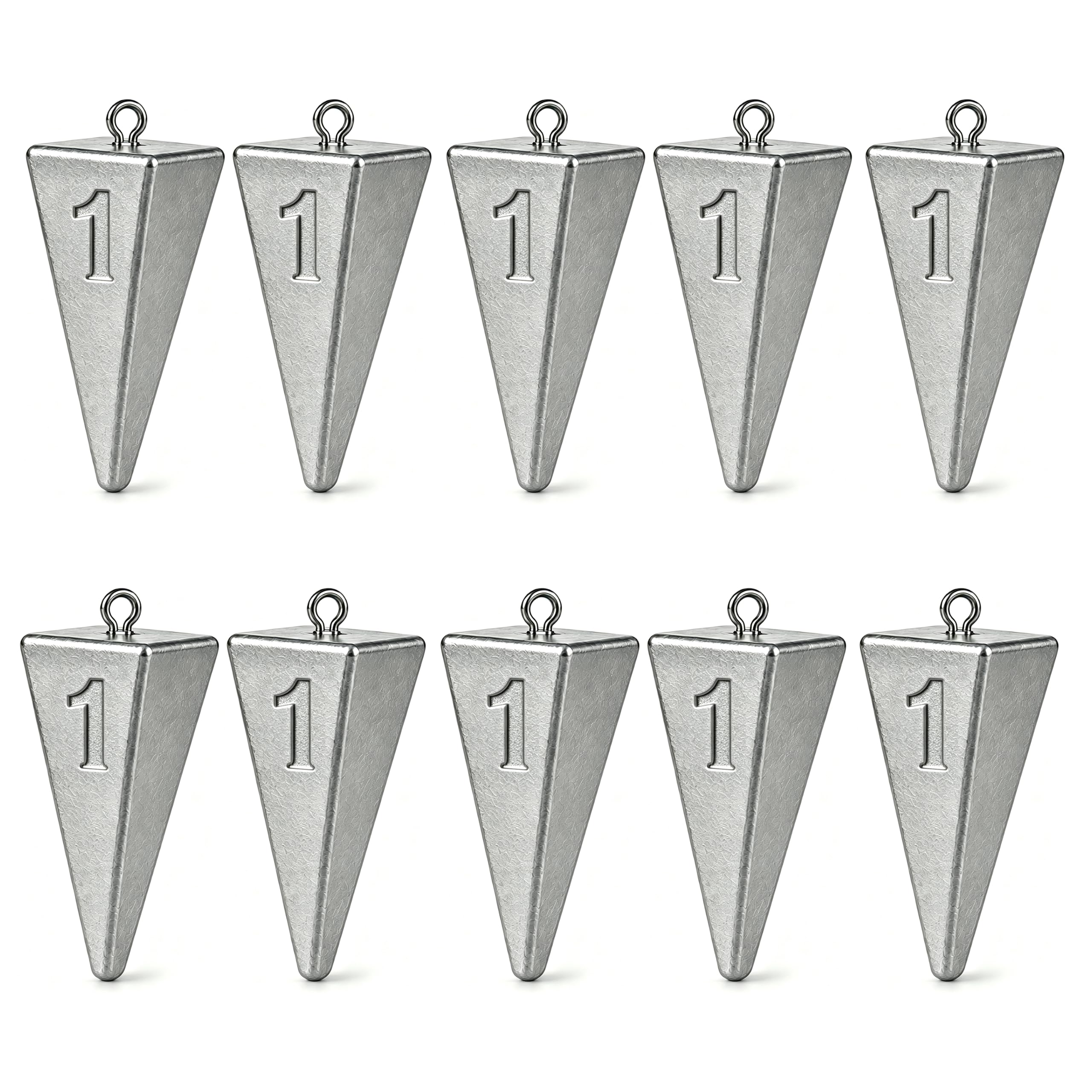
TKHDBF Pyramid Sinkers

93 /100
Angler Score Outstanding

Key details

Count
10 pieces
Shape
Pyramid
Weight
1 oz
Size Range
1 oz to 16 oz
Check Details on Amazon

Eleven weights, from 1 ounce to 16, is the reason this listing is worth your time. A pyramid is a specialized tool, and buying it in the size the surf demands on the day, rather than the size that happened to be in stock, is how you actually get use out of one.

The shape does two jobs at once. The tapered point digs into sand and soft mud and anchors there, while the four flat sides give moving water something to push against without rolling the weight down the beach. On a falling tide that combination is what keeps bait on the bar instead of in the trough. We fished the 1 ounce version off a bay beach and it held in the wash; for an ocean tide the 3 and 4 ounce sizes are the ones that hold, which is exactly why the spread matters.

Buy it for beaches, bars, and pier bottoms where the ground is soft. On rock, hardpack, or a jetty it tips and slides, and a bank sinker does that job better. The eyelet is a plain ring rather than a generous one, so check it against your snap swivels before you order the heaviest sizes.

Pros

  • Eleven sizes from 1 to 16 ounces
  • Tapered point digs into sand
  • Flat sides resist rolling in current

Cons

  • Needs sand or mud; tips over on rock
Our verdict

For surf and pier anglers, this is the shape that holds in sand, and eleven sizes let you match the day's tide instead of guessing.

Check Latest Price
5

Best Bulk Value

Bullet Weights Bank Sinkers

94 /100
Angler Score Outstanding

Key details

Count
40 pieces
Shape
Bank, flat sided
Weight
2 oz
Material
Lead
Check Details on Amazon

Forty two-ounce bank sinkers in one box comes out to the lowest cost per weight here, and that arithmetic is the entire argument. Sinkers are consumables and structure eats them, so paying bulk prices for the size you actually fish is how you stop rationing them through a good tide.

The bank sinker is a teardrop with flat sides and a hole straight down the middle. The flats slow its roll in current, the taper walks over structure instead of wedging into it, and the through-hole lets it slide above your leader on a fish-finder rig, so you can change weight without cutting the rig apart. The casting on these is clean and the holes are clear of flash.

Flexibility is the trade. Two ounces is a lot of lead, which suits boat, pier, and heavy surf work for tautog, striped bass, fluke, and big bottom rigs, and is far too much for a medium spinning rod in a farm pond. As one box to cover a season of saltwater bottom fishing it is hard to beat; if you want a range of sizes, add a pyramid or egg pack alongside it.

Pros

  • Forty 2 oz weights per box
  • Lowest cost per weight in this guide
  • Flat sides cut rolling in current

Cons

  • Sold in one 2 oz size only
Our verdict

For saltwater bottom fishing that eats sinkers, this box is the value play: forty two-ounce weights at the lowest cost per weight here.

Check Latest Price
6

Best for Heavy Current

BLUEWING Bank Sinker 8 oz

91 /100
Angler Score Outstanding

Key details

Count
10 pieces
Shape
Hexagonal bank
Weight
8 oz
Box Total
5 lb
Check Details on Amazon

Eight ounces is a decision rather than a default. This box is for the angler on a pier or jetty with a heavy rod and water that moves: a tide line, an inlet, a wreck in current, where anything lighter finishes the drift somewhere downstream of the bait.

The finishing is better than the price of entry suggests. BLUEWING files the eyelets and polishes the body, so line runs over a smooth ring instead of a raw casting edge, and the hexagonal flats resist tumbling in a way a round bank sinker does not. Ten of them arrive in a five-pound box, which is real weight in a bag, so decant what you need into a pouch for the walk out.

The reservation is fit rather than function. Eight ounces is past the rating of most medium rods, and lobbing it with one is how tips break; this is gear for a rod built to cast it. For that job it is the cleanest-made bank sinker of the ones here, and the polished eyelet is the specific reason we pay more for it rather than buying the cheapest box.

Pros

  • 8 oz holds in deep, fast water
  • Filed eyelets and polished body
  • Hexagonal flats resist tumbling

Cons

  • Too heavy for medium rods
Our verdict

Heavy-tackle anglers fishing deep, moving water get a well-finished 8 ounce bank sinker here, with polished eyelets that treat braid kindly.

Check Latest Price
7

Trolling Big Water

AMYSPORTS Streamlined Weights

93 /100
Angler Score Outstanding

Key details

Count
8 pieces
Shape
Streamlined teardrop
Eyelet
Brass
Weight
2.1 oz
Check Details on Amazon

Set next to the skinny pencil weights above, these are a different animal: a streamlined teardrop built to get heavy lead down and away rather than finesse a bait in place. At 2.1 ounces it is a big-water weight, and it behaves like one.

The profile is a raindrop with brass eyelets cast into it, smooth enough to cut current and slim enough to come back through rock instead of wedging in a crevice. Eight to a pack in a single size, tied on rather than clipped, so you rig it once and leave it alone.

Where it fits: walleye trolling behind a release clip, a heavy drop shot when the wind is up, long casts off a beach with bait that has to stay put. It is the answer when a 1/4 ounce pencil will not hold bottom and you still want the bait up off the rocks.

So it is a specialist, and a good one. What it is not is versatile: one size, tied on, and heavy enough that a medium rod will not cast it well. That narrowness is why it sits behind the pencil weights here rather than beside them.

Pros

  • Streamlined shape sinks fast with little resistance
  • Brass eyelets cast into the lead

Cons

  • Single 2.1 oz size per pack
Our verdict

A specialist for trolling and heavy current: buy it if your rod casts two ounces, skip it if your tackle tops out near half an ounce.

Check Latest Price
8

First Tackle Box

TaoTaoChong Egg Assortment

90 /100
Angler Score Outstanding

Key details

Bore
Plastic line channel
Count
81 pieces
Extras
24 sinker stoppers
Weights Included
0.18 oz to 1 oz, five sizes
Check Details on Amazon

The ceiling is the first thing to know: nothing in this box is heavier than 1 ounce. That makes it a starter assortment for ponds, lakes, and slow rivers rather than a surf kit, and it is the honest limit on what the set can do.

Inside are 81 pieces across five egg sizes from 0.18 ounce to 1 ounce, each with a plastic core channel so line runs on plastic rather than lead, plus 24 sinker stoppers. The stoppers are the overlooked part: peg one above the weight to protect the knot and stop the sinker sliding up to your hook.

It is the box we hand a beginner building a first tackle bag, or a carp and catfish angler who wants a spread of sliding weights without buying five packs. The eggs are cleanly cast, the cores are free of the flashing that frays line, and five sizes mean you can move up a step when the wind picks up.

Our hesitation is the same as our interest: the range is short, so it duplicates the egg sinkers above and runs out before the water gets serious. Buy it to learn which size you reach for, then replace the two you use most with full packs.

Pros

  • 81 pieces across five egg sizes
  • 24 sinker stoppers included
  • Plastic core channels protect the line

Cons

  • Nothing heavier than 1 oz
Our verdict

A sensible first assortment for ponds and lakes: five egg sizes and stoppers in one box, though the whole range stops at an ounce.

Check Latest Price

How We Tested the Best Fishing Sinkers

We started by pulling every multi-size pack and bulk box we could find, then narrowed on three things: whether the pack covered a genuinely useful spread of sizes, whether the stated weights were listed clearly enough to compare, and whether the price per sinker made sense for something you will eventually lose to rocks. Listings with a pattern of complaints about weights running light or heavy got cut, which left 16 styles and kits — split shot, egg, bullet, drop shot, pyramid, and bank — fished over four months.

A fair amount of the testing happened at the kitchen table. We weighed ten sinkers from every pack on a digital scale and compared them to the label, then sorted each pack into its sizes to see whether the assortment was actually usable or just six versions of the same weight. On the water, we rigged each style on 6-, 8-, and 15-pound line, made a dozen casts, and checked whether the sinker had crept up the line, scarred the line, or left a burr at the eye. Split shot got crimped, opened with pliers, and reused until it stopped gripping — a few never gripped twice.

To judge behavior rather than looks, we dragged each style across gravel in current and noted whether it held, rolled, or tumbled; pyramid and bank shapes went into surf and onto a shelving sandbar, where staying put matters more than feel. Drop shot and bullet weights got worked slowly along weed edges, where a hang-up costs you the whole rig. We finished each session by counting what was still in the box and what had failed, which is how value sorted itself out: a cheap pack of 120 that won't hold is more expensive than a smaller pack that will.

How to Choose Fishing Sinkers

Start With the Bottom, Not the Fish

Shape is a bottom-matching decision before it is anything else. A tapered pyramid is built to dig into sand and soft mud, so it belongs on a beach or a sandy flat. A bank sinker's flat sides and teardrop body are for rock, wreck, and current, where the problem is rolling rather than drifting. An egg slides on your main line so a fish can take bait without dragging the weight, which is why it is the default for live and cut bait.

A skinny pencil gets through rock and grass on a drop shot, and split shot is for finesse and bobbers on light line. Pick the shape from the ground you will be standing over, then buy two sizes of it rather than one, because the tide and the wind rarely agree with the forecast.

Weight for the Water, Then for Your Rod

Use the lightest weight that reaches bottom and stays there. If you cannot feel the bottom through the rod, you are light; if the rig keeps dragging, you are still light. That is the whole test and it takes about two casts. As a starting point, 1/8 to 1/4 ounce covers finesse and shallow bait fishing, 1/2 to 1 ounce handles general inland work, 2 to 4 ounces is surf and moderate tide, and 6 to 8 ounces is heavy water.

Then check the rod. Casting above its rating breaks tips, and a two-ounce bank sinker on a medium spinning rod is already past what it wants to throw.

The Attachment Decides How Often You Retie

There are four ways a sinker meets your line, and the choice is really about how often you change weight. A closed eye is tied on: strongest, slowest to change. An egg's sleeved bore slides, freeing line for a taking fish and keeping braid off bare lead. A pinch clip goes on and off in seconds, which is why drop shot anglers use one, and it grips according to line diameter, so thin fluoro needs a firm squeeze and a test pull. Split shot jaws let you add or peel off weight anywhere on the line.

Counts and Cost Per Weight

Sinkers are consumables. Structure takes them, snags take them, and the box that costs more up front often costs less per ounce, with the bulk bank sinker box here the clearest example. The trap is buying depth in a size you never fish: forty weights that do not suit your water are worse value than ten that do.

Buy the size you use most in the largest count you can justify, keep a small pack of the next size up for windy days, and stop rationing the ones you actually need.

Frequently Asked Questions

Final Verdict

Our default is the AMYSPORTS egg sinker, because the sleeved bore is the kind of small decision that pays off on every trip and one ounce covers most inland bait fishing. If your water is surf and sand, buy the TKHDBF pyramid instead and get it in 3 or 4 ounces; the tapered point holds where an egg rolls. Fishing deep, fast water off a pier or a boat, the BLUEWING box is the specialist worth the outlay.