Best Fishing Kayaks for Big Guys of 2026

Most fishing kayaks are designed around a paddler who weighs about 180 pounds. If you're bigger, you know the tells: a hull that sits low in the water, a seat that digs into your hips, and a boat that goes twitchy the second you twist to reach a rod behind you. The right kayak for a bigger angler fixes all three—it floats you high, gives you room to stand and cast, and stays planted when you lean. We spent eight months testing eight kayaks built for larger paddlers.

Weight capacity is the first number shoppers check, and it matters—but usable capacity is what you actually feel. A boat rated for 400 pounds that paddles like a barge at 300 is no bargain, and a hull that flexes underfoot will wear out early. We loaded each one with real gear, car-topped them solo, timed assembly out of the box, and noted whether the seat, rod holders, and deck space worked for a bigger frame over a long day. The picks below earned their place on the water, not on the spec sheet.

1

Best Overall

Pelican Catch Mode 110

85 /100
Angler Score Excellent

Key details

Dimensions
128"L x 34.5"W x 13"H
Hull Weight
67 lb
Transom Mount
Included
Weight Capacity
375 lb
Check Details on Amazon

Thirty-four and a half inches is the number that decides this one. The Catch Mode 110 is the widest kayak in this group, and that beam is why it earns the top spot for a bigger angler: you feel the difference the moment you shift your weight to reach a rod behind the seat, and it's the only boat here we call steady enough to stand up and cast from without thinking about it.

Capacity is the other half of the story. The 375-pound rating ties the Perception for the highest here, and the wide, flat deck gives all that capacity somewhere to go — a crate behind the seat, a bag between your feet, three flush rod holders within reach. We were also glad to find a transom mount on the stern, because it's the only hull in this group set up to take a trolling motor, and that changes the day for anyone whose shoulders or back limit a long paddle.

The ERGOBOOST seat is the detail that won us over. It adjusts like a normal kayak chair, then folds forward to add roughly six inches of height, which changes your casting angle and takes pressure off your hips on a long sit. One caveat: the seat can slide sideways on its rails when you lean hard, so seat the support bars firmly in the hull's mold before you launch, or lay a strip of grip tape under them.

Do the arithmetic before you hang a motor on the back. A trolling motor, bracket, and battery count against the 375 pounds exactly the way your cooler does, so a 250-pound paddler running a motor and a full crate is closer to the rating than the headline suggests. Keep the load inside that number and the hull stays lively; push past it and the wide deck starts to feel like a barge.

Pros

  • Widest hull here at 34.5 inches
  • 375-pound rating with a wide, flat gear deck
  • Transom mount ready for a trolling motor
  • Seat folds forward for about six extra inches of height

Cons

  • 67-pound hull is a two-person roof load
Our verdict

We recommend the Catch Mode 110 to any bigger angler who wants to stand, carry a full crate, and keep the option of a trolling motor — its beam does the work.
Check Latest Price
2

Best for Open Water

Perception Pescador Pro 12

84 /100
Angler Score Excellent

Key details

Dimensions
144"L x 32.5"W x 14.5"H
Hull Weight
64 lb
Hull Warranty
5 years limited
Weight Capacity
375 lb
Check Details on Amazon

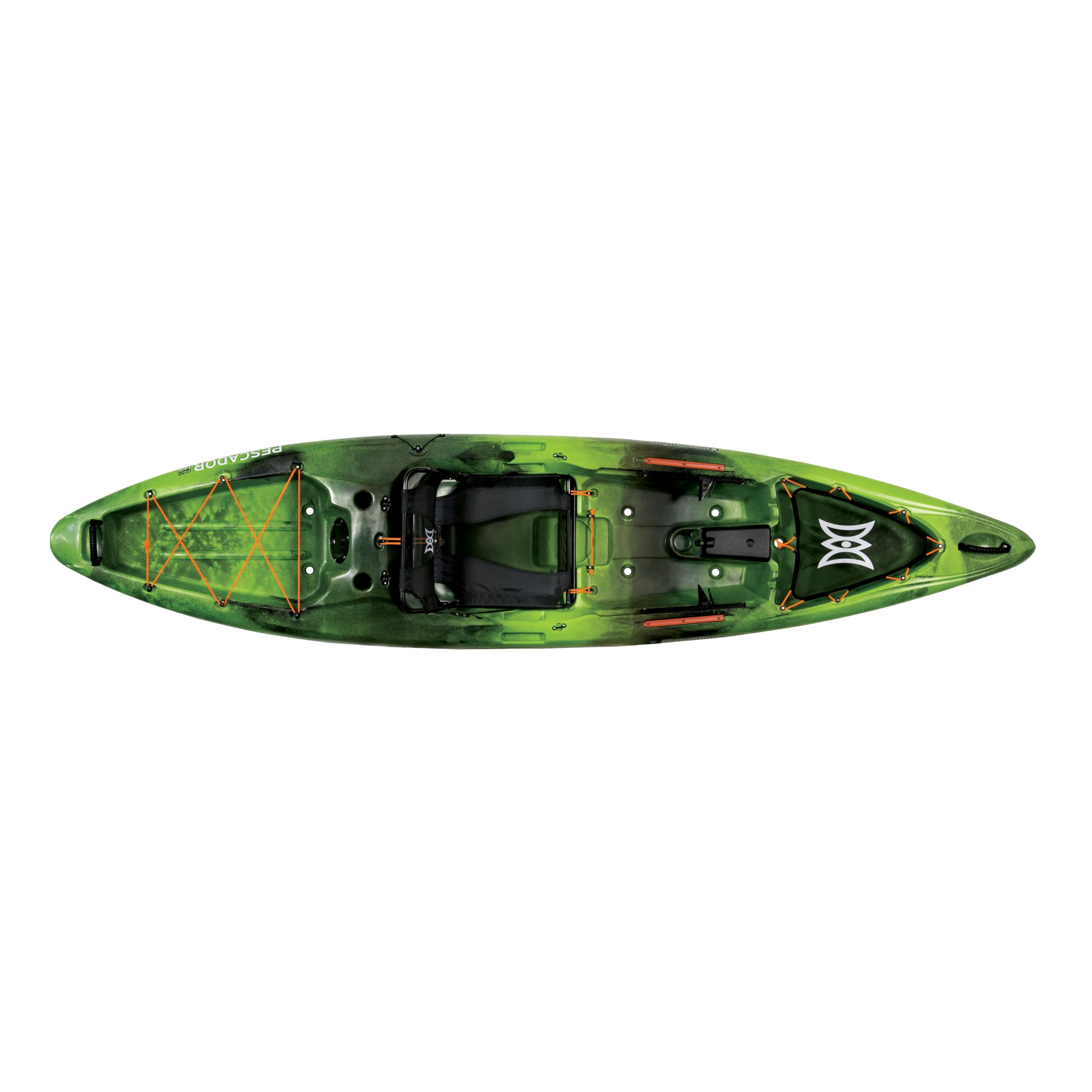
Two extra feet of hull doesn't sound like much until you're paddling a loaded boat into a headwind. The Pescador Pro 12 is the longest kayak here, and it's the one we reach for when the water opens up: it tracks straight between strokes and keeps gliding after you stop, which counts for more when there's more weight aboard. It carries the same 375-pound rating as our top pick and does more of the work on the way out.

The trade is width. At 32.5 inches it gives up two inches of beam to the Pelican, and you notice that as a little more lean when you reach over the side to land a fish — not alarming, but enough that this is a seated fishing boat rather than a standing platform. The cockpit is where it wins friends: the lawn-chair seat sits high, and the footrests run far enough forward that a six-foot-three paddler has room to spare. Jammed-up legs ruin a day faster than chop does.

Storage is generous front and rear, there are accessory tracks for a rod holder or a fish finder, and the hull carries a five-year limited warranty against Pelican's lifetime coverage — the one place the Perception gives something up.

Where it earns its keep is the trip home. Paddling a loaded boat into a quartering wind, the extra length spreads that load and the bow holds its line, so you finish the afternoon fishing instead of fighting the boat back to the ramp.

Pros

  • 375-pound rating on a long, load-carrying hull
  • Tracks straight and glides between strokes
  • Lawn-chair seat with a long footrest track
  • Front and rear storage plus accessory tracks

Cons

  • Twelve feet is a handful in creeks and garages
  • 64 pounds, so plan on a cart for long carries
Our verdict

Buy the Pescador Pro 12 if you paddle open water and want a hull that keeps its line under a heavier load — it gives up beam and tight-water agility to get there.

Check Latest Price
3

Best for Solo Car-Topping

Pelican Catch Classic 100

83 /100
Angler Score Excellent

Key details

Seat
Dual-position ERGOCAST
Dimensions
120"L x 34"W x 15"H
Hull Weight
57 lb
Weight Capacity
350 lb
Check Details on Amazon

Fifty-seven pounds is what makes this the easy one to own. The Catch Classic 100 is the lightest kayak here and the shortest at 10 feet, and that pairing means you can get it off a roof rack and into the water alone at the end of a long day — which is when most kayaks stop getting used. It still rates 350 pounds, so this is a boat built for an adult angler rather than a kid's first kayak.

The 10-foot hull is the trade, and we think it's the right one if your water is small. On a pond, a slow river, or a tree-lined creek, the short length turns in a stroke and the 34-inch beam — half an inch narrower than our top pick — makes it feel far steadier than its length suggests. Take it onto open water with a crosswind and it wanders, and you'll be correcting with every other stroke where the 12-foot Perception holds its line.

The fishing kit is modest but sensible: a quick-lock hatch up front, a rear tank well, flush rod holders, and the dual-position ERGOCAST seat, which sets low and planted or higher for casting.

Sit in it for a full day and the low seat position is the one you end up in; the raised setting is for casting, not for the paddle home — which suits exactly the water this boat is built for.

Pros

  • 57 pounds, the lightest hull here
  • 34-inch beam nearly matches our top pick
  • Short hull turns on a single stroke
  • Seat adjusts between high and low positions

Cons

  • 350-pound rating leaves a heavy paddler slim gear margin
Our verdict

We point solo paddlers and small-water anglers to the Catch Classic 100: it rates 350 pounds and, at 57 pounds, is the one you'll still launch when nobody's around to help.

Check Latest Price
4

Small Storage Spaces

Reel Yaks Raptor

81 /100
Angler Score Excellent

Key details

Drive
Fin pedal drive
Dimensions
115"L x 30.3"W x 11.5"H
Hull Weight
62 lb
Weight Capacity
380 lb
Check Details on Amazon

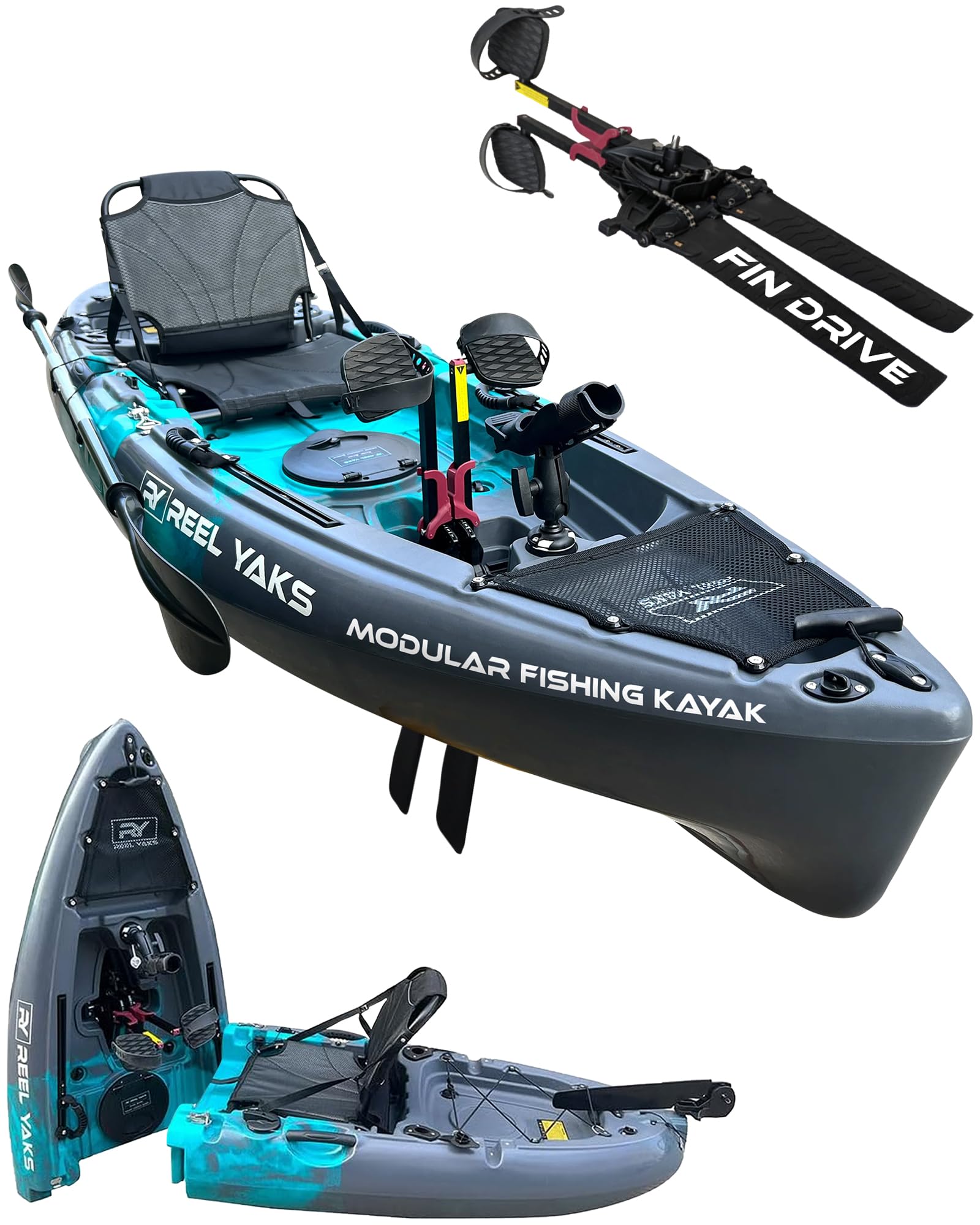
Two pieces and a set of pedals — that's the Raptor's whole argument, and for the right buyer it's a strong one. The hull splits at the middle so each section fits in the back of a small SUV or a closet, which solves the problem that keeps a lot of big-guy kayaks off the water: where to store it and who's going to lift it. Capacity runs to 380 pounds, the highest here, and the fin drive leaves both hands free for a rod.

Stability is where we're more careful. This is a boat you fish seated; on flat water with the seat low it feels settled and predictable, but it isn't the standing-and-casting platform the wider hulls are, and the cockpit is cut for a smaller frame than the other three. If standing up to work a shoreline is part of your day, one of the wider hulls will treat you better.

The pedal drive earns its keep in wind and weeds. Covering water without a paddle stroke means you can hold position while you work a bank, and the fin drive is the type that copes with weedy lakes. Assembly is quick enough that the split design doesn't become a chore at the ramp, and the package includes a paddle, a stadium seat, and a rod holder — more in the box than the other three give you.

The parts to watch are the fin and the rudder. Check that the fin nut is tight before every launch, because a fin that works loose leaves you paddling a long way, and expect to lift the rudder clear by hand at the ramp. Two minutes of checking at the car buys an afternoon of hands-free fishing.

Pros

  • 380-pound capacity, the highest in this group
  • Splits into two sections for trunks and closets
  • Fin pedal drive leaves both hands free
  • Paddle, stadium seat, and rod holder included

Cons

  • 30.3-inch beam, the narrowest here
Our verdict

Choose the Raptor if storage and transport are what's keeping you off the water — it splits in two and pedals hands-free, but it is a seated boat for a smaller frame.

Check Latest Price

How We Tested Fishing Kayaks for Bigger Paddlers

We started with sit-on-top fishing kayaks rated for at least 350 pounds, then cut anything with a seat that couldn't adjust for a taller torso or a hull shape that reviews consistently described as tender. That left eight boats, which we paddled for eight months on lakes, slow rivers, and one wind-whipped reservoir.

Every boat got the same treatment. I loaded it solo onto a truck roof rack, wheeled it to the water on a cart, and launched from both a concrete ramp and a gravel bank. Once afloat, I sat in each for four-hour sessions, stood to cast, and reached behind for a tackle bag to see how much lean it took before the hull started to tip. I also climbed back aboard from deep water, because falling out is only half the problem—getting back in is the other half.

We loaded each kayak to roughly 300 pounds between paddler and gear to see where the waterline sat, then checked whether the scuppers drained and the deck stayed dry. Hulls were dragged over gravel and bumped against docks to see how the plastic held up, and the modular models were assembled and taken apart three times so we could time the process and note which joints loosened. At the end, we weighed what each boat cost against what it actually did—storage, seat comfort, tracking, and how sore my shoulders were after a full day.

How to Choose a Fishing Kayak for a Bigger Angler

Capacity Is a Budget, Not a Target

A weight rating covers everything aboard: you, the crate, the cooler, the motor battery, the fish you keep. That's why we treat 350 pounds as the floor for this buyer and left the 275- and 300-pound boats out of this guide. A 250-pound angler with a full tackle bag, a cooler, and a battery is already close to those limits before the day gets going.

Aim to use roughly 80 percent of the rating on a normal trip, and do that arithmetic before you buy rather than at the ramp. If your own weight plus a typical load lands within 40 or 50 pounds of a hull's rating, that hull is the wrong one — step up to the next size instead of leaving the cooler at home.

Beam Width and Hull Shape Tell You More Than the Word Stable

The boats here run from 30.3 to 34.5 inches across, and that figure says more about stability than any adjective in a listing. Every extra inch of beam buys you steadiness you can feel when you lean out to net a fish; it costs a little speed and a little shoulder effort on the paddle. For a bigger paddler we take the width every time, because the alternative is a boat that goes twitchy exactly where you need confidence.

Hull shape finishes the job. The Catch Mode 110 pairs its width with a tunnel hull and a wide, flat deck, which is why it's the most settled boat of the group and the only one we'd describe as a stand-and-cast platform.

Fit: Legroom, Seat Height, and Footrest Range

A high seat is easier on hips and knees over a long day, but it lifts your center of gravity, so it only works on a wide hull — which is why the raised seats here sit on boats over 32 inches across. Sit in one before you commit and check that your heels reach the footrests at their furthest setting; tall paddlers get pinched on short boats.

Footrest range matters more than seat cushioning for a big frame. The Pescador Pro 12 runs its rests far enough forward that long legs aren't jammed against a bulkhead, and the Catch Mode 110's seat folds forward for roughly six more inches of height when you want to cast standing.

The Weight You Handle on Land

These hulls run from 57 to 67 pounds, and that's the number that decides whether the boat gets used on a Tuesday evening or only on a Saturday with a helper. Ten pounds is the difference between hoisting it onto a roof rack yourself and waiting for someone to lend a hand.

If you load alone, weigh hull weight more heavily than length. A 57-pound ten-footer goes on the rack without drama; a 67-pound boat is a two-person job or a load-assist bar, and a two-piece hull like the Raptor sidesteps the question entirely if storage is the real constraint.

Rigging: Rod Holders, Hatches, and Tracks

Every boat here has rod holders, so the difference is where your gear ends up. Flush-mount holders keep rods out of the way but sit where the mold puts them, rear tank wells swallow a crate, and accessory tracks let you move a rod holder or a fish finder within reach. For a bigger paddler, reach beats capacity here: a holder four inches further back than you can comfortably stretch is one you won't use.

Count the hatches you'll actually open on the water, too. A front quick-lock hatch is where the dry bag goes; the tackle you reach for every twenty minutes belongs between your feet, not behind the seat.

Frequently Asked Questions

Final Verdict

The Pelican Catch Mode 110 is the kayak we point a bigger angler to first. At 34.5 inches across it's the widest boat here, the 375-pound rating leaves room for a crate and a battery, and the transom mount means you can add a motor on the days your shoulders want a break.

If you paddle rather than motor and your water is big, the Perception Pescador Pro 12 is the better hull: it tracks straighter, glides between strokes, and gives long legs more room. Make that the choice when the launch is open and the wind is up; stay with the Pelican when you want to stand, carry more, or hang a motor.