Best Inflatable Fishing Boats of 2026

The knock on an inflatable fishing boat has always been the same: tippy under a standing cast, one seam away from a long swim back to the dock, and an hour of pumping before you get a line wet. What a good one actually buys you is access — water you can't trailer to, a trunk that still closes, a boat that lives in a closet instead of a storage lot. I fish from the bank plenty, but the day my boat fit in the hatchback next to the rods, I stopped borrowing trailers.

My team and I have spent the past seven months inflating, dragging, and fishing from 10 of these boats, from a two-person dinghy up to a nine-foot pontoon. Here's what nobody tells a first-time buyer: the capacity printed on the box is generous. Four people means four adults sitting still, not four anglers casting. Chamber count and floor construction matter more than tube diameter, and the pump in the box is usually the first thing you'll want to replace. The picks below separate on exactly those points.

1

Best Overall

Intex Seahawk 4

89 /100
Angler Score Excellent

Key details

Floor
Inflatable I-beam
Included
Oars, hand pump, 2 rod holders
Boat Weight
45.6 lb
Weight Capacity
1,050 lb
Check Details on Amazon

Forty-five pounds is the number that decides whether a raft gets used. The Seahawk 4 is the boat here that one person can walk from the trunk to the shoreline, and that fact kept resurfacing every time we set these hulls side by side — an inflatable you can't launch alone is a boat you launch twice a summer. Inflated it measures 138 by 54 inches, carries 1,050 pounds, and still rolls down small enough to live in a closet.

The floor is an inflatable I-beam rather than a hard panel, and that's the right call at this price. You sit lower and you fish seated, but the boat is cushioned enough for a long morning and needs no trailer, ramp, or second set of hands. Two molded rod holders sit in the tubes, so your rod has somewhere to live while you row out or re-tie.

Three air chambers — one of them an auxiliary chamber inside the main hull — is the detail that surprised us most here. A puncture in the outer tube leaves you with a boat-shaped life raft instead of a swim, which is more redundancy than we expect from a package that also throws in oars and a hand pump.

The oars are the weak link. They're short, and working any distance into a breeze turns into a chore, so put a better pair on the list if you plan to cover water rather than drift a pond. Everything else in the box is complete enough that the boat is fishable the afternoon it arrives.

Pros

  • 45.6 lb, so one person can launch it
  • Three chambers with an inner auxiliary hull
  • Oars, hand pump and two rod holders included

Cons

  • Included oars are short for rowing distance
Our verdict

This is the one we recommend to most people: light enough to launch solo, redundant enough to trust, and rigged with rod holders and a pump at the lowest price in this group.

Check Latest Price
2

Best with a Motor

Intex Mariner 4

88 /100
Angler Score Excellent

Key details

Floor
Heavy-duty panel
Boat Weight
77.6 lb
Motor Mount
Fitting included
Weight Capacity
1,100 lb
Check Details on Amazon

Stand up in most inflatable rafts and you feel the floor flex under you. The Mariner 4 is the exception in this group: its heavy-duty floor panel drops in to make a rigid platform, and that changes the whole outing — you can stand to cast, step aboard at a dock without the boat skittering away, and reach over the tube instead of leaning around it. We rate it the best of these for stand-up fishing.

The motor mount fitting is the other half of the case. A trolling motor on the back lets you hold a line along a weed edge hands-free, and the rigid floor gives a battery somewhere sensible to sit. That combination is worth more than the nine inches of length you give up to the Seahawk, especially since the Mariner is the wider boat at 57 inches.

What it isn't is a four-adult boat. The rating says four and 1,100 pounds, but with two seats, a cooler and a tackle bag aboard, two anglers is the realistic fishing load — the third and fourth are on a bench with nowhere to put a foot. At 77.6 pounds it's also a two-person carry from the car, so setup is a small operation rather than a solo one.

Before the first trip, inflate it at home, leave it overnight and look closely at the seams between chambers. A leak along those seams is the fault to watch for on this hull, and finding it in the driveway beats finding it mid-lake — particularly with only a 90-day warranty to work with.

Pros

  • Rigid floor you can stand on to cast
  • Motor mount fitting built in
  • Three chambers with an inner auxiliary

Cons

  • Two anglers, not four, with gear aboard
  • 77.6 lb makes it a two-person lift
Our verdict

Buy it if you want to stand and cast or hang a trolling motor; the rigid floor is what separates it from every raft here, and two anglers will be comfortable.

Check Latest Price
3

Best Heavy-Duty Pick

BRIS 10.8 Inflatable Boat

84 /100
Angler Score Excellent

Key details

Hull
1,100-denier PVC
Floor
Sectional aluminum
Warranty
3 years
Weight Capacity
1,213 lb
Check Details on Amazon

1,100-denier PVC at 0.9 mm, heat-welded seams with most of them quadruple-overlapped, and a sectional aluminum floor instead of an inflatable one — you can see where the money went on this boat. That's tender construction rather than pool-toy construction, and it's why the BRIS sits in this guide at several times the price of the Intex rafts.

The aluminum floor is what you notice first. It's stiff underfoot, it doesn't telegraph every ripple the way an air floor does, and it gives you a flat surface where a tackle box stays put. With 1,213 pounds of capacity, two aluminum bench seats and seating for four, plus oars, a foot pump, a repair kit and a carry bag, it fishes two people with room to spare and takes a third without drama.

We've come to think of this as the boat for someone who is finished with rafts. The keel keeps it tracking in a crosswind, a small outboard is a realistic addition rather than a hopeful one, and it will absorb a gravel launch and a season on a mooring. Then there's the warranty: three years here against 90 days on the Intex hulls, which is the kind of difference that matters the first time a seam gives trouble.

The friction is at assembly. The floor panels and side supports have to seat inside the inflated hull, and getting that right takes patience the first time and a routine every time after — do the first fit in your driveway with the manual open, not at the ramp. The listing puts it at 55 kg, roughly 120 pounds, so moving it is a two-person job and car-topping is a stretch for most vehicles.

Pros

  • Heat-welded 1,100-denier PVC hull
  • Sectional aluminum floor stays stiff
  • Three-year manufacturer warranty
  • 1,213 lb capacity with seating for four

Cons

  • Floor panels and supports are fiddly to seat
  • 55 kg listed weight needs two people
Our verdict

Our pick when the water is big and the launch is rough: heat-welded PVC, an aluminum floor, and a three-year warranty that the budget boats can't match.

Check Latest Price
4

Best for Solo Anglers

Sea Eagle 285

84 /100
Angler Score Excellent

Key details

Hull
Inflatable U-hull
Warranty
3 years
Boat Weight
42 lb
Weight Capacity
450 lb
Check Details on Amazon

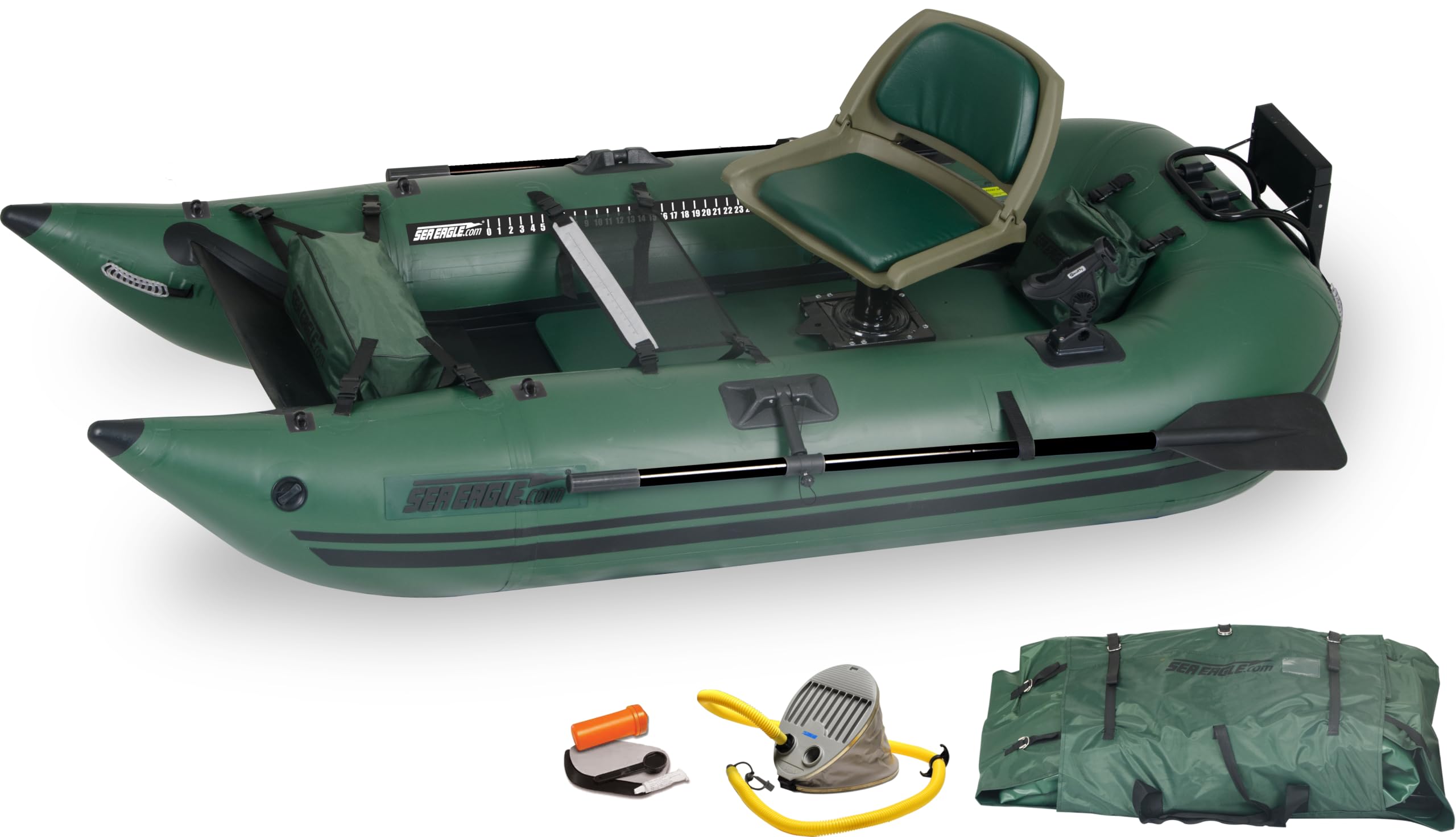
Two pontoons, a floor slung between them, and an open channel at the stern: the 285 doesn't look like the rest of this group and it doesn't fish like them either. The U-hull sets you down between the tubes with water close on both sides, so a landed fish and a net end up in open space rather than draped over an air chamber. All of that weighs 42 pounds.

For the angler who works a shoreline alone rather than anchoring up with company, we think this is the best answer in the group. It rows, it motors, the swivel seat turns a full circle, and the Pro Package arrives with Scotty rod holders, a motor mount, oars, a foot pump and stow bags — a fishing boat out of the box rather than a raft you spend a season rigging. Sea Eagle claims five minutes to set up; we didn't clock it, but the frameless design is what makes the claim plausible.

The floor is where that five-minute promise gets tested. It goes in harder than the rest of the assembly, and the boat is smaller inside than the photos suggest: a cooler, a tackle box and a net fill the space between the tubes quickly, and standing room is limited to shifting your weight rather than walking about.

It's priced at the top of this group, and what you're paying for is the shape and the packing. Stowed, it drops into a trunk, which is the one thing no other boat here can do, and the three-year warranty backs a hull built for rocky creeks and shallow bays rather than a manicured lake.

Pros

  • U-hull fishes like a one-person platform
  • 42 lb and stows in a car trunk
  • Pro Package includes seat, rod holders, motor mount
  • Three-year manufacturer warranty

Cons

  • Floor install is fussier than the five-minute claim
  • Little room for gear or a second person
Our verdict

For solo anglers who want a real fishing platform that fits in a trunk, this is the pick — as long as you're fishing alone and packing light.

Check Latest Price

How We Tested 10 Inflatable Fishing Boats

We started with about 40 boats and cut the list by reading spec sheets closely — how many separate air chambers, what the floor is made of, packed weight, and what actually comes in the box. Boats with a single chamber or no keel didn't make it, and neither did anything that needed a trailer to move. That left 10, ranging from a two-person dinghy to a nine-foot frameless pontoon, which we ran for seven months.

Setup got timed, not estimated. I inflated each boat alone with the pump it shipped with, from bag to fully pressurized, then repeated it with an electric pump, and wrote down both numbers. Every boat was deflated, folded, and loaded into the trunk of a mid-size sedan to see whether it truly fit, and each packed bag went on a luggage scale before I carried it from car to water in one trip or noted where I had to stop and rest. To check for slow leaks, we left each boat inflated in the sun for a full day and re-read the pressure gauge and ran a hand along every seam and valve afterward.

On the water, we stood to cast, leaned over the tube to net fish, and shifted two adults plus a cooler and tackle bag side to side while watching the freeboard. Gravel ramps and beaches were deliberate: we dragged loaded boats over both to see how the bottoms scuffed. Rod holders, oar locks, and seat positions were judged with an actual rod in them during a full day of fishing, and we weighed what came in the box against what we had to buy separately to sort out real value.

How to Choose an Inflatable Fishing Boat

Start with the floor, not the length

An inflatable I-beam floor, as on the Seahawk 4, packs small and keeps the boat light, but it rolls under a standing cast, so you fish it seated. A rigid drop-in panel, as on the Mariner 4, gives you something to stand on and somewhere to set a battery. A sectional aluminum floor, as on the BRIS, is stiffer still and turns the boat into something closer to a tender.

Watch the wording here. A listing that advertises a hard floor may mean a panel that still flexes between the tubes, so ask what the floor is made of rather than whether it is firm, and decide which of the three you are buying before you compare anything else.

Weigh it against how you launch

Packed weight is the specification shoppers skip and then resent. Anything around 45 pounds goes from trunk to water with one person and no plan; 75 pounds and up is a two-person lift, and a boat that needs a helper stays home when your usual partner is busy.

Be honest about your access. Car-topping or a long carry from a parking lot argues for the light end of this group, while a trailer, a slip, or a truck bed makes the heavier and stiffer hulls worth the effort they cost.

Chambers, seams and valves

Three chambers, one of them an auxiliary chamber inside the main hull, is the minimum we want on moving water: one puncture shouldn't end the trip. Heat-welded seams hold better than glued ones, and thicker PVC — the BRIS uses 1,100-denier — shrugs off gravel and submerged timber.

Warranty length is a fair proxy for how much faith the maker has in those seams. The Intex hulls here carry 90 days; the BRIS and the Sea Eagle carry three years. Whatever you buy, inflate it at home and leave it overnight before the first trip.

Capacity, and the room you actually get

Rated capacity counts every pound aboard — people, cooler, tackle, anchor, motor and battery — so treat the person count as a ceiling rather than a target. Inflatable rafts are generous on paper and tighter in practice: a four-person hull fishes two with gear spread out, and a five-person hull is comfortable at three.

If you want two anglers casting from opposite ends without moving a cooler, buy one size up from the number of people. If you fish alone, a one-person platform like the Sea Eagle 285 makes far more sense than a big raft you rattle around in.

Motors, oars, and what comes in the box

Motor readiness varies more than the listings suggest: the Mariner 4 has a mount fitting built in, the Sea Eagle Pro Package includes one, and a rowed raft may need more than a bracket before it trolls. Check before you buy, because a trolling motor changes the day — you hold a line along structure instead of repositioning with oars — and the battery's weight counts against capacity.

The oars are consistently the weakest item in these packages. Plan on a better pair if you intend to row any distance, and read the included-components list closely: oars and a pump are standard, while seats, rod holders and stow bags are not.

Frequently Asked Questions

Final Verdict

The Intex Seahawk 4 is the boat we recommend without a caveat. It's the lightest four-person raft in this group, it has the chamber redundancy we want once you're away from shore, and it arrives with the oars, pump and rod holders that make a first trip possible.

Spend more only when you know what the extra money buys. Standing to cast or trolling a shoreline makes the Mariner 4 and its rigid floor the better boat; gravel launches and open water make the BRIS the one that lasts; and if you fish alone, the Sea Eagle 285 beats every raft here for one.