Best Fishing Knot Tying Tools of 2026

The light is going, your fingers are wet, and the eye of a size 2 hook looks like it's been shrink-wrapped. Everyone who fishes eventually hits the point where tying a clinch knot by feel stops being charming and starts costing casts — or costs you the fish that broke off because the knot seated wrong. A knot-tying tool is a cheap fix for that specific misery: something that holds tension and guides the line so cold, clumsy hands can do what they can't do bare.

I keep one clipped to my vest and a second in the boat's glovebox, and the lesson after years of this is that the gadget matters less than the match — a tool built around 8-pound mono is a paperweight when you're pulling 50-pound braid. Over the past four months we've fished 16 of these, from pocket-size hook threaders to bench-mounted knotters, and the ones worth carrying all hold tension without fraying the line and never demand a third hand. What follows is organized around the situations each one actually suits.

1

Best Overall

TIE-FAST Knot Tyer

89 /100
Angler Score Excellent

Key details

Made In
USA
Material
Stainless steel
Line Weight
120 lb
Construction
One piece
Check Details on Amazon

A knot tyer with no moving parts is a quiet kind of luxury. There is no hinge to stiffen in the cold, no spring to snap on a finger, and nothing to come apart in a tackle box that has been sliding around a truck bed since May. The TIE-FAST is one piece of stainless steel, made in the USA and rated for line up to 120-pound test, and it is the tool we point to first when someone wants one knot tool and no decisions after that.

What it gives you is a third hand. The notched end grips the line and holds the loop open while both of yours stay where you put them, which is the part we care about, because most knots fail when the tension goes slack mid-wrap rather than because the angler was clumsy. Nail knots, snells, and line-to-line splices all come off the same motion, and it does not care whether you are spooled with monofilament, fluorocarbon, or braid.

The working end is sized for real hooks, which is the right call for most of us and the wrong one for a dry-fly box. On a size 20 midge and 6X tippet it feels like using a wrench on a watch, and the Lake below is the better fit there. Everything else about it is a tool you keep for years, which is exactly what we want from the one we recommend to a stranger.

Pros

  • One-piece stainless steel with nothing to break
  • Rated for line up to 120 pounds
  • Ties nail knots and snells on any line type

Cons

  • Printed instructions are thin; the video teaches it
Our verdict

We recommend the TIE-FAST as the default knot tool: one piece of stainless steel, rated to 120-pound line, tying the nail knots and snells most anglers actually use with no part to break.

Check Latest Price
2

Best for Beginners and Kids

HOOK-EZE Knot Tying Tool

89 /100
Angler Score Excellent

Key details

Includes
Cutter
Material
Polypropylene
Dimensions
3 x 1 x 0.5 inches
Hook Range
4/0 to #28
Check Details on Amazon

The first time a kid ties on their own hook, the odds of a barb in a finger are higher than anyone involved would like. HOOK-EZE's small green clip solves that exact problem: the hook sits inside a plastic cover with the eye end exposed, so small hands can wrap and pull without ever coming near the point. It is the tool we hand over when someone is learning, and the one we suggest to anglers whose hands have stopped cooperating.

What we like most is that it does two jobs without asking anything of you. It holds the hook while you tie, and it stays on as a hook keeper when you clip a rigged rod into the truck. The stated range runs from 4/0 down to a #28, which covers everything from bass flipping to ice-fishing tear drops, and the polypropylene body does not mind salt spray or February.

The plastic is also the part to think about. Under steady use the body can crack, and while the lifetime warranty helps, the angler who ties a handful of knots a trip will never stress it the way a guide does. Ours lives in the boat bag with a hook still covered, which is the sort of small convenience that turns out to matter more than the spec sheet suggests.

Pros

  • Covers the barb while you wrap
  • Fits hooks from 4/0 down to #28
  • Doubles as a hook keeper on rigged rods

Cons

  • Cover is a squeeze at the top of its hook range
Our verdict

Buy the HOOK-EZE if you are teaching someone to fish or your fingers need help staying clear of the point: it covers the barb, holds the hook, and ties down to a size 28.

Check Latest Price
3

Best for FG Knots

Daiichi Seiko Knot Assist 2.0

90 /100
Angler Score Outstanding

Key details

Made In
Japan
Material
Carbon fiber reinforced plastic
Knot Type
FG braid-to-leader
Line Weight
70 lb
Check Details on Amazon

The FG knot sorts anglers into two camps: those who tie it in the dark and those who gave up and went back to a double uni. The Knot Assist 2.0 is built around that single connection, and in our hands it turns a fiddly wrap-and-rip into something closer to routine, because the carbon-fiber frame holds the braid under tension while both hands wrap the leader.

The body is carbon-fiber-reinforced plastic, made in Japan, and light enough to vanish in a chest pocket, which is a compliment and a small problem: we spent more time looking for it than we expected to. It is rated to 70-pound line, and the tension frame earns its place on the thin, slick braids where a hand-tied FG wants to slip. Twenty-pound braid is where we noticed the biggest difference between this and fingers alone.

It is, though, a tool for one knot. If your fishing is braid to a fluorocarbon leader, you will use it every trip; if you are tying snells for bait or a clinch for a lure, it will sit in the drawer while the TIE-FAST does the work. Buy it for the knot, not for the category.

Pros

  • Holds braid under tension while you wrap
  • Makes thin, slick braid manageable
  • Pocket-sized and light in a chest pack

Cons

  • Printed instructions are in Japanese only
  • Premium price for a single-knot tool
Our verdict

If braid-to-leader is the connection you care about, the Knot Assist 2.0 is the FG tool we trust: it holds the tension so both hands can wrap, even on thin, slick braid.

Check Latest Price
4

Best for PR Bobbin Knots

Shimano TH-202N Bobbin Knotter

91 /100
Angler Score Outstanding

Key details

Weight
2.08 oz
PE Range
1.5 - 8
Knot Type
PR bobbin
Line Type
PE
Check Details on Amazon

This is the most committed piece of kit in the group: a Shimano bobbin knotter built to wind PR knots in PE line from 1.5 to 8, with the fit and finish you expect from a reel maker. If you have never watched a PR connection travel through a guide, the appeal is simple. It is slim enough to pass without ticking, and it holds up to repeated casts in a way a bulkier knot does not.

In use it is a winder, not a gadget: clamp the braid, wind the leader, and the bobbin lays the wraps evenly instead of by feel. We were impressed by how repeatable the result is, the same tension and the same spacing every time, and it will also lay the serve on a wind-on leader, which is more than most of us will ever ask of it. At 2.08 ounces it disappears into a boat bag.

So it is a specialist's tool, and we are comfortable saying that out loud. It earns its place for anglers who fish heavy braid and long leaders often enough that a slim, repeatable connection matters more than convenience. If that is not you, the Daiichi handles the FG knot and the TIE-FAST covers everything else, both for less.

Pros

  • Winds even PR knots in PE 1.5 to 8
  • Repeatable wraps instead of by feel
  • Also lays serves on wind-on leaders

Cons

  • Instructions are not in English
  • Specialist tool: PR-style knots on PE only
Our verdict

For anglers who fish heavy braid and want a slim, repeatable PR connection, the Shimano bobbin knotter is the most precise tool here, provided you will use it often enough to learn it.

Check Latest Price
5

Best for Fly Anglers

Lake Three-in-One Knot Tool

88 /100
Angler Score Excellent

Key details

Length
10 inches
Weight
0.8 oz
Material
Stainless steel and Delrin
Attachment
Clothing loop
Check Details on Amazon

Cold hands and small flies are the reason this tool exists. The Lake is a spring-loaded wand with a slotted head that grips a hook eye, a magnet, and a hook-eye cleaner, all on a loop you clip to a vest. Threading a size 18 midge onto 6X tippet in November is the exact job it was built for, and it is the job most of us quietly avoid.

We like it best of the fly-focused picks because it keeps working when your fingers do not. Press the spring, the head grips the hook, and you tie the clinch or nail knot around a hook that is being held still for you. That is the whole trick, and it is why the same tool helps an angler with arthritis as much as it helps someone in gloves. The Delrin body with a stainless shaft and loop is the right material for a wet environment, and at 10 inches overall it is easy to find in a chest pack and long enough to keep your hand out of the way.

It is at its best on clinch knots and small flies, and it is not a snelling tool for bait chunks, so match it to how you fish. The 32-page booklet indexes 14 knots, and while a few of the diagrams take a second read, the tool is forgiving enough that a video plus ten minutes at the bench gets you going.

Pros

  • Grips and holds small hook eyes
  • Magnet and hook-eye cleaner built in
  • Lanyard loop clips to a vest
  • Comes with a 32-page knot booklet

Cons

  • Spring-loaded head can work loose and shed parts
Our verdict

The Lake is the fly angler's pick: it grips a small hook and holds it still, which is what cold, stiff, or arthritic fingers actually need on the water.

Check Latest Price
6

Best Budget

Deekin Nail Knot Tool 3-Pack

89 /100
Angler Score Excellent

Key details

Design
2-in-1
Length
3.94 inches
Material
Stainless steel
Pack Count
3 pieces
Check Details on Amazon

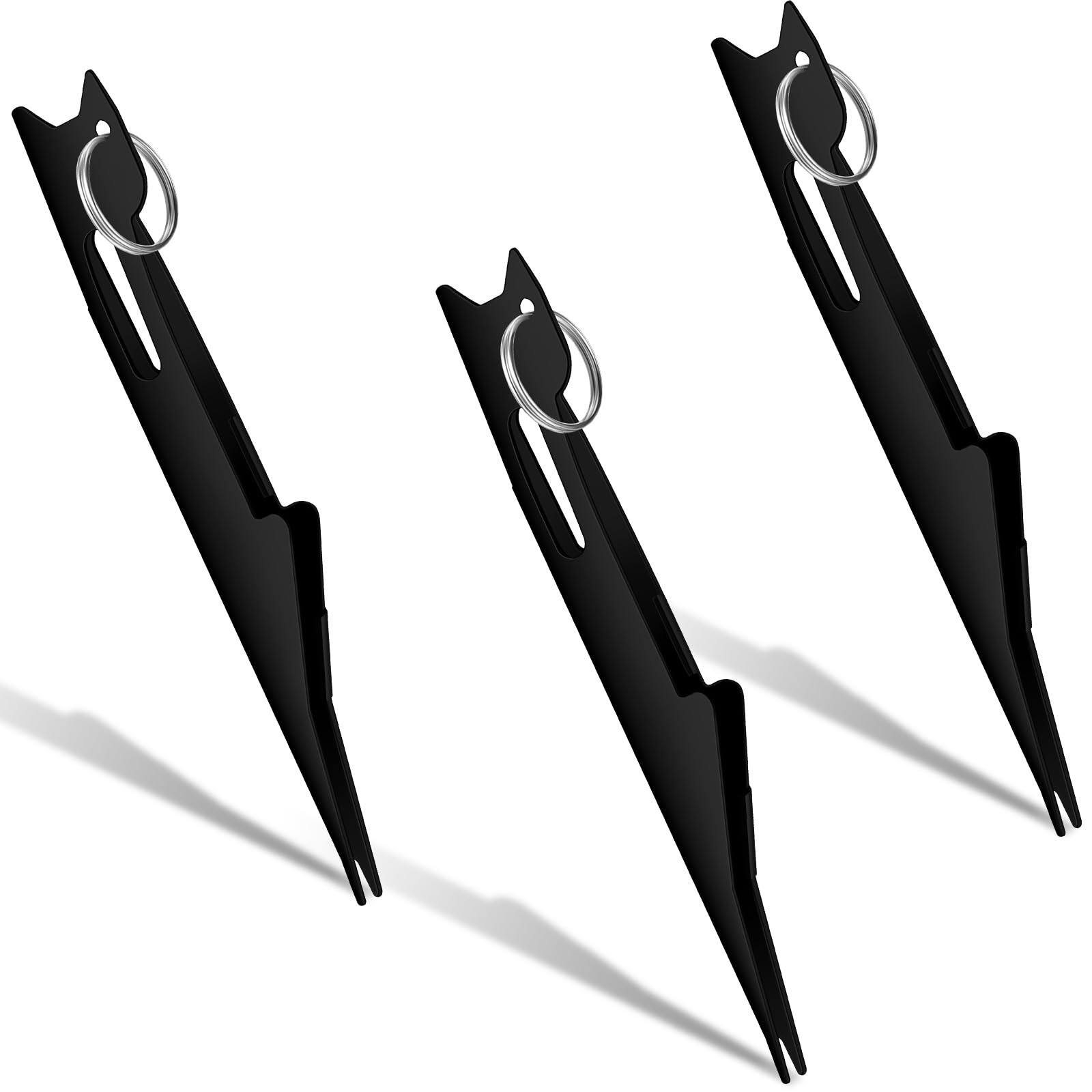
The cheapest way to put a nail knot tool in three tackle boxes is to buy them three at a time, and that is exactly what the Deekin set is for. Three stamped stainless tools, 3.94 inches each, doing the same job as the single-tool versions here: hold the line or the hook, give the wraps something to close against, and let you pull the knot down hard.

The working end holds a hook steady while you wrap, and the ones we tried handled monofilament, fluorocarbon, and braid without complaint. One detail worth knowing: a small tab has to sit close to its mating notch for the tool to grip, and a stamped part can arrive a little out of line. If your first knot keeps slipping, nudge that tab closer before you blame your technique.

Nothing comes in the pack but the tools, so plan on a video before your first nail knot. Once you have it, the three-pack logic is obvious: one in the boat bag, one in the vest, one for the person who keeps borrowing yours. For a family, a club, or a group trip it is the sensible buy, and it costs less than a single specialist tool.

Pros

  • Three tools, so every bag gets one
  • Stainless body at 3.94 inches
  • Handles mono, fluoro, and braid

Cons

  • Stamped edges can arrive sharp
Our verdict

For a group, a family, or anyone who wants a knot tool in every bag, the Deekin three-pack is the budget buy we recommend: stainless, small, and cheap enough to give away.

Check Latest Price
7

Tightening Heavy Braid

GaiRen FG GT Knot Puller

88 /100
Angler Score Excellent

Key details

Design
Two nesting pullers
Length
4-1/2 inches
Weight
2.8 oz
Material
Aluminum alloy
Check Details on Amazon

Heavy braid under tension cuts like a cheese wire, and the last step of an FG or GT knot is where it does it: you take a wrap around each hand and pull. The GaiRen puller exists for that one moment. It is two nesting aluminum barrels that give the line something to bite that is not your fingers.

The method is almost too simple. Unscrew the halves, wrap the line three to five loops around each barrel, and pull them apart; the wraps lock up and the knot seats without the braid sawing into your skin. At 4-1/2 inches and 2.8 ounces it lives in a pocket, and the non-slip handle still works when your hands are wet.

What it does not do is tie anything. This is the last ten percent of a knot, not the knot itself, so it is an add-on rather than a replacement for a tyer. The foam liner inside the barrels is also the wear point. Heavy braid can cut through it, and once it is chewed up the grip goes with it.

Add one to the bag if you fish heavy braid and tie leader knots on the water. It costs less than the knot machines here, it solves the part of the job that actually hurts, and it is the tool we reach for at the end of a long day when the light is going and the leader still needs changing.

Pros

  • Saves fingers when pulling heavy braid
  • Two nesting barrels store as one piece
  • Aluminum body at 2.8 ounces

Cons

  • Only tensions knots; it does not tie them
Our verdict

If heavy braid has ever sliced your fingers at the final pull, the GaiRen puller is a simple fix: two aluminum barrels that let you seat the knot hard without the sting.

Check Latest Price
8

Vest and Pack Carry

SAMSFX Quick Knot Tool

88 /100
Angler Score Excellent

Key details

Design
4-in-1
Material
420 stainless steel
Zinger Cord
24 inches
Set Contents
Two tools, two clippers, two zingers
Check Details on Amazon

The clippers are the weak link, and it is worth saying first: the snips on the SAMSFX 4-in-1 cut monofilament and tippet cleanly and struggle with braid, so if you spool nothing but braid, plan on carrying a separate cutter. Everything else on the tool earns its spot on a vest.

The knot tyer is the part we kept using. It is a nail-knot-style holder with a hook-eye cleaner at the other end, and it does what a clip-on tool should: you reach for it without looking, tie, trim, and let it drop back onto the zinger. The 420 stainless body has a red rubber grip that stays put with wet hands, and the hook hone is a bonus you will use more than you expect.

The zinger is the other half of the package: 24 inches of nylon cord and enough retraction force to keep the tool off the deck when you let go of it mid-tie. Treat that little carabiner as the wear part and give it a look before each trip, because it is carrying the whole kit.

Two complete sets is the reason to choose this over a single-tool version: one for the vest, one for the boat bag, each with its own clipper and zinger. Buy it as your grab-and-go kit, not as your only line cutter.

Pros

  • Knot tyer, snips, hone, and eye cleaner in one
  • Zinger keeps it off the deck
  • Two complete sets included
  • 420 stainless with a grippy rubber handle

Cons

  • Snips struggle with braided line
  • Retractor carabiner is the first part to fail
Our verdict

The SAMSFX is the one to clip to your vest: a knot tyer, snips, hone, and eye cleaner on a zinger, sold as two complete sets for a vest and a boat bag.

Check Latest Price

How We Tested Fishing Knot Tying Tools

We started by gathering every tool we could find that claimed to tie, seat, or tension a knot: pocket hook threaders, clippers with a built-in tyer, bobbin-style knotters, and puller assists aimed at heavy braid. We dropped anything that only handled a single line class, anything with no way to hang or clip it to a vest, and anything priced higher than a fresh spool of line, which left us with 16 tools to fish.

Testing ran four months, and most of it happened on the water rather than at a bench: bank fishing into a headwind, a kayak where a dropped tool is a lost tool, and plenty of after-dark sessions under a headlamp where you can't see your wraps. Each tool tied the knots we actually fish — clinch, palomar, and a braid-to-leader connection — and we timed the first ten ties bare-handed, then repeated them with wet, cold fingers and gloves on.

To judge whether a knot was genuinely sound, we pulled each finished one against a handheld scale until something gave, noting whether the knot failed or the line did, and we re-checked the line above every knot for the scuffing that tells you a tool is pinching too hard. Cutters got braid, mono, and fluoro, then a look at the ends under a bright light: a clean cut sits flat, a bad one frays and tags, and a dull blade crushes before it slices. We also handed each tool to a friend who'd never seen it and timed how long they fumbled before the knot came out right, with and without the printed instructions.

The last measure was just living with them. Four months loose in a box full of jigs and treble hooks is a fair simulation of a season, so we checked for rusted springs, cracked plastic, and blades that had gone soft, and we noted which ones disappeared into a shirt pocket versus which needed a lanyard to come along at all. Price only counted against how often we reached for the thing.

How to Choose a Fishing Knot Tying Tool

Start With the Knot You Tie Most

Hook knots like the clinch and snell, line-to-line connections like the FG and PR, and nail knots all pull in different directions, and the tool follows the knot. A hook holder like the HOOK-EZE gives you somewhere safe to wrap; a frame like the Daiichi holds braid tension while you work; a bobbin like the Shimano lays the wraps for you. Buy for the knot you tie ten times a trip, then add a generalist like the TIE-FAST for everything else.

The common mistake is buying a hook-holding tool expecting it to form a nail knot, or a nail knot tool expecting to help with an FG. Read what the tool actually grips before you order.

Check the Stated Hook and Line Range

A range is a ceiling, not a comfort zone. HOOK-EZE lists 4/0 down to a #28, the TIE-FAST is rated to 120-pound line, the Daiichi to 70, and the Shimano is built for PE 1.5 to 8. A tool that tops out where your fishing starts is the wrong tool, and the top of a plastic cover's hook range is a squeeze rather than a fit.

Work out the middle of your fishing, meaning the hook sizes and line you use on a normal Saturday, and buy a tool that sits comfortably there. If your season is size 12 and smaller for panfish and trout, a small-hook tool matters far more than a wide advertised range.

Plan for Cold, Wet Hands

Knots get tied in the worst conditions of the day: wind, spray, and fingers that have gone numb. Springs, hook covers, and lanyard loops are not gimmicks there; they are what lets you finish without stripping a glove. The HOOK-EZE covers the point you would otherwise be fumbling around, and the Lake's spring-loaded head holds a hook eye still while you wrap.

The other half of this is safety. Keep the barb covered or inside the tool's grip while you wrap, especially with a beginner holding a rod beside you.

Know Which Part Will Fail

Every design has one wear point. Plastic bodies crack, stamped steel can arrive with a burr, spring-loaded heads work loose, foam liners get cut through by heavy braid, and retractor carabiners give out before the tool they carry. A one-piece stainless tool has the least to lose; a multifunction clip-on has the most to check.

Rinse anything that has been in salt water, dry it before it goes back in the box, and do not store a wet tool in a sealed bag. That is most of the maintenance any of these need.

Instructions Are Part of What You Buy

Several tools here ship with a manual that is not in English, or with nothing at all, and that is not a dealbreaker, since the video for almost any of them beats the card. What matters is planning for it: learn the tool at a table with a length of line in your hand, not on a rocking boat with a knot in the wind.

Frequently Asked Questions

Final Verdict

The TIE-FAST is the one we point to first: a single piece of stainless steel with nothing to break, rated to 120-pound line, tying the nail knots and snells most of us actually use. Buy the HOOK-EZE instead if you are teaching a kid or your hands need help staying clear of the point.

And if your fishing lives at the braid-to-leader connection, the Daiichi is the tool that earns its place every trip, with the Shimano waiting a step above for anyone who wants PR knots wound rather than wrapped.