Best Fishing Tool Lanyards of 2026

The worst part of fishing isn't the fish you miss — it's the sound of forceps sliding out of a vest pocket into water you can't see the bottom of. A lanyard is a small, unglamorous fix: a short coiled tether that keeps pliers, nippers, a net, or a scale attached to you instead of resting somewhere downstream. The good ones vanish into the routine, and you stop thinking about them entirely.

I've clipped them to vest D-rings, wader straps, and the deck of a kayak, and the failures tend to look the same: a coil that stretches out and stays stretched, or a magnet that lets go of a pair of pliers the moment you lean over the side. Over four months, our team fished with 15 lanyards and retractors across wade trips, dock mornings, and a handful of kayak sessions, and the thing I'd tell a first-time buyer is that the attachment point, not the cord, is where most of them give out. The picks below are the ones that held on and stayed out of the way.

1

Best Overall

Booms Fishing T04 Coil Lanyard 6-Pack

90 /100
Angler Score Outstanding

Key details

Ends
Stainless steel split ring, zinc lobster clip
Pack
6 lanyards
Max Length
59in/150cm
Safety Tension
15lb/7kg
Check Details on Amazon

Fifteen pounds is the number that settles this one for us. The zingers on this list are rated in ounces of pull; the Booms T04 is rated to 7 kg — about 15 pounds — of safety tension, because the coil is a steel wire under a TPU jacket rather than a nylon line on a spring. That's why we're comfortable hanging pliers, a lip gripper, or a framed net on it, and why it takes the top spot over lighter, prettier options.

The reach is the other half of the argument. Fifty-nine inches of stretch covers the distance from a vest loop to a net bag hanging behind you, and the coil shrinks back to its original length when you let go, so nothing trails in the current or wraps a leg while you wade. The crimped ends are covered in heat-shrink, which sounds like a small thing until a bare crimp has caught your rod guide mid-cast.

Six in the pack is a rigging budget rather than a bonus. Count what actually leaves the dock — pliers, nippers, net, paddle, and keys is five before you've pushed off, and the sixth lives in the toolbox. One end is a 304 stainless split ring that threads a lanyard hole and stays put; the other is a zinc alloy lobster clip you move from vest to kayak without unthreading anything. That clip is the end that will show salt first, so a fresh-water rinse at the end of the day is cheap insurance.

Pros

  • Rated to 15 lb, enough for pliers and nets
  • 59-inch stretch on a steel wire core
  • Six lanyards in one pack
  • Heat-shrink covered crimps don't snag

Cons

No notable drawbacks to flag.

Our verdict

We put this first because the rating covers real tools: 15 pounds of tension and 59 inches of reach handle pliers, a net, or a paddle, and six in the pack means each gets its own.

Check Latest Price
2

Best for Nippers and Small Tools

Hook-Eze Fly Fishing Zinger 3-Pack

89 /100
Angler Score Excellent

Key details

Pack
3 zingers
Cord Length
22 in
Cord Strength
14.6 lb
Retraction Force
2.6 oz
Check Details on Amazon

Vest anglers carry a different load: nippers, forceps, a bottle of floatant, maybe a hook file. None of it weighs anything, and all of it needs to come back to your chest after you let go. That's the job these Hook-Eze zingers are built for — 2.6 ounces of retraction force, a 22-inch polyester cord with a 6.6 kg breaking strength, and a detachable carabiner that clips to a vest loop, a belt loop, or a pack strap.

The hardware is what we keep coming back to. The carabiner opens wide enough to go over webbing without a fight, and the clip and spring are stainless and coated, which is more than most zingers at this level bother with. Three in the pack means nippers, forceps, and floatant each get their own, and a zinger you have to move between tools is a zinger you'll eventually drop.

The weight ceiling is a specification rather than a flaw. Two and a half ounces of pull is right for small tools and wrong for pliers: hang something heavier and the cord stays out instead of winding back. Treat these as pocket-tool hardware and they do exactly what they promise, in fresh water or salt.

Pros

  • 2.6 oz pull suits nippers and forceps
  • Stainless spring and hardware for saltwater
  • Wide carabiner moves between vest and pack
  • Three zingers in the pack

Cons

  • 22-inch cord won't reach a net behind you
Our verdict

For nippers, forceps, and floatant on a vest, these are the zingers we hand people: a light pull, 22 inches of cord, and hardware that shrugs off salt.

Check Latest Price
3

Best for Landing Nets

SF Magnetic Net Retractor

91 /100
Angler Score Outstanding

Key details

Weight
1.76 oz
Material
Aviation aluminum, steel wire, PVC
Attachment
Carabiner with magnetic release
Coil Length
45 cm
Check Details on Amazon

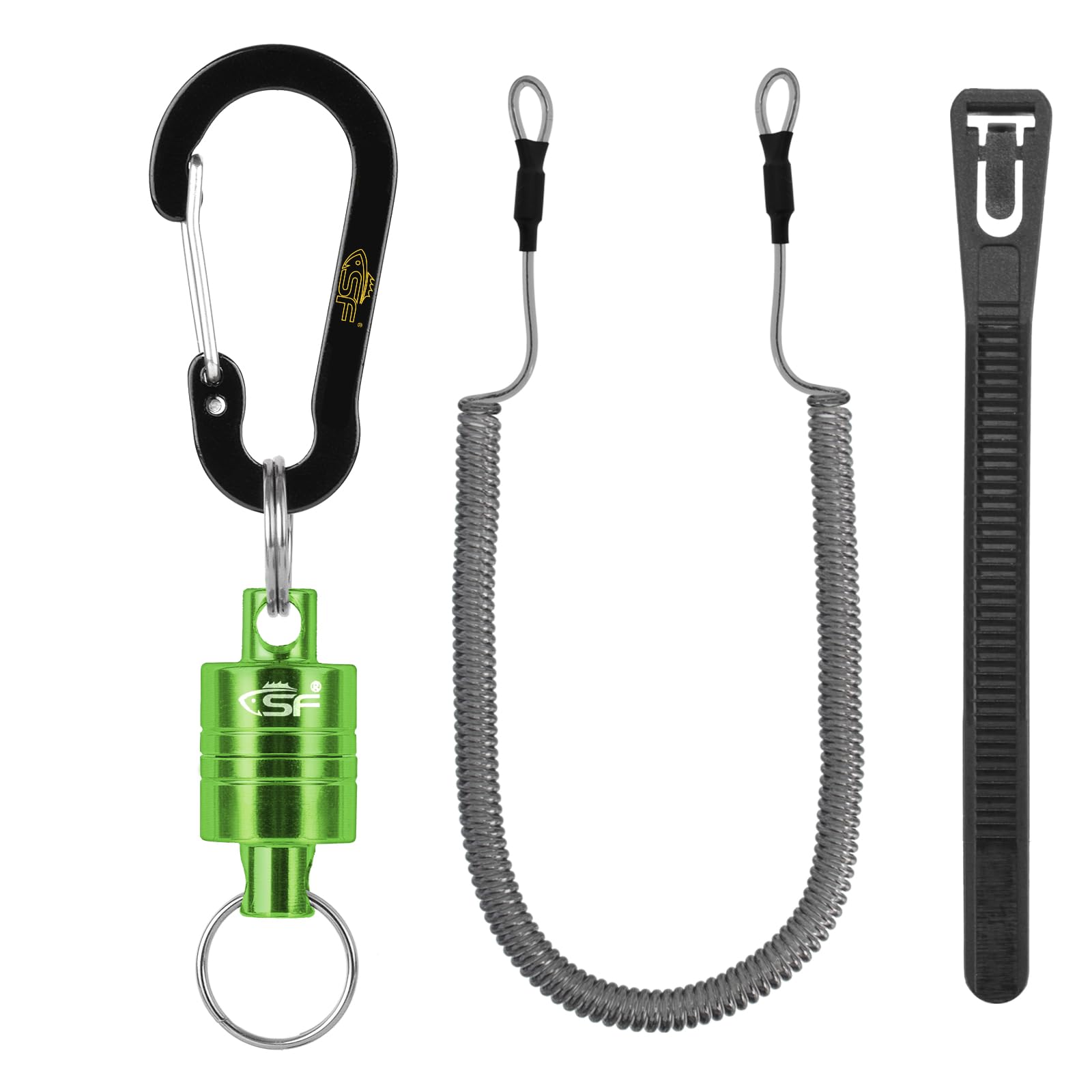
The moment that matters with a landing net comes when a fish is still in the water and one hand is already holding a rod. The SF retractor answers it with a magnet instead of a clip: the carabiner end stays on your vest or pack, the net end holds magnetically, and the two go back together when you bring them close. Reattaching it one-handed turned out to be the reason we kept reaching for this one over a clip-style tether.

The magnet is strong enough for the job it's sold for — a net stays put while you wade and cast, and the coiled lanyard keeps the bag from dragging once the net is off and hanging. The coil is listed at 45 cm, short enough that it doesn't loop around your legs in current, and the aviation aluminum body is light enough that it doesn't pull a vest sideways.

Two things to know before you lean on it. It arrives smaller than the product photos make it look, so don't expect a palm-filling carabiner. And the zip tie fastening the magnet to the net frame is the cheapest piece in the assembly and the first thing to give; swap it for a small stainless split ring before a good net depends on it, which takes about five minutes.

Pros

  • Magnet reattaches one-handed
  • Holds a net securely while wading
  • Coil keeps the net out of the water
  • Doubles as a clip for pliers and nippers

Cons

  • Arrives smaller than the photos suggest
Our verdict

If your net is the piece you're always fumbling, the magnetic release is what earns this one a place — it reattaches one-handed without you looking down.

Check Latest Price
4

Best for Rigging a Kayak or Boat

BB Hapeayou Coil Lanyard 7-Pack

88 /100
Angler Score Excellent

Key details

Ends
Stainless steel ring, aluminum carabiner
Pack
7 lanyards
Cable
Steel wire, TPU coated
Max Stretch
59 in
Check Details on Amazon

Seven lanyards in a single pack is the pitch, and for a kayak it's the right number. Sit-on-top cockpits swallow gear: a paddle, pliers, a lip gripper, a net, a dry bag, a water bottle. Every one of those wants its own tether and every tether wants a clip at both ends, which is exactly the shape of this pack — stainless ring on one end, aluminum carabiner on the other, 59 inches of steel-cored coil in between.

The carabiner is the part that decides whether a seven-pack is useful or just a bag of cords, and this one opens wide enough to snap over a deck line or a seat frame without taking a glove off. The coil has a steel wire inside and a TPU jacket over it, so it returns to length instead of stretching into a limp noodle, and the coating keeps it from marking a hull.

The rings are the compromise. They're on the small side — fine through a pliers' lanyard hole or a paddle leash point, awkward on anything with a thick handle, and you'll stretch one slightly making it fit. On a boat, run the carabiner straight to the frame of a big net instead of the ring and the problem disappears.

Pros

  • Seven lanyards cover a whole cockpit
  • 59-inch stretch for paddles and nets
  • Aluminum carabiner clips over deck lines
  • Steel wire core with TPU coating

Cons

No notable drawbacks to flag.

Our verdict

For a kayak or a small boat where gear ends up everywhere, seven lanyards with real carabiners are the practical, no-drama buy.

Check Latest Price
5

Long Reach

Booms Fishing RG1 Zinger 3-Pack

91 /100
Angler Score Outstanding

Key details

Case
Plastic with stainless steel spring
Pack
3 zingers
Tether Length
28in/70cm
Retraction Force
2.6 oz
Check Details on Amazon

Twenty-eight inches is the longest cord on any zinger here, and from a boat seat that extra reach is the difference between unhooking a fish with your forceps and leaning out over the gunwale to do it. The RG1 gives you three of them, with a coated stainless spring, a copper split ring, and a plastic case that won't rattle against aluminum.

For light work the build holds up. The spring is coated against rust, the cord runs out to 70 cm, and the retraction is smooth when there's almost nothing on the end — which is what these were designed around. The split ring threads a small tool easily, and the case is compact enough to ride a vest without swinging.

Where the RG1 gives ground to the Hook-Eze is the spring. It's light, and with anything heavier than nippers on the cord it pays out easily and doesn't wind back with much conviction, so tools end up dangling at whatever length you left them. Keep these for forceps, nippers, and floatant and treat the 28 inches as the reason to buy — the reach is real, the pull isn't.

Pros

  • 28-inch tether reaches past the gunwale
  • Three zingers in one pack
  • Coated stainless spring resists rust

Cons

  • Bulkier on a vest than expected
Our verdict

For forceps, nippers, and floatant, the 28-inch cord reaches further than any zinger here and you get three of them in the pack.

Check Latest Price

How We Tested Fishing Tool Lanyards

We started by pulling every retractor and coiled tether we could find that was actually built for fishing — carabiner clips, vest loops, split rings, magnetic net releases — then cut the list by coil length, attachment style, and what each one cost per lanyard once you counted the multi-packs. Fifteen made the final cut and went into rotation for four months.

Magnetic strength came first, because a retractor that lets go is worse than no retractor. We hung a steel plate from each magnetic release and added weight until it dropped, then repeated it with a real pair of forceps and a small net, lifting and swinging them the way you would leaning over a gunwale. For retraction, we stretched each coil to full length 200 times in a row and measured whether it returned to its resting length or hung slack.

Everything else happened on the water. We clipped lanyards to vest D-rings, wader straps, belt loops, backpack straps, and kayak decks, then tried to deploy pliers, nippers, and a net one-handed — including on a 35-degree morning with gloves on, which is where ease of use sorts itself out. We noted how much bulk each one added to a vest, whether the clip could be worked with wet hands, and whether the tool came back to hand or had to be hunted for.

Durability got its own abuse: a saltwater soak, a few weeks baking on a dashboard, and plenty of sand. Several coils never recovered their snap and a couple of swivels worked loose, which is the failure we saw most. We also counted what you actually get for the money, since a three-pack and a single retractor aren't priced the same way — and the pricier one wasn't reliably the better tool.

How to Choose a Fishing Tool Lanyard

Rate the Tether to the Tool

The number on the package means different things depending on the kind of tether. A spring zinger is rated in ounces of retraction force — 2.6 ounces is typical here — and that describes what the spring can pull back, not what the clip can hold. A coil lanyard is rated in pounds of breaking tension instead; our top pick is rated to 15 pounds.

Put pliers on a zinger built for nippers and the cord pays out and stays out. Weigh your heaviest tool before you buy: pliers, a lip gripper, or a net want a coil, while nippers, forceps, and floatant want a zinger.

Match the Reach to the Anchor Point

Twenty-two inches of cord is plenty from a vest loop to your hand and nowhere near enough to reach a net hanging behind your shoulders. Sixty-inch coils handle the reaching jobs: a net on your back, a paddle on a kayak deck, a dry bag in the stern.

Buy the reach the anchor point demands and no more. A long coil on a chest loop leaves slack swinging around all day, while a short zinger bolted to a boat seat never gets where you need it. Where you clip decides the length.

Look Hard at Both Ends

The hardware decides what the lanyard can hold and how fast you can move it. A split ring threads a tool's lanyard hole and stays there for good; a carabiner or lobster clip is the end you unclip to shift the tether from vest to kayak. Thin rings and small clips are where a heavy tool gets away, so check the ring against the hole on your pliers before you commit.

A magnetic retractor is the third option and the best one for a net: the two halves pull apart and snap back together when you bring them close, which you can do without looking down.

Choose Materials for Salt and Sun

Steel wire under a TPU or PVC jacket holds its shape far better than plain elastic, and every coil on this list uses it. Stainless hardware is worth insisting on in salt water; where one end is zinc alloy and the other stainless, treat the zinc as the part that will age first.

Covered crimps and heat-shrink sleeves are a real feature, not a cosmetic one — bare crimps catch rod guides, fly line, and brush. If you fish salt, buy the version with stainless at both ends and rinse accordingly.

Decide How Many Tethers You Need

Pack counts are a rigging budget, not a quality signal. Every tool that leaves your hand wants its own tether, and the count climbs faster than most anglers expect — a fly vest alone absorbs three without trying. Six- and seven-packs make sense when gear is spread across a boat or kayak.

Spares matter because the hardware, not the coil, is the cheap part. When a ring or a zip tie gives out you want another tether in the bag rather than a reason to go shopping.

Frequently Asked Questions

Final Verdict

Most anglers should start with the Booms Fishing T04 six-pack. The 15-pound rating and 59-inch stretch cover pliers, a net, and a paddle, the covered crimps don't snag a rod guide, and six tethers mean you stop shuffling one clip between tools. It's the one we'd reach for first.

If your gear is all small — nippers, forceps, floatant riding on a vest — the Hook-Eze zingers retract more neatly and cost about the same. And if the net is the piece you keep fumbling, buy the SF magnetic retractor, which is built around exactly that moment.