Best Handheld Anemometers of 2026

An anemometer is a simple idea: air moves, a small fan or a heated wire senses it, and a number appears on the screen. The catch is that two meters held into the same gust can disagree by a couple hundred feet per minute, and only one of them is lying. That gap matters whether you're balancing a supply register, deciding if it's safe to send a drone up over the field, or checking the wind before you push off the dock. A good handheld gives you a number you can act on.

My team and I have spent the past eight months carrying a dozen of these clipped to a tool bag or rattling around in a jacket pocket, and the field sorts itself out fast. The ones worth keeping are small enough that you actually bring them along, survive a drop onto concrete, and settle on a reading instead of flickering at you. I also stopped trusting any meter whose temperature runs five degrees warm because the sensor has been sitting in my hand. Not all twelve survived the cut.

1

Best Overall

BTMETER BT-100

91 /100
Angler Score Outstanding

Key details

Weight
5.29 oz
Extra Readings
Wind chill, air temperature
Stated Accuracy
±2% of reading
Wind Speed Range
0.67–67.1 mph
Check Details on Amazon

The BT-100 covers 0.67 to 67.1 mph with a stated tolerance of plus or minus 2 percent of the reading, and it shows wind speed, air temperature and wind chill on a backlit LCD. In the hand it's a 150-gram plastic body about 6.5 inches long, with a neck strap, a zip case and two AAA batteries in the box. Sixty-seven miles an hour is more wind than any of us wants to fish, paddle or fly in, which means the top of the range is never the limit. The light end is, and this one starts turning well under 1 mph.

What keeps it at the top of the list is how little ceremony it asks for. Point, press, read, and the number is big enough to see with the sun behind you. We were also glad of the tripod thread in the base: screw it onto a small tripod and it keeps measuring while your hands stay on a rod, a paddle or a controller. The wind chill figure is the quietly useful part, because air temperature tells you what to wear and wind chill tells you whether to stay out.

The temperature sensor is the half of the display to treat with suspicion. It needs a few minutes in moving air before the number settles, and until then it reads warm from your hand and the case, so give it time or take it as a rough companion to the wind figure. The wind reading itself repays a bit of technique: hold the meter out at arm's length and square to the breeze and the number steadies, while letting it drift off-axis drops the reading.

Pros

  • Stated accuracy of 2 percent of reading
  • Backlit screen readable at dusk
  • Hard case and tripod thread included
  • Wind chill alongside air temperature

Cons

  • No CFM airflow calculation despite the title
Our verdict

We point most anglers and drone pilots here: a backlit screen, a hard case, a tripod thread, and a wind reading stated to within 2 percent.

Check Latest Price
2

Best Display

TopTes TS-301

91 /100
Angler Score Outstanding

Key details

Screen
2.26-inch backlit LCD
Weight
4.76 oz
Warranty
3 years
Extra Readings
Temperature and humidity
Check Details on Amazon

The 2.26-inch backlit screen is the whole argument for this meter. Most wind meters give you a postage stamp of digits that vanishes the moment the sun comes over your shoulder; the TS-301 gives you something you can read at arm's length, with wind speed, temperature and humidity on the display together. It's the pick here for anyone whose eyes are past forty, or who reads without pulling a glove off.

The rest of the package is sensible rather than exciting. At 135 grams it disappears into a jacket pocket, it switches between six wind-speed units and between Fahrenheit and Celsius, it runs on three AAA cells, and it comes with a soft pouch. The three-year warranty is longer than anything here except the Kestrels' five.

One small annoyance: every button press chirps. We found no obvious way to silence it, and on a quiet bank at first light it carries further than feels polite. By the second trip none of us noticed it any more, which is usually the verdict on a beep.

Pros

  • 2.26-inch backlit screen, the largest here
  • 135 grams with a soft carry pouch
  • Temperature and humidity on one screen
  • Three-year warranty

Cons

  • Can sit at 00.00 instead of registering
Our verdict

If you want to read the number without squinting, this is the meter we hand over: the largest screen here, a light body, and humidity as well as temperature.

Check Latest Price
3

Best for Wet Conditions

Kestrel 1000

89 /100
Angler Score Excellent

Key details

Weight
6.4 oz
Warranty
5 years
Drop Rating
MIL-STD-810G
Water Resistance
IP-67, floats
Check Details on Amazon

Kestrel builds the 1000 to take a beating: IP-67, meaning dust-tight and able to survive a dunking, a body that floats, and a shell drop-tested to MIL-STD-810G. It ships with a slip-on cover and a neck lanyard, runs on a CR2032 coin cell, and carries a five-year warranty. For a meter that spends its life in a boat bag or a wading jacket, that list does more work than any extra digit on the screen.

What it reports is wind speed and nothing else: current, maximum and average, in five units plus Beaufort. No temperature, no humidity, no CFM. The detail that matters over the long haul is the impeller, because the spinning part is the part that wears, and on this one it is replaceable rather than a reason to buy a new instrument.

This is the priciest wind-only meter in the set, and we minded the premium less than expected. What it buys is the thing you can't see in a table: you stop thinking about where you set it down. On a wet deck, in spray, at the bottom of a tackle bag, that's worth more than a temperature reading. If you want the weather picture as well as the wind, the Kestrel 3000 is the same body with the sensors added.

Pros

  • Waterproof to IP-67 and it floats
  • Replaceable impeller and five-year warranty
  • Current, average and maximum wind speed

Cons

  • No temperature, humidity or CFM
  • The priciest wind-only meter here
Our verdict

The one we carry on a boat: waterproof to IP-67, it floats, and it comes with a five-year warranty and a replaceable impeller.

Check Latest Price
4

Best Budget

Mcbazel 3-in-1

88 /100
Angler Score Excellent

Key details

Weight
3.53 oz
Dimensions
6.5 x 2.17 x 1.54 in
Extra Readings
Temperature, Beaufort 1–12
Wind Speed Units
m/s, km/h, kts, ft/s, mph
Check Details on Amazon

At 100 grams and 6.5 inches long, the Mcbazel is the meter that ends up in a jacket pocket and stays there until the morning it's needed. It reads wind speed in five units, air temperature in Fahrenheit or Celsius, and a Beaufort number from 1 to 12 on a double-line backlit LCD, and it holds maximum, minimum and average readings. It is also the least expensive meter here and the lightest, which is an unusual pair of things for one instrument to be at once.

The savings come out of the box contents and the feature list. You get the meter and a manual, with no batteries and no pouch, so add two AAA cells and something to carry it in. There's no volume-flow calculation either, which puts it firmly in the wind-and-temperature camp. For a first meter, or a spare that lives in the glovebox, neither omission costs you a reading.

Pros

  • Cheapest meter in this set
  • 100 grams, slim enough for a pocket
  • Beaufort scale alongside wind speed
  • Backlight, MAX/MIN/AVG and data hold

Cons

  • No batteries or case in the box
  • No CFM airflow calculation
Our verdict

When the budget decides, this is the meter we point to: the lightest and least expensive here, with a Beaufort number that answers the go-or-stay question.

Check Latest Price
5

Best for Airflow and CFM

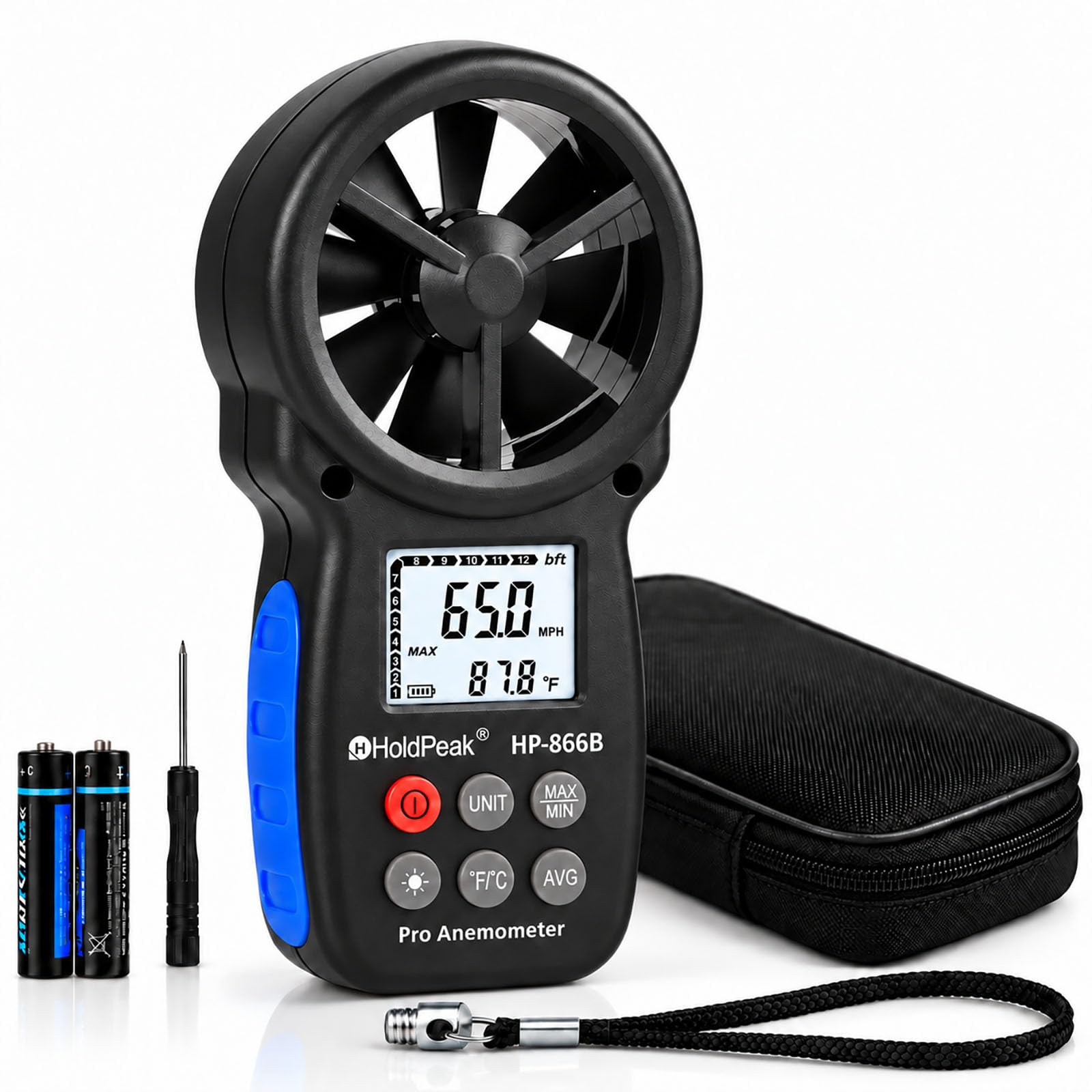
HoldPeak 866B

91 /100
Angler Score Outstanding

Key details

Weight
7.05 oz
Volume Flow
CFM from vent area
Stated Accuracy
±5% of reading
Wind Speed Range
0.67–67.1 mph
Check Details on Amazon

The 866B measures 0.67 to 67.1 mph with a stated tolerance of plus or minus 5 percent, reads air temperature from 14 to 113 degrees Fahrenheit, and does the thing most inexpensive meters here only claim: it converts velocity into CFM once you enter the area of the opening you're measuring. Maximum, minimum and average are all on the keypad, which is how you catch a gust rather than a moment.

That conversion is why it holds a place. Most of the meters in this set read velocity and stop, leaving you to multiply by the vent area on your phone; the HoldPeak does the arithmetic and shows you the answer. For balancing registers, checking a return grille or working out whether a bath fan is actually moving air, that's the difference between a reading and an answer. The eight-blade impeller turns in light flow, and the hard case and wrist strap mean it survives being carried between jobs.

Two practical notes. At 200 grams and 6.5 inches it's a tool-bag meter, fine beside your gauges and less so in a shirt pocket. And the digits wash out in direct sun, so you'll cup a hand over the screen or step into shade to read it. Neither has stopped us reaching for it on a vent check.

Pros

  • Calculates CFM from vent area
  • MAX, MIN and AVG for gust tracking
  • Hard case, wrist strap and tripod mount
  • Reads wind speed and air temperature

Cons

  • Readings can stall in strong, gusty wind
Our verdict

If you need cubic feet per minute as well as wind speed, this one does the arithmetic: enter the vent area and it reports volume flow.

Check Latest Price
6

Best for Duct Work

testo 405i

90 /100
Angler Score Outstanding

Key details

Sensor
Hot-wire
Probe Reach
Extends to 15 in
Volume Flow
Calculated from duct size
Connectivity
Bluetooth 4.0 with app
Check Details on Amazon

The 405i is a different animal from everything else here. Instead of a fan on the nose, it has a heated-wire sensor on a telescoping shaft that extends to 15 inches, so the tip can go into a duct, behind a register grille or around a bend where a handheld fan can't be aimed. A hot-wire element reads the slow air that won't turn an impeller, which is exactly the range most residential ductwork sits in.

Everything else happens on your phone. The probe pairs over Bluetooth 4.0 with the Testo Smart app, which shows readings as numbers, tables and graphs, stores them and exports the record afterwards. Enter duct dimensions and it calculates volume flow, so CFM arrives without a second round of arithmetic. Three AAA batteries run it.

For a technician, this is the one we point to. Of everything in this set, it answers questions about air inside a system rather than air over a deck, and the saved record is the difference between a hunch and a number in a report. For wind on open water it is simply the wrong instrument: the reading lives on a phone, and a phone in the rain is not an anemometer.

Plan around the connection. Pairing is quick on some handsets and stubborn on others, and everything runs through the app, so a flat phone means no readings at all. Neither is a problem in a service bag with a charger in it, which is where this probe is going to live anyway.

Pros

  • Hot-wire probe reads very low air speeds
  • Telescoping shaft reaches into ducts
  • Calculates volume flow from duct size
  • App records and exports readings

Cons

  • Bluetooth pairing can be inconsistent
  • Readings depend on the Testo app
Our verdict

For measuring airflow inside ducts and at registers, nothing else here comes close: a hot-wire probe on a 15-inch shaft that logs to your phone.

Check Latest Price
7

Heat and Humidity

Kestrel 3000

90 /100
Angler Score Outstanding

Key details

Weight
6.4 oz
Warranty
5 years
Extra Readings
Humidity, dew point, heat index
Water Resistance
IP-67, floats
Check Details on Amazon

Wind is only part of what the 3000 measures. Alongside current, average and maximum wind speed it reads relative humidity, dew point, heat stress index, wind chill and air, water or snow temperature. Water temperature is the number anglers reach for: dip the body, read the degrees, and you know more about where the fish will sit than any air-temperature figure tells you.

The body is the familiar Kestrel formula: IP-67, it floats, it's drop-tested to MIL-STD-810G, the impeller is replaceable, the warranty runs five years and a CR2032 cell powers it. It's light enough for a jacket pocket and the LCD stays legible in low light. The digits are small, though, and if you wear reading glasses you'll be wearing them to use this.

Heat stress index is the sensor set's second act. On a still August afternoon, temperature plus humidity tells you more about whether to keep working a flat or get off the water than the wind number does, and it's the same calculation athletic trainers and outdoor crews use this model for.

The case for it rests entirely on whether the humidity and water-temperature readings will earn their keep. If they will, nothing else in this set puts them in one hand with a wind reading. If they won't, the Kestrel 1000 is the same body without the sensors, and the BT-100 covers wind, chill and temperature for a fraction of the money.

Pros

  • Humidity, dew point and heat stress index
  • Measures water temperature as well as air
  • IP-67, floats and MIL-STD-810G drop-tested
  • Five-year warranty and replaceable impeller

Cons

  • The most expensive meter in this set
Our verdict

If heat index, dew point and water temperature matter as much as wind, this is the one: the same tough Kestrel body with a full weather picture.

Check Latest Price
8

Budget Vent Flow

Proster Anemometer

87 /100
Angler Score Excellent

Key details

Weight
11.3 oz
Battery
9V (included)
Volume Flow
CFM, CMM, CMS
Wind Speed Range
0.4–30 m/s
Check Details on Amazon

Start with the battery. The Proster runs on a single 9-volt cell, included, where nearly everything else here takes AAA. That's convenient if you already keep 9-volts around for a fish finder or a smoke alarm, and mildly irritating if you don't, because it's a bigger cell sitting in a bigger compartment.

The ranges are why it's on the list. Wind speed spans 0.4 to 30 m/s across five units, and volume flow covers CFM, CMM and CMS once you key in the vent area. Reading hold, maximum and minimum are on the keypad, and the backlit LCD is easy to read in a dim mechanical room.

Outdoors it's a compromise. The body runs 6.5 inches long, the unit labels on screen are small enough to need a second look, and the backlight times out after a few seconds. None of that matters on a bench, and all of it is noticeable on a boat.

Where it earns its place is capability against cost: volume-flow arithmetic that otherwise costs considerably more, on a screen you can read indoors, running on a battery any hardware store stocks. If the work is vents and registers rather than open water, that trade is a good one.

Pros

  • Calculates CFM, CMM and CMS
  • Five wind-speed units and reading hold
  • Backlit screen for dim rooms
  • 9-volt battery included

Cons

  • Heaviest meter here at 11.3 ounces
Our verdict

A vent-flow meter first and a wind meter second: it does CFM, CMM and CMS, and it runs on a 9-volt battery that's in the box.

Check Latest Price

How We Tested the Best Handheld Anemometers

We started with the specs people in the field actually compare: measurement range and resolution, which units the meter cycles through, whether it does CFM at all, battery type, and how the sensor is housed and protected. From there we cross-checked owner complaints and return notes, set aside anything with a fixed vane and a reputation for drifting, and landed on 12 meters spanning bare-bones pocket units to instruments priced like real tools. We judged each against its own price, not against the field average.

Over eight months, every meter ran the same three setups. On a rooftop and again in front of a ducted fan, we mounted all 12 side by side on a mast, took three readings at low, medium, and high speed, and compared each pass against a reference meter; anything that wandered between passes got flagged. Indoors, we held each one against the same supply register, bathroom exhaust grille, and open window, timing how long it took to settle and whether the number held or bounced.

Outdoors we took them to a lake dock on a gusty afternoon, a drone field, and a cold morning where wind chill mattered, checking whether the reading matched what the flag and the water were doing. For temperature, each meter sat in the shade for ten minutes away from hands and pockets, then went up against a calibrated thermometer. Each unit also got dropped waist-high onto concrete twice, then carried loose in a bag with keys and a screwdriver to see what rattled.

We weighed them, pocketed them in jeans and chore coats, and handed each to someone who had never used one to see how quickly they got a steady number with gloves on. Screen legibility in direct sun, button feel, and battery life after two months of daily use all went into the notes.

How to Choose a Handheld Anemometer

Match the Sensor to the Air You're Measuring

Two sensor types cover almost everything here. A spinning vane or impeller is the cheap, tough option: it's what nearly every pocket meter uses, it's accurate in open breeze, and it can't read air that won't turn the blades — a light draft from a register, or flow inside a duct where you can't aim it. A hot-wire probe, like the one on the testo 405i, measures air moving across a heated element and picks up the slow stuff.

If your question is which way the wind is running across the water, buy an impeller. If it's what's moving through a vent, buy a probe.

How Much Accuracy You Can Actually Use

Published tolerances in this set run from 2 percent of the reading to 5 percent, and both are fine for the decisions most of us make: whether to launch a kayak, whether the drift will hold, whether the drone goes up. What moves the number more than the tolerance is technique.

Hold the meter at arm's length and square to the breeze, because your body makes its own calm pocket, and take two or three readings rather than trusting the first flicker. On a gusty day the spread between them tells you more than the average does.

What CFM Really Requires

Several listings carry CFM in the title and never display it. Volume flow is velocity multiplied by the area the air passes through, so a meter needs a way to enter that area — 12 by 6 inches for a register, or the cross-section of a duct — before it can report cubic feet per minute.

The HoldPeak and the Proster let you key the area in; the testo 405i takes duct dimensions in its app. If you only need to compare one vent with another, velocity alone is enough and you can skip the feature entirely.

Screens, Batteries and Pocket Space

A wind meter gets read outdoors, which is the worst possible place for a small LCD. Bigger digits and a backlight help, but the backlight is for dusk, not noon; in direct sun the shading you make with your free hand does more. Weight matters more than length for pocket carry — 100 to 150 grams disappears into a jacket, 200 grams and up feels like a tool.

On batteries, AAA cells are the easiest to replace anywhere, coin cells last years but are a pharmacy purchase, and a 9-volt adds bulk. Cold mornings shorten the life of all three, so carry a spare.

Water, Drops and the Warranty

Most pocket meters here carry no water rating at all, which is worth remembering on a boat or a jetty. The Kestrels are the exception: IP-67, they float, and they're drop-tested to a military standard — which is what a five-year warranty is built on.

If your meter lives in a dry bag and comes out on the bank, that protection is money you don't need to spend. If it lives in a wader pocket, it isn't.

Frequently Asked Questions

Final Verdict

Wind meters are cheap enough that the smart move is to buy the one that fits how you'll carry it. For most people that's the BT-100: light, bright, cased, with a tripod thread for hands-free reading and a stated tolerance that punches above its price.

If the meter will spend its life on a boat, pay for the Kestrel 1000 and stop worrying about spray. If the job is air inside ducts rather than air over water, skip both and buy the testo 405i.