Best Ice Fishing Cleats of 2026

Anyone who has dragged a sled onto first ice knows the half-second of doubt that comes with it: your heel slides, the load shifts, and you suddenly realize how much of that walk you were taking on faith. Ice fishing puts you on the slickest surface most of us ever stand on, often before sunrise, usually wearing boots that were picked for warmth rather than grip. Cleats close that gap between a good boot and a surface with no friction at all.

I've fished the same handful of lakes for years, and I've also watched a grown man go down on a boat ramp in front of an audience. So my team and I spent this past winter in 14 pairs of cleats, walking them out to the hole before light and back after dark. One thing first-timers rarely consider: point length is its own trade-off — long enough to bite hard ice, short enough that you aren't clomping around the shack or gouging a truck bed. The picks below cover that whole range.

1

Best Overall

Icetrax V3

95 /100
Angler Score Outstanding

Key details

Attachment
Slip-on
Heel Detail
Reflective
Traction Points
Tungsten crampons
Check Details on Amazon

The reflective heel is a small detail, but it is the one that makes the Icetrax V3 easy to live with: you can spot the pair in a dark truck bed or at the bottom of a sled. The tungsten crampon points are the real reason it holds our top spot. They bite on hard lake ice without the tall, aggressive stance of a mountaineering crampon, so you can walk naturally from the ramp to the hole.

The slip-on harness is the other half of the appeal. It stretches over shoes and winter boots, and the wrap around the toe and heel keeps the frame from rolling sideways when you walk. The harness goes on without a fight and comes off just as easily, which matters when you are balancing on one leg at the truck.

Durability is where cheap cleats lose their value, and this is the pair in the group with the fewest worries on that front. The tungsten points are hard enough for repeated ice contact, and the rubber holds its shape through cold sessions. It is not the most aggressive option here for sheer spike count, but it has enough bite for lake ice and packed snow.

The boundary is steep, hard alpine terrain, where a true mountaineering crampon with rigid points and a different harness is the right tool. For ice fishing, that is not the job. The Icetrax is the pair we hand to most anglers first.

Pros

  • Tungsten points bite on hard ice
  • Reflective heel is easy to spot
  • Slip-on harness goes on over boots
  • Durability holds up better than the budget picks

Cons

No notable drawbacks to flag.

Our verdict

We recommend the Icetrax V3 as the default ice-fishing cleat because it balances tungsten grip, easy on/off, and durability better than anything else in this group.

Check Latest Price
2

Best Premium for Long Walks

Kahtoola MICROspikes

94 /100
Angler Score Outstanding

Key details

Chains
Welded stainless steel
Weight
14.1 oz
Harness
Elastomer, TPU eyelets
Spikes Per Foot
12 stainless steel
Check Details on Amazon

The price is the first thing you notice, and it is a real jump from the midrange pairs here. What you get for it is a purpose-built winter traction tool rather than a stretchy rubber band with points pushed through it. The MICROspikes are aimed at winter hiking, backpacking, and ice trekking, and that shows in the hardware.

Twelve heat-treated stainless spikes per foot, with eight up front and four at the heel, give this pair the most deliberate bite in the group on glare ice. The elastomer harness uses TPU-reinforced eyelets at the stress points, and the stainless chains are welded rather than simply twisted. We trust that combination on refrozen lake ice and steep access trails, where a rolled ankle is the real risk.

The fit is secure over hiking boots and winter boots, and the package folds down to 5 by 3 by 2 inches, which is small enough to live in a pack. At 400 grams, it is heavier than the lightweight studded pairs, but the weight is in the metal and the reinforced harness. A two-year warranty stands out in this group.

For a long approach, the extra hardware is worth carrying. The MICROspikes are the pair we reach for when the lake is a mile from the truck and the shoreline is steep, and the confidence they give on hard ice is the reason they stay near the top of this list.

Pros

  • 12 spikes bite on hard ice
  • Welded chains and reinforced eyelets add durability
  • Packs small for a serious traction tool
  • Two-year warranty backs the build

Cons

  • Snow balls up in deep, soft conditions
Our verdict

We keep the Kahtoola MICROspikes in the premium slot because its 12-spike harness and welded chains are the most confidence-inspiring combination here for long, rough walks to a distant lake.

Check Latest Price
3

Best Aggressive Grip

Win.MAX 19-Spike

92 /100
Angler Score Outstanding

Key details

Harness
5.49 mm TPE
Warranty
1 year
Chain System
Double chain
Spikes Per Foot
19 stainless steel
Check Details on Amazon

Nineteen stainless teeth per foot is the number that separates the Win.MAX from the lighter studded cleats here. The double-chain layout spreads those points across the sole, and the 5.49 mm TPE harness is thick enough to hold them in place without feeling like a rigid plate.

That extra metal is most useful on glare ice that has been polished by wind or refrozen after a thaw. The points sit close enough together to keep several engaged at once, and the chain system lets the frame flex with the boot instead of skating on top of it. The one-year warranty is a useful backstop for a cleat in this price range.

We choose the Win.MAX when the lake is slick and you want more metal underfoot than the Icetrax provides. The fit is the part to get right: the Large size can run small over a wide pac boot, so check the chart and size up if you are between sizes. The harness takes a firm pull, but it settles once it is centered.

This is a cleat for the angler who wants aggressive bite and does not mind a more substantial piece of gear. It is not the pair for a long hike in, but for the walk from the truck to the holes on a hard-frozen lake, the extra points earn their place.

Pros

  • 19 stainless spikes per foot
  • Double-chain frame spreads load
  • Thick 5.49 mm TPE harness
  • One-year warranty

Cons

  • Heavier than the lightweight picks here
Our verdict

We point aggressive ice anglers to the Win.MAX 19-spike because its double-chain frame puts more stainless steel underfoot than our top pick.

Check Latest Price
4

Best for Mixed Terrain

Yaktrax Diamond Grip

90 /100
Angler Score Outstanding

Key details

Size
Large (W 10.5+/M 9.5-12.5)
Upper
Natural rubber
Cables
Aircraft-grade steel
Grip Points
Swiveling diamond beads
Check Details on Amazon

Ice fishing rarely means pure glare ice from the truck to the hole. There is a parking lot, a plowed path, maybe a ramp, and then the lake. The Yaktrax Diamond Grip is the pair we choose for that mixed walk because the swiveling diamond beads roll with your stride instead of catching and tripping.

Instead of fixed spikes, the Diamond Grip strings case-hardened steel alloy beads on aircraft-grade steel cables. The beads swivel as you walk, which helps them shed snow and keep contact across the whole foot. The natural rubber upper stays flexible in cold, and the full-foot coverage gives you stability on icy inclines and hard-packed trails.

The Large size fits women's 10.5 and up and men's 9.5 to 12.5, and the elastic upper goes on over boots without a strap to adjust. At 16 ounces, it is heavier than the ultralight studded pairs, but it still packs into a sled or a daypack. The ride is smoother than a spike cleat on pavement, which is the point.

This is not the pair for the angler who logs serious miles on sharp, refrozen ice; fixed spikes bite harder there. For the angler who crosses a mix of surfaces and wants one pair for the whole walk, the beads are the better compromise.

Pros

  • Swiveling beads shed snow
  • Full-foot traction on mixed surfaces
  • Natural rubber upper stays flexible

Cons

  • Cables can break with heavy mileage
  • Short 90-day warranty
Our verdict

We recommend the Diamond Grip for the angler who walks a mix of ice, packed snow, and cleared pavement, where swiveling beads feel more natural than a field of spikes.

Check Latest Price
5

Maximum Spike Coverage

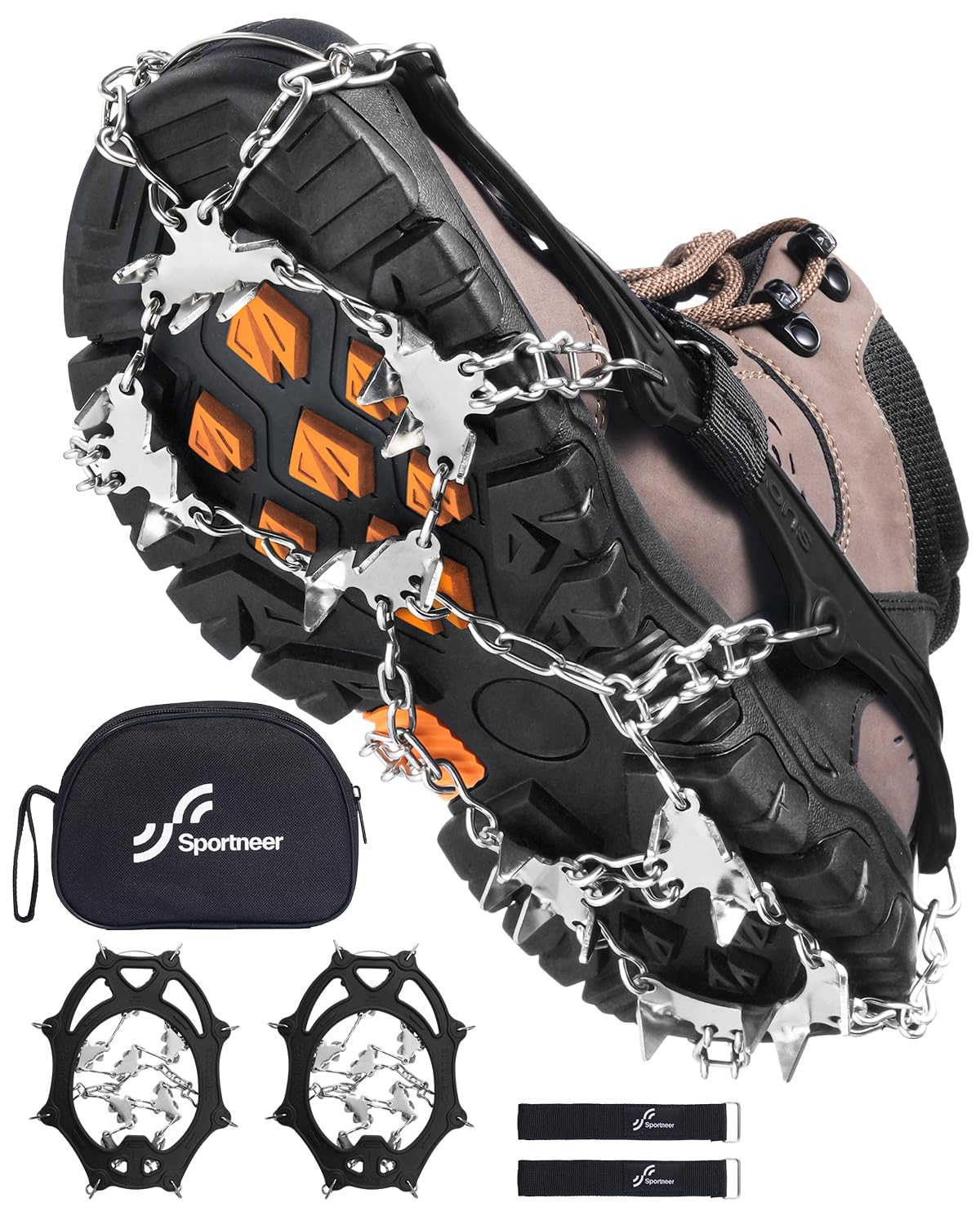
Sportneer 28-Spike

92 /100
Angler Score Outstanding

Key details

Harness
5 mm TPE
Included
Adjustable strap
Chain System
Double chain
Spikes Per Foot
28 stainless steel
Check Details on Amazon

Twenty-eight stainless spikes per foot is the headline, and it is not just a number for the box. On a lake that has thawed and refrozen into a hard, uneven surface, more points mean more chances to find purchase with each step. The double-chain frame and 5 mm TPE harness hold the pattern together.

We see the appeal for anglers who move between shanties and hole to hole on slick ice. The adjustable strap gives you a way to center the frame on the boot, and the extra points make the cleat feel planted rather than skittery. It is a purposeful design for hard ice rather than a do-everything walking cleat.

The Large size takes a firm stretch over a bulky boot, and the TPE softens as it warms. The one-year warranty is a reasonable backstop. For a dedicated ice-fishing pair, the 28 points are a real advantage on rough ice, and the lower price than most of the group makes it easy to try.

Pros

  • 28 stainless spikes per foot
  • Double-chain frame spreads load
  • Adjustable strap keeps frame centered
  • Budget-friendly for the spike count

Cons

  • Durability is inconsistent under hard use
  • Bulkier than minimalist pairs
Our verdict

We suggest the Sportneer 28-spike when maximum bite matters more than a minimalist build, especially for shanty hopping on slick ice.

Check Latest Price
6

Cold-Weather Backup

Cimkiz 19-Spike

93 /100
Angler Score Outstanding

Key details

Weight
9.44 oz
Harness
5 mm TPE
Cold Rating
-45°C
Spikes Per Foot
19 stainless steel
Check Details on Amazon

The minus-45-degree Celsius claim is the kind of spec that gets attention in an ice-fishing article. The Cimkiz backs it with a 5 mm TPE harness that stays stretchy in cold, and that is the reason it belongs in this group.

Nineteen stainless spikes per foot and a double-chain layout put it in the aggressive half of the set. The adjustable strap is a useful second line of defense: it gives you a way to pull the frame back to center if the harness shifts on a bulky boot. At 9.44 ounces, it is light for the amount of metal.

The Cimkiz earns its place on deep-cold trips where a stiff rubber harness is the last thing you want to fight. It goes on over boots, the strap gives you a way to recenter the frame after you pull it on, and the 19 points give you more bite than a 10-stud pair. The one-year warranty is standard for the class.

Pros

  • 19 stainless spikes per foot
  • 5 mm TPE harness rated to -45°C
  • Adjustable strap helps center the frame
  • Light for the spike count

Cons

  • Chain system can come apart under hard use
Our verdict

We keep the Cimkiz 19-spike as a cold-weather alternative for anglers who want a thick TPE harness and an adjustable strap over a 19-spike frame.

Check Latest Price
7

Lightweight Spare

Limm Ice Cleats

88 /100
Angler Score Excellent

Key details

Size
X-Large
Weight
5.92 oz
Harness
TPE
Studs Per Foot
10 stainless steel
Check Details on Amazon

The Limm is the pair you leave in the truck for the day you forget your main cleats. At 5.92 ounces, it is light enough to keep in a glovebox or a jacket pocket without noticing, and the TPE base rolls up small. The 10 stainless studs are not the most aggressive tread here, but they are enough for a short walk across a plowed access.

The harness slips over boots, and the X-Large is the listed size. The fit is the part to check: over a very bulky pac boot, the stretch can run tight, so size up if you are between sizes. The rubber membrane base stretches over the boot and folds up small.

This is not the pair for a long, rough trek. The 10 studs give less bite on refrozen, uneven ice than the 19- and 28-spike designs, and the lighter build is better suited to short trips. It is a spare, not a primary.

We keep the Limm in also-consider because it is easy to justify as a backup and easy to carry. For the angler who wants one pair for the whole season, the Icetrax or Kahtoola is the better call. For a spare in the sled, the Limm does the job.

Pros

  • Light enough to keep as a spare
  • 10 stainless studs for basic ice grip
  • TPE harness folds small

Cons

  • Durability is inconsistent with hard use
Our verdict

We see the Limm as a lightweight spare for short walks to the shack, where its low weight and ten studs are easy to justify.

Check Latest Price

How We Tested Ice Fishing Cleats

Every pair here started as research rather than a recommendation. We compared specs on dozens of options and narrowed on three things: what the points are made of, since tungsten carbide and hardened stainless hold an edge while soft steel rounds off; how many points sit under the ball and heel where your weight actually lands; and how the cleat attaches — a full sole plate with a heel strap versus an elastic band stretched over the toe. That left 14 pairs, worn through one full winter.

Testing happened where cleats actually live. I wore them on the 5 a.m. walk out with a sled in tow, on the boat ramp, on refrozen slush at dusk, and across a plywood shack floor, where too much grip becomes its own hazard. We timed how long each pair took to pull on over a bulky pac boot, both bare-handed and with gloves on, and noted whether the elastic had to be wrestled or simply stretched. After a hundred yards we checked whether the plate had shifted sideways underfoot, and we stopped short on purpose to see if the heel kept holding.

Fit got its own pass, because a loose cleat is a useless one: each pair went onto a size 9 boot, a heavy floatation boot, and a slimmer snow boot, and we noted which ones slid around on the smaller boot and which folded down small enough to ride in a coat pocket. Durability we judged at the end of the season rather than the start, checking for bent or rounded points, stretched-out elastics, and cracks forming at the stress points. Several pairs are still in the truck now, and we'll update this list if any of them give out.

How to Choose Ice Fishing Cleats

Match the traction to the surface

Start with the ice you actually walk on. Fixed stainless spikes, like the 12 on the Kahtoola MICROspikes, bite hardest on glare ice and hard-packed snow; a 19- or 28-spike frame adds more contact points for rough, refrozen lake ice. Coils and diamond beads, like the Yaktrax Diamond Grip, trade some bite for smoother walking across pavement, packed snow, and cleared paths. We prefer spikes for a dedicated ice-fishing walk and beads for the angler who crosses a parking lot and a plowed ramp before reaching the lake.

Fit over the boots you actually wear

Ice-fishing boots are bulky, and a cleat sized for a running shoe can be a fight to get on and a liability once it is there. Look for a harness that wraps the toe and heel, and check the maker's range against your boot size rather than your street shoe. If you are between sizes or wear a wide pac boot, go up; the Win.MAX 19-Spike is a strong example of a design that rewards careful sizing. A loose cleat rolls sideways, while one that is too tight is hard to pull on with cold hands.

Check the harness and chain, not just the spike count

The metal gets the attention, but the rubber or TPE harness and the chain links decide whether a pair lasts a season. Reinforced eyelets, welded links, and a thick TPE base resist stretching and pull-through better than a thin rubber sling. We look for a harness that stays flexible in cold and a chain system that distributes load across the foot. Even a good pair needs a quick inspection before each trip: a cracked harness or a loose link is the warning that matters. Replace the pair rather than repairing a broken traction point.

Plan for on/off and snow

You will put cleats on and take them off in gloves, often in the dark, so a heel tab or simple strap is worth more than an extra feature. Snow can ball up under any cleat, especially in wet, deep conditions; knock it off before it turns into a platform under your boot. Carry a small bag for the ride home, and practice the pull-on motion once before you need it on the ice. The easier the pair is to handle, the more likely you are to wear it every trip.

Frequently Asked Questions

Final Verdict

For most ice anglers, the Icetrax V3 is the pair we recommend first. It puts tungsten points under the boot, stays put over winter footwear, and comes off without a fight, which is the combination that matters on a cold morning. If your walk to the lake is long and rough, the Kahtoola MICROspikes are the upgrade; the 12-spike harness and welded chains justify the premium. The Win.MAX 19-spike is the aggressive alternative for glare ice, as long as you size it for your boots.