Best Ice Fishing Heaters of 2026

Heat on the ice comes down to one tradeoff: a propane heater lights in seconds and pours warmth at your hands, while a wood stove takes ten minutes to catch but burns dry and cooks your lunch. The mistake I see most is buying more BTU than the shelter can hold — an oversized heater chases you out of a two-man flip-over faster than the cold does. What you want is a unit sized to your space that starts on the first click and shuts off when it's knocked over. Seven months and 11 heaters later, that's the bar.

Last winter I watched a heater that lit fine in my driveway quit once the wind crossed the lake — the difference between a spec sheet and a Saturday on the ice. So we tested where these live: flip-overs at dawn, a hub shelter in a crosswind, a wall tent overnight, and a couple of cold camping weekends away from the ice. The picks below run from a one-person bucket to a weekend tent, each earning its place on heat output, fuel cost, and whether I'd trust it zipped in with me.

1

Best Overall

Mr. Heater Portable Buddy

95 /100
Angler Score Outstanding

Key details

Weight
7.1 lb
Coverage
225 sq ft
Heat Output
4,000 / 9,000 BTU
Indoor Rating
Rated for indoor and outdoor use
Check Details on Amazon

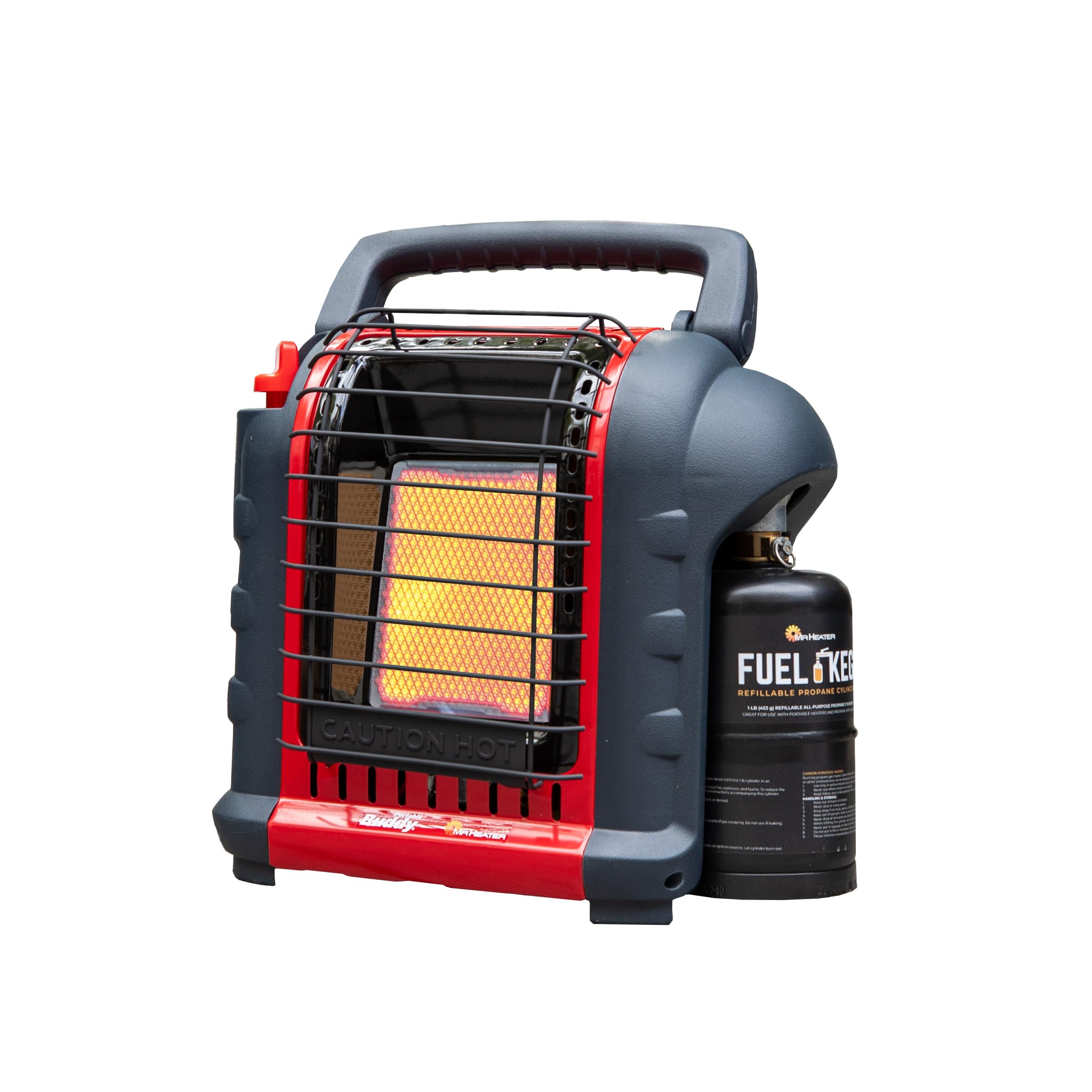
Four thousand BTU on low, 9,000 on high, and rated for indoor as well as outdoor use — that combination is why this is the heater we point ice anglers to first. Nearly every cheap propane radiant unit in this group is outdoor-only, which rules it out of a zipped-up pop-up. This one carries an oxygen-depletion sensor and a tip-over switch and is approved to run indoors, which a shelter with a vent cracked is.

Nine thousand BTU is rated at roughly 225 square feet, and a two-man flip-over is a fraction of that, so most of a trip happens on low with a hand on the knob only when the wind picks up. Radiant heat is what makes it feel immediate: it warms faces and hands rather than the air, which suits the way you actually fish — short sits, plenty of moving between holes.

At 7.1 pounds and about 15 inches tall it takes up the footprint of a bait bucket and sits on the ice beside you. The 1 lb canisters are the real limit: one is good for a few hours, not a night, so a day on the ice means two or three spares in the sled. The tip-over switch is lively too — nudge the unit while sliding to a new spot and it goes out, which is the design doing its job, so set it where you want it and leave it there.

Wind is the thing that changes the math. There's no fan, so in a shelter that's flapping, whoever sits closest gets most of the heat and everyone else gets the leftovers. Point it at knees and take turns.

Pros

  • Indoor-rated with low-oxygen and tip-over shutoffs
  • 9,000 BTU is plenty for a two-man shelter
  • 7.1 lb with a small footprint on the ice

Cons

  • One-year warranty, the shortest of the Mr. Heater picks
Our verdict

For a zipped-up pop-up or a two-man flip-over, this is the one to buy: indoor-rated, 9,000 BTU, and light enough to sled in with the rest of your gear.
Check Latest Price
2

Best for Big Shelters

Mr. Heater Hunting Buddy

91 /100
Angler Score Outstanding

Key details

Weight
11.2 lb
Coverage
300 sq ft
Ignition
Electronic start knob
Heat Output
6,000 / 12,000 BTU
Check Details on Amazon

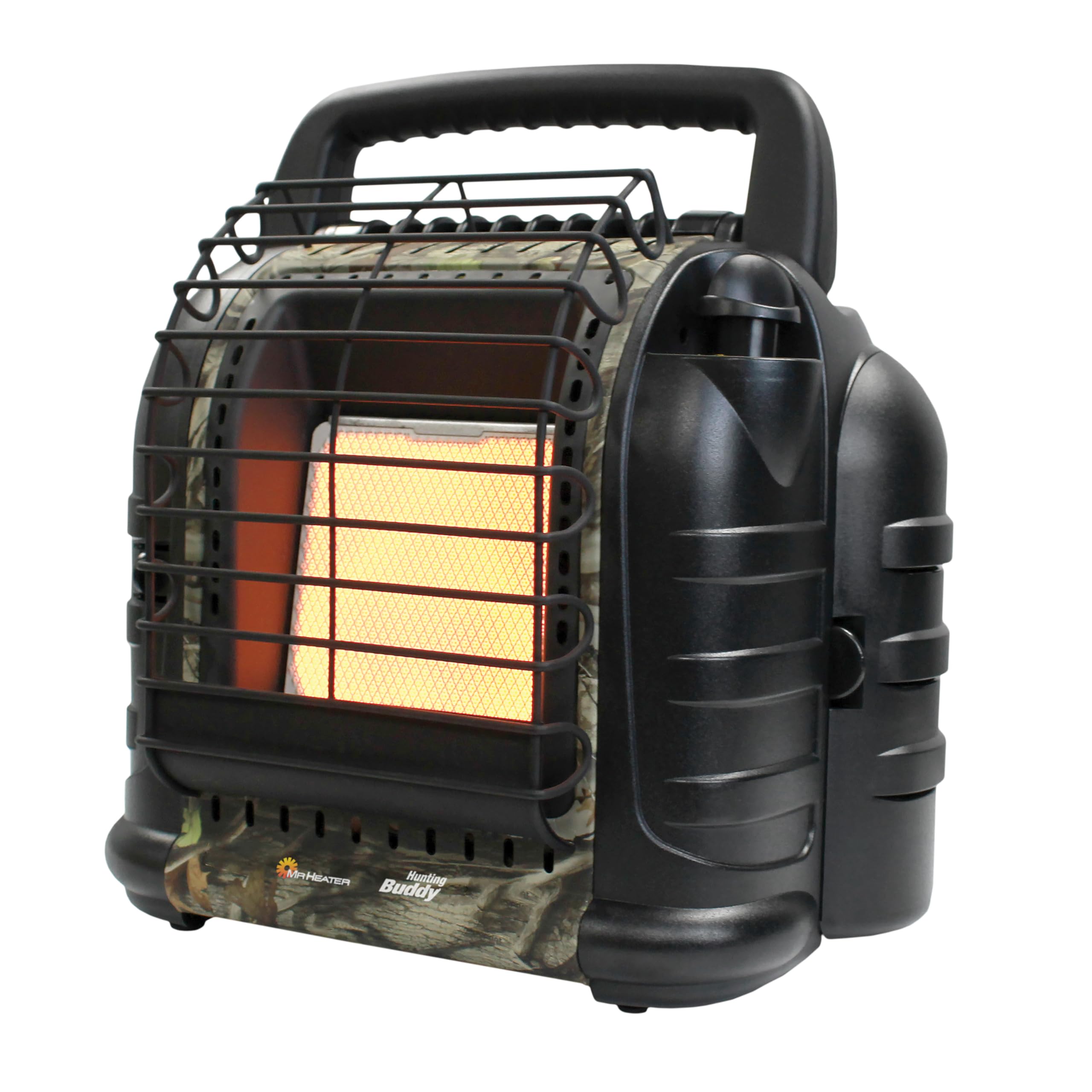
Twelve thousand BTU against our top pick's 9,000, coverage of 300 square feet against 225, and four more pounds to haul: that's the whole trade. In a shelter with three or four anglers in it, the difference between comfortable and merely not-cold is exactly this margin, and we've been glad of it on mornings when the thermometer sat in single digits and the fabric was drumming in the wind.

The 6,000 BTU low setting earns its keep on milder days, and it's the setting that keeps a canister alive through an afternoon. The ignition is electric, which is the right call for a hunting-season heater, but the button sits behind a small hinged plastic door — the kind of detail that is invisible on a product page and annoying at first light with a glove on. The start knob itself is big enough to work without stripping a layer.

One thing to get right before you buy: the warranty text is explicit that unauthorized accessories void coverage. Plenty of people want to run one of these off a 20 lb tank, and you can, but use Mr. Heater's own hose rather than a generic one from the hardware store. That's a small cost that keeps a three-year warranty intact, which is the best in this group.

Give the emitter and the thermocouple a look before the season starts. An aging or dusty burner is the usual reason a radiant heater starts flaring or refusing to hold a flame, and two minutes with a soft brush is cheaper than a new heater.

Pros

  • 12,000 BTU for four-man shelters
  • Three-year limited warranty
  • Large start knob that works with gloves

Cons

  • 11.2 lb and 17 inches deep
Our verdict

If your shelter seats three or four, or you fish a hard-side that never warms up, the extra output and three-year coverage here beat our top pick for the money.

Check Latest Price
3

Best Wood Stove for Hot Tenting

AVOFOREST Hot Tent Stove

86 /100
Angler Score Excellent

Key details

Fuel
Wood
Weight
15.3 lb
Chimney
7 sections, 12 in each
Stove Dimensions
17.8"L x 11"W x 9.73"H
Check Details on Amazon

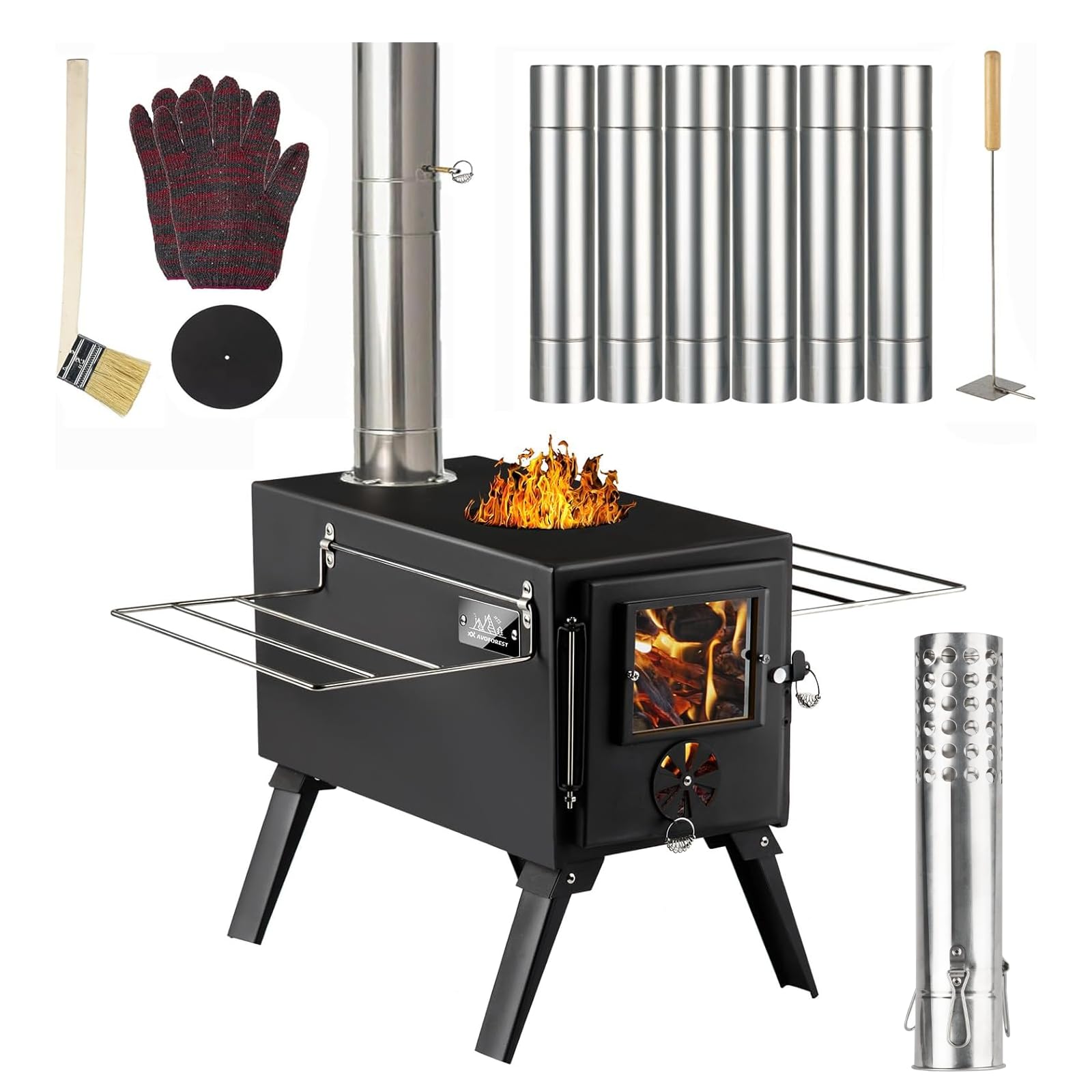
Seven chimney sections of a foot each come out of the box first, and that's an honest summary of what a wood stove is: a fire in a box with seven feet of pipe above it. The pipe is the part that matters, because the outlet has to clear the roof, which means a stove jack sewn into the fabric. That's a decision you make before you buy, not after.

The body is iron rather than stainless, about 15 pounds all in, with a glass window in the door. That window is more useful than it sounds: you can see how much wood is left without opening the door and dumping your heat up the pipe. The firebox is 17.8 inches long and 9.73 tall, so it takes splits around a foot and a half rather than the big rounds a barrel stove swallows.

Where this earns its place is the overnight. There's no canister to run dry, no regulator to freeze, and no low-oxygen sensor deciding it's had enough at the worst possible moment. You get a fire you can put a pot of chili on and a tent that stays dry inside instead of dripping on your bag — and it's our pick of the two stoves here because it's the lighter one to drag out to the ice.

Plan the first burn for the driveway, not the lake. The manufacturer wants a thorough outdoor burn before the stove goes in a tent, and you'll understand why the moment the paint starts curing and smoking. After that it's a matter of learning the damper, which is the difference between a stove that draws and one that sulks.

Pros

  • No fuel canisters to run out
  • Glass door shows the fire without opening it
  • About 15 lb packed, lighter than the other stove here

Cons

  • Needs a shelter with a stove jack sewn in
  • You'll refeed it every couple of hours
Our verdict

For an overnight in a stove-jack hot tent, this is the pick: dry heat, a top you can cook on, and no canister to sputter out at three in the morning.

Check Latest Price
4

Ventilated Hard-Sides

XtremepowerUS Dual-Burner Tank Top

89 /100
Angler Score Excellent

Key details

Burners
Two, independent
Coverage
750 sq ft
Heat Output
Up to 30,000 BTU
Heat Settings
3 per burner
Check Details on Amazon

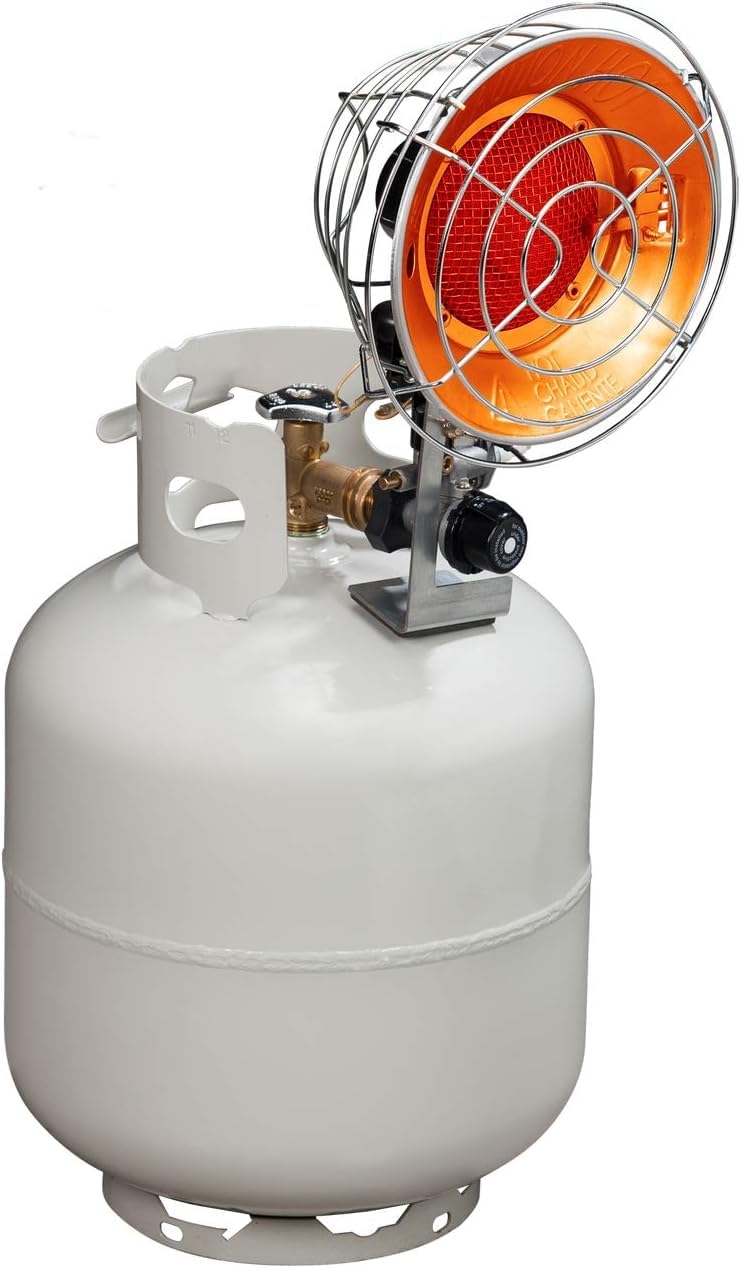
Two burners, 30,000 BTU, and one hard rule: this threads onto a 20 lb cylinder and it's rated for outdoor use, so it belongs in a hard-side shack with a window up, not in a sealed pop-up. Read that as the price of the heat. For less money than our top pick you get more than three times the output, which is the entire argument for a tank-top.

The two burners are why we'd choose this over a single-burner tank-top — light one side on a mild morning and both when the thermometer is being stubborn, and you're only burning half the propane the rest of the time. Each side has three settings, the chrome guard keeps your sleeve off the emitter when you lean past it, and the whole head threads on with no assembly. A safety valve cuts the gas if the flame dies, and the tip switch handles a knock.

The listing claims 750 square feet, which is a garage number rather than a shack number — figure on warming the space you're sitting in, not the whole building. What you're really buying is radiant output pointed at a bench, and at 30,000 BTU it will win that argument with any shelter you can carry.

Storage is the small annoyance. Once it's off the tank you have a dish-shaped head with nothing flat to stand on, so it rides in the truck on its side and you thread it back on at the lake. That's the trade for a heater that costs so little per BTU.

Pros

  • Up to 30,000 BTU for the price of a mid-range heater
  • Burners light independently, saving fuel
  • Chrome guard and tip-over shutoff

Cons

  • Outdoor-rated only, so no sealed shelters
  • The 20 lb tank is the base
Our verdict

If your shack has a vent and you want the most heat for the least money, this dual-burner tank-top delivers — just never zip it into a sealed tent.

Check Latest Price
5

Cheap Hard-Side Heat

Avenger 15,000 BTU Tank Top

91 /100
Angler Score Outstanding

Key details

Weight
3 lb
Ignition
Match light
Heat Output
15,000 BTU
Heat Settings
3
Check Details on Amazon

This is the cheapest of the tank-tops here, and it's also the least complicated: a burner on a stem, a valve, and a match. The head is three pounds, so the only heavy thing you carry is the 20 lb cylinder it screws onto, and the burner swivels through 45 degrees so you can point it at your chair and leave it alone.

Ignition is the catch. Match-light means a long-nose lighter or a torch, and it means crouching over a tank in whatever wind is running that morning, which is the least pleasant thirty seconds of the trip. Once it's lit, the automatic safety valve cuts the gas if the flame goes out and the tip switch handles a knock, so it behaves like the bigger units.

Fifteen thousand BTU is more than our top pick's high setting, which is the whole value story: this is the least money you can spend here on a heater that will actually warm a shack, and it does it without a fan or a circuit board to fail. What you give up is the indoor rating, so a ventilated hard-side or an open sled is the setting — not a sealed pop-up.

Avenger rates it at up to 36 hours on a 20 lb tank, which is the kind of number that only holds on the lowest setting. Treat it as a ceiling and you won't be disappointed on a long weekend.

Pros

  • 15,000 BTU for the least money here
  • Three pounds of head
  • Swivel head aims heat where you sit

Cons

  • Match-light ignition, so bring a long lighter
Our verdict

The cheapest tank-top here and the simplest: buy it for a ventilated hard-side where you want heat now and don't mind carrying a lighter.

Check Latest Price
6

Truck-Based Hot Tenting

unho Stainless Hot Tent Stove

81 /100
Angler Score Excellent

Key details

Fuel
Wood
Weight
22 lb
Chimney
6 stainless pipes
Stove Dimensions
15.75"L x 12.2"W x 7.68"H
Check Details on Amazon

Twenty-two pounds is the first thing to know about this stove, and it explains most of the rest: stainless steel instead of iron, a ceramic glass door, and a body you won't worry about denting on the way out of the truck. Against the AVOFOREST above it's about seven pounds heavier, with a shallower firebox and the same six-pipe chimney arrangement.

Whether that's a good trade depends entirely on how the stove reaches the ice. In a truck bed and a trailer, the weight is nothing and the stainless earns its keep — it doesn't rust, it doesn't need a season of paint curing, and the glass door lets you run the fire by eye. Dragged a mile on a sled behind a walk-on, those seven pounds are seven pounds, and the lighter iron stove wins on the spot.

Smoke is the skill this stove asks you to learn. With a hot fire and the damper set right, the pipe pulls cleanly; with a smoldering fire it spills at the door and your tent fills. Dry wood and a fast start solve most of it, which is advice worth more than any feature on the spec sheet.

Pros

  • Stainless body that won't rust between trips
  • Glass door for running the fire by eye
  • Cheaper than a season of canisters

Cons

  • 22 lb before you add pipe and wood
  • Glass door is the part that can crack
Our verdict

Buy this stove if it rides in a truck: the stainless body and glass door are worth the weight, and it costs about the same as the lighter iron stove.

Check Latest Price
7

Walk-On Trips

HEYDUOTON Portable Propane Heater

83 /100
Angler Score Excellent

Key details

Weight
1.3 lb
Coverage
200 sq ft
Included
Windproof lighter
Heat Control
Adjustable knob
Check Details on Amazon

A pound and three ounces is the number that sells this one. On a walk-on trip — park, load the sled, drag a mile to the spot — the heater is the last thing you want to be counting, and this one disappears into a pack beside the auger. The 1 lb canister it runs on weighs almost as much as the heater itself, which tells you most of what you need to know about the scale of the thing.

The foldable base is the detail we didn't expect to matter as much as it does. It cradles the canister so the whole assembly sits steady on uneven ice instead of balancing on a bottle, and the control knob is big enough to work with a glove on. It ships with a windproof lighter, which is either a thoughtful inclusion or an admission about the ignition, depending on your mood.

It's rated for outdoor use, so a ventilated shack or an open sled is the setting — crack a window and don't kid yourself about a sealed pop-up. Heat comes on fast and lands in one place: this is a heater you sit in front of and warm your hands over, not one that raises the temperature of the whole shelter.

That's the honest boundary, and it's also why we keep it on the list. As a second heater for the walk-on angler who wants to take the edge off for an hour, or as the thing that lives in the truck all winter, it does a job nothing else here does at its weight. As the only heat for a family shelter on a January morning, it isn't enough heater.

Pros

  • 1.3 lb
  • Foldable base steadies a canister on uneven ice
  • Lighter included, so it lights out of the box

Cons

  • Heat lands in a hot spot, not across the shack
Our verdict

For walk-on trips where every pound counts, this is the heater that actually rides in the pack — just don't expect it to warm a four-man shelter.

Check Latest Price

How We Tested 11 Ice Fishing Heaters

We started with roughly 40 heaters sold for ice fishing and cold-weather camping, then cut anything without a tip-over or low-oxygen shutoff, anything whose chimney wouldn't clear a four-person shelter, and anything too bulky to drag out one-handed with a sled behind you. What survived was a mix of radiant propane units, tank-top burners, and small wood stoves. We bought 11 of them and ran each through seven months, from first ice in December to a last frosty camping weekend in May — never on a bench, always in the shelter it was built for. Price went in the same column as BTU, since what matters is how much heat you get per dollar and per pound you haul onto the ice.

Every propane heater got the same morning: lit at first light in a flip-over on six inches of ice, then moved to a hub shelter on a day the wind was pushing 15 mph. I timed how long it took before I could feel warmth through a glove, ran each on low and high to see how far a one-pound bottle stretched, and tipped every one on purpose to confirm the shutoff caught before the heater hit the ice. In the wall tent I checked the ceiling for condensation and noted which units left the inside clammy by midnight and which kept it dry enough that my jacket didn't soak through.

The wood stoves were judged on ignition and smoke: how many tries it took to get a fire holding in a crosswind, whether smoke rolled back inside when someone opened the door, and whether the damper and door gaskets carried a burn overnight without babysitting. After the season we went back over every weld, hinge, hose, and fitting looking for cracks or looseness, and weighed each unit packed with its fuel so we could say plainly what counts as portable. A couple are still riding in my truck.

How to Choose an Ice Fishing Heater

Match the heat to the shelter, not the box

Coverage figures assume an open room with eight-foot ceilings, and a flip-over is nothing like that: a fraction of the volume, usually uninsulated, and full of people in coats. Our top pick's 9,000 BTU is more than a two-man shelter can use on a normal day, and 12,000 BTU handles the four-man end of things. Past that you're paying for heat you won't need and burning fuel to make it.

The exception is the other direction. A hard-side shack or a garage-sized fish house has the volume and the leaks to soak up 30,000 BTU, which is why the tank-top units still have a following among anglers who drive to the ice. Buy for the space you sit in, not the space on the box.

The indoor rating is the line that matters

What decides where a heater can go is its rating, not its output. A unit approved for indoor use carries an oxygen-depletion sensor and a tip-over switch and is built to burn cleanly enough for a room. An outdoor-only tank-top pulls combustion air from the space around it and puts the exhaust back into that same space, which is fine in a garage with the door up and not fine in a zipped-up pop-up.

Even with a rated unit, leave a vent cracked. The sensor is a backstop for a fault, not a ventilation system, and a shelter is a very small room with a very large flame in it.

Fuel, runtime, and what a weekend actually costs

Canisters are the convenient fuel and the expensive one, and the empties pile up over a long weekend. A 20 lb cylinder through an approved hose is cheaper per hour and gives you days of heat, at the cost of dragging twenty pounds of steel onto the ice and something else to trip over in the dark.

Wood sits outside that arithmetic entirely: free if you cut it, but you pay in feeding the fire every couple of hours and in owning a shelter with a stove jack. Most anglers land on canisters for the walk-on trip and a bulk tank for the truck-and-trailer setup, and that split is worth deciding before you shop.

Lighting it with gloves on

Ignition is where cheap heaters show their age. A piezo push-button is the simplest and the one that quits first. Electronic ignition is easier with gloves but often hides behind a small hinged door that's fiddly with cold fingers. Match-light means carrying a long lighter or a torch and finding a windbreak to use it, which is exactly the wrong job at six in the morning.

Look at the control knob the same way. A fat, detented knob you can turn without taking a glove off beats a smooth one that needs bare skin, and two or three settings are enough — a thermostat on a shelter heater is mostly a conversation piece.

Weight, packed size, and how you get there

Weight matters in proportion to how far you carry it. A 1.3 lb heater and a 22 lb stove are both reasonable purchases, just not for the same trip. Count the fuel too: a 1 lb canister is most of a small heater's total load, and a 20 lb tank turns any tank-top into twenty-odd pounds of ballast.

'Compact' in a listing usually means it fits a sled, not that it's light. If you drive to the ice, buy for comfort and ignore the scale. If you walk on, weigh the whole kit — heater, fuel, lighter, spare canister — before you commit.

Frequently Asked Questions

Final Verdict

Most ice anglers should buy the Mr. Heater Portable Buddy. It's rated to run inside a sealed shelter, 9,000 BTU gets a two-man flip-over comfortable quickly, and 7.1 pounds doesn't wreck a sled. The one-year warranty is the only weak spot, and it's a small one next to a heater you can legally zip in with you.

Two cases change the answer. A shelter that seats four, or a hard-side that never warms up, justifies the Mr. Heater Hunting Buddy's extra 3,000 BTU and three-year coverage. An overnight in a stove-jack hot tent makes the AVOFOREST the better tool, because a fire doesn't run dry in the middle of the night.