Best Ice Fishing Spoons of 2026

An ice fishing spoon is a piece of metal doing one job: falling in a way that a cold, pressured fish can't ignore. Two spoons that weigh exactly the same can behave nothing alike — one flutters out and hangs, the other drops like a stone. That difference is usually what stands between a mark on your flasher and a fish on the ice, and it's what I end up thinking about most mornings on a bucket.

Over the past five months I've fished 18 spoons from first ice to late ice — rattling models, stamped brass, tungsten — for perch, crappie, and walleye. Two things I'd tell a first-time buyer: the split ring and hook matter as much as the paint job, and some of the least expensive spoons in my box out-fished the ones with the fanciest finishes. The picks below are the ones my team kept tying back on, sorted by how you'll actually fish them.

1

Best Overall

Northland Buck-Shot Rattle Spoon

87 /100
Angler Score Excellent

Key details

Hook
Treble
Action
Rattle
Finish
Holographic baitfish
Weight
1/4 oz
Check Details on Amazon

Shake a Buck-Shot and the brass rattle chambered inside the metal body clicks and thumps — it's the loudest spoon in this group by a wide margin. Sound travels farther under ice than light does, which is the whole idea. The body also wears a holographic baitfish image, so every lift throws flash in a different direction while the rattle keeps working on the long-range job.

That combination of noise and flash is why it's our top pick. Under thick ice, or in the stained water a lot of walleye lakes turn in February, fish aren't getting much light, and a bait they can hear as well as see gets found faster. At 1/4 ounce it's also the most useful single weight in this set: enough metal to drop on a count in 15 or 20 feet, light enough that short snaps of the rod tip give it action instead of just dragging it.

The species list runs from bluegill and crappie through perch and walleye to lake trout, and nothing about the design argues with that. The treble hangs bare, so tip it with a spike, a waxworm, or a minnow head when perch are nosing up and refusing. The Wonderbread body is bright and easy to track against dark ice, with the holographic finish underneath doing most of the flash work.

One thing to know before you lean on it: a rattle spoon is the loudest tool in the box, and in shallow, clear water with pressured fish, quiet usually beats loud. That's the case for carrying a flutter spoon as well, and it's why the Thumper sits right behind this one on our list. In stained water, deep water, or on first-ice fish, the Buck-Shot is the one that gets bit.

Pros

  • Brass rattle carries in stained water
  • Holographic baitfish body throws flash
  • 1/4 oz fishes mid-depth without feeling heavy
  • Species list runs bluegill to lake trout

Cons

  • Sold as one spoon per pack
Our verdict

The one we tie on first when we don't know the water: it rattles, flashes, and covers everything from walleye to bluegill at a middle-of-the-road 1/4 ounce.
Check Latest Price
2

Best Flutter Spoon

Northland Thumper Spoon

87 /100
Angler Score Excellent

Key details

Hook
Treble
Sizes
1/16 to 1/4 oz
Length
1.375 inches
Weight
1/8 oz
Check Details on Amazon

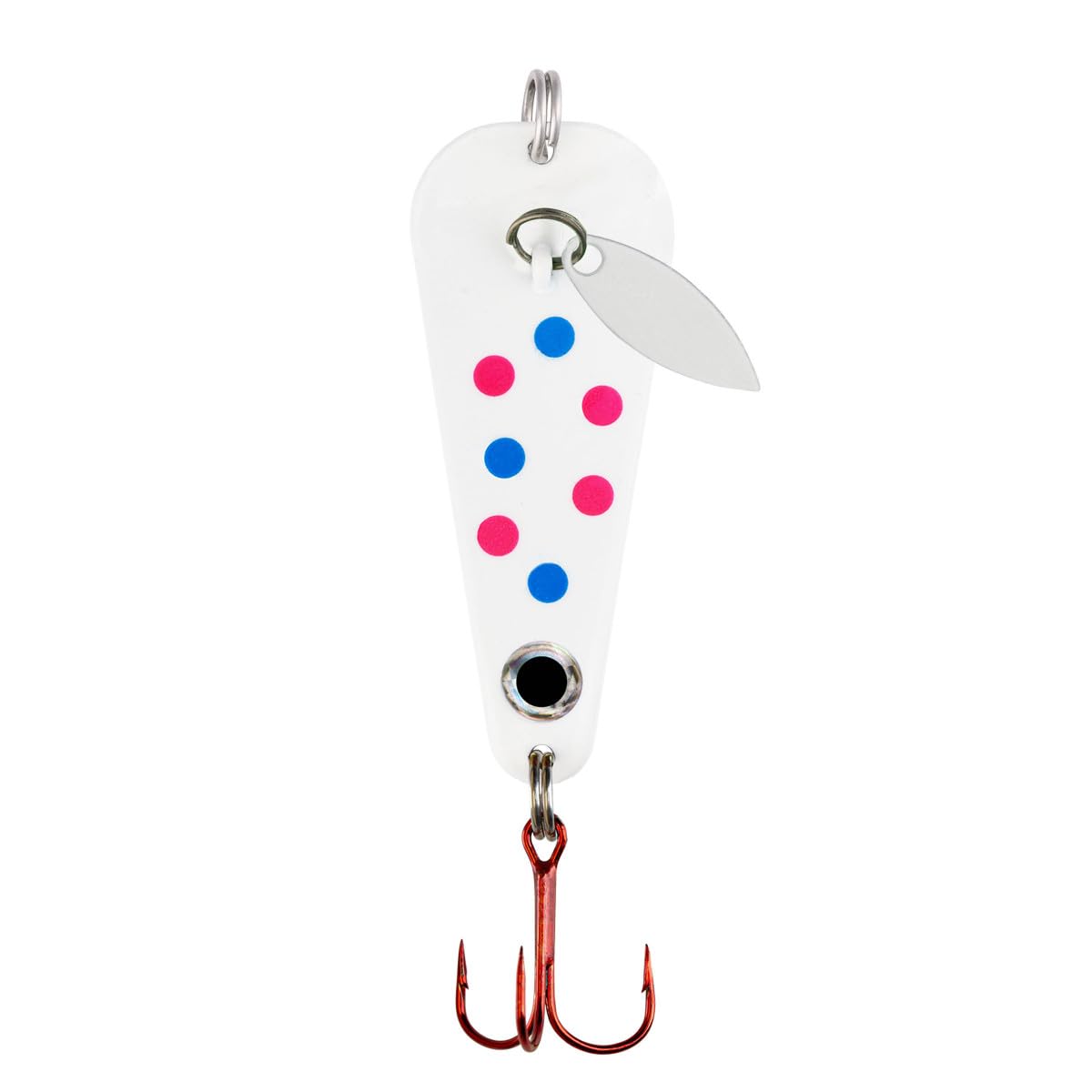
Where the Buck-Shot shouts, the Thumper whispers, and that difference is the whole reason it made the list: this is the finesse side of our spoon box. The body is thin stamped brass, bent on purpose, with a small flicker blade trailing off the back. A modest lift sends it fluttering and flashing sideways instead of thumping straight down.

That flutter is what we reach for when a flasher shows fish that rise, look, and turn away. The spoon slides and rocks on the fall like a baitfish that has lost its balance, and the blade adds a flicker of light at the tail that a plain spoon can't manage. At 1.375 inches and 1/8 ounce it's small enough for perch, crappie, and bluegill but still heavy enough to get down at a sensible rate in the 10-to-20-foot range where most panfish sit.

The color program is the other argument for it. Ten options, including Super-Glo finishes that keep glowing after the lure leaves your headlamp, cover clear water, stained water, and the last half hour of light. We like carrying two or three — a natural baitfish pattern and a glow — and it helps that this is the least expensive spoon in the group, so a small spread doesn't sting.

Pros

  • Thin bent brass flutters wide on the fall
  • Flicker blade adds tail flash and vibration
  • Ten finishes including Super-Glo glow
  • Least expensive spoon in this group

Cons

  • Tops out at 1/4 oz, so deep water needs another spoon
Our verdict

The quiet half of a two-spoon plan: thin brass, a flicker blade, and a fall that looks like a wounded minnow — our pick for clear water and educated fish.

Check Latest Price
3

Best for Deep Water

Reaction Tackle Tungsten Spoon

85 /100
Angler Score Excellent

Key details

Pack
2 spoons
Sizes
1/2 to 2 oz
Weight
1/2 oz
Material
Tungsten
Check Details on Amazon

Thirty feet of water under the ice is a different problem from eight. A light spoon takes its time getting down and swings away from the hole on the way, and the fish you marked drift out of the cone before the lure arrives. A dense body drops fast and keeps your line closer to vertical, which is the whole case for tungsten.

Reaction Tackle's spoons are pure tungsten, and the density is the point: a compact body that sinks quickly, lets you feel the bottom, and telegraphs a fish taking on the drop. Of the deep-water options here, this is the one we want on the rod.

The action is whatever you make of it. A lift gets a wobble; a pause turns that into a flutter, a dart, or a long glide. Short lifts with long pauses suit it, since the spoon does most of its work falling. Weights run from 1/2 ounce to 2 ounces in gold or silver, so the same shape covers perch in 20 feet and lake trout over a deep hump.

The catch is packaging. Each pack holds two spoons of the same weight and color, so you're buying a spare rather than a color assortment — if you want to find out whether gold beats silver on a given day, that's a second pack. For vertical jigging in deep water, the trade is worth it.

Pros

  • Tungsten density drops fast in deep water
  • Compact body holds a near-vertical line
  • Wobble, flutter, dart, or glide from one spoon
  • Weights run 1/2 oz to 2 oz

Cons

  • Two identical spoons per pack, no color mixing
Our verdict

Our deep-water choice: the tungsten body drops fast, stays vertical, and telegraphs bottom — buy a pack and accept the duplicate.

Check Latest Price
4

Best Small-Profile Kit

Iron Decoy Trout 3-Pack

83 /100
Angler Score Excellent

Key details

Hook
Eagle Claw J hooks
Pack
3 spoons
Length
2 inches
Weight
1/10 oz
Check Details on Amazon

Two inches and a tenth of an ounce is not much metal, and that's the honest boundary of this kit: it's built for shallow water and small mouths. Over 8 feet of weedy flat, with trout or perch cruising through, it's exactly the right size. Over walleye sitting in 25 feet, it isn't. If your season is mostly panfish and stocked trout, keep reading.

The spoons are solid brass with a bright plated finish that resists tarnishing, and each one carries a ball-chain trailer at the tail. That chain is not decoration — it adds a wobble and a light knock of its own on the fall, and it keeps the spoon moving at the slow speeds cold water demands. The Eagle Claw hooks and split rings come ready to fish, which saves you a swap before your first drop.

Three color patterns — gold and chartreuse, silver with blue and pink, and a copper pattern — is a smart way to start a trout box: a bright, a natural, and a wildcard, without committing to a dozen spoons you'll never tie on. At 2 inches the profile sits right where stocked rainbows and perch are looking, and the plating holds up better than the price point suggests.

Pros

  • Three color patterns in one purchase
  • Solid brass with a tarnish-resistant finish
  • Ball-chain trailer adds action and sound
  • Eagle Claw hooks ready out of the pack

Cons

  • 1/10 oz is a shallow-water weight
Our verdict

A smart first trout and panfish kit — three colors, real brass, and a chain trailer — as long as the water you fish is shallow.

Check Latest Price
5

Shallow Panfish Bite

Lindy Rattl'N Flyer Spoon

86 /100
Angler Score Excellent

Key details

Hook
J hook
Action
Rattle and glide
Weight
1/16 oz
Material
Non-lead alloy
Check Details on Amazon

The detail that sold us on the Rattl'N Flyer is one you won't see in a product photo: it doesn't spin on the drop. Tie it straight to your line — no swivel, no leader — and it falls without twisting, which is one less knot to manage with cold, wet hands.

The rest is a hybrid, and it fishes like one. The non-lead alloy body is light enough to dance on a short lift and heavy enough that you can still feel it, and the brass rattle and scale-pattern finish give fish something to look at and something to hear. It also darts and flies wide of the hole rather than dropping plumb. That's not a fault; it's how it covers water off to the side of your cone.

At 1/16 ounce this is a panfish and early-ice spoon, and it's for exactly that: perch and crappie under new ice, where a heavy spoon is overkill and a plain jig won't glide. A spoon that both rattles and glides is unusual — most give you one or the other.

Pros

  • Falls without spinning, so no swivel needed
  • Glides and darts wide to cover water
  • Brass rattle plus baitfish scale pattern
  • Non-lead alloy body

Cons

No notable drawbacks to flag.

Our verdict

For early ice and shallow panfish, the Flyer glides and rattles without twisting your line — the easiest spoon here to fish on light tackle.

Check Latest Price
6

Big-Profile Fishing

Iron Decoy Steely Spoon

86 /100
Angler Score Excellent

Key details

Hook
Treble
Length
3.5 inches
Weight
1/4 oz
Trailer
Ball chain
Check Details on Amazon

At 3.5 inches and a quarter ounce, the Steely is the biggest single spoon here, and it's the priciest single as well — so the question is whether the extra metal and the hardware under it earn the difference. For walleye, pike, and lake trout, we think they mostly do.

A spoon this size gives a big fish leverage, and the parts are where that leverage lands: Eagle Claw hooks and Rosco split rings rather than no-name hardware, plus a ball-chain trailer at the tail that adds vibration and a knock to the action. The prism finish throws a wide, bright flash on the lift, the kind you want with a big profile in off-color water.

Two things to keep in mind. The prism finish is tape rather than plating, so check the edges after a few trips and keep hook points away from it — a lifted corner is how a taped spoon starts looking tired. And the size is the point: this is not the spoon for a light panfish bite, it's the one you tie on when you're hunting a fish that eats something three inches long.

Pros

  • 3.5-inch profile for bigger fish
  • Eagle Claw hooks and Rosco split rings
  • Ball-chain trailer adds vibration and sound

Cons

  • Priciest single spoon in this group
Our verdict

The premium single in this group: a big prism body, brand-name hooks and rings, and a chain trailer — worth it for fish with shoulders.

Check Latest Price

How We Tested Ice Fishing Spoons

We started with a long list of everything we could find in the sizes people actually fish for perch, crappie, and walleye — roughly 1/16 to 1/2 ounce — then cut it down by hardware: hooks worth trusting out of the package, split rings a fingernail could get under, and enough of a size and color run to fish both clear and stained water. That left 18 spoons, and they went with us for five months, from first ice through late ice.

The fall is where a spoon earns its keep, so before anything touched a lake we filled a five-gallon bucket in the garage, dropped each spoon beside a tape measure, and filmed it with a phone. Played back slowly, that told us which ones fluttered wide and hung, which spiraled, and which dropped nose-down like a rock — plus how far each kicked out from the line.

On the ice, every spoon got fished on a jigging rod in a flip-over, both hole-hopping and sitting over a pod the flasher wouldn't leave, and most got a second rod as a deadstick. We counted marks that turned into commits and commits that turned into fish on the ice, and noted which spoons pulled fish in from a distance versus only catching the ones already under the hole. Snap-and-pause, slow lift, and dead-sticking were all in the rotation.

Functionality in the cold got its own check: tying one on with gloves at dawn, swapping a split ring with numb fingers, and whether the eye took 4-pound line cleanly. Back home we looked at the paint after a season rattling around a tray, whether the rattles still rattled after a freeze, and whether a hook bent out on a good fish. Value came down to fish per spoon, not dollars per spoon.

How to Choose an Ice Fishing Spoon

Pick the Weight for the Water You Fish

A spoon has to reach the strike zone and stay under your hole, and that's a weight question before it's anything else. In shallow early-ice water, roughly 6 to 12 feet, a 1/16-ounce spoon is plenty and gives you a slow, fluttering fall. Around 15 to 25 feet, 1/8 to 1/4 ounce keeps the line closer to vertical and gets you back down after every hookset. Deep, suspended fish call for tungsten in the 1/2-ounce-and-up range.

The trap is buying for the species instead of the spot. Walleye are big fish, but a one-ounce spoon in 8 feet of water is a lump of metal that kills the action you came for. Buy the weight for the depth you fish most, then add one step heavier for wind or current.

Choose an Action: Rattle, Flutter, or Glide

Three families do most of the work. Rattle spoons like the Buck-Shot carry a brass chamber that knocks on every lift — the right call in stained water, under heavy snow, or on first-ice fish that haven't seen a lure in months. Flutter spoons like the Thumper are thin, bent brass with no rattle: they slide and rock on the fall like a dying baitfish, and they're what we tie on when a flasher shows fish that follow and turn away. Hybrids such as the Lindy Flyer glide and dart wide of the hole, covering water off to the side.

Carry one of each in the sizes you actually use rather than five of one family. The decision on the ice is usually about noise: loud first, quiet once the fish get educated.

Match the Profile, Then Check the Hardware

Length and weight together decide what a spoon imitates. A 2-inch, 1/10-ounce body is trout and panfish size; a 3.5-inch, 1/4-ounce profile is walleye and pike size. If you're unsure, match the length of the baitfish you see on your electronics.

Then look at the metal at the end. Trebles hold a tipped minnow head and hook fish that swipe at the tail; single J hooks come out of a fish faster and snag less in a shanty. Check that the hook hangs from a split ring you can open — carry split-ring pliers and you can swap hardware in a minute. A spoon that doesn't spin on the drop, like the Flyer, saves you a swivel and a foot of knotted line.

Finishes, Glow, and What You're Paying For

Finish does real work under ice, where light is scarce. Holographic and plated bodies throw flash; glow finishes keep emitting after your headlamp charges them, which is worth having for the last hour of the day and for heavily stained water. Plated and taped finishes are not the same thing — tape is lighter and cheaper but can lift at the edges, so check a taped spoon now and then.

You don't need twenty colors. A natural baitfish pattern, a bright chartreuse or orange, and one glow cover most days. Compare price per spoon as well: a three-pack of small trout spoons can cost less per lure than a single premium walleye spoon, but only if the size and weight suit the water you fish.

Frequently Asked Questions

Final Verdict

If you're building a spoon box from scratch, start with the Northland Buck-Shot Rattle Spoon. It has the loudest rattle and the brightest flash of anything we handled here, it comes in a weight that covers most walleye and perch water, and it tells you quickly whether fish want noise.

Add the Thumper for clear shallows and pressured fish, and step up to the Reaction Tackle tungsten spoons when the fish are suspended deep. Those three cover almost any hole you'll drill this winter; everything else on this list is a refinement of one of them.