Best Kayak Anchors of 2026

There's a specific kind of frustration in paddling half an hour to a good fishing spot, dropping a line, and then feeling the wind drag you off it inch by inch. A kayak anchor is the fix: a compact weight and a length of line that pins you over structure so you can fish it properly, eat lunch without spinning in circles, or rest in a chop without white-knuckling the paddle. The trouble is that kayaks have almost no deck space and no patience for a sloppy setup, so the right anchor isn't just the one that holds — it's the one that stows, sets, and comes back up without soaking your lap.

Over the past four months, my team and I have paddled with 14 anchors — folding grapnels, mud sticks, clamp-style grips — on lakes, tidal creeks, and one gusty reservoir. The ones worth recommending held on the first set, came up clean, and didn't bleed rust onto the deck. Here's what nobody tells a first-time buyer: weight matters less than scope. Pay out at least three times the water depth in line and even a 3.5-pounder will bite, where a heavier anchor on a short leash just skips along the bottom. The picks below are sorted by how and where you paddle.

1

Best Overall

Best Marine 3.5 lb Anchor Kit

92 /100
Angler Score Outstanding

Key details

Rigging
Shackle at either end
Material
Carbon steel
Rope Length
40 ft marine-grade
Anchor Weight
3.5 lb
Check Details on Amazon

Forty feet of line is the first thing we look at, and it is why this kit sits at the top. Most kayak anchor kits here carry 20 or 25 feet, which runs out at roughly seven or eight feet of water once you let out the three-to-one scope an anchor needs; this one keeps working in 12 or 15 feet with slack left over when the breeze gets up. The anchor is a 3.5-pound four-fluke grapnel in carbon steel, and the rope, buoy, and storage bag arrive with it.

That extra length is what moved it ahead of the other kits for us. Holding is only half of anchoring; the other half is having enough line out that the pull stays shallow, and a longer rope is the upgrade people end up buying for a cheaper kit anyway. We also rate the shackle at either end: rig from the crown when you want the flukes to trip, or from the eye for a straight pull, and either way it clips to a trolley without extra fittings. Over sand, gravel, and rock the flukes set with a short tug and stay set.

Two practical notes. The buoy marks the spot if you have to leave the anchor and come back, and the bag swallows the whole wet assembly so the inside of a hatch does not turn into a rope pile. Coil the line loose rather than tight when it goes away, since a rope that dries in open loops runs out clean the next time you need it in a hurry.

Pros

  • 40 ft line gives real scope in 12 ft of water
  • Shackle at either end for flexible rigging
  • Buoy and storage bag included
  • Sets and holds over sand, gravel, and rock

Cons

  • 3.5 lb holds a kayak, not a jet ski or boat
  • 40 ft of line takes longer to coil and stow
Our verdict

We recommend it first because 40 feet of line lets the flukes work in the depths most kayak anglers fish, and the anchor rigs from either end.

Check Latest Price
2

Best Travel Kit

Gradient Fitness Anchor Kit

94 /100
Angler Score Outstanding

Key details

Included
Anchor, 25 ft rope, buoy, storage bag
Material
Galvanized steel
Rope Length
25 ft braided polyethylene
Anchor Weight
3.5 lb
Check Details on Amazon

The padded bag is the detail that makes this kit feel finished. It is wide enough to take the folded anchor and the rope without a fight, and it will not scuff a paddleboard deck the way a bare grapnel does. Add the stainless carabiner on the line and the floating buoy, and you have a kit you can clip on, drop, and recover without untying anything.

The anchor is the familiar four-fluke folding pattern in galvanized steel, locking open with a twist of the collar and folding to roughly eight by eight by twelve inches. It holds in rock, sand, and mud, the three bottoms most kayak anglers meet, and the folding action means it drops into the bag instead of snagging on everything in the crate on the way past.

What we watch on a kit like this is the line and the fittings, not the anchor. The braided polyethylene is the first thing to age: a fuzzy patch near the carabiner or a stiff, kinked section is the warning, and cutting back a foot and re-tying costs nothing next to losing the whole rig. Rinse the carabiner and dry the rope before it goes back in the bag.

Pros

  • Padded bag protects a board and contains wet line
  • Stainless carabiner makes clipping on quick
  • Floating buoy marks the anchor
  • Sets well in rock, sand, and mud

Cons

  • 25 ft rope is short for deeper water
Our verdict

Buy this one if you want a complete kit that packs into a padded bag and clips on in seconds, and you fish water under about eight feet.

Check Latest Price
3

Best Budget Kit

AIRHEAD Grapnel Anchor System

90 /100
Angler Score Outstanding

Key details

Included
Anchor, 25 ft rope, padded nylon case
Material
Stainless steel
Rope Length
25 ft marine-grade
Anchor Weight
3 1/3 lb
Check Details on Amazon

Some kits here are trying to be a system. This one is an anchor, a line, and a case: a 3 1/3-pound four-fluke grapnel with 25 feet of marine rope and a padded nylon case narrow enough to slide under most boat seats. That is exactly the sort of kit that ends up living in the hull all season rather than being packed deliberately for a trip.

The flukes are shaped for mud, sand, gravel, and rock, and the finish holds up in gravel and silt without the flaking we expect from thinly coated anchors. It is rated for kayaks, canoes, personal watercraft, and float tubes, which covers the small-craft range without pretending to be a boat anchor.

As a value pick it is easy to defend. The anchor sets, the 25-foot line covers the water most kayak anglers fish, and the case keeps wet rope off everything else in the hatch. We treat it as the anchor that lives in the boat rather than the one we pack carefully, and at this price that is a reasonable way to own two.

Pros

  • Complete kit at the low end of the price range
  • Case slides under most boat seats
  • Works across kayaks, canoes, PWCs, and float tubes

Cons

  • Drags in strong wind over soft bottom
  • 3.3 lb is light for a loaded tandem
Our verdict

Our pick when the budget is tight: it sets and holds in light wind, comes with its own case, and asks nothing of you.

Check Latest Price
4

Best for Mud and Weeds

Attwood Mushroom Anchor 8 lb

0 /100
Angler Score Fair

Key details

Material
PVC-coated cast iron
Dimensions
8.66 x 7.68 x 7.6 inches
Bottom Type
Mud, silt, weeds
Anchor Weight
8 lb
Check Details on Amazon

Eight pounds of cast iron in a shape with nothing to set is what silt, muck, and weed call for. The mushroom's wide dome pushes down into soft ground and the weight does the rest, so there is no collar to twist, no fluke to jam, and no tug needed to make it bite. On a mud-bottom lake or a tidal flat we rate it above every folding anchor in this group.

The eye is large enough to take a decent line or a chain leader, and the PVC coating blunts the edges that would otherwise mark a hull or a deck. It is also the heaviest thing here by a wide margin at 8.1 pounds and roughly nine inches across, so carrying it is a decision rather than an afterthought, especially if you portage.

Where the coating chips, bare cast iron goes orange quickly, and salt water will find every nick. A rinse, a dry, and a smear of grease or a dab of paint on the chips keeps it serviceable for years of mud.

Pros

  • Wide dome bites in mud, silt, and weed
  • No moving parts to jam or set
  • PVC coating protects hull and deck

Cons

  • Slides on rock and gravel
  • No line, buoy, or bag included
Our verdict

For silt, muck, and weed, we take eight pounds of mushroom over any folding anchor here: no moving parts, no fuss, no dragging.

Check Latest Price
5

Best for Shallow Flats

YakGear YakStick Mud Anchor

92 /100
Angler Score Outstanding

Key details

Length
6 ft
Weight
22 oz
Material
Fiberglass with foam grip
Check Details on Amazon

In three feet of water over a soft flat, a stake beats an anchor. You push the YakStick into the bottom and the boat is pinned: no rope to run out, no flukes to drag, no splash. For the kind of fishing where you want to stop now and stop quietly, that immediacy is the entire argument.

The pole is hollow fiberglass with an oversized foam grip and a molded attachment point in the handle, and it weighs 22 ounces, so it rides on deck without you noticing. Six feet is long enough to reach through a chop into the mud below and short enough to work from a seated position.

Side load is what breaks a fiberglass stake. Jammed into the bottom and shoved sideways by a hull moving fast, the shaft can split. Plant it straight down, tie off with a little slack, and let the boat swing on the line instead of levering against the pole.

It is a single-purpose tool at the top of the price range in this group, and it earns that in shallow water specifically: the boat stops dead, quietly, and stays put while you work a bank. Once the depth goes past a few feet, the advantage disappears and a folding anchor takes over.

Pros

  • Stops the boat instantly and quietly
  • 22 oz fiberglass shaft rides easily on deck
  • Doubles as a push pole

Cons

  • Only bites in soft bottom, nothing to grab on rock
Our verdict

If your fishing happens in two to four feet of soft bottom, this stake pins the boat faster and quieter than any anchor on this list.

Check Latest Price
6

Anchor-Only Setups

Seachoice Folding Grapnel

88 /100
Angler Score Excellent

Key details

Included
Anchor only
Material
Galvanized malleable iron
Folded Size
2.87 x 2.87 x 12 inches
Anchor Weight
3.5 lb
Check Details on Amazon

This is the anchor and nothing else: 3.5 pounds of galvanized malleable iron, with no rope, no bag, and no buoy in the box. If you already run a trolley and a line you trust, that is not a shortcoming. It is the point.

The grapnel locks open for use and closed for storage, and the galvanizing is heavy enough to survive salt water with a rinse at the end of the day. Folded, it is a foot-long bundle about three inches across, which is why it ends up as the spare in the hull rather than the anchor you plan a trip around.

We keep it on the list as the spare-anchor buy: the least expensive way into a 3.5-pound grapnel, and a sensible one once the line and trolley are sorted. Check that the shackle pin is seated and snug before it goes over the side, because that pin is the only thing between you and a lost anchor.

Pros

  • Least expensive way into a 3.5 lb grapnel
  • Locks open or closed and folds flat
  • Heavily galvanized malleable iron

Cons

  • No line, bag, or buoy included
  • Rough casting edges can catch the lock collar
Our verdict

A sound, cheap anchor for someone who already owns a line and a trolley and wants a spare that stows in a hatch.

Check Latest Price
7

SUPs and Float Tubes

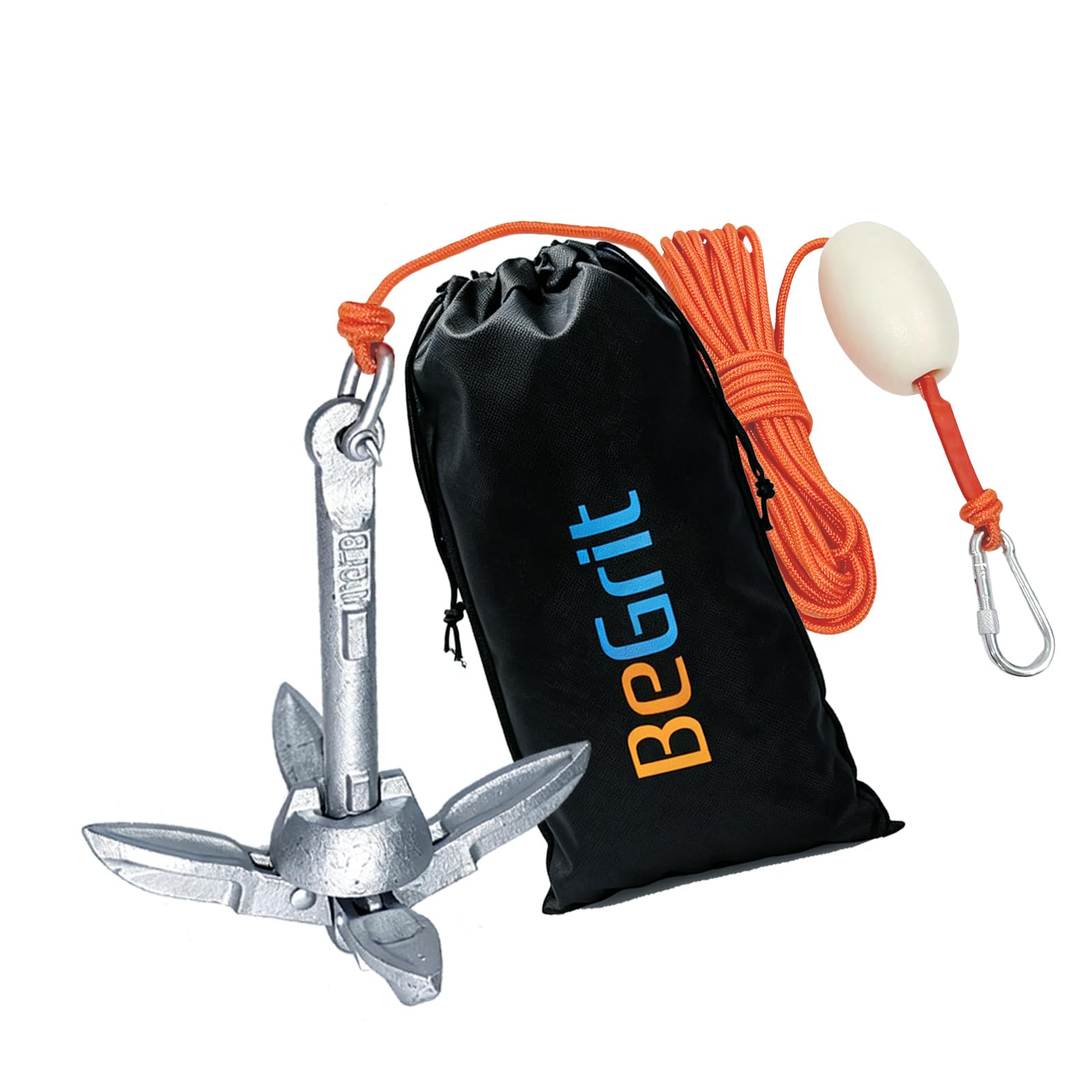
BeGrit Small Kayak Anchor

89 /100
Angler Score Excellent

Key details

Material
Galvanized carbon steel
Folded Size
1.77 x 1.77 x 7.09 inches
Rope Length
10 m with hook
Anchor Weight
1.5 lb
Check Details on Amazon

Folded, the BeGrit is seven inches long and under two inches across, which is small enough to live in a crate or a dry bag and light enough at 1.5 pounds that you stop counting it as gear. The kit adds a 10-meter line with a hook, a small buoy, and a bag.

That is the whole case for it, and a good one when your craft is a paddleboard, a float tube, or a small sit-on-top and your anchoring is a lunch stop in light air. Clip the bag to the deck, drop the anchor, and you stop drifting down the lake. It is a fair-weather tool, and at this weight it is honest about that.

Retrieval takes a little thought. If a fluke wedges under a rock or into a stump, take the strain off, paddle around to the other side, and pull the anchor backward out of the snag rather than hauling straight up. The buoy helps you find the spot again if you have to leave it and come back.

Pros

  • Folds to 7 in and weighs 1.5 lb
  • Comes with rope, hook, buoy, and bag
  • Holds a board or small kayak in light wind

Cons

  • Too light for a loaded kayak in a breeze
  • Rope is the first part to fail
Our verdict

The anchor we keep for paddleboards and float tubes: small enough to forget and quick to set for a lunch stop.

Check Latest Price
8

Timber and Grass

Farwater Canoe Anchor Grip

91 /100
Angler Score Outstanding

Key details

Weight
8 oz
Material
Coated steel
Cord Length
15 ft paracord
Check Details on Amazon

This is not an anchor for open water, and it does not pretend to be. The Farwater grip is a spring clamp with teeth that bites a branch, a root, or a clump of marsh grass and hangs on, which is exactly what a river or backwater kayak angler needs when the current is doing the work and the cover is within reach.

Eight ounces of coated steel and 15 feet of paracord, clipped to a deck line: that is the whole rig. The jaws are shaped so the harder the load pulls away, the tighter they close, which means a modest clamp can hold a drifting kayak in a way a hook or a loop of rope will not.

The coating is where it loses ground. Chips along the jaw edges are the first place rust shows, and a rinse and dry after every trip is not optional if you paddle salt or brackish water.

As a fishing tool for timber and grass it is genuinely clever, and at 8 ounces the lightest way here to stop a kayak in current. Where a folding anchor costs you a minute of rope work every time you move, this costs you a squeeze and a tug, which is why it stays clipped to the deck on a river boat.

Pros

  • Bites onto branches, roots, and grass
  • Jaws grip tighter as the load increases
  • 8 oz with 15 ft of paracord stows anywhere

Cons

  • Short 15 ft cord limits reach to nearby cover
Our verdict

For river and backwater fishing where there is brush to grab, this clamp holds harder the harder the current pulls.

Check Latest Price

How We Tested Kayak Anchors

We started by gathering every anchor a paddler could realistically stow on a kayak deck — folding grapnels in the 3- to 5-pound range, mud sticks, and clamp-style grips — then narrowed the field by packed weight, the length of rope included, and whether the kit arrived complete. Anything that shipped without a carabiner, shackle, or enough line to be useful in 10 feet of water didn't make the cut. That left 14 anchors, which we paddled with for four months.

Testing happened where anchors actually get used: shallow grass flats, a deep rocky reservoir, and a muddy tidal creek. At each spot we dropped the anchor, paid out roughly three times the water depth in line, and marked our position with a buoy, then sat for five minutes in whatever wind and current we had and noted how far we drifted. We also set and retrieved every one from the cockpit without standing up, timing each drop and pull to see how much of it could be done one-handed.

Back on shore, we checked the rope for kinks, abrasion, and stiffness once it dried, and inspected flukes, shackles, and swivels for rust after every trip. We counted hardware against the box contents on day one and again in month three, and weighed what came in the kit against what it cost — an anchor plus a separately bought rope and shackle usually runs more and takes longer to sort out than a complete system that sets right out of the bag.

How to Choose a Kayak Anchor

Match the shape to the bottom

The bottom under you decides more than the weight on the label. A four-fluke grapnel is the generalist: the points catch on rock, gravel, and the edges of weed beds, and it folds flat when you slide the collar up. In deep silt there is nothing for a fluke to catch, which is where a wide mushroom like the Attwood 8-pounder earns its keep, since the dome pushes down and the weight holds. For shallow flats and river edges, a stake-out pole beats both for speed.

Think about the two or three places you actually fish before you compare anchors. A kit that is superb on gravel is mediocre over muck, and no anchor is good on every bottom.

Buy line for the depth, not for the box

Anchor line works at an angle, so you need several feet of rope for every foot of depth. Three to one is the minimum in calm water, and five to one or more when wind and chop push the boat around. A 20- or 25-foot kit line is used up by about seven or eight feet of water; 40 feet, like the Best Marine kit, gets you past 12 with slack in hand.

Measure the deepest water you plan to anchor in against the line supplied, and add a length of your own if the answer is close. The kits here with the shortest lines are the ones that limit where you can fish, not how hard the anchor bites.

Weigh holding power against what you carry

Three to three and a half pounds is the working size for a kayak, canoe, or paddleboard, and it sets and holds in the bottoms most people fish. A pound and a half belongs on a board or a float tube in light air, and eight pounds is a mushroom for soft ground. Weight holds an anchor once it has bitten; it does not make a fluke bite, so buy the shape that suits your bottom rather than the heaviest thing you can lift.

Plan how it comes back up

Sooner or later a fluke wedges under a rock or into a stump, and an anchor that will not release costs you the whole rig. Folding grapnels come free when you take the strain off, paddle past the anchor, and pull from the opposite direction; a buoy helps by letting you unclip, mark the spot, and return for it.

Before that happens, practice releasing the line from the seat. A jammed anchor should never be a reason to lean out over the gunwale.

Kit or anchor alone

A kit saves you guesswork: line, buoy, bag, and fittings matched to the anchor. Look at what the hardware is made of, since stainless and galvanized fittings outlast painted spring hooks, and check the line's length and how it attaches at the anchor end. If you already run a trolley with a line you trust, an anchor on its own, like the Seachoice, is the cheaper way in and gives you a spare that stows in a hatch.

Frequently Asked Questions

Final Verdict

The Best Marine kit is the one we point most kayak anglers to. Forty feet of line gives the anchor room to work in the depths people actually fish, and the shackle at either end lets you rig it to a trolley or a quick release without buying extra hardware.

If your home water is silt and weed, the Attwood mushroom holds where flukes cannot. If you want a complete kit that stays in the hull all season for as little as possible, the AIRHEAD is the one to grab.