Best Shallow Water Anchors of 2026

You've found the flat, cut the engine, and the boat is sitting exactly where you want it. Then you look up from tying on a lure and you've drifted forty yards down the bank. Shallow water anchoring is a fussy problem dressed up as a simple one — sand shifts to shell to soup-thick mud in a single boat length, and whatever held at the last spot goes slack at this one. What you actually need is something that sets fast, stays put through a tide swing or a passing wake, and doesn't become dead weight in the rod locker.

I've now spent seven months with 12 shallow water anchors — sand spikes, mud sticks, fluke anchors, and powered poles — and the good ones share a handful of traits. Here's what nobody tells a first-time buyer: holding power in sand comes from surface area, but holding power in mud comes from a slow, angled pull, so the model that's perfect on a firm sandbar is often the one that drags on a soft flat. Weight matters too, just not the way you'd expect — a slightly heavier anchor you can set one-handed beats a featherweight one you have to fight. The picks below cover both bottoms, plus the boats and budgets in between.

1

Best Overall

Superstick 7' Anchor Pin

91 /100
Angler Score Outstanding

Key details

Length
7 feet
Weight
2.2 lb
Tip Material
Stainless steel
Shaft Diameter
5/8 inch
Check Details on Amazon

Stainless steel is the detail that sold us on this one. The Superstick is a 7-foot fiberglass pin with a stainless spike tip, and that tip is the part that takes the abuse when you are probing a sand flat or a muddy creek edge. At 2.2 pounds it is light enough to carry all day, but the 5/8-inch shaft still feels like a tool rather than a toy. For a simple stake-out anchor, this is the best combination of length and wear resistance in this set.

The 7-foot length is the reason it earns the top spot. It gives you more margin to reach a firm layer in shallow water than a short beach spike, and it works as a simple push pole when you need to move a kayak or skiff a few feet. The storage clips and cinching lanyard are small additions, but they give the pin a secure place when it is not in the water.

We like the oversized foam grip because wet hands and cold mornings make a skinny shaft harder to hold than it looks. The one-piece build is also one less thing to fail. For soft sand and mud, it is the simplest tool here.

Pros

  • Stainless tip resists wear on sand
  • 7-foot length reaches deeper flats
  • Light 2.2-pound pole carries easily
  • Storage clips and lanyard keep it secure

Cons

  • Sinks quickly if dropped without a leash
  • Needs sand or mud; rock defeats the tip
Our verdict

For anglers who want one simple, long stake for soft-bottom flats, the Superstick is our top pick; just leash it, because it sinks.
Check Latest Price
2

Best for Kayaks and Paddleboards

YakGear YakStick 6.5'

92 /100
Angler Score Outstanding

Key details

Length
6.5 feet
Weight
22 oz
Buoyancy
Floating
Material
Fiberglass
Check Details on Amazon

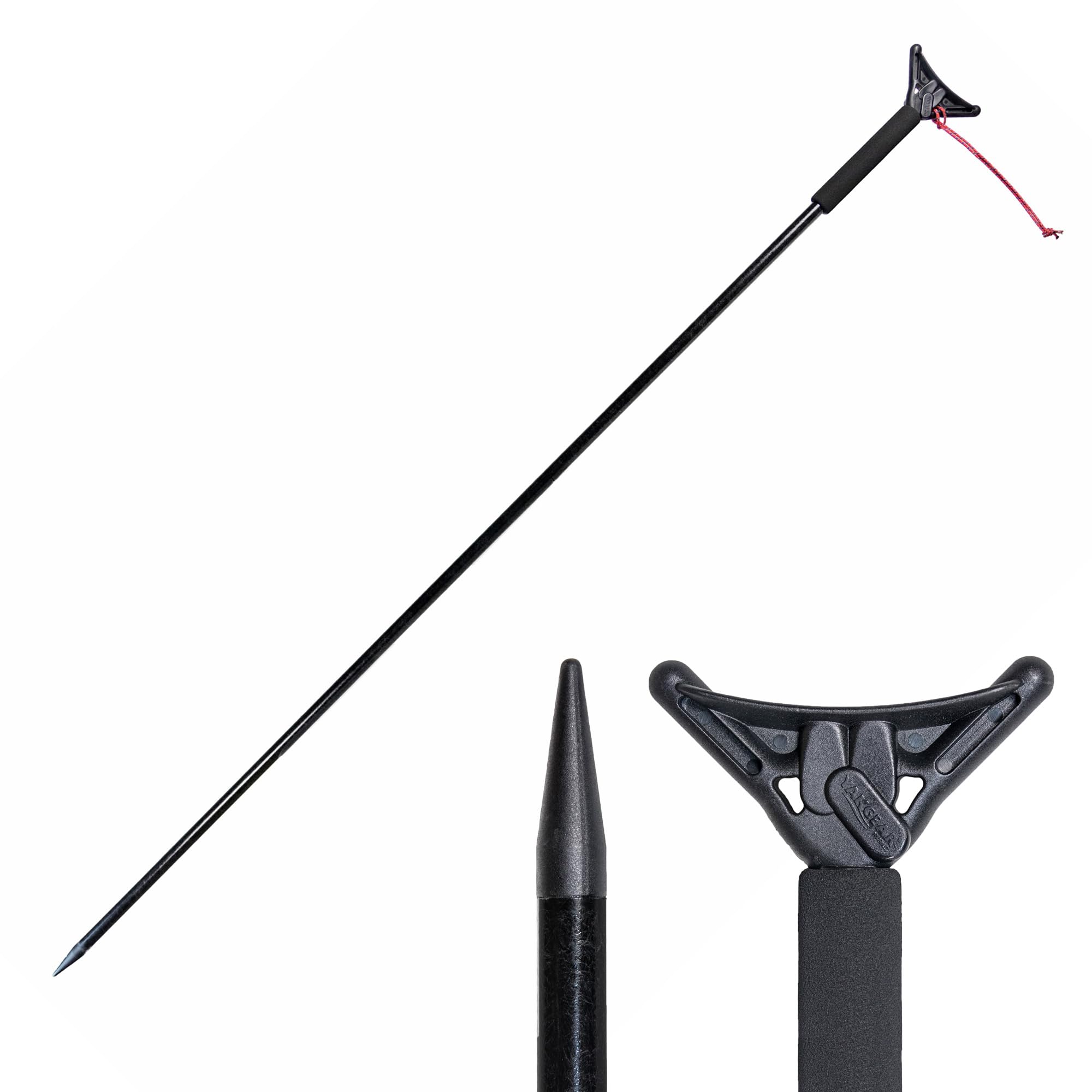
On a kayak or paddleboard, the anchor you want is often the one you can drop in a hurry and find again. The YakStick is a 6.5-foot floating stake with a molded rope attachment in the handle and an oversized foam grip. That combination is why it earns a place for paddlers: you can set it in a scupper or beside the hull, tie off, and keep your hands free.

We like the 22-ounce weight and the floating design. A 6.5-foot pole is easy to manage from a seated position, and if it goes overboard it stays on the surface. The foam grip gives you something substantial to push against. For shallow flats, sandbars, and quiet river eddies, it is a more natural fit than a metal anchor. That is the role we keep it for: a light, floating tie-off for a paddler who is already managing a paddle, a rod, and a dry bag.

The molded rope attachment is more useful than a clip you have to thread one-handed. We also appreciate the 3-year warranty, which is longer than most of the stakes here. For a paddler who wants a simple stake and not a project, that is a sensible package.

Pros

  • Floats if it goes overboard
  • 22-ounce pole is easy to manage seated
  • Molded rope attachment and foam grip
  • 3-year warranty backs the pole

Cons

  • 6.5-foot length limits deeper flats
  • Hollow fiberglass can crack under side load
Our verdict

For kayak and paddleboard anglers who want a light, floating stake they can set in a hurry, this is the YakStick we reach for.

Check Latest Price
3

Best Screw-In Anchor for Boats

SandShark SuperSport 3.0

89 /100
Angler Score Excellent

Key details

Length
29 to 48 inches
Weight
5 lb
Material
Aluminum and nylon
Boat Size
Up to 24 feet
Check Details on Amazon

The SuperSport is the pick for a boat or PWC that needs adjustable depth rather than a fixed stake. It telescopes from 29 to 48 inches, and the screw-style auger twists into sand instead of relying on a straight push. The screw creates mechanical hold by twisting into the sand, which is a different feel from driving a pole straight down. At 5 pounds it is still a one-person deploy, and the padded case makes it easy to stow.

We like the range. A 48-inch anchor covers more water than a short beach spike, while collapsing to 29 inches keeps it out of the way. The aluminum and nylon construction is aimed at saltwater and freshwater, and the ergonomic handle gives you leverage when you are twisting it down. We also like that the case is padded, because an auger tip that has been in the sand is not something you want loose in a hatch.

The joint is the part to watch. Sand in the telescoping section can make it bind, and the anchor does not like being forced once grit gets in. Rinse and dry it before storage. That maintenance step is the price of the adjustable length, and it is a fair one if you anchor in sand often. For sandbars, beach stops, and shallow water with a soft bottom, it is a useful step up from a simple spike.

Pros

  • Telescopes from 29 to 48 inches
  • Screw auger bites into sand
  • 5-pound package deploys solo
  • Padded case protects the auger

Cons

  • Not for rock or hard-packed ground
  • Handle and components show mixed long-term durability
Our verdict

For boat and PWC owners who want a screw-in anchor with adjustable depth, this is the SuperSport we recommend first.

Check Latest Price
4

Best Budget PWC Sand Anchor

Airhead PWC Sand Anchor

90 /100
Angler Score Outstanding

Key details

Buoy
Included
Capacity
35 lb
Dimensions
8.5 x 6 x 4 inches
Line Length
6 feet
Check Details on Amazon

A sandbag is not a glamorous anchor, but it is a smart one for a jet ski. The Airhead is a tri-laminate bag that holds up to 35 pounds of sand or rocks, with a 6-foot braided line, a giant snap hook, and a buoy. The tri-laminate fabric is meant to stand up to rocks as well as sand, which is the difference between a beach anchor and a plastic grocery bag. The idea is simple: fill it on the beach, clip it to the ski, and keep the impeller off the sand.

We like how little space it takes when empty. It folds down for storage, and the buoy makes the line easy to find when you come back. The snap hook is big enough to handle with wet hands, which matters more than it sounds. For a PWC, that combination is a lot easier than hauling a metal anchor.

The bag is also easy to rinse and repack, and the 6-foot line is long enough for a beach tie-up without turning into a tangle. We keep it in the storage compartment for day trips. It is a beach-day tool, and that is the job it does best.

Pros

  • Holds up to 35 pounds of sand or rocks
  • Folds flat for storage
  • Buoy and snap hook simplify tie-up

Cons

  • Can drag in chop or wakes
  • Seams and closure are the long-term weak point
Our verdict

For a PWC owner who wants a packable beach anchor that folds flat, the Airhead is our calm-water choice.

Check Latest Price
5

Best Compact Beach Spike

WAVESRX 12" Beach Anchor

88 /100
Angler Score Excellent

Key details

Length
12 inches
Weight
9 oz
Material
Aluminum
Warranty
3 years
Check Details on Amazon

At 9 ounces, the WAVESRX is the anchor you can clip to a PWC and forget about until you need it. It is a 12-inch aluminum spike with a patented shape, and it is meant to be pushed into soft sand at the beach rather than driven into a hard flat. The rust-free finish is a real advantage around saltwater.

We like it for a jet ski that you want to keep just offshore. Push it into the sand at an angle, run the line low, and the ski stays off the beach without a heavy anchor in the storage compartment. It is also easy to pull out, which is not always true of a buried anchor. The small size means it disappears in a gear bag.

The 12-inch length is a deliberate choice: it is a beach spike, not a flats pole. That makes it easy to carry and easy to stow, and it keeps the weight off a small craft. For a PWC that needs to stay put for a few hours in soft sand, it is a neat piece of gear. We also like the three-year replacement warranty, because a small anchor that lives in a jet ski compartment is easy to lose or abuse.

Pros

  • Weighs less than 9 ounces
  • Aluminum construction resists rust
  • Easy to push in and pull out of soft sand

Cons

  • One anchor can let a PWC swing
Our verdict

For a PWC owner who wants an ultralight beach spike that stores almost anywhere, we rate the WAVESRX highly; use two in current.

Check Latest Price
6

Best Powered Shallow-Water Anchor

Power-Pole Sportsman II 8'

92 /100
Angler Score Outstanding

Key details

Finish
Powder-coated
Length
8 feet
Deployment
Down and away
Package Weight
40 lb
Check Details on Amazon

The Power-Pole Sportsman II is the one here that turns anchoring into a button press. It is an 8-foot powered shallow-water anchor with a quiet pump, a powder-coated finish, down-and-away deployment, and drive-off protection. For a boat, that is a different kind of convenience from a pole you push by hand.

The 8-foot length gives you more reach than the hand-held stakes, and the down-and-away motion keeps the pole out of the way when it is stowed. We like the drive-off protection for the simple reason that forgetting an anchor is an expensive mistake. The quiet pump is also a plus on a flat where sound carries.

The powder-coated finish is the kind of detail that matters in saltwater, and the system is built around repeated use rather than a weekend trip. We also appreciate that the control is simple: deploy, hold, retract. There is no rope to manage and no spike to wrestle back out of the mud.

If push-button anchoring is what you want, this is the system we point to. It is the most effortless way here to hold a boat in shallow water, and that is worth a lot on a hot day.

Pros

  • Push-button deployment with quiet pump
  • 8-foot reach for deeper shallow water
  • Drive-off protection guards against mistakes
  • Powder-coated finish suits marine use

Cons

  • Permanent mount limits it to one boat
  • 40-pound package is not portable
Our verdict

For a boat owner who wants push-button shallow-water anchoring and can commit to a mounted system, we point to the Sportsman II.

Check Latest Price
7

Best Two-Piece Travel Pole

EDSRDPLT 7.75' Anchor Pole

82 /100
Angler Score Excellent

Key details

Length
7.75 feet
Weight
3.75 lb
Diameter
1.22 inches
Tip Material
316 stainless steel
Check Details on Amazon

The EDSRDPLT pole is for the angler who has to carry everything to the water. It breaks into two pieces, measures 7.75 feet assembled, and floats, so it can live in a kayak or a small boat without taking over the deck. The floating design is a real advantage in a kayak: a dropped pole stays on the surface instead of going to the bottom. The T-handle doubles as a push pole, which is a useful second job for a long stick.

We like the 316 stainless tip and the grooved helix. The point is sharp enough to start in hard-packed sand or clay, and the groove gives it a little more bite as you twist. The EVA foam grip is comfortable when you are leaning on it. The two-piece design is also easier to stow than a one-piece 7-foot pole.

For travel and mixed push-pole duty, it earns its place. The packed length is the reason we take it on a kayak trip, and the floating shaft is the reason we do not worry about losing it. If you want one stick that packs down and can move a kayak off a bar, this is a clever choice.

Pros

  • Breaks into two pieces for travel
  • Floats if dropped
  • T-handle doubles as a push pole
  • 316 stainless tip and grooved helix

Cons

  • Two-piece joint can loosen with use
  • Less rigid than a one-piece pole
Our verdict

For kayak and skiff anglers who want one pole that packs down, floats, and doubles as a push pole, the EDSRDPLT earns our nod.

Check Latest Price
8

Larger Boats

SandShark Premium Fluke

85 /100
Angler Score Excellent

Key details

Shaft
Retractable
Weight
5 lb
Material
Aircraft-grade aluminum
Boat Size
16 to 30 feet
Check Details on Amazon

The Premium Fluke is not a stake-out pole, and that is the point. It is a retractable-shaft fluke anchor for boats from 16 to 30 feet, made from aircraft-grade aluminum and built to dig into sand or mud rather than stand straight up in it. If your shallow-water anchoring is really sandbar parking for a bigger boat, this is a different tool.

At 5 pounds, it is light enough to handle from the bow, and the retractable shaft lets it store in a smaller locker than a fixed fluke. The serrated edges are meant to bite once the anchor is set, and the aircraft-grade aluminum should hold up in salt or fresh water.

We like the locking pin and the way the fins lock for storage. It is a simple system: pull the pin, deploy, set the anchor, and retrieve. There is no twisting or pushing into the bottom, which is a nice change when the wind is pushing you toward the beach.

The fluke also has a smaller footprint in the locker than a traditional danforth-style anchor, and the retractable shaft makes it easier to carry from the truck to the boat. That matters if your sandbar stop is a short one and you do not want to wrestle a full-size anchor.

For a 20- to 30-foot boat that spends time on sandbars, the Premium Fluke is the pick when a pole is too small and a traditional anchor is too much trouble. For a kayak or PWC, a stake or screw anchor is simpler.

Pros

  • Retractable shaft stores compactly
  • Aircraft-grade aluminum keeps weight at 5 pounds
  • Serrated fluke edges bite into sand
  • Locking pin simplifies deployment

Cons

  • Needs a proper pull to set
  • Can struggle in very soft sand
Our verdict

For a 16- to 30-foot boat that needs a packable sandbar anchor, we recommend the Premium Fluke; it is not a kayak stake.

Check Latest Price
9

Paddleboards and Rafts

Phoncoo Sand Anchor Bag 2-Pack

83 /100
Angler Score Excellent

Key details

Capacity
20 liters
Material
500D PVC
Pack Count
2
Fill Capacity
50 lb
Check Details on Amazon

The Phoncoo kit is two 20-liter sand bags with floating ropes and clips, and it is the most flexible packable way here to hold a paddleboard, raft, or small kayak in calm water. Fill the bags with sand or seawater, roll the tops, and clip them off. The two-pack means you can anchor both ends of a board or raft instead of letting it swing.

We like the 500D PVC fabric and the roll-top closure. It is easy to fill on the beach, easy to rinse, and the bright color makes it findable. The bags hold up to 50 pounds each when filled, which is more than enough for a paddleboard or a float tube.

The closure is the part that matters. Roll it down three to five times, fasten it, and check that the top is not twisted. A bag that is not sealed well will leak its fill and lose hold. The floating rope is a nice touch because it keeps the clip at the surface.

For a day at the lake, a sandbar, or a slow river, these are simple and packable. The two-bag kit is also easier to store than a metal anchor, and it will not bang around in a hull. That is the niche it fills.

Pros

  • Two 20-liter bags anchor both ends
  • Holds up to 50 pounds per bag
  • Roll-top closure and floating rope
  • Packs flat when empty

Cons

  • Not for rough water or rocky bottoms
  • Seams and closure can fail over time
Our verdict

For paddleboarders and raft floaters who want a packable two-bag anchor for calm water, the Phoncoo kit is one we keep aboard.

Check Latest Price

How We Tested Shallow Water Anchors on Sand, Mud, and Everything Between

We started with roughly 40 anchors sold for shallow water work — sand spikes, auger-style poles, folding flukes, mud-foot sticks, and a couple of powered poles — then cut anything that couldn't hold a 20-foot bay boat or couldn't be stowed on a jet ski. That left 12 units, from the simplest push-in pin to a powered pole.

Testing ran seven months, spring through fall, across firm sandbars, shell hash, grass flats, and soft river mud, with each anchor rotating between a jet ski, a couple of kayaks, and a 21-foot bay boat. Every set followed the routine a real boater uses: motor in, kill the engine, push or drop the anchor, get the boat secured.

To judge hold, we set a floating marker off the bow, then idled or paddled against the line to see how far the boat traveled before the anchor bit. We repeated that check after the tide turned and again after an afternoon of wakes rolled through. Sand anchors got a full day of kids jumping off the swim platform; mud anchors were pulled by hand to feel whether they released with a steady tug or had to be broken free.

Weight and ease of use were measured, not guessed — each anchor and its case went on a luggage scale, then into the hatch or rod locker where it would actually live, and we noted whether it fit under a seat or slid around underway. After every trip we rinsed the hardware, so by midsummer we could see which finishes were spotting at the welds and which pivots had stiffened. The value call came last: did it do something the inexpensive pins genuinely couldn't?

How to Choose a Shallow-Water Anchor

Match the Anchor to the Bottom

A stake-out pole is the simplest tool for sand, mud, and soft flats: you push or twist it in and tie off. It is the wrong tool for rock, shell, or hard clay, where the tip cannot get enough bite. A screw-in auger works better in firm sand, a sand bag works when you want something packable for a PWC, and a fluke anchor is the choice for a larger boat that needs to dig in and hold. We choose the bottom type first and the brand second.

Size the Pole to the Water and the Boat

Pole length is a reach decision. A 6.5- to 7-foot stake gives you more margin in shallow flats than a 12-inch beach spike, while a 48-inch telescoping anchor is easier to stow on a PWC. The Superstick's 7-foot shaft is a good example of a pole built for reach; the SandShark SuperSport's 29-to-48-inch range is the stowable alternative. For a boat, match the anchor's stated boat size to your load: a pole rated for boats up to 24 feet is not the same tool as a fluke rated for 16 to 30 feet.

Weigh Stowage Against Convenience

One-piece poles are simple and strong, but a 7-foot shaft takes gunwale space. Telescoping and two-piece designs pack smaller, yet joints can bind or loosen when sand gets in. We like a padded case or storage clips for any pole that lives in a boat or kayak. If you have a dedicated boat and a mounting spot, a powered system removes the manual work but adds weight and installation. That trade is worth it when you anchor often; it is overkill for a kayak.

Think About Retrieval, Not Just Deployment

Getting the anchor out is where a lot of shallow-water gear earns or loses our trust. A stake in soft sand can pull free as the hole widens, so set it deep and keep the line low. A screw anchor needs a full twist and a firm pull to check it is set. A sand bag needs a firm fill and a secure closure. We also prefer a floating pole for kayaks and a leash for anything that sinks. The best anchor is the one you can retrieve without a struggle.

Frequently Asked Questions

Final Verdict

The Superstick is our top pick because it does the basic job with the least fuss: a long, light stake, a stainless tip, and enough reach for soft-bottom flats. If you paddle a kayak or board and want the anchor to float, the YakGear YakStick is the better companion. For a boat that needs push-button anchoring, the Power-Pole Sportsman II is the powered step up. Match the tool to your bottom and your craft, and the choice gets simple.