Best Kayak Fishing Nets of 2026

Every kayak angler has a version of this story: a good fish comes to the boat, you reach with one hand while the other holds the rod, and a short handle or a tiny hoop turns a photo into a should-have-been. Sitting inches off the water makes the reach longer and your balance worse. A net built for kayak fishing closes that gap, folds small enough to stash behind the seat, and lets you release a fish without stripping its slime coat.

The past five months have put 14 nets through that exact scenario. The classic first-timer mistake is shopping hoop size alone: a wide hoop forgives big fish but swings clumsily one-handed, while a compact one is quick but caps what you can land. Mesh matters just as much, since a rubber coating is far gentler on fish you plan to release. The picks below stowed cleanly, opened one-handed, and stayed where I clipped them.

1

Best Overall

PLUSINNO Floating Fishing Net

90 /100
Angler Score Outstanding

Key details

Mesh
Rubber-coated nylon
Floats
Yes
Handle
16.7 in, fixed
Weight
12.5 oz
Check Details on Amazon

A net that goes over the side of a kayak is gone, and that single fact is why the foam-padded hoop on this PLUSINNO decided it for us. It floats. It also folds, weighs 12.5 ounces, and costs less than most of the nets here, which makes it the easiest one in this group to recommend to someone who is not yet sure what they want.

The rubber-coated mesh is the second thing that earns it the top spot. Treble hooks come out of it with a shake instead of a wrestling match, and a fish you are putting back keeps its slime coat instead of being scraped dry against nylon. After a morning of unhooking smallmouth in it, we stopped thinking about the mesh at all, which is about the highest compliment a net can get.

The compromise is the handle. At 16.7 inches, fixed, it means leaning to reach a fish sulking off the bow, and leaning is the part of kayak netting that gets awkward fast. Sit low in a sit-inside and it never comes up. Fish from a high lawn-chair seat, or want to reach past the stern, and a telescoping net earns its keep instead.

One more thing worth knowing before you order: this is a light aluminum frame built for bass, panfish, and schoolie fish, not for a twenty-pound-class fish in current. Rinse the fold joint after saltwater and it does the job it was designed to do.

Pros

  • Floats when it goes overboard
  • Folds flat and weighs 12.5 ounces
  • Rubber mesh sheds hooks and protects fish

Cons

  • Light frame is not built for big fish
Our verdict

This is the net we point most kayak anglers to: it floats, folds, and weighs 12.5 ounces, which solves the three things that go wrong on a small boat.
Check Latest Price
2

Best Reach from a Kayak

Calamus Triangle Fishing Net

86 /100
Angler Score Excellent

Key details

Mesh
PVC-coated nylon
Floats
Yes
Handle
Telescopic, 44 in full
Weight
1.2 lb
Check Details on Amazon

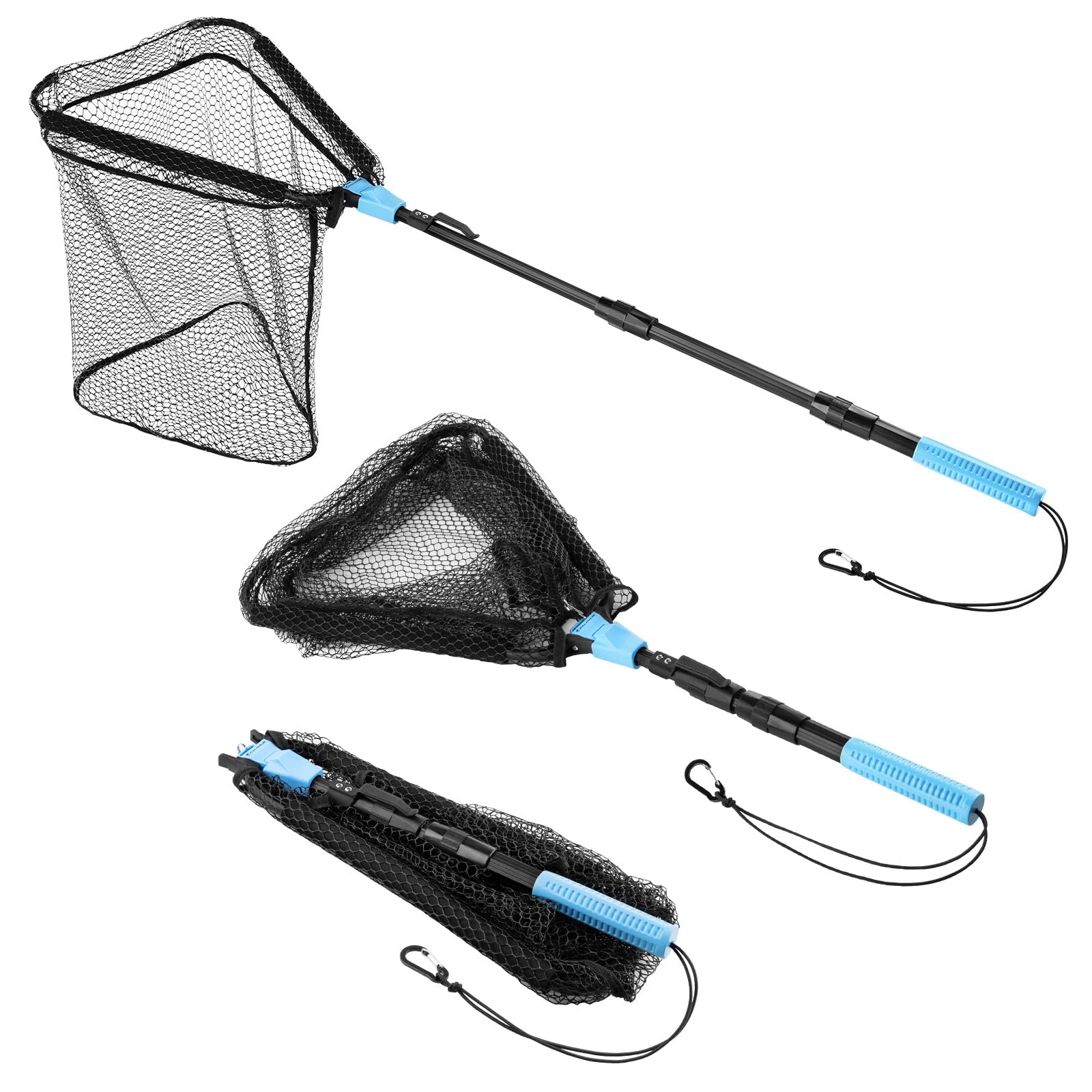
Forty-four inches is the entire argument for this Calamus. Extended, the telescoping pole puts the hoop out where a fish running wide of the boat actually is, and no amount of leaning gets you there from a 17-inch handle.

We think it is the best of these for open-water kayak fishing, where you do not get to choose which side the fish comes up on. It folds as readily as it extends, with the frame collapsing back against the handle on a locking collar, and it floats, so a fumbled swipe at a hot fish does not cost you the net. At 1.2 pounds it is heavier than the lightest picks here, and that weight is the pole.

The PVC-coated nylon mesh does what coated mesh should: hooks back out, the netting does not waterlog, and a released fish goes back without half its slime coat left on the webbing. The bright blue elastomer grip is easy to find when the deck is wet and cluttered. The belt clip is the one detail that lets it down — worn on a belt, the hoop works itself open and knocks against your leg as you walk.

Pros

  • 44 inches of telescoping reach
  • Folds down and floats
  • PVC-coated mesh keeps hooks free

Cons

  • Belt clip lets the hoop flop open as you walk
Our verdict

We hand this one to anyone fishing open water from a kayak, where the hoop has to arrive where the fish is rather than where the boat is.

Check Latest Price
3

Best Value

KastKing Pontus Landing Net

90 /100
Angler Score Outstanding

Key details

Hoop
16 in
Floats
Yes
Length
28 in, fixed
Weight
1.1 lb
Check Details on Amazon

KastKing builds a length scale into this net, and once you have watched someone hunt for a tape measure with a fish flopping in the mesh, the point is obvious. Lay the fish against the markings, take the photo, put it back. Add a floating frame, a hoop that folds on a push-down switch, and a price near the bottom of this group, and you have the value pick here.

Sixteen inches of hoop and 28 inches of net, on a fixed handle, is a compact package that folds into a triangle and stores in the bag that comes with it. For bass, crappie, and the occasional pike there is enough basket, and the nylon-covered PVC mesh is coated well enough that trebles do not bury themselves in it.

Where it runs out is reach. Twenty-eight inches total means the fish has to be close before the net goes under it, so you end up positioning the kayak instead of extending the net. That is fine — often better — when you are working structure you can swing around. If fish routinely come up six feet off the bow, this is not the net for that water.

Pros

  • Built-in length scale for measuring fish
  • Folds flat and floats
  • Storage bag included

Cons

  • 16-inch hoop is tight for big fish
Our verdict

We think this is the smartest value in the group for a compact floating net that also measures your catch.

Check Latest Price
4

Best for Trout and Catch-And-Release

Frabill Floating Trout Net

91 /100
Angler Score Outstanding

Key details

Hoop
13 x 18 in
Mesh
1 mm rubberized micromesh
Floats
Yes
Weight
11.3 oz
Check Details on Amazon

The mesh here is a one-millimeter rubberized micromesh, the finest of anything in this group, and the bottom of the bag is flat rather than sack-shaped. Both details serve the fish rather than the angler: a trout lies supported instead of folding in half, and a small hook backs out of the coating without tearing anything on the way.

The hoop floats, which is the part that matters when you are netting one-handed over the side, and Frabill puts a lanyard and carabiner on the handle so the net has somewhere to live between fish. Thirteen by eighteen inches is a working size, and the net is rated to 9.1 pounds — enough for the steelhead and small salmon it is aimed at.

For catch-and-release trout work it is the best net in this group, and the one we hand someone heading out for steelhead. It is also the most expensive net here, and what you are buying is mesh, a flat bottom, and a floating hoop rather than a pile of features.

Pros

  • Finest mesh here, gentle on trout
  • Flat bottom supports the fish
  • Floating hoop with lanyard and carabiner

Cons

  • Rigid frame takes up deck space
Our verdict

If trout and clean release are the whole point of your fishing, this is the net we consider worth paying for.

Check Latest Price
5

Most Packable

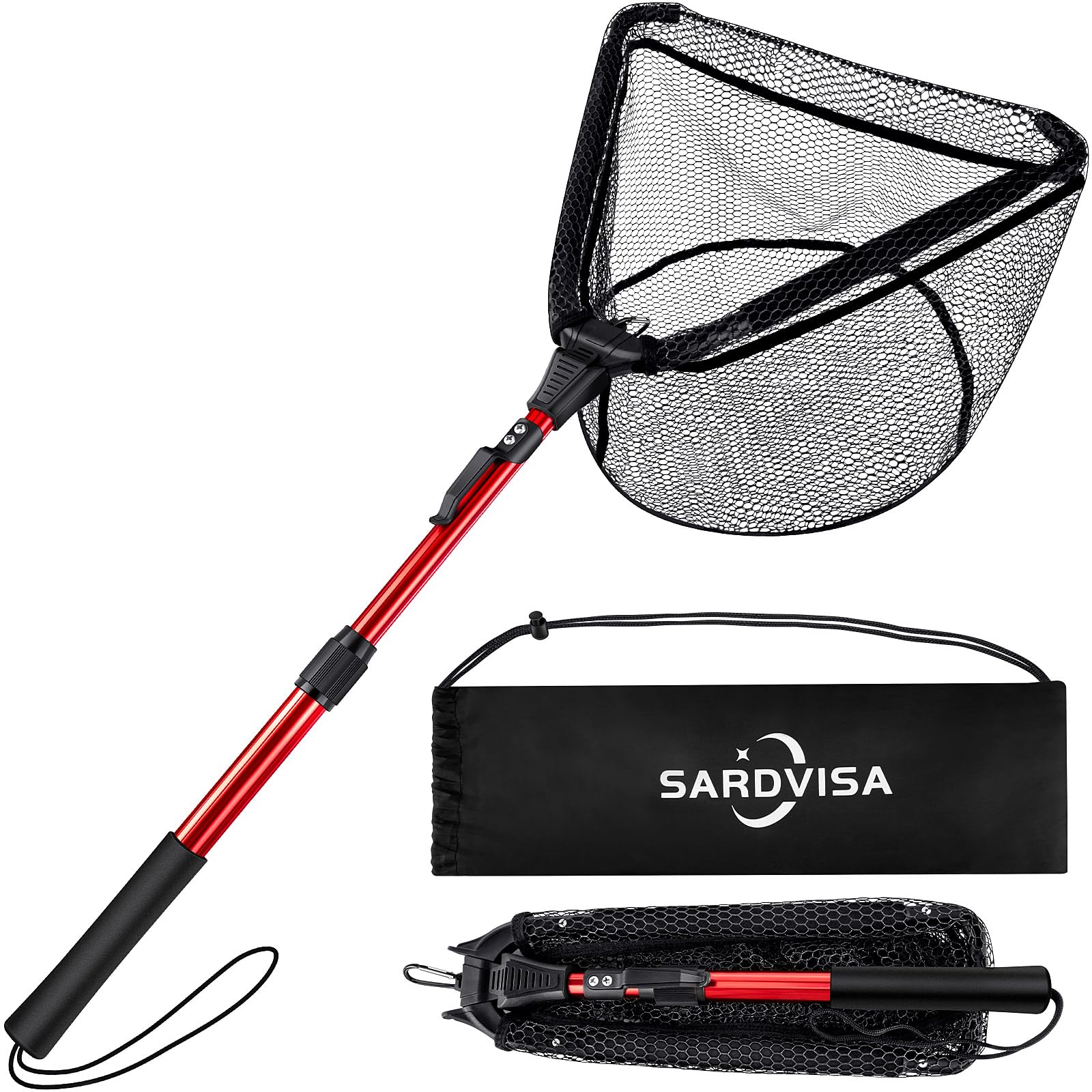
SARDVISA Foldable Floating Net

89 /100
Angler Score Excellent

Key details

Floats
Yes
Handle
Telescopic, 27-35 in
Weight
15.5 oz
Includes
Storage bag, lanyard, belt clip
Check Details on Amazon

Stowed, this is the smallest net here that still gives you something to reach with. The hoop folds on a triangle hinge and the handle telescopes down, so it drops into a hatch or under a deck bungee instead of lying across your lap while you paddle out.

We think it is the pick for a kayak with no deck space at all — a sit-inside, a pack canoe, or a rig where the net lives in the hull until the moment it is needed. The handle adjusts from 27 to 35 inches, which is enough to work over the side without the lean a short fixed handle forces, and the buoyant foam in the hoop keeps it on the surface when a swipe goes wrong.

The EVA grip is bright enough to find under a wet deck, and the package includes a carry bag, an elastic lanyard, and a built-in belt clip, so there is always a way to attach it. The mesh is rubber-coated and fine enough that hooks come free, and it drains rather than waterlogging. It is a compact net, so treat it as one: fish you can lift, not fish you have to horse.

Pros

  • Folds and telescopes into a small package
  • Floats and ships with bag and lanyard
  • Bright EVA handle is easy to spot

Cons

  • Reach tops out at 35 inches
Our verdict

Nothing here stows smaller, and we recommend it for any kayak where the net has to live inside the hull.

Check Latest Price
6

Fly and Kayak

GOODCAT Fly Fishing Net

87 /100
Angler Score Excellent

Key details

Hoop
17 x 11.5 in
Magnet Release
Included
Extended Length
32.5 in
Collapsed Length
17 in
Check Details on Amazon

Two magnets and a spring cord are what make this GOODCAT worth a look. The release holds the net flat against your vest or the side of the kayak with both hands free, and the cord stretches far enough that you can deploy it, land a fish, and reattach without ever putting the rod down.

The rest of the package is compact and sensible: a 17-by-11.5-inch hoop, a handle that extends to 32.5 inches, and a frame that folds to 17 inches. It locks open after folding out, which is the detail that separates a net you trust with one hand from one you keep re-checking mid-drift.

The clear rubber mesh is soft enough for catch-and-release on trout and small bass, and the EVA grip stays usable when everything is wet. Where it lands in this roundup is as a specialist: the magnet and that 17-inch folded length make it the net for an angler who wants one net that works from the kayak and from the vest on the days the boat stays home.

Pros

  • Magnetic release frees both hands
  • Folds to 17 inches
  • Rubber mesh is gentle and snag-free

Cons

  • 32.5-inch maximum reach limits it
Our verdict

We see it as a specialist's net for a fly angler who splits time between the kayak and a vest.

Check Latest Price
7

Small Fish

SANLIKE Telescopic Fishing Net

86 /100
Angler Score Excellent

Key details

Mesh
Rubber-coated, 5 mm
Folds
Yes
Weight
12.3 oz
Extended Length
51 in
Check Details on Amazon

Fifty-one inches of reach for the lowest price in this group is the trade this SANLIKE is making, and for a lot of anglers it is the right one. Extended, the pole puts the hoop well past the gunwale; collapsed, the whole net folds down and stores against the hull.

The telescoping sections lock with a rotary switch rather than a small push button, which is easier to work with wet hands when a fish is waiting. The EVA grip is skid-resistant, the mesh is rubber-coated with 5-millimeter openings, and the net weighs 12.3 ounces, so it never argues with you about being carried.

The fold is a one-click affair, and folded it takes up about as much room as a thermos, which is why it ends up in boats that supposedly have no room for a net. The coating is fine enough that small hooks do not bury, and the mesh drains rather than holding water against the frame.

That makes it a fair spare, a loaner for a kid, or a first net while you work out what you actually want from one. It is also the net here most likely to be replaced rather than repaired, which is worth knowing before you count on it for a decade.

Pros

  • 51 inches of reach at the lowest price tier
  • Folds and telescopes small
  • Rotary lock is easy to work wet

Cons

  • Pole flexes under a heavy fish
Our verdict

We rate it as a spare, a loaner, or a first net for small fish — just do not ask it to lift anything with shoulders.

Check Latest Price
8

Wading Anglers

SF Fly Fishing Landing Net

91 /100
Angler Score Outstanding

Key details

Hoop
16.3 x 10.4 in
Frame
Laminated bamboo and hardwood
Handle
8.5 in, wood
Weight
15.2 oz
Check Details on Amazon

Laminated bamboo and hardwood, a copper swivel ring at the butt, and a magnet release in aviation aluminum — this is the best-looking net in the roundup by a wide margin, and the one that feels least like gear.

The magnet is genuinely strong, the kind that snaps the net home on your vest without you looking, and the spring cord stretches far enough that you can net a fish and let the cord take the weight rather than your shoulder. At 15.2 ounces it adds almost nothing to a pack or a PFD.

The hoop is 16.3 by 10.4 inches with clear, small-hole rubber mesh, which makes a trout-sized basket and a gentle one — the kind of net that lets you leave a fish in the water while you back the hook out. The finish on the wood is a little rougher in the hand than it looks in photos, which is the one place the price shows.

Where it belongs is on your back while you wade a river, or clipped to a PFD in a float tube, anywhere you are already standing in the water close to the fish. It is the net we take when the kayak stays on the roof rack.

Pros

  • Magnetic release holds it on a vest
  • Wood frame at 15.2 ounces
  • Small clear mesh is gentle on trout

Cons

  • 8.5-inch handle gives no reach from a kayak
Our verdict

Waders and float-tubers are who we have in mind here: a light, fish-safe net that rides on your vest rather than on the deck.

Check Latest Price

How We Tested Kayak Fishing Nets on the Water

To build the shortlist, I started with the specs that actually matter from a kayak seat: collapsed length, hoop width and depth, handle material, whether the frame floats, mesh coating, and how the net attaches to a vest or crate. Anything too long to stow behind the seat or too stiff to open with one hand came off the list before it ever got wet. That left 14 nets, spanning budget house names and fly-fishing specialists.

Testing ran five months, mostly from sit-on-top kayaks on flat water and in current, with a handful of sessions in a canoe and off a dock for comparison. I practiced the awkward part on purpose: rod in one hand, reaching over the gunwale to scoop, then folding the net down and re-clipping it while drifting. Every net got dunked, dragged across the deck, and left in the sun between trips.

Foldability was judged by how each one behaved with cold, wet hands, whether the hinge released cleanly or needed two hands and a knee. I measured hoop opening and bag depth against the fish I actually catch, then watched how a coated mesh held a fish compared with bare nylon. Magnetic attachments got clipped to a PFD, paddled a mile, and checked to see what was still hanging there.

Reach came next: how the net felt after a long day of casting and drifting, and whether a telescoping handle stayed put once extended. Durability was the slow part, with a freshwater rinse and saltwater wipe-down after each trip, plus regular checks on hinges, threads, and coating. Value came down to whether the parts that wear, the hinge, the coating, the clip, felt like they would survive a second season.

How to Choose a Kayak Fishing Net

Start with where the net lives, not how big the hoop is

A net that has to be unpacked is a net you will not reach for. Measure the space you actually have — a tank well behind the seat, a hatch, or a bungee along the gunwale — then choose the net that fits that hole rather than the one with the biggest basket. Folding frames and telescoping handles buy the most room; a long fixed net like the Calamus rides on top of the kayak or in a rod holder and effectively stays there.

The trap is the word compact. On a listing it usually means compact next to a boat net, not compact on your deck. A frame that folds down to 17 inches genuinely disappears behind the seat; one that folds to 28 inches still lies across your lap while you paddle, which is the difference that matters at the end of a long drift.

Reach: fixed, telescoping, or on your body

Reach decides how much of the fish you have to bring to the boat. The nets here run from a 16.7-inch fixed handle to a 44-inch telescoping pole, and the middle of that range — roughly 28 to 35 inches — is where most seated kayak netting happens. Telescoping buys you the extra feet when a fish sulks wide of the hull, but it costs a motion at the worst possible moment, so pick it when reach matters more than a fast one-handed swipe.

There is a third option: a short magnet-held net that lives on your vest. Those belong to waders and float-tubers, where you are already standing in the water next to the fish. From a seated kayak, an 8.5-inch handle simply cannot get the hoop to the surface without help.

Assume you will drop it

Every net in this group that floats does so because of foam built into the hoop, and that is worth having — a floating net turns a lost-net moment into a retrieval. But a floating net that drifts off downwind is barely better than a sunken one, so clip the lanyard to the boat rather than to your body, and keep the tether short enough that the net does not trail while you paddle or foul a hook on the backcast.

If you only fish sheltered water and always have a hand free, flotation is a convenience. If you fish open water, wind, or current, treat flotation plus a tether as the standard, not as a bonus feature.

Hoop, mesh, and the fish you are actually catching

Match the basket to the fish. A 13-by-18 hoop with fine rubberized micromesh, like the Frabill's, holds trout flat and protects them for release; a wider 16- or 17-inch hoop with coated mesh is the better all-round shape for bass, pike, and schoolie stripers. Rubber and PVC-coated mesh shed treble hooks with a shake and do not waterlog; plain nylon is cheaper, snags more, and dries slower.

Depth counts as much as width. A deep bag lets a fish lie flat while you back the hook out, and a shallow one lets it thrash while you fumble. For fish you intend to release, the coating and the depth do more for the outcome than an extra inch of hoop.

Frequently Asked Questions

Final Verdict

The PLUSINNO floating net is the one we point most kayak anglers to, because floating, folding, and 12.5 ounces solves the three things that go wrong on a small boat, and it does it for less than most of the group. Change one requirement and the answer changes with it.

If your fish come up wide of the hull and you would rather extend a pole than reposition the kayak, the Calamus and its 44 inches are worth the extra weight. If trout and a clean release are the whole point of the trip, pay for the Frabill's micromesh and flat-bottom bag.