
Best Kayak Rod Holder of 2026

The worst part of a rod holder isn't the holder — it's the second it lets go mid-hookset with your best rod headed for the bottom. I've watched it happen from a paddle seat, which is why I distrust anything that mounts with two screws and a shrug. A holder has one job: keep the rod where you left it, at the angle you left it, whether you're trolling a weedline, drifting bait, or tying on a lure with both hands. Done right, your deck stops being a pile of rods you're afraid to move.

We spent the past six months running 14 holders through a full paddling season — flat water, a couple of blown-out afternoons, and more than one accidental dunking. The keepers shared three traits: the mount stayed tight, the lock held under a real hookset, and the angle changed without hunting for a wrench. One thing no product photo tells you — measure your rod butt and look at your deck first. That eliminates half the field. The picks below are the ones that survived.

1

Best Overall

YakAttack Omega Pro

93 /100
Angler Score Outstanding

Key details

Mounting
LockNLoad track mount
Rotation
360 degrees
Rod Types
Spinning, casting, conventional, fly
Dimensions
7"D x 4"W x 7"H
Check Details on Amazon

The extension arm is why the Omega Pro takes the top spot. It lifts the cradle a few inches above the base, so the reel sits clear of the water sloshing across a sit-on-top deck and a long rod butt has somewhere to go besides into your ribs. On a spec sheet that gap looks like a detail; after four hours of paddling it is most of the difference between a comfortable holder and one you fight.

The cradle takes spinning, casting, conventional, and fly reels, and the rotating collar clamps over the reel foot rather than letting the rod sit in a bucket. We loaded a spinning rod, turned the collar down, and lifted — the rod came up with the holder instead of sliding out of it. Loosen the collar and the rod lifts free in one hand, which is exactly what you want when a fish hits.

Mounting runs through the LockNLoad base: locked, adjust, and remove, sliding into YakAttack's GearTrac and MightyMount as well as most factory tracks. It needs a track to sit on. On a kayak without one, the Scotty 230 further down this list is the place to start rather than this.

What we keep noticing once the novelty wears off is that nothing on it needs a tool. The collar, the arm, the base release — every adjustment is a hand twist, and hand twists are the only adjustments that actually get made while you are drifting.

Pros

  • One cradle for spinning, casting, conventional, and fly
  • Collar clamps over the reel foot
  • Tool-free locking, adjusting, and removal
  • Raised arm keeps the reel out of the splash

Cons

  • Taller, bulkier profile than a flush holder
Our verdict

The track-mount holder we point most kayak anglers to: it takes any reel, clamps the rod down, and lifts off the rail in seconds.
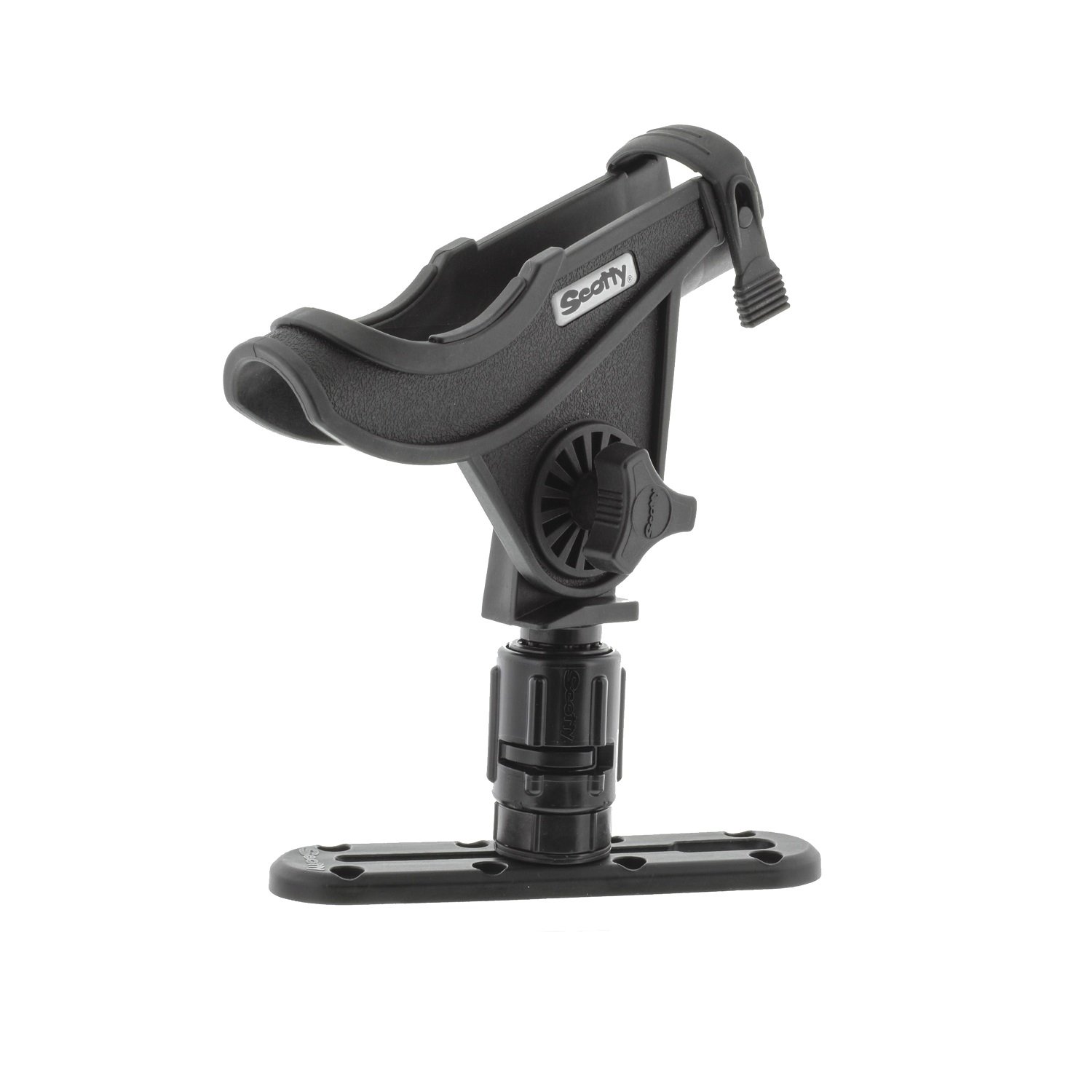
Check Latest Price
2

Best Track Mount for Baitcasters

Scotty 282 Baitcaster

93 /100
Angler Score Outstanding

Key details

Weight
12.8 oz
Mounting
Gearhead track adapter
Retention
Soft latching strap
Rod Types
Baitcaster and spinning
Check Details on Amazon

Less money than our top pick buys a different cradle here, not a lesser one. The 282 is built around baitcasters: the reel sits in a cushioned seat, a slot at the front takes a spinning reel instead, and the bottom is open so a trigger grip passes through rather than propping the rod up on its butt.

The Gearhead base is the part we care about most. It slides into the rail once, locks with a twist, and then travels up and down the track to wherever you want the rod — or comes out entirely for the drive home. We shifted ours from the front of the cockpit to behind the seat and back again in a single morning without touching a screwdriver.

The strap is the other detail worth knowing. It snaps over the top for a baitcaster and under the bottom for a spinning reel, so both reel types get the same security from one holder. On a choppy crossing with the rod pointed forward, that latch is what stops the rod lifting.

The cradle runs generous, which suits a big baitcaster handle and leaves a slim fly rod swimming in the bucket. If fly fishing is most of your day, the Omega Pro's clamping collar is the better match and worth the extra.

Pros

  • Cushioned cradle seats a baitcaster properly
  • Front slot and open bottom take spinning reels and trigger grips
  • Gearhead base slides and locks along a track
  • Strap works over a baitcaster or under a spinning reel

Cons

  • Gearhead joint can take a couple of tries to seat
Our verdict

Our baitcaster pick for track boats — the cradle seats the reel properly, the strap keeps it there, and the base twists free of the rail.

Check Latest Price
3

Best for Kayaks Without Tracks

Scotty 230 Powerlock

92 /100
Angler Score Outstanding

Key details

Cradle
Universal
Weight
16 oz
Mounting
Side or deck, 241 mount included
Rotation
360 degrees horizontal
Check Details on Amazon

No track on your kayak? Start here. The 230 arrives with the 241 side/deck mount, a bracket that screws to the top or the side of a gunwale, so any kayak with a flat patch of deck can take one — no rail, no adapter plate, no second purchase.

The cradle is a universal opening with a front locking ring that closes over the rod, and the post gives a full 360 degrees of horizontal swing — forward for a troll, sideways for a drift, tucked in when you are rigging up.

What sells it on a kayak is the geometry. The post mount tilts the cradle so the rod angles forward rather than standing straight up, which keeps the tip out of your paddle's way and the butt out of the footwell. We tipped ours forward for a drift and laid it flat against the deck for the paddle back, and the ring held the rod through both.

The opening is generous in both directions. A big conventional reel or a thick muskie handle drops in with room to spare, while a slim fly rod swims around in it. At 16 ounces it is the heaviest holder here, and the nylon is thick where the mount meets the post — the stress point on every one of these.

Pros

  • Includes the 241 side/deck mount
  • Front locking ring closes over the rod
  • 360 degrees of horizontal swing
  • Thick fiber-reinforced nylon build

Cons

  • Elevation adjusts in coarse, fixed steps
  • Mounting screws are not in the box
Our verdict

We keep this one for kayaks without tracks: the included deck mount screws to a flat gunwale and the front ring closes over the rod.

Check Latest Price
4

Best Value Two-Pack

PLUSINNO 2-in-1 Kayak Rod Holder

90 /100
Angler Score Outstanding

Key details

Pack
2 holders
Mounting
Deck or rail
Rotation
360 degrees, 10-degree detents
Rod Types
Spinning and baitcasting
Check Details on Amazon

Two holders come in the box, which is the entire pitch: deck or rail mounting on both sides of the cockpit for less than our top pick costs on its own. Each one screws to a flat deck surface or clamps to a rail, and the silicone pads on the mounting faces are what keep them from creeping once tightened.

The strap is the detail we appreciated most. It snaps down over the rod rather than wrapping the blank, so a thick baitcaster handle and a slim spinning handle get the same treatment, and the rod cannot lift out while you paddle to the next point. Both holders turn 360 degrees vertically and horizontally, with 10-degree detents for fine work.

Those small detents are the spec we expected to be filler. In practice, pointing a rod tip just off the bow quarter for a slow troll is a click or two, and the same job takes a lot more guesswork on a holder with three coarse positions.

The version we used is the no-track pack: it mounts to deck or rail, and running it on a track means buying the adapter plates separately. If your kayak already has tracks and you want to use them, budget for the plates or start with a track-ready holder instead.

Pros

  • Two holders in one box
  • 360-degree rotation with 10-degree fine adjustment
  • Silicone pads keep the mount from creeping
  • Strap snaps over the rod, not the blank

Cons

  • Track adapter plates sold separately
Our verdict

Rigging a bare kayak on a budget? This is the pair we hand over: two strap-held holders for less than one premium pick.

Check Latest Price
5

Flush-Mount Builds

Anndason Flush Mount 2-Pack

91 /100
Angler Score Outstanding

Key details

Pack
2 holders
Length
19cm / 7.5 inch
Mounting
Flush mount
Inner Diameter
45mm
Check Details on Amazon

This is the only holder here that asks you to cut a hole in your boat. Two flush tubes, 7.5 inches long with a 45 mm inside diameter, drop through the deck at 30 degrees and disappear behind a cap when you are not fishing — which on a clean sit-on-top deck is the tidiest way to carry a pair of rods.

The foam gasket under the flange is the detail we appreciate most. It seals the joint between tube and deck, so water sloshing around your feet does not run into the hull through the new hole. It is a small part doing the job people worry about most when they first take a hole saw to a kayak.

Fitting them is real work. You need a hole saw, sealant under the flange, and enough access beneath the deck to get a backing ring and nuts onto the mounting points, which rules out any spot above a sealed compartment. Pick a flat patch of deck, drill once, and bed it properly the first time.

In use, rods sit deep and feel secure while you paddle, and the three positions in the head let you change the rod angle without lifting the rod out. The cap over the top is the part we would refine — it pops open and shut, but it takes more thumb than it should.

Pros

  • Hides under a cap when not in use
  • Foam gasket seals the deck joint
  • Two holders for the lowest price here
  • 30-degree angle keeps rods ready to grab

Cons

  • Short tube gives a long-butt rod little support
  • Cap takes more effort to pop open than it should
Our verdict

If you want rods out of the way, these are the flush holders we recommend: cheap, tidy under a cap, and sealed against deck water.

Check Latest Price

How We Tested Kayak Rod Holders on Moving Water

We started with research rather than a cart: we mapped every deck, track, and flush-mount holder we could find, then cut anything with hardware that wouldn't fit a standard track, a published butt diameter too narrow for the rods most people actually paddle with, or a mount that looked like it would flex under load. Fourteen made the cut, and we ran them from spring into fall.

Each one got the same first test — bolted or tracked onto the same two boats, one polyethylene and one composite, by the same person, with a screwdriver, a wrench, and a stopwatch. We noted whether the included hardware lined up with holes already in the deck or demanded new ones, whether the base shifted when we leaned our weight onto the rod, and how much of the mount sat proud of the deck where a paddle could catch it.

Then it all went on the water. We trolled, drifted bait, and stood to cast, loading each holder with combos from an ultralight to a heavy musky rod to see whether the cradle or clip pinched, rattled, or let the butt creep. We pulled rods out at bad angles to mimic a hookset and watched for the whole unit spinning on its base, and we changed angles one-handed mid-drift to find out whether the locking mechanism needed a tool or a second hand. Every trip ended with a bolt check, a look for stress cracks and rust, and a rinse.

By month six there was a clear split between holders that still felt new and ones we'd quietly stopped trusting — and price turned out to be a poor predictor of which was which.

How to Choose a Kayak Rod Holder

Start With the Mount, Not the Holder

Track mounts slide in, lock, and lift out for the drive home, but they need GearTrac, MightyMount, or a factory rail already on the boat. Side and deck mounts screw to a flat patch of gunwale and work on almost any kayak, at the cost of holes you live with. Flush tubes disappear into the deck and carry a rod lowest of all, but the hole you cut today is permanent. We start every recommendation with what the deck will accept, because a superb holder on the wrong fitting is just a spare part.

Match the Cradle to the Reels You Actually Fish

A universal cradle takes a spinning reel, a baitcaster, and often a conventional outfit, which is why most holders here are shaped that way. A dedicated baitcaster cradle seats the reel in a cushioned well and uses a front slot for spinning reels; it holds a baitcaster better and everything else slightly worse. Two measurements settle the fit: the reel foot and the handle diameter. Too wide an opening and the rod rocks; too narrow and a big conventional reel never seats. Bring your biggest reel to the decision, not the smallest.

Adjustment You Can Work One-Handed

Rotation matters less than release. A holder has to swing the tip forward for a troll and out to the side for a drift, but the moment that counts is the one where a fish takes and you need the rod clear without looking down. We favour collars, rings, and straps that open in one motion, and adjusters that need no tool. Fine detents earn their keep too — ten-degree steps reach a trolling angle that a three-position holder never finds.

Height, Clearance, and the Paddle Stroke

Height is the trade nobody warns you about. A raised arm keeps the reel out of the splash and stops a long butt fouling your legs, but it also puts the rod where a paddle blade finds it on a sweep stroke. A flush mount keeps the deck clear and the rod low, at the cost of a wet reel and a butt down by your ankles. Sit in the boat, mime a few strokes, and look at where the holder sits relative to the blade before you drill.

Hardware, Sealant, and Salt

Assume the fasteners are not in the box. Several holders here ship without screws, and the ones that do include hardware aren't always stainless — a poor choice on a boat that sees salt. Buy stainless machine screws, washers, and nyloc nuts, bed every deck fitting in sealant, and confirm you can reach underneath to put a nut on before the first hole goes in. Rinse the holder and base after a saltwater trip; the joints and the track are where corrosion starts.

Frequently Asked Questions

Final Verdict

For most kayak anglers with a track already on the boat, the Omega Pro is the pick. What decides it is not the cradle, which several holders here match, but the raised arm: the reel stays out of the splash, a long rod butt clears the deck, and the whole thing lifts off the rail in seconds when you load up.

If your kayak has no track, skip it. The Scotty 230 screws to a flat patch of deck, closes a front ring over the rod, and costs a good deal less — and it will still be holding rods when you fit that track.