Best Kayak Seats of 2026

The three-hour mark is where a kayak seat either earns its place or it doesn't. Your legs are fine, your arms are fine — it's the spot between your shoulder blades that starts complaining, and the thin foam pad bolted to your boat isn't going to answer. A good seat fixes that: a back panel that holds you upright without digging in, cushioning that doesn't flatten by lunch, and straps that stay where you set them so the seat doesn't slide out from under you mid-stroke.

I've spent the past eight months swapping 12 seats in and out of sit-on-tops, a canoe, and a paddleboard, and the gap between an inexpensive pad and a properly built seat is wider than the price difference suggests. Fit is the quiet variable — strap length and buckle placement decide whether a seat that reviews well elsewhere actually stays put on your hull. The picks below cover different backs, boats, and budgets, and the one that matches how you paddle is in there.

1

Best Overall

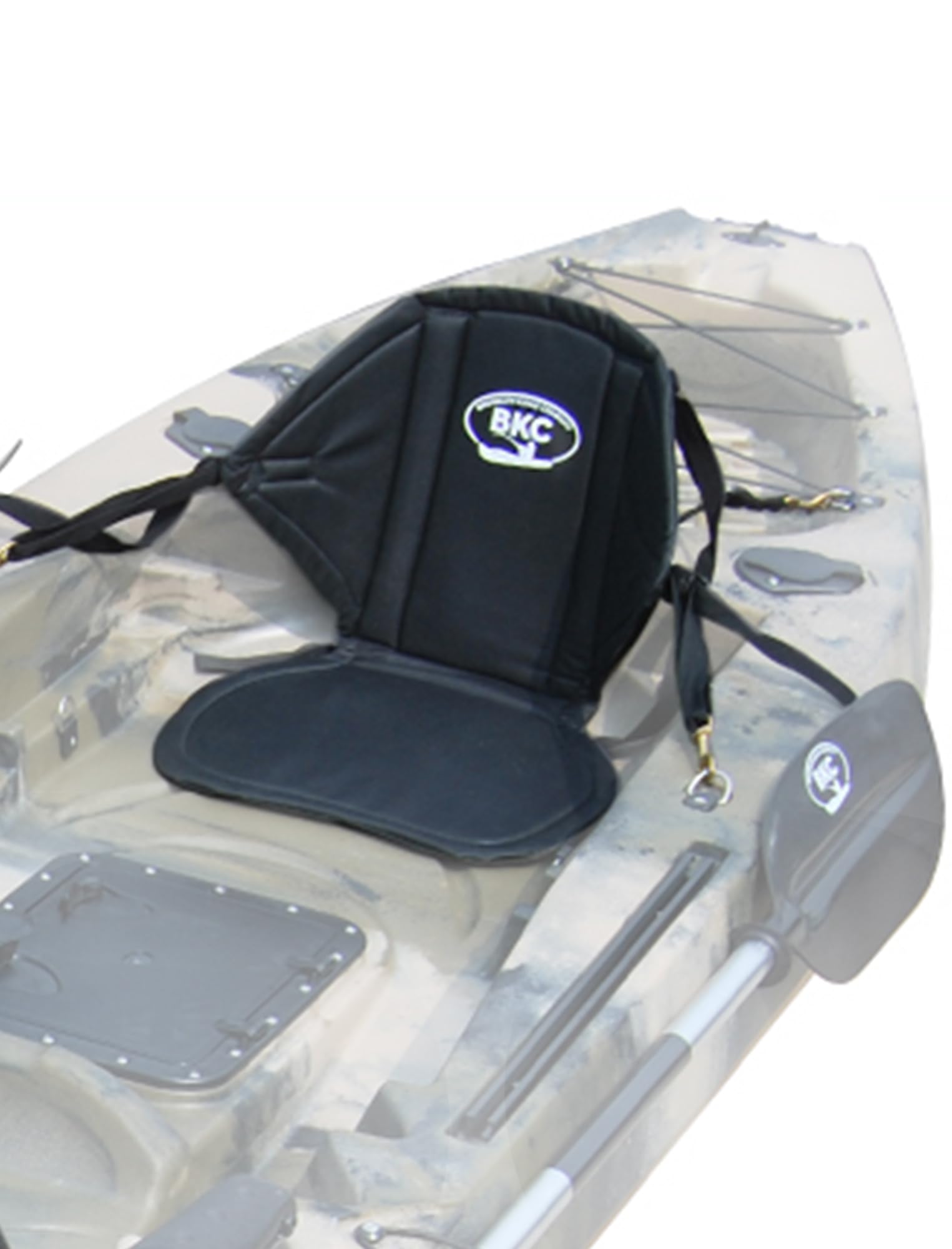
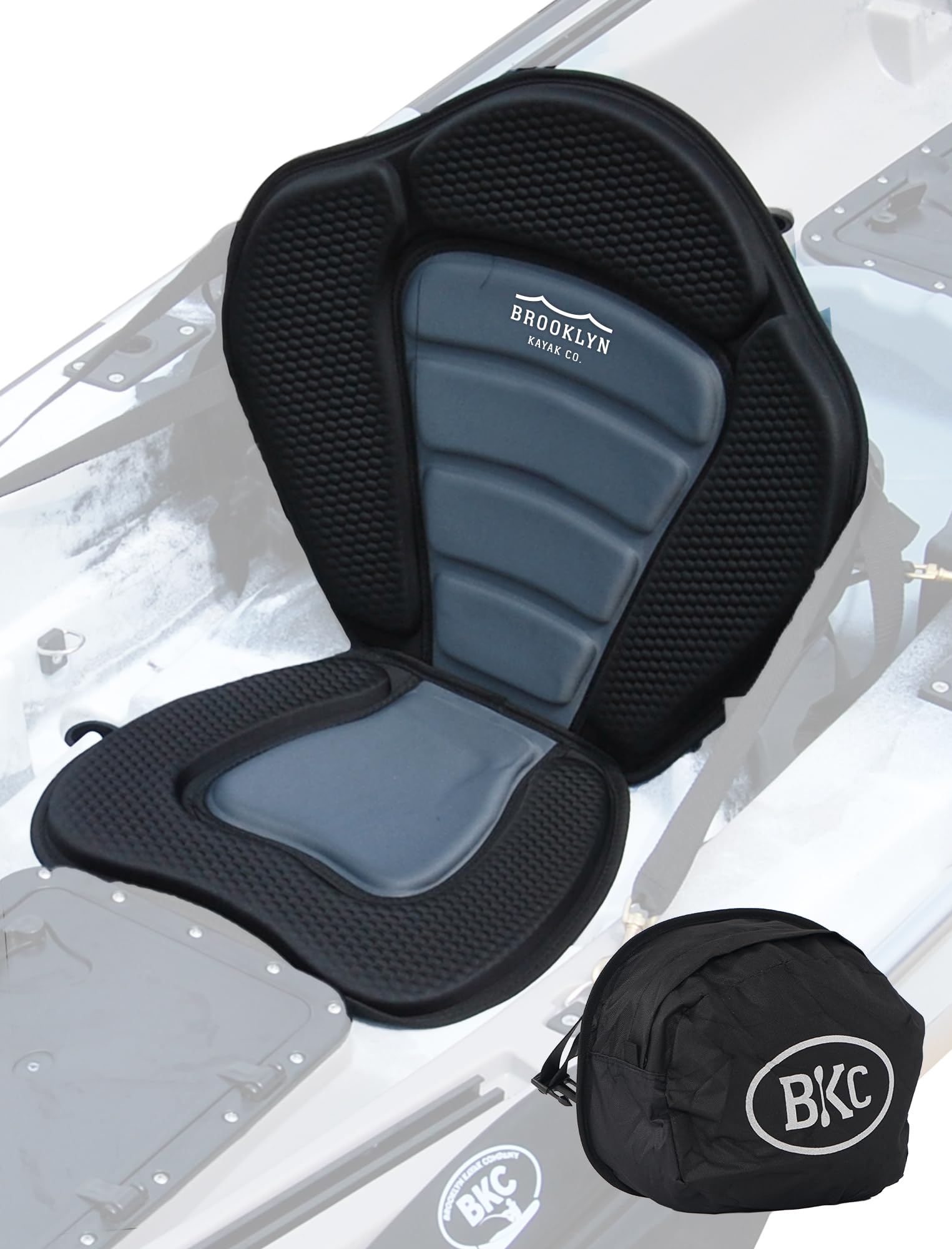
BKC PS223 Memory Foam Seat

87 /100
Angler Score Excellent

Key details

Straps
4-way adjustable
Weight
2.5 lb
Seat Depth
12 in
Backrest Height
17.7 in
Check Details on Amazon

The thing that sends most people looking for a kayak seat is not comfort in the abstract. It is the moment, usually somewhere in the second hour, when the backrest that came with the boat stops holding you upright and you start bracing with your paddle instead of pulling with it. The BKC PS223 is the seat we hand to that paddler. Its backrest stands 17.7 inches tall, which puts support between your shoulder blades rather than at the small of your back, and the padding is memory foam rather than the folded closed-cell sheet so many stock seats use.

Four straps, two forward and two aft, run through marine-grade hardware, and the back holds the angle you set instead of curling forward with every stroke. The seat pad is 12 inches deep and firm. It is not the plushest cushion in this group, but firm is what keeps you off the hull in hour four. The money went into the shell and the frame: 600D polyester over neoprene, with a one-year limited warranty behind it.

What usually ends a kayak seat's life is boring: the stitching at the strap anchors, the clips, the seam where the backrest meets the seat. BKC overbuilds all three compared with the cheaper seats here, and that is most of the reason this one takes the top spot instead of sitting in the middle of the list with the rest of the padded seats.

One practical note before you order. Four straps need four attachment points, and a boat with two molded loops up front and nothing behind will need hardware added before this seat does what it is supposed to do. That is the single detail we check before committing a seat to a boat.

Pros

  • Tall 17.7-inch memory-foam backrest
  • Stiff back holds the angle you set
  • Marine-grade hardware and 600D polyester shell
  • One-year limited warranty

Cons

  • Tall back may not clear a low sit-in rim
Our verdict

This is the seat we recommend first: a tall memory-foam backrest that holds its angle, marine-grade hardware, and a warranty behind it.

Check Latest Price
2

Best for Two Kayaks

RELIANCER 2-Pack Kayak Seat

87 /100
Angler Score Excellent

Key details

Clips
Marine-grade brass
Backrest
18 x 20.4 in
Seat Pad
12.2 x 15.3 in
Seats Included
2
Check Details on Amazon

Two complete seats arrive in one order here, backrest, seat pad, four straps and a detachable bag on each, which is the whole argument if there are two boats in the driveway or a tandem in the garage. Per seat, it is the least expensive way into a padded high-back in this group, and nothing about it reads as the cheap option when you unwrap it.

The backrest measures 18 by 20.4 inches, as tall as any seat here, and it is molded rather than flat: deep center panels that cup your back and hold their shape instead of bowing out the moment you lean on them. We put its back support just behind the BKC's and ahead of it on cost per boat, and the clips are the detail we did not expect at this level. They are marine-grade brass, the part that rusts first on a cheap seat.

The seat pad is 12.2 by 15.3 inches, generous front to back and narrower across, and on a long day it is the backrest doing most of the work. The storage bags detach, so load them on shore rather than reaching behind the backrest mid-paddle. What you give up is the ability to buy one: this is an all-or-nothing pair, which suits a household with two boats and leaves a solo paddler paying for a spare.

Pros

  • Two complete seats in one order
  • 18 x 20.4-inch molded backrest
  • Marine-grade brass clips
  • Detachable storage bag on each seat

Cons

  • Sold only as a two-pack
  • Tall back sits high in a low cockpit
Our verdict

Buy the two-pack if there are two boats in your life: a full high-back seat for each at the lowest per-seat cost here.

Check Latest Price
3

Best for Tall Paddlers

OceanMotion Ergo-Fit Seat

87 /100
Angler Score Excellent

Key details

Weight
3.28 lb
Warranty
1 year
Seat Width
15 in
Strap Reach
Up to 22 in
Check Details on Amazon

Twenty-two inches of strap is the number that put this seat on our list. On a wide sit-on-top, or a boat whose pad eyes sit forward of the seat well, that reach is the difference between a seat that lands where you want it and one that is hauled tight and still short. If you are a big paddler, or your boat is a barge, start here.

The other half is the foam. The back is reinforced so it stays upright instead of curling forward when you lean into a stroke, and the padding behaves like the ultra-thick name suggests, dense enough to support you rather than bottom out. Taller paddlers get the most from it, because a stock backrest tends to stop below their shoulders, and that is the group we point here first.

It is the most expensive single seat here, and the money is in the padding, the strap length and a one-year warranty from a U.S. company. The trade is weight and bulk: at 1.49 kilograms it is not the seat you carry across a long portage. That is a fair exchange if the boat lives on a rack near the water and the carry is the short part of the day.

Pros

  • 22-inch straps reach across wide boats
  • Reinforced back stays upright
  • Dense, extra-thick padding
  • One-year warranty

Cons

  • Firmer cushion than the soft-foam seats
Our verdict

For a wide boat or a tall paddler, the long straps and dense padding here solve a problem the others cannot reach.

Check Latest Price
4

Best Universal Fit

Leader Accessories Kayak Seat

90 /100
Angler Score Outstanding

Key details

Weight
2.7 lb
Storage
Detachable bag
Warranty
1 year
Seat Width
33 cm
Check Details on Amazon

This is the seat that moves between boats. Leader builds it as a universal unit, two straps forward and two aft with 33 centimeters of seat width, and it clips to a sit-on-top kayak, a canoe or an inflatable paddleboard without drilling or tools, which is the whole point when Sunday's craft depends on what is inflated.

The backrest is a stiffened high-back rather than a fabric sling, so it holds an upright angle while you paddle and does not fold the moment you stop leaning on it. EVA foam under a 210D polyester shell is the same recipe as most of the seats here, done well, and the detachable bag on the back is the right size for a phone, keys and sunscreen.

We push back on the seat pad. The back gets the attention and the cushion under you does not, and by mid-afternoon on a long float you feel the boat through it. For two-hour paddles in a household that owns a board and a kayak, that is a fair trade for the flexibility and the price. For an eight-hour fishing float, we take the BKC instead.

Pros

  • Fits kayaks, canoes and paddleboards
  • Stiffened high back holds its angle
  • Clips on without tools or drilling
  • Detachable storage bag

Cons

No notable drawbacks to flag.

Our verdict

The one to keep in the car when the boat changes: it clips to kayaks, canoes and SUPs, and its stiffened back holds an upright angle.

Check Latest Price
5

Best for Hot Days

WOOWAVE Deluxe Kayak Seat

88 /100
Angler Score Excellent

Key details

Fill
Memory foam
Straps
4-way, front and rear
Weight
4.41 lb
Cushion
Thickened grooved foam
Check Details on Amazon

The seat pad here is cut into channels, grooves running across the cushion that let air and water move instead of trapping a warm puddle under you. It is a small thing on a product page and a large one in August, and it is the reason this is the seat we reach for when the forecast is hot and flat.

The padding is real memory foam and there is more of it under you than on most seats in this group, which puts this at the soft end, the opposite of the BKC's firm support and the right call if you want a cushion that gives. The high back sits you upright, and the four-way webbing runs front and rear so you can dial in the recline once you are on the water.

Two things to know. At 2 kilograms it is on the heavy side for this group, which is the price of a thick pad and shows up on a portage rather than on the water. And the tall back needs clearance: on a low sit-in cockpit, or a boat with a crate right behind the seat, measure before you commit. Both are things you stop noticing once you are seated.

Pros

  • Grooved pad moves air and water
  • Generous memory-foam cushion
  • High back with four-way webbing
  • Softer ride than the firm seats here

Cons

  • Buckles can let the webbing slip
Our verdict

A softer, breathable seat for warm, flat water, where the grooved cushion and generous padding earn their keep.

Check Latest Price
6

Best Budget

BKC KS222 Padded Kayak Seat

87 /100
Angler Score Excellent

Key details

Straps
4-way adjustable
Material
Woven nylon
Warranty
1 year
Seat Width
18 in
Check Details on Amazon

A bare plastic bench and a budget that is already stretched: that is the case for this seat. It is a low-profile padded nylon seat, 18 inches across, with four-way straps and a small pouch on the back, and it clips on or comes off in about a minute, the kind of seat you can leave on the boat all season without thinking about it.

What you give up is back support. The backrest is soft rather than stiffened, which is the whole difference between this seat and the ones above it on this list. The seat pad is thin too, and a cheap closed-cell pad slipped under it is the fix if you plan to be out more than half a day.

The straps matter more here than on any other seat in this group. The front pair sets the backrest angle, and getting them snug before you launch is the difference between the seat staying put and the whole thing sliding forward under you. Set it up on land, sit in it the way you will sit on the water, adjust once more, then push off.

Pros

  • Low-profile, lightweight nylon seat
  • Clips on and off in about a minute
  • 18-inch wide seat
  • Rear storage pouch

Cons

  • Soft backrest folds under a hard lean
Our verdict

Spend the least and still get a real backrest: a light, low-profile seat for short trips and calm water.

Check Latest Price
7

Paddleboard Conversions

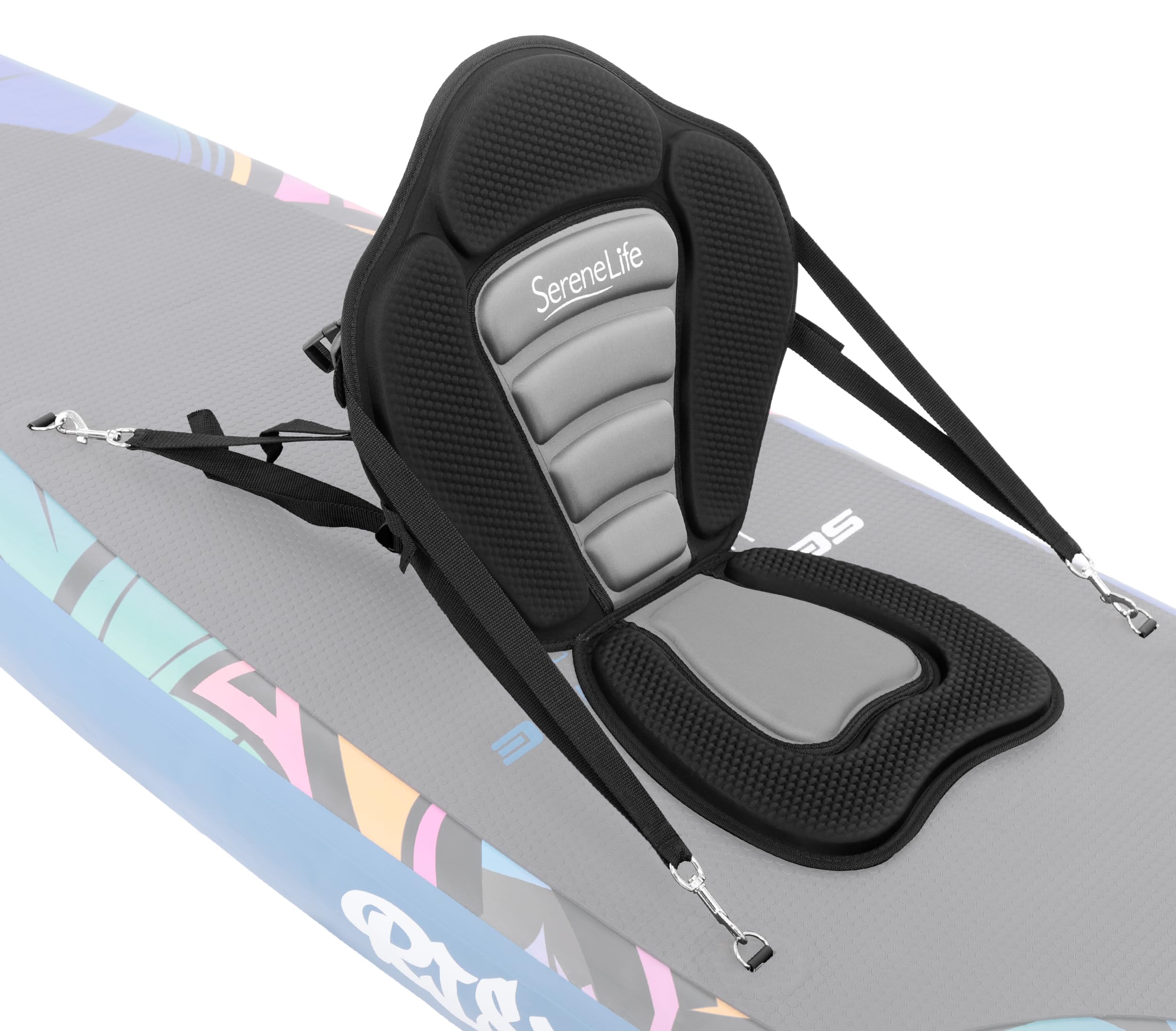
SereneLife Detachable SUP Seat

88 /100
Angler Score Excellent

Key details

Fill
EVA foam
Hooks
Copper metal
Shell
Polyester
Warranty
1 year
Check Details on Amazon

Sold as a paddleboard seat first, this is the one here that is happiest clipped to the D-rings of an inflatable SUP, turning a standing board into something you can kneel or sit on for an hour. If the board is your boat and a backrest is the missing piece, this is where we point.

It is built on EVA foam with a polyester shell, and the high back is shaped rather than flat, so there is a place to lean instead of a slab to press against. On a sit-on-top it does the same job as the rest of this group, just with a softer, less rigid back than the BKC's, and the detachable design means it comes off as easily as it goes on.

There is more webbing to manage here than on a plain two-strap seat, and the hardware is the substantial part: copper hooks rather than plastic, which is the right call for salt water but leaves you with a fit question to settle on your own board before you order.

Of the high-backs here, this is the softest, which feels generous at a relaxed angle and gives you less to push against when you are working into wind or covering distance. For a board that becomes a kayak a few afternoons a summer, that is the right compromise. It is not the seat that grows into a distance boat.

Pros

  • Detachable design suits paddleboards
  • EVA foam with a shaped high back
  • Copper hooks resist corrosion
  • Plenty of strap adjustment

Cons

  • Hooks need D-rings with clearance
Our verdict

The paddleboard answer: a detachable high-back that turns a standing board into a seat for an afternoon.

Check Latest Price
8

Restoring Older Kayaks

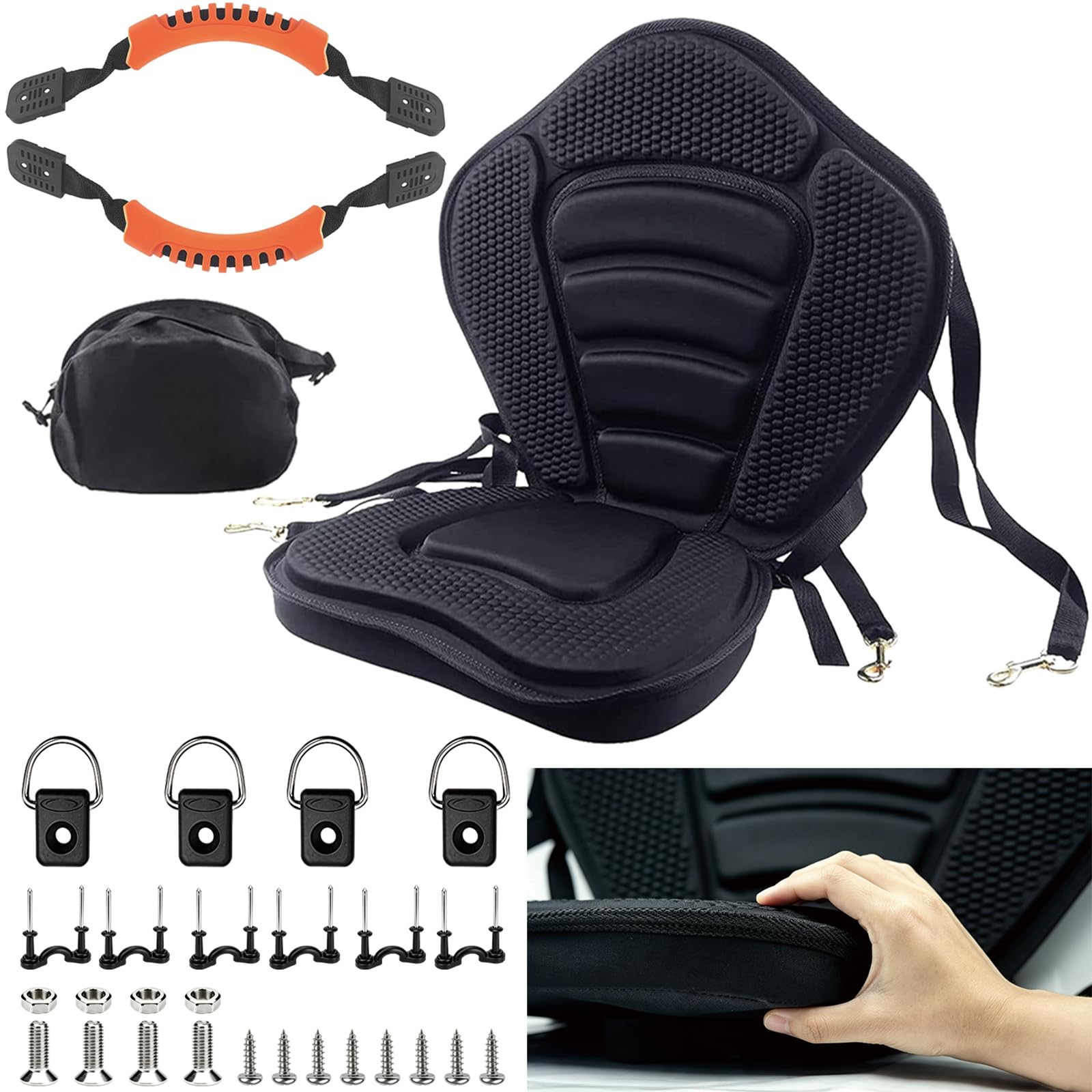
HLOGREE Thicken Padded Kayak Seat

86 /100
Angler Score Excellent

Key details

Weight
4.23 lb
Backrest
17.73 x 20.16 in
Seat Size
12.61 x 15.4 x 2.17 in
Deck Rigging Kit
Included
Check Details on Amazon

Most seats arrive as fabric and foam and leave you to sort out the mounting. This one ships with a deck-rigging kit in the box, which is a strange thing to get enthusiastic about until you are replacing a seat on a boat whose handles are sun-cracked and whose attachment points have started to pull.

The seat itself is substantial: a 17.73 by 20.16-inch backrest, a cushion 2.17 inches through, and EVA foam that sits you upright and holds the angle rather than sagging back. The tall back is the reason it is here, because on a long paddle it is the closest thing in this group to the BKC's support.

Mounting is four straps, and the fit is listed as vehicle-specific rather than universal, so measure before you order. Check that your boat has four usable attachment points and that the seat back will not foul a crate or a rudder line behind you. The straps adjust easily on land; on the water, less so, which is true of every seat here.

Firmness is the thing to think about. This pad has more spine than the word thicken suggests, good if you want support underneath you and less good if you want to sink in, and the back is tall enough that you notice it on a long sit. If a soft landing is the priority, the WOOWAVE is the better fit; if a supported one is, this is the seat.

Pros

  • Deck rigging kit included
  • 17.73 x 20.16-inch backrest
  • 2.17-inch thick seat cushion
  • Firm EVA foam holds its shape

Cons

  • Clips tarnish with use
Our verdict

A tall, firm seat that arrives with deck hardware: our choice for putting an older kayak back into service.

Check Latest Price

How We Tested 12 Kayak Seats on the Water

We started by pulling every seat we could find that shipped with four independent straps, a backrest tall enough to reach the middle of the shoulder blades, and hardware that looked like it would survive a season of sun. Anything with a fixed strap length or a back that stopped at the waist got cut, since those are the two things that make a seat unusable on a hull it wasn't designed for. Price counted only as a ratio against foam density and buckle quality — a sewn-in back with plastic hardware isn't a bargain at any number. That left 12 seats, which we bought ourselves and mounted on the same handful of boats.

Testing ran from late spring through the fall, about eight months, across flatwater lakes, one slow river float, and a few early fishing mornings where we sat still for hours. We also strapped two seats to a paddleboard and clamped a pair into a canoe. Each seat got at least three long paddles, and we rotated several between a wide recreational hull and a narrower sit-on-top to see how the same strap layout behaved on different decks.

In the driveway we pressed a thumb into every cushion and timed how long the foam took to spring back; on the water we noted where it bottomed out after the second hour. We watched whether the back panel held us upright or folded backward with each stroke, whether the seat crept forward once things got wet, and how much strap tail was left flapping in the wind. We counted how many adjustments we could make one-handed while afloat, and after every trip we hosed each seat down, dried it in the sun, and checked the stitching, webbing, and buckles for wear. The seats that stayed comfortable into the fourth hour were the ones with denser foam and a back that anchored at the sides as well as the base.

How to Choose a Kayak Seat

Start With Backrest Height and Stiffness

Back support comes from height and rigidity, in that order. A backrest that stops at your waist leaves your lower back doing all the work; one that reaches the bottom of your shoulder blades shares the load. That is why the seats here run 17 to 18 inches tall, and why the ones with a stiffened back, such as the BKC pair, the OceanMotion and the Leader, feel different from a soft sling even when the foam looks similar.

Two checks before you buy. Sit against the backrest and make sure the top lands between your shoulder blades rather than in your ribs, and on a sit-in kayak confirm that a tall back clears the cockpit rim so you can still get out in a hurry.

Straps, Clips, and Attachment Points

Four straps beat two, but only if your boat gives them somewhere to go. Sit-on-tops usually have pad eyes or molded loops fore and aft; canoes and cheaper kayaks sometimes have two up front and nothing behind, which means adding hardware or running both rear straps to a single point.

Strap reach matters as much as strap count. It runs from 17 inches on a folding bench seat to 22 inches on the OceanMotion, and if your pad eyes sit forward of the seat well, the short end of that range will not get you there. Metal clips outlast plastic in salt water, and the front pair is what sets your backrest angle, so those are the ones to pull snug.

Thickness Is Not Support

Foam comes in densities, and a thick soft pad can bottom out under a heavier paddler where a thinner firm one holds its shape. Memory foam gives a softer landing; EVA stays firmer under load. Judge the two halves of a seat separately, because the seat pad is where most builders save money, and several seats here have a well-made back paired with a thin cushion.

If you paddle in heat, look at the surface. Grooved or channeled pads, like the one on the WOOWAVE, let water and air move under you instead of leaving you sitting in a puddle.

Fit, Weight, and the Rest of the Day

Match the seat to the seat well, not to the boat's overall length. A 20-inch-wide backrest can foul a narrow cockpit or a crate stowed behind the seat, and a seat pad wider than the well bunches under your thighs.

Weight matters if you portage or car-top, and the seats here run from roughly 1.1 to 2 kilograms. A detachable bag earns its place only if you can reach it, so pack it on shore before you push off rather than twisting around mid-paddle.

Frequently Asked Questions

Final Verdict

Buy the BKC PS223 if you want one seat that handles a long day without your back joining in: tall, firm memory-foam support, four straps of marine-grade hardware, and a warranty behind it. If two boats need seats, the RELIANCER pair covers both at the lowest cost per boat; if your boat is wide or you are tall, the OceanMotion's 22-inch straps reach where the others fall short; and if the budget decides, the KS222 still gives you a real backrest for short trips, though it folds under a hard lean.

Whichever you choose, count your attachment points first. That number decides which seats fit your boat at all, and it is the one thing worth checking before you click buy.