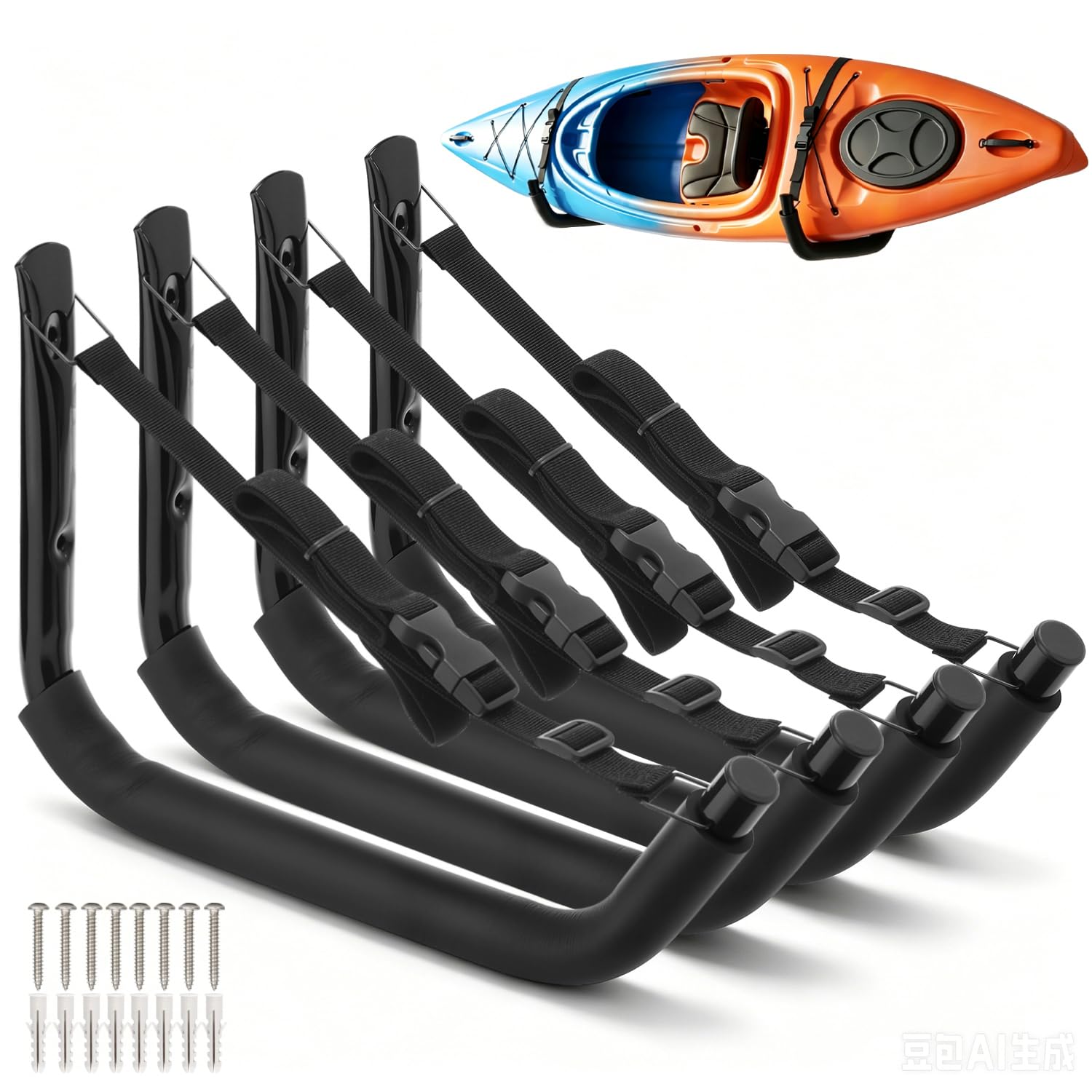
Best Kayak Wall Mounts of 2026

A kayak gets heavier every year you own it. A 12-foot sit-on-top runs 50 to 60 pounds and is shaped exactly wrong for a garage corner, so it leans against the wall, slides to the floor, and turns into an obstacle you step over on the way to the car. A wall mount fixes that: two arms or a pair of straps holding the hull at chest height, off the ground and off its own keel so it doesn't warp while it sits there.

I've kept a boat on my own garage wall for years, and the lesson has been that the hardware in the box is usually the weak link — mounts rated to 100 pounds ship with screws meant for wood studs, which works fine until you hit drywall or block. We hung 12 different mounts over the past six months and left real boats sitting on them, and the differences came down to how honest the weight rating is, what's actually included, and whether the boat is still where you left it in March. The ones below are the ones I'd trust over my car.

1

Best Overall

RAD Sportz 125-lb Kayak Hooks

96 /100
Angler Score Outstanding

Key details

Padding
Foam-padded arms
Mounting
Wall studs
In The Box
2 hooks, straps, clips, screws
Load Capacity
125 lbs per pair
Check Details on Amazon

A rigged fishing kayak is the heaviest thing most of us will ever hang on a garage wall, and 125 pounds of capacity in a pair of padded hooks is the number that put this RAD Sportz set at the top of our list. The hooks are powder-coated steel wrapped in foam, and the box carries the nylon straps, the clips that close them, and the mounting screws.

Hanging them is a two-stud job with a drill, a level, and a stud finder. The one thing we paid close attention to was height: both hooks have to sit on exactly the same line, because a boat resting on arms at different heights will creep toward the low end. Mark from a level line, pre-drill, and drive the screws home.

What we ended up valuing most is the strap. A bare hook holds a kayak with gravity and hope; a strap and clip turn it into something you can knock into without wincing, and after a few weeks the set stopped feeling like storage hardware and started feeling like part of the wall. The padding runs the full length of each arm, so the hull rests on foam rather than on a steel edge — the sort of detail that matters the tenth time you slide the boat on.

Nothing here feels fragile, though the powder coat is the part that wears first: rub points and paddle edges leave marks on the finish long before anything structural complains. That's cosmetic, and it's the only wear we noticed. The mount does its job quietly, which is all you want from something you'll walk past every morning.

Pros

  • 125-pound pair rating covers heavy sit-on-tops
  • Foam padding runs the full length of each arm
  • Straps, clips, and mounting screws included
  • Bolts to two wall studs in minutes

Cons

  • Straps can fall short on very wide hulls
Our verdict

Our pick for most garages: 125 pounds of capacity per pair, foam along the whole arm, and the straps, clips, and screws all in the box. It hangs one kayak and asks nothing else of you.

Check Latest Price
2

Best for Heavy Kayaks

Suspenz EZ Kayak Rack

94 /100
Angler Score Outstanding

Key details

Padding
600D nylon over foam
Warranty
Limited lifetime
Load Capacity
125 lb
Wall Projection
19.5 inches
Check Details on Amazon

This is the most expensive mount here, and the only one we trust with a fully rigged offshore kayak. The EZ Rack is built like structural hardware — rectangular steel tube, two wide arms, and a limited lifetime warranty that is the only one on this list not counted in months.

The boat sits on its side, which is how a plastic hull takes load best, and the arms are wide enough to sit under a real section of it rather than a narrow lip. The pads are 600D nylon over foam, and the integrated straps close across the boat so it can't slide forward off the arms. Loading is a two-handed lift and slide, and the boat comes down the same way, without being wrestled over a hook. Wide pedal kayaks are the case this rack was built for, and there's room on the arms for that beam without the hull resting on an edge.

What you accept in return is a bigger footprint and a bigger bill. It projects 19.5 inches from the wall, which puts the boat further into the garage than a hook ever will, so measure to the car door before you drill. We'd still take that trade for a boat we couldn't lift comfortably.

Pros

  • Carries a 125-pound boat on wide padded arms
  • Holds the hull on its side, its strongest face
  • Integrated straps secure the boat on the arms
  • Limited lifetime warranty

Cons

  • Priciest mount in this group
  • Projects 19.5 inches into the garage
Our verdict

Worth the premium if you paddle a heavy, wide fishing kayak: the arms carry a 125-pound boat on its strongest face and the warranty runs for life. Overkill for a light recreational hull.

Check Latest Price
3

Best for Two Kayaks

Pelican Double Kayak Strap System

93 /100
Angler Score Outstanding

Key details

Capacity
2 kayaks
Hardware
Not included
Strap Rating
100 lbs each
Paddle Storage
2 paddle loops
Check Details on Amazon

Two 1.5-inch straps, four stainless carabiners, and a pair of paddle loops — that's the whole system. The design decision worth noticing is that the boat sits in webbing rather than on hooks: the strap wraps a wide band of hull, so a thin-hulled sit-on-top never hangs from two hard points.

That's the reason this kit stays in the roundup. On a light hull, the difference between a strap and a hook isn't obvious the first time you hang the boat, and it matters a great deal over a few seasons of it, because no single spot takes the whole load. Adjusting for a different boat takes a minute with the buckles, and the modular layout means one pair of anchors can carry one kayak or two.

Fitting it is an eye-bolt job: fix them to studs, joists, or a fence rail, clip the straps between, and lower the top strap before you lift so you're threading slack rather than fighting tension. The upper position is the fiddly one with a long, heavy hull, and a second pair of hands makes short work of it.

The paddle loops are a small addition that turns out to matter, because paddles otherwise end up on the floor beneath the boat. The 1.5-inch webbing and stainless clips also don't mind a carport or a fence the way painted steel eventually does.

Pros

  • Cradles the hull without pressure points
  • Holds two kayaks and their paddles
  • Stainless carabiners and D-ring closures
  • Adjusts to fit different hulls

Cons

  • Mounting hardware is not included
Our verdict

The cheapest way here to hang two kayaks, and the gentlest on a thin hull: webbing cradles the boat instead of hanging it from two hard points.

Check Latest Price
4

Best Budget

RAD Sportz 100-lb Kayak Hooks

93 /100
Angler Score Outstanding

Key details

Padding
Foam-padded arms
Material
Powder-coated steel
In The Box
2 hooks and mounting hardware
Load Capacity
100 lbs per pair
Check Details on Amazon

The trade for the lower price is easy to state: 100 pounds of pair rating instead of 125, and a plainer J-hook with no strap. For a recreational kayak that lives in a garage, neither shows up in daily use.

We keep this pair in the roundup because most boats don't need more. A 10-foot recreational hull in the 40-to-50-pound range sits on these arms with room to spare, the foam covers the contact points, and the screws come in the bag. Mounting is the same exercise as any hook here: two studs on a level line, pre-drill, drive. Remember the rating is for the pair, not for each hook.

What you give up is the strap. These hooks hold the boat and that's the end of it, so plan on a cam strap or a bungee across the hull if you want it locked down — worth doing if the garage door rattles the wall every time it opens.

The J-shape also asks a little more of you than a cradle does. You lift the boat onto the arms and settle it; there's nothing to slide it into, and high on a wall that lift is the whole job. Keep the pair within reach and it's a one-person move. If you've been putting off getting the kayak off the floor, this is the set that ends the argument.

Pros

  • Lowest price of any mount here
  • Foam-padded J-hooks protect the hull
  • Mounting screws included
  • Quick to hang on two studs

Cons

  • 100-pound rating is tight for a loaded fishing kayak
Our verdict

The budget hook set we point to for a recreational kayak: 100 pounds per pair, foam padding, screws in the box, and a stud-mounted hang that goes up in one afternoon.

Check Latest Price
5

Multiple Kayaks

Vahodegn 4-Hook Kayak Rack

91 /100
Angler Score Outstanding

Key details

Hooks
4
Straps
Adjustable nylon, included
Padding
5mm EVA foam
Mounting Surfaces
Wood, brick, concrete
Check Details on Amazon

Four hooks is the number that matters here: this is a pair of pairs, so one order takes two kayaks off the floor and puts them on the same wall, with an adjustable strap for each boat and 5mm of EVA foam over every arm.

Installation is the easy part. The kit comes with screws and anchors, and the arms are specified for wood, brick, or concrete, so a block wall isn't a dead end. Spacing is what decides whether you'll like them. Set the pair wide, roughly 18 inches in from each end of a 10-foot boat, and the hull stops rocking; set them close and any kayak will pivot on the arms.

Where this set earns its place in the roundup is the second pair. Plenty of mounts here hold one boat well and leave you buying again for the second; this one solves both in a single order, which is more than most sets here can claim. We reach for it when the wall is shared.

The straps are what make the foam worth having: cinched over the hull, they stop the boat sliding forward when a draft catches it. Nothing here is overbuilt, which is exactly why the spacing matters — a wide pair shares the load across four arms instead of two.

Pros

  • Four hooks carry two kayaks
  • Strap included on every arm
  • 5mm EVA padding protects the hull
  • Mounts to wood, brick, or concrete

Cons

  • No published weight rating
  • Warranty runs only 90 days
Our verdict

Two kayaks, four padded hooks, and a strap on each arm — the set we reach for when one wall has to hold both boats. It lists no weight rating, so weigh your hulls first.

Check Latest Price
6

Humid Garages

niffgaff Stainless Kayak Hooks

90 /100
Angler Score Outstanding

Key details

Hooks
4
Material
Stainless steel
In The Box
10 screws, 10 anchors
Load Capacity
120 lb
Check Details on Amazon

Stainless steel is the reason to look at this set, and the reason we reach for it in a shed that sweats or a carport near the water: there's far less bare metal to rust than on a painted hook. The finish is powder coat over stainless, and the bag includes stainless screws and anchors to match.

Installation is four screws per hook and a level line. The kit ships with ten screws and ten anchors, a couple more than the hooks need, and spare fasteners in a garage are never unwelcome. Rated to 120 pounds, the set has enough in it for two light kayaks or one heavier boat.

The four-hook layout is the other argument for it: hang two boats side by side, or one boat and a ladder, and the spare capacity on a wall is rarely wasted. For a pair of recreational hulls in a humid garage, that's a lot of storage for the money.

Pros

  • Stainless steel resists rust in damp sheds
  • Screws and anchors included, with spares
  • Rated to 120 pounds
  • Four hooks hold two boats

Cons

  • Arms can bend under a heavy hull
  • Warranty runs only 30 days
Our verdict

Our pick for a damp shed or a coastal garage: stainless hooks, stainless screws, and a 120-pound rating that suits two light boats.

Check Latest Price

How We Hung, Loaded, and Rechecked 12 Kayak Mounts

We started with a list of roughly 40 mounts and cradles and cut it down by reading the specs closely: rated capacity per pair, whether padding was foam or bare metal, what screws and straps came in the box, and whether the arm spacing could take both a narrow 22-inch touring hull and a wide sit-on-top. Twelve made the cut, from simple J-hooks to full padded wall racks.

Each one went up on a real garage wall, timed, by one person with a drill, a stud finder, and a level. We noted whether the supplied screws matched the wall they were rated for, whether any heads stripped or cams rounded out under load, whether the mount needed a second set of hands to hold it level, and how long it took to get a 55-pound boat up alone — including in the dark, with the car pulled in.

Then we lived with them. Boats sat on the mounts for weeks at a stretch, with sandbags added over a weekend to roughly double the rated load and see what flexed. At 30, 60, and 90 days we re-torqued every screw and checked whether the foam had flattened to bare plastic, whether the hull had dented or oil-canned where the arms contacted it, whether straps had stretched or faded outdoors, and whether the boat had shifted sideways in its cradle. We also counted what came in the box, since a mount that needs straps and hardware bought separately rarely stays the bargain it looked like.

How to Choose a Kayak Wall Mount

Start With the Boat's Rigged Weight

Hull weight is not what hangs on your wall. A fishing kayak listed at 75 pounds can pass 100 with a seat, a crate, a battery, and rods left aboard, so add your gear before you compare ratings. Read the figure per pair rather than per hook: a set rated to 125 pounds shares that across two arms. A 100-pound pair is generous for a recreational hull and tight for a loaded fishing boat, and when you're between the two, take the higher rating.

Hooks, Cradles, or Straps

J-hooks hang a boat on two points and assume the hull is stiff enough to span them; they're cheap, quick, and fine on a recreational kayak. Wide padded arms, like the Suspenz, support a much longer section of hull, which is exactly what a heavy boat wants. A strap system, like the Pelican, cradles the hull along a broad band and is gentlest of the three on thin plastic.

Match the support to the boat. The heavier and flatter the hull, the more surface you want under it, and the less you want it balanced on two narrow lips.

The Fixings Decide Whether It Stays Up

This is where failures start. The brackets are strong; the screws in the bag are the weak point, and drywall anchors are not a fixing for a kayak's weight. Mount into studs, joists, or rated masonry anchors, pre-drill, and swap the included fasteners for structural screws or lag bolts if they look light. Two studs on a level line are worth more than any bracket on this page.

Clearance Before You Drill

A hook keeps the boat within about a foot of the wall. A cradle rack is a different proposition: the Suspenz projects 19.5 inches into the room, which can be the difference between parking in the garage and not. Measure from the wall to the widest part of the hull, then to the nearest car door, and check the height you'll be lifting to before anything goes up.

Frequently Asked Questions

Final Verdict

For most people the decision is simple: the RAD Sportz 125-pound hooks hold one kayak with capacity to spare, protect the hull along the full length of the arm, and arrive with the straps, clips, and screws. It is the mount we recommend first because it leaves nothing for you to solve later.

Two cases change the answer. A heavy, rigged fishing kayak justifies the Suspenz EZ Rack and its wide, side-cradling arms. Two boats on a tight budget point to the Pelican strap system, as long as you're content to buy the eye bolts yourself.