Best Kayak Stakeout Poles of 2026

You pole onto a flat, find tailing fish, set the rod down to re-tie a lure — and by the time you look up, the wind has walked you thirty yards off the spot. A stakeout pole is the fix: shove it through grass or sand, clip off, and stay exactly where the fish are. The trouble is that the wrong one makes the problem worse. Too whippy and it bends instead of biting, too short and it won't hold in chop, and if it doesn't float, you get to watch it disappear into four feet of murk and think about it for the rest of the morning.

I've owned three of these, and the ones that stay on my deck are stiff through the middle, easy to set one-handed while the other hand is still on a rod, and buoyant enough that a fumble isn't a loss. Over the past eight months, my team and I have put 11 stakeout poles into tidal creeks, marsh grass, sand, and shell, and the gaps between them come down to construction and how they behave in the worst ten seconds of a drift. Here's what held, what floated, and what actually kept the boat where I put it.

1

Best Overall

YakGear YakStick Mud Anchor

92 /100
Angler Score Outstanding

Key details

Floats
Yes
Length
6.5 ft
Weight
22 oz
Material
Fiberglass
Check Details on Amazon

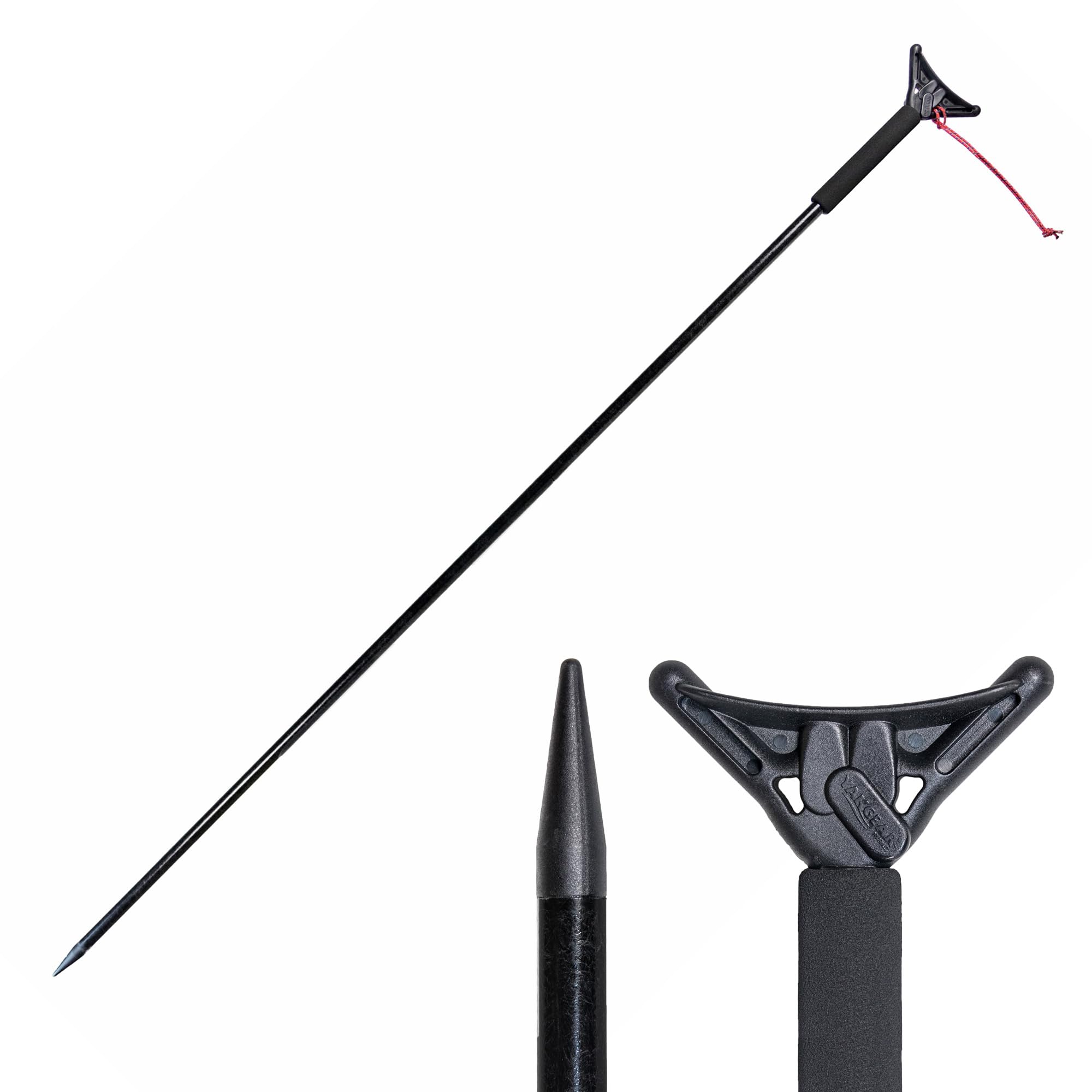
At 22 ounces and buoyant enough to fish out if it goes overboard, the YakStick is the pole we reach for when we want to stake out without adding noticeable weight to the kayak. The 6.5-foot fiberglass shaft is long enough for most inshore flats, and the oversized foam grip gives you something secure to hold when you push the tip into mud. That combination is why it is our top pick.

The grip is more than a comfort detail. It gives you a dry hold when you are setting the pole one-handed, and the molded rope attachment at the handle makes it easy to add a leash or anchor line without a separate clip. We also like the three-year warranty; it is the kind of coverage that matters on a pole that will meet gunwales, decks, and shallow bottoms.

The shaft is hollow fiberglass, and side load is where it is most vulnerable. Use it as a pry bar or try to pole hard through shell and it can crack; treat it as a stakeout pole that can help with short pushes, not a heavy-duty push pole. For soft mud, marsh edges, and sandbar stops, that trade-off is easy to accept.

Pros

  • Light at 22 ounces
  • Floats if dropped
  • Foam grip and molded rope attachment
  • Three-year warranty

Cons

  • Shorter reach than the 7- and 8-foot picks
Our verdict

We think the YakStick is the easy default for most kayak anglers: it's light, floats, and has a comfortable grip with a leash point.

Check Latest Price
2

Best for Hard Bottoms and Current

Superstick Shallow Water Anchor Pin

91 /100
Angler Score Outstanding

Key details

Tip
Stainless steel
Length
7 ft
Weight
2.2 lb
Diameter
5/8 in
Check Details on Amazon

When the bottom stops being soft, the Superstick is the pole we want in our hand. The 5/8-inch fiberglass shaft is slim enough to push deep, and the stainless steel tip takes the wear that a nylon point struggles with. At 7 feet, it is longer than the YakStick, and the extra length gives you more room to hold on a hard-bottom point.

The stainless tip is the reason it earns a runner-up spot. It bites into packed sand and clay with less fighting, and the narrow shaft leaves a smaller hole, so the pole sets deeper and holds better in a steady tide. We also appreciate the included 6-foot lanyard and storage clips. Clip the lanyard to the kayak before you set the pole; that is not a step to skip with a slim pin.

The 5/8-inch shaft is built for setting, not for long hours of poling. If you want a T-handle to lean on, the EDSRDPLT is the better fit. For short moves between potholes and for holding in current, the Superstick is the one we trust to stay put.

Pros

  • Stainless tip handles hard bottoms
  • Slim shaft sets deep
  • Holds in current
  • Includes lanyard and storage clips

Cons

  • Heavier than the top pick at 2.2 pounds
Our verdict

We reach for the Superstick when the bottom firms up or the current pushes: its stainless tip and slim shaft make it the stronger holding tool here.

Check Latest Price
3

Best for Stowing in the Hull

YakAttack ParkNPole Link

85 /100
Angler Score Excellent

Key details

Length
8 ft
Pieces
2
Weight
1.8 lb
Material
Fiberglass
Check Details on Amazon

The ParkNPole Link solves a problem the one-piece poles can't: it breaks into two sections, so an 8-foot pole can live inside the hull of a fishing kayak instead of riding on top. At 1.8 pounds, it is light for its length, and the fiberglass shaft is UV stabilized. We liked that the two sections make it easy to stash in a hatch or along the hull; on a small deck, that matters more than a fancy grip.

The reach is the other reason it earns a runner-up spot. Eight feet gives you more room to work than the 6.5- and 7-foot picks, and it is the pole we choose when a flat drops off faster than expected. We found it worked best in water up to about 7 feet deep.

The joint is the thing to watch. A two-piece pole depends on a secure connection, and the midpoint can come loose after a few uses; check it before you push hard. That maintenance is the cost of the compact storage.

Pros

  • Two-piece design stores inside the hull
  • 8-foot reach for deeper flats
  • Light for its length at 1.8 pounds
  • UV-stabilized fiberglass

Cons

  • Premium price for the storage convenience
Our verdict

We recommend the ParkNPole Link when deck space is tight and you need an 8-foot pole that disappears into the hull.

Check Latest Price
4

Budget Two-Piece

EDSRDPLT Anchor and Push Pole

82 /100
Angler Score Excellent

Key details

Tip
316 stainless steel
Length
7.75 ft
Pieces
2
Weight
3.7 lb
Check Details on Amazon

The T-handle and built-in compass make the EDSRDPLT the most distinctive pole here, but the feature that matters is the two-piece shaft that floats. At 7.75 feet, it reaches farther than the YakStick and Superstick, and the 316 stainless tip is the right material for hard-packed sand and clay. The grooved tip is designed to screw in, and the T-handle gives you something to push against when you are poling across a flat.

We see it as a push-first alternative rather than the best all-around stakeout. The two-piece joint needs attention; if it works loose, the pole feels wobbly when you lean on it. The T-handle is comfortable for poling, but it adds bulk compared with the slim foam grip on the YakStick.

In soft mud, the grooved tip bites and holds; in harder ground, it takes more effort to set. The compass is a nice touch, though it is not why we choose the pole. This is the one for a paddler who wants a push pole first and a stakeout second, and it costs less than the premium pick.

Pros

  • T-handle with integrated hook
  • Floats and breaks into two pieces
  • 316 stainless tip
  • Long 7.75-foot reach

Cons

  • Heaviest pole here at 3.7 pounds
Our verdict

We think the EDSRDPLT is a solid push-first choice for kayak anglers who want a T-handle, a floating two-piece shaft, and a long reach.

Check Latest Price

How We Chose and Tested Kayak Stakeout Poles

We started with roughly 40 poles marketed for kayak use and cut anything that was too short to hold in wind chop, too long to lay flat along a 12-foot boat, or built around a handle that only works with two hands. That left 11, ranging from 6.5 to 8 feet in aluminum, fiberglass, and composite, and we fished them over eight months — spring grass flats through fall creek crossings — swapping them between a sit-on-top and a pedal boat so no single hull flattered one pole.

The real test is never a calm day standing still. It's the moment the wind is pushing you sideways and you need the boat stopped now, so we deployed each pole one-handed with a rod in the other hand, timed how long it took to set and to pull free, then sat on a three-minute soak and measured how far the boat drifted. In sand we watched whether the tip bit and held or spun loose; in mud we noted whether it released without a two-handed fight; over oyster shell we checked whether the point chipped, dulled, or skated off.

Then we got careless on purpose. Every pole went into the water to see whether it floated flat, floated tip-up, or went down, and we timed how fast we could recover it. We also worked each handle with wet, sandy hands, bounced the shaft off shell to see how the finish held up, and flexed the two-piece joints to check for wobble and water intrusion. Value came down to that simple math: how many seasons it looks likely to survive for what it costs.

How to Choose a Kayak Stakeout Pole

Match Length to the Water You Fish

A stakeout pole only works if it reaches the bottom with enough left over to hold. For most kayak anglers on flats, in marsh creeks, and around sandbars, a pole in the 6.5- to 7-foot range is enough; an 8-foot pole gives you more room on deeper flats and when you want to push off a bar. Don't buy the longest pole you can find and assume it will be better. Extra length is more to carry, more to stow, and more leverage when the current pushes against the shaft.

The YakGear YakStick sits at the short, light end of this group, while the YakAttack ParkNPole Link runs a full 8 feet. Choose based on the depth you actually fish, not the deepest water you might visit once a season.

Weight, Grip, and Tether Matter More Than You Think

You will lift and reset a stakeout pole dozens of times in a session, so weight matters. The YakStick is 22 ounces; the Superstick is 2.2 pounds; the EDSRDPLT is 3.7 pounds. That difference is small on the first set and obvious by the last. A foam grip or T-handle also changes how hard you can push without your hand slipping.

Flotation is not a substitute for a tether. A floating pole can drift away, and a sinking pole disappears faster. Clip a lanyard or rope to the kayak before you set the pole, and use the attachment point the maker provides. The YakGear has a molded rope attachment; the Superstick includes a lanyard.

Match the Tip and Shaft to the Bottom

Soft mud and sand are forgiving; packed sand, clay, and shell are not. A stainless tip holds up better in hard ground, while a nylon pick is fine for mud and grass. The shaft matters just as much: a hollow fiberglass pole is light and buoyant, but it is not a pry bar. Side load is what cracks poles, so push straight down and use the pole to hold, not to lever the kayak sideways.

The Superstick's stainless tip and slim 5/8-inch shaft are the hard-bottom choice here. The YakStick's nylon pick is happier in soft mud. If you fish shell or rock, no stakeout pole is the right tool; use an anchor or drift instead.

One-Piece or Two-Piece?

A one-piece pole is simpler and has no joint to check. A two-piece pole stores inside a hatch or along the hull, which is the difference between carrying the pole on deck and leaving it at home. The trade-off is the joint: it can work loose, so check it before you push hard and keep it clean of grit.

The YakAttack ParkNPole Link and EDSRDPLT are the two-piece options here. Choose one if storage is the limiting factor; choose a one-piece pole if the pole will live on deck and you want fewer parts to think about.

Frequently Asked Questions

Final Verdict

For most kayak anglers, the YakGear YakStick is the one to buy. It is the lightest pole here, it floats, and the foam grip and rope attachment make a shallow-water stakeout feel simple. Treat it as a stakeout pole rather than a heavy push pole and it will handle the flats, marsh, and sandbar stops that make up most kayak fishing.

If you fish hard sand or current, the Superstick's stainless tip and slim shaft are the better tool. If the pole has to live inside your hull, the two-piece YakAttack ParkNPole Link is worth the premium.