Best Kayak Storage Racks of 2026

The moment you get a kayak home is also the moment you realize you have nowhere to put it. A 12-foot boat doesn't lean neatly against a wall — it slides down the garage drywall, collects leaves under the deck, and becomes the thing everyone in the house trips over. A good rack fixes that: it lifts the hull off the floor, cradles it along its widest point so the plastic doesn't deform, and lets one person load up alone. The wrong rack is worse than no rack at all — thin screws pull free of a stud, webbing stretches, and a 50-pound boat comes down at 2 a.m.

My garage doubles as a woodshop and a bike shed, so I take the space math personally. Over the past eight months, my team and I assembled and loaded 12 racks — wall hooks, ceiling hangers, strap slings, and freestanding stands — using a recreational kayak and a heavier touring boat. The surprise wasn't the racks themselves; it was how often the hardware in the bag turned out to be the weak link. The picks below are the ones that held.

1

Best Overall

RAD Sportz Kayak Storage Hooks

96 /100
Angler Score Outstanding

Key details

Straps
Adjustable nylon
Arm Length
29 in
Mounting Type
Wall
Weight Capacity
125 lb
Check Details on Amazon

Two 29-inch arms, foam down their length, and a strap to pin the hull in place: that combination is why this pair is the set we point most people to. The pair is rated to 125 pounds, which covers any recreational or fishing kayak we have hung on them, and the arms are long enough that a wide sit-on-top rests across both instead of balancing on two narrow points.

That width is the detail worth paying for. A broad hull supported at two small spots can flatten over a summer — kayakers call it oil-canning — while a long padded arm spreads the load along the chine. The foam here runs the full length of the arm rather than sitting in a patch at the tip, and the adjustable nylon straps with clips stop a boat rocking every time the garage door comes down.

Installation is two studs, a level, and the hardware that comes in the box. Set both hooks at the same height and under the widest, stiffest part of the hull, with the boat's weight resting on the arms rather than hanging from the strap. Orange is not a subtle color, and in a cluttered garage that helps: you can see from the doorway whether the hull is seated all the way down.

The catch is arithmetic. One pair carries one kayak, so two boats means two sets — still cheaper than the ceiling and freestanding racks here, and it takes less wall than either.

Pros

  • 125-pound rating covers recreational and fishing kayaks
  • Foam runs the full length of each arm
  • Adjustable straps and clips hold the hull down
  • Hardware and instructions in the box

Cons

  • One pair carries only one kayak
  • Paint chips at the contact points
Our verdict

For one kayak and a stretch of stud wall, these are the hooks we recommend: long foam arms, a 125-pound rating, and straps included.

Check Latest Price
2

Best Ceiling Rack

StoreYourBoard Hi Port 2 Ceiling Rack

95 /100
Angler Score Outstanding

Key details

Arm Width
30 in
Mounting Type
Ceiling
Weight Capacity
150 lb total; 75 lb per side
Height Adjustment
10 to 18 in
Check Details on Amazon

The ceiling is the one surface in a garage that usually has nothing on it, and this rack uses it for two boats at once. Hulls hang just below the joists, clear of car doors, bikes, and the pile of things that accumulates against every wall.

Adjustability is what we appreciate most. The arms slide to hang anywhere from 10 to 18 inches below the ceiling, so you can keep the boats high enough to walk under and low enough to reach, and the mounting plate turns 90 degrees to follow the joists whichever way your garage was framed. Thirty-inch arms give a wide fishing hull real contact at both ends rather than a perch.

Capacity is 150 pounds total, 75 per side, which covers a pair of 60-pound fishing kayaks with room on the total and just enough on each side. Closed-cell foam covers the arms, the mounting hardware is in the box, and the frame is powder-coated steel.

What you pay for the space saving is work. There is a real assembly before anything goes up, and then you are lifting a hull overhead and holding it there while you seat it on the arms — a job that goes better with a second person. Check the welds when the box arrives, and be sure the joists are sound before you trust them with two boats.

Pros

  • Stores two kayaks in otherwise unused ceiling space
  • Arms adjust from 10 to 18 inches
  • Base rotates to follow the joists
  • Closed-cell padding and hardware included

Cons

  • Each side is rated to 75 pounds
  • Needs solid joists and clear headroom
Our verdict

We think this is the best way to get two kayaks off the floor entirely, provided your ceiling has sound joists and enough headroom.

Check Latest Price
3

Best Strap System

Pelican Double Kayak Strap System

93 /100
Angler Score Outstanding

Key details

Paddle Loops
2
Strap Rating
100 lb each
Mounting Type
Wall or ceiling
Kayak Capacity
1 or 2
Check Details on Amazon

A sling holds a kayak differently from a pair of hooks. Instead of two pressure points, the webbing carries the hull along a stretch of its length, which is the kinder arrangement for a boat that sits on a wall from October to May. It is also the simplest thing here: straps, carabiners, and two anchor points.

Two 1.5-inch webbing straps, each rated to 100 pounds, close with stainless carabiners and D-rings, so you can clip both to one boat with a gap between them or run two boats one above the other. Two paddle loops come with the kit, and that matters more than it sounds — paddles end up on the floor more often than kayaks do.

It is the pick for a fence, a carport, or the space under a deck, where a framed rack is overkill, and it is the cheapest route into sling storage in this group. The webbing does not care what it is fixed to as long as the fixing is solid, and the whole thing unclips and moves in about a minute when you want the boats somewhere else.

Pros

  • Sling spreads load along the hull
  • Two straps rated at 100 pounds each
  • Works on a wall, ceiling, fence, or deck
  • Two paddle loops included

Cons

  • Mounting hardware sold separately
  • Upper sling is awkward to load alone
Our verdict

Our pick when the boat lives on a wall or a fence all winter and you want the hull supported along its length, not pinched at two points.

Check Latest Price
4

Best Freestanding

RAD Sportz Freestanding Kayak Rack

92 /100
Angler Score Outstanding

Key details

Levels
2
Dimensions
94 x 26 x 52 in
Mounting Type
Freestanding
Weight Capacity
175 lb
Check Details on Amazon

Not everyone gets to drill. If you rent, if the garage wall is already a wall of shelving, or if the boats live on a dock or under a deck, this stand solves the problem without touching the building: two hulls on padded arms, sitting on the floor.

It measures 94 inches long, 26 wide, and 52 tall, and holds 175 pounds across two levels, so a pair of 60-pound fishing kayaks fits with room to spare. The frame is powder-coated steel with UV-treated sleeves on the arms, which is what lets it live outdoors, and hold-down anchors come in the box for windy spots. There is a frame to bolt together before anything goes on it — that is the price of not hanging from a stud.

Loaded and anchored, it sits still. Empty, it weighs about 40 pounds, light enough that a gust on an open deck can shift it, which is exactly why the anchors are included. The real cost is floor: 94 inches is a whole car-length strip, and the upper boat still has to be lifted onto the arms.

What you get for that is a rack that loads from the side rather than overhead, and one that leaves the building as unmarked as it found it.

Pros

  • No drilling into walls or ceilings
  • Holds 175 pounds across two levels
  • Powder-coated frame with UV-treated sleeves
  • Hold-down anchors included for wind

Cons

  • Consumes a 94-inch strip of floor
Our verdict

If you cannot drill, or will not, this stand stores two kayaks without a single hole — and it comes with you when you move.

Check Latest Price
5

Best for Two Kayaks

Vahodegn Kayak Wall Hooks (4-Pack)

92 /100
Angler Score Outstanding

Key details

Straps
Adjustable nylon
Padding
5 mm EVA foam
Mounting Type
Wall
Hooks Included
4
Check Details on Amazon

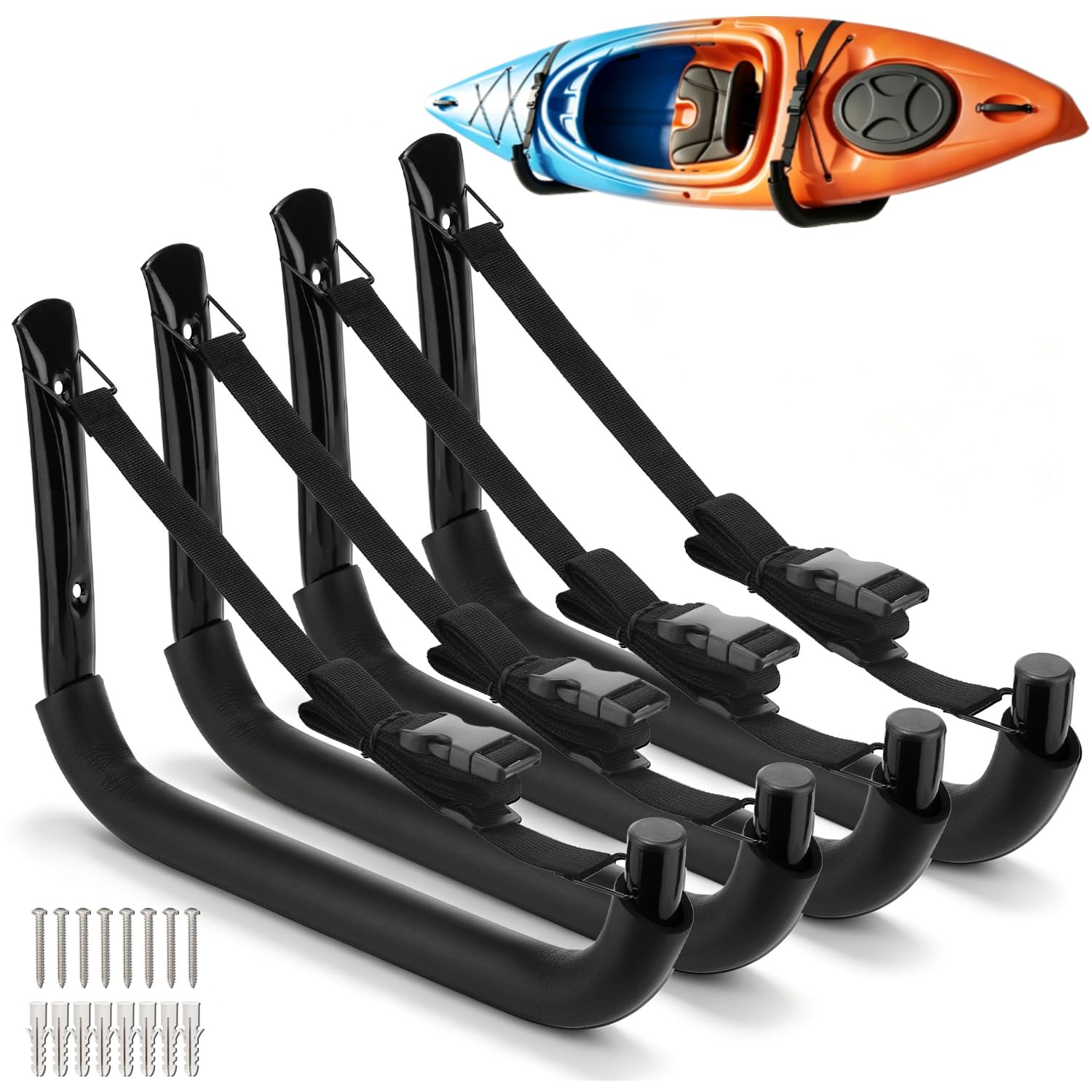
There is no weight rating on this set. Not on the hooks, not in the listing — so the first thing to know is that you are buying four powder-coated hooks with 5mm EVA pads and adjustable nylon straps, and no number telling you what they will hold. What the design gets right is the count: four hooks means two kayaks on one wall, and among the fixed hangers here that is the most boat capacity for the money.

The hardware covers wood, brick, and concrete, the straps clip a hull down flat, and the foam is thick enough to keep gelcoat off steel. Installation is the same two-studs-and-a-level job as our top pick, done twice — and the second pair goes faster once you know where your framing is.

Where it fits: light recreational hulls, a ten-foot sit-on-top, a kid's boat, anything that hangs on a wall where the studs happen to line up. Push past that and the missing rating stops being paperwork and becomes a question, because the arms are where the flex shows up first. For two light boats on a budget, it is the value pick of this group.

Pros

  • Four hooks hold two kayaks on one wall
  • 5 mm EVA foam protects the hull
  • Adjustable nylon straps secure each boat
  • Hardware for wood, brick, or concrete

Cons

  • No published weight rating
  • ⚠️ Hooks can fail under a heavy boat
Our verdict

A sensible buy for two light recreational kayaks on one wall, as long as you accept that the hooks carry no stated weight rating.

Check Latest Price
6

Damp Sheds

niffgaff Garage Storage Hooks (4-Pack)

90 /100
Angler Score Outstanding

Key details

Padding
EVA foam
Material
Stainless steel
Hooks Included
4
Weight Capacity
120 lb
Check Details on Amazon

Stainless steel is the reason to look at this set. Store a boat in a shed, a boathouse, or against a fence and powder-coated carbon steel eventually shows rust where the finish gets scratched; stainless shrugs it off, and this is the only stainless rack here.

Four hooks rated to 120 pounds, EVA foam covering the front of each arm — the part a hull actually touches — and ten screws with ten anchors plus a spare set. The powder coat is even, the pads are thick, and the arms are long enough that a hull sits in the hook rather than perched on the tip.

Bend is the caveat. These are single arms, and a long, heavy rotomolded boat on two of them asks a lot of the design, so treat 120 pounds as a ceiling rather than a target. The 30-day warranty is the shortest in this group, which makes a close look at the welds and pads worthwhile when the box arrives. For a light boat in a wet shed, the material alone makes the case.

Pros

  • Stainless steel resists rust in damp storage
  • EVA foam covers the front of each arm
  • Rated to 120 pounds
  • Ships with screws, anchors, and a spare set

Cons

  • 30-day warranty is the shortest here
  • ⚠️ Single arms can bend under a heavy hull
Our verdict

Choose this one for a damp shed or a salt-air dock, where stainless steel outlasts the powder-coated hooks that dominate this group.

Check Latest Price

How We Tested Kayak Storage Racks

We started by gathering every rack we could find that claimed a 100-pound capacity or better, then sorted them by format: wall hooks, ceiling hangers, strap slings, and freestanding multi-tier stands. Anything that didn't state its hardware sizes or a working load for its straps got cut. That left 12 racks, which we bought ourselves and installed over eight months.

Each one went into the same two-car garage, mounted into studs and ceiling joists we located with a finder and confirmed with a pilot bit. We timed assembly straight out of the box, followed the instructions as written first, and noted where they skipped a step or contradicted the hardware bag. Installation was judged on whether the included lag screws bit cleanly into framing, whether bolt heads rounded off under a socket, and whether mounting holes lined up with standard 16-inch joist spacing. Two racks sent us to the hardware store for better fasteners before we'd trust them with a boat.

Then we lived with them. I loaded a 12-foot recreational kayak solo, then the heavier touring boat, watching how much lifting and balancing each design demanded and whether the hull sat on its widest point or a pressure spot. The freestanding stands and outdoor slings stayed out through rain and a long stretch of hard sun so we could check for rust, chalky faded webbing, and side-to-side wobble; stability got a plain test — an open-palm shove with a boat loaded. Every rack was loaded and unloaded at least a dozen times, and we re-tightened and rechecked every bolt at the end of the eight months.

Sturdiness and value were scored together, since a cheap hook set that held a boat without flexing beat a pricier system we had to reinforce. Two racks showed visible strap stretch after a few months in the sun, and those didn't make the list.

How to Choose a Kayak Storage Rack

Start With the Surface You Can Drill Into

Three families cover almost every garage: wall hooks, ceiling racks, and freestanding stands. Wall hooks need two studs at usable spacing — commonly 16 inches on center, 24 in older framing — plus clear wall for the hull's length, so measure both before ordering. Ceiling racks need joists and headroom; one hanging 18 inches below the joists will not clear a low door track.

If you rent, or the walls are already shelving, a freestanding stand skips the question entirely. We would put location first and features second, because the best hook in the world is useless on drywall alone.

Match the Rating to What Your Boat Actually Weighs

A 10-foot recreational sit-on-top runs roughly 45 to 55 pounds; a rigged fishing kayak can pass 80. Ratings are quoted per pair, per side, or per hook depending on the maker, so find which number you are reading before you trust it. Two 50-pound boats on a rack rated 75 pounds per side is fine; the same two on a 50-pound-per-pair rating is not.

Think About How You Will Load It Alone

The right rack is the one you can still use on a wet Tuesday when you are tired. Wall hooks at chest height are the easiest: lift one end, walk the boat up, set it down. Ceiling racks and slings put the upper position overhead, which is fine for a 45-pound boat and a chore for an 80-pound one. Be honest about which of those you will actually do at the end of a paddling day.

Support the Hull, Not Just the Weight

Two narrow hooks can hold a boat's weight and still ruin it. A hull resting on small, hard points for months can flatten where it sits — kayakers call it oil-canning — and a boat left on one side can take a set along the chine. Look for foam running the length of the arm rather than a patch at the tip, wide arms for wide hulls, and webbing slings for anything stored longer than a season.

If the hooks you already own are bare steel, a length of pipe insulation is the cheapest upgrade in this category.

Measure the Ceiling Before You Buy an Overhead Rack

A ceiling rack drops its arms 10 to 18 inches below the joists, and the hull sits on top of that, so the lowest point of your boat is that distance plus its depth. Add the beam width, then look underneath: the door track, the space over the car hood, the path you carry the boat through. In a low garage, a wall rack or a freestanding stand puts the boat back where you can reach it.

Frequently Asked Questions

Final Verdict

For most garages, the answer is the RAD Sportz hooks: long foam arms, straps included, and a 125-pound rating, for two holes in two studs. Add a second set when a second kayak arrives and you still have less invested than the ceiling rack costs.

Go elsewhere when the situation changes. Two boats and sound joists make the StoreYourBoard ceiling rack the better buy, and a rented house or an open dock makes the freestanding RAD stand the only sensible one. Whatever you choose, match the rating to the boat — a 70-pound fishing kayak on a rack with no stated capacity is how hulls and car hoods get damaged.