Best Kids Life Jackets of 2026

The first time my daughter wore a borrowed life jacket, she bobbed through the shallow end like a cork in a shirt two sizes too big — chin pressed to the collar, arms pinned, grinning anyway. That's the trade-off you inherit: a vest that floats well can be bulky, hot, and chafing enough that kids beg to shed it, while a lighter one rides up or hangs loose. A good kids life jacket fixes both — it holds them at the surface and lets them forget they're wearing it.

Nobody warns you that fit, not features, decides everything: these vests are sized by weight rather than age, and a gap at the shoulders or a side strap that won't cinch tight matters more than anything printed on the tag. I've spent four months putting 14 kids life jackets on wiggly, impatient children in pools, off lake docks, and behind a boat, and the ones that earned a spot all stayed put when a kid jumped in. Below, the picks are grouped by weight and age — start there.

1

Best Overall

Body Glove Paddle Pals

96 /100
Angler Score Outstanding

Key details

Shell
Polyester
Closure
Back buckle plus shoulder harness
Weight Range
33-55 lb
USCG Approval
Type V/III
Check Details on Amazon

The harness is what sold us. It runs over both shoulders and locks into a three-point buckle in the middle of the back, so when a kid jumps in and the foam tries to climb, the vest gets held down at the chest instead of bunching up around the ears. Ride-up is the failure that turns a good vest into something a child fights instead of swims in, and this is the most deliberate answer to it here.

That rear buckle is a two-adult job — one to hold a wriggling preschooler, one to fasten. We think it's a fair trade, because it sits exactly where small hands cannot reach. A child who can undo a front zip mid-lake is a child who will. The multi-panel polyester is soft enough that we did not see the red marks under the arms a stiffer shell leaves after an hour.

Sizing is the catch, and it is a real one. Body Glove builds a single certified band, 33 to 55 pounds, for ages 2 to 6 — no infant collar, no youth vest. At 30 pounds this one will not be snug; at 58 it will not close. The upside of one band is that the panels are cut for one body size instead of stretched across three, which is part of why it sits so well inside its range.

The dinosaur does more work than it looks like it should. A vest a kid wants to put on is a vest that stays on, and this is the one in the set children ask for by name. Body Glove backs it with a two-year warranty against defects.

Pros

  • Shoulder harness resists ride-up
  • Rear buckle is hard for kids to undo
  • Soft, chafe-resistant panels
  • Coast Guard approved for 33-55 lb

Cons

  • Only one weight band, 33-55 lb
  • Back buckle takes a second adult
Our verdict

We recommend the Paddle Pals first for a 2- to 6-year-old in the 33-55 pound band: the harness over the shoulders is the best answer to ride-up in this set.
Check Latest Price
2

Best for Babies

Stohlquist Infant

94 /100
Angler Score Outstanding

Key details

Buoyancy
7.6 lb stated
Head Support
Sculpted collar, grab handle
Weight Range
20-30 lb
USCG Approval
Type II (infant)
Check Details on Amazon

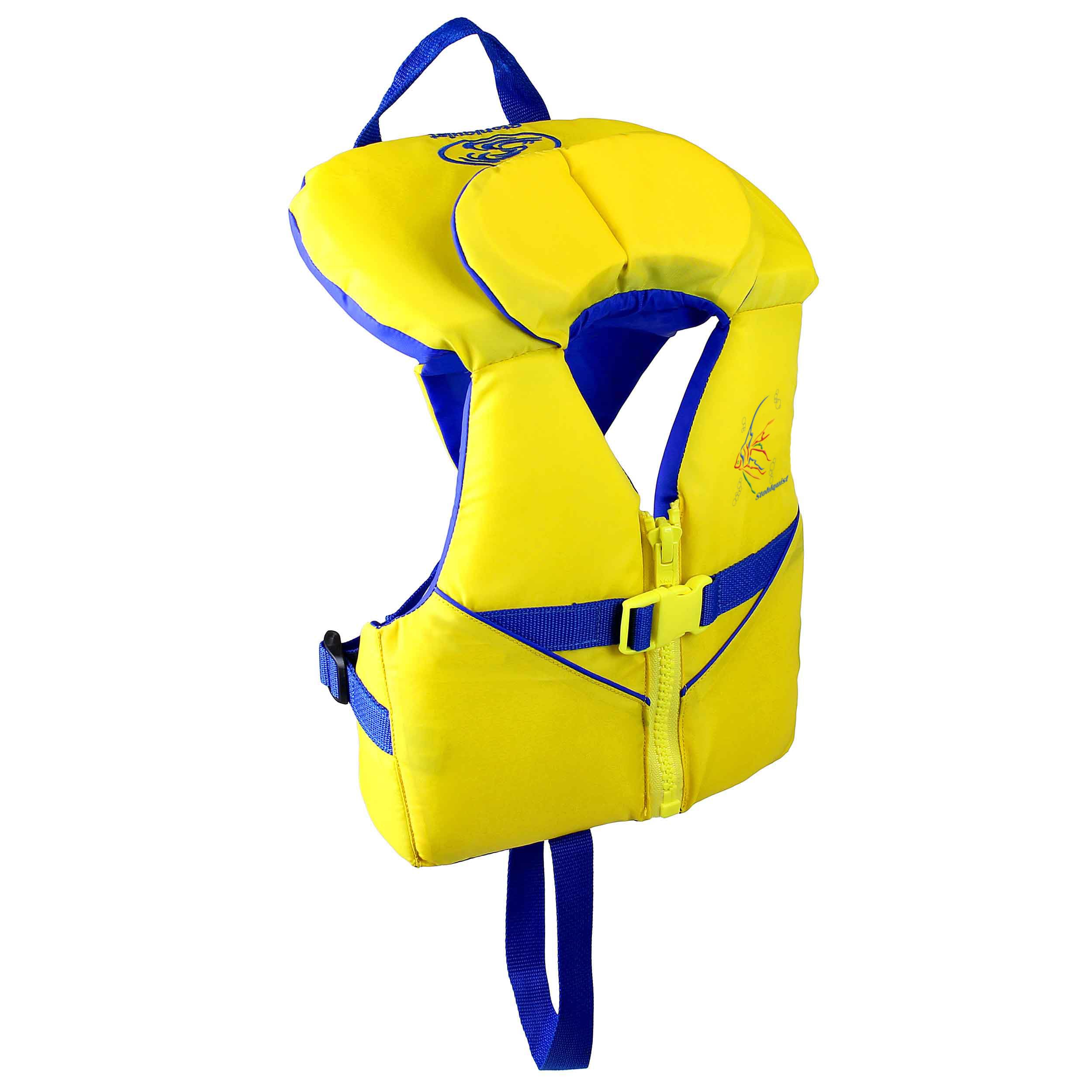
Between roughly 20 and 30 pounds, most of the kids' aisle stops fitting: the child vests start at 30 or 33, and a baby that size is still too small for them. That is the gap this Stohlquist fills, as a Coast Guard Type II infant vest sized for a baby who has outgrown the newborn carrier but is nowhere near a child vest.

What we noticed first is the collar. It is sculpted foam that sits behind and beside the head, holding a small head up instead of letting it loll, with a V-shaped opening that leaves room under the chin rather than pressing on it. The grab handle at the back is the other thing we came to rely on: it lets one adult lift a baby out of the water or off a swim step without peeling them out of the vest.

It is a rigid vest, and that is the trade for the collar. A baby in a Type II sits propped rather than cuddled, and the foam is bulky enough that some babies object loudly for the first few minutes. The headrest also does not put every baby on their back — it can hold a very small one tipped slightly forward — so try it in shallow water at home before committing to a day on the boat.

The materials are a step above the rest of the list: Gaia PVC-free foam, a 200-denier nylon shell and liner, and 7.6 pounds of stated buoyancy. A zipper plus adjustable straps and a crotch strap keep the vest where you put it, and the bright yellow and blue is easy to spot from the dock. With a baby on open water, this is the one here we trust most.

Pros

  • Face-up collar with a grab handle
  • Serious materials for the money
  • Certified infant Type II, 20-30 lb
  • Zip plus crotch strap hold it down

Cons

  • Most expensive pick in this set
  • Covers only 20-30 lb, outgrown fast
Our verdict

For a 20- to 30-pound baby on a boat, this is the vest we trust most — a certified infant Type II with a collar that holds a small head up.

Check Latest Price
3

Best Value

Airhead Trend

93 /100
Angler Score Outstanding

Key details

Size
Child, 30-50 lb
Shell
200-denier polyester
Closure
Zip, buckles, crotch strap
USCG Approval
Type III
Check Details on Amazon

Closed sides, a front zip, two side-release buckles and a crotch strap for the least money in this set: that is the Trend's pitch, and it delivers. Closed-side vests are the ones that stay put, because with the foam wrapped around the torso there is simply less room for the vest to shift when a child is vertical in the water.

The shell is 200-denier polyester with a UV and stain-resistant finish, which is the right call for something that lives in a beach bag and gets left in the sun. It is sized Child, 30 to 50 pounds, and the straps are the reason there is any range at all — a 48-pounder is at the limit of what they will take up.

What we like is that nothing on the Trend is precious. Sand, sunscreen, lake water, a dunking — it comes back for more, and a second one for a cousin is not a decision. Not every vest has to be the last one you buy.

Pros

  • Closed sides plus a crotch strap
  • Least expensive vest in this set
  • Soft, UV-resistant 200-denier shell
  • Coast Guard approved Type III

Cons

  • Seams can fray and dye can transfer
Our verdict

The Trend is our budget pick: closed sides, a crotch strap and Coast Guard approval for the least money here, as long as you accept a shorter service life.

Check Latest Price
4

Best for Bigger Kids

Stohlquist Kids 50-90

91 /100
Angler Score Outstanding

Key details

Closure
Three front buckles
Back Panel
Thin, seat-friendly
Weight Range
50-90 lb
USCG Approval
Type III (youth)
Check Details on Amazon

Somewhere around 50 pounds, the child-size vest that has worked for years stops closing, and the options get thin. The Stohlquist youth vest covers 50 to 90 pounds, and it is designed by people who assume the kid will be sitting in something — the back panel is deliberately thin so it does not fight a kayak seat or a boat cushion. That one detail is why it holds a place here.

The three front buckles are the fit story. You can take up slack at the chest and not just the waist, which is where a youth vest either settles down or starts climbing. Sculpted foam panels leave the arms free, the 200-denier nylon shell dries fast, and a kid can paddle in it for an afternoon without asking to take it off.

It is still a Type III, so it is for calm water and quick rescue rather than for turning an unconscious child face-up — that is the job of the infant collars here. And a child right at 50 pounds sits at the bottom of the band, so tighten the chest buckles with the vest on and check it in the water before the boat leaves the dock.

Pros

  • Thin back panel clears seats
  • Three front buckles for chest fit
  • Free arm movement for paddling
  • Covers the 50-90 lb range

Cons

  • Starts at 50 lb, so it can't be a first vest
Our verdict

We point families here once a child passes 50 pounds — the thin back panel and three chest buckles make it the better youth vest for boating and paddling.

Check Latest Price
5

Best for Comfort

Airhead Wicked Kwik-Dry

94 /100
Angler Score Outstanding

Key details

Shell
Quick-dry NeoLite neoprene
Closure
Zip, buckle, crotch strap
Weight Range
33-55 lb
USCG Approval
Type II/III
Check Details on Amazon

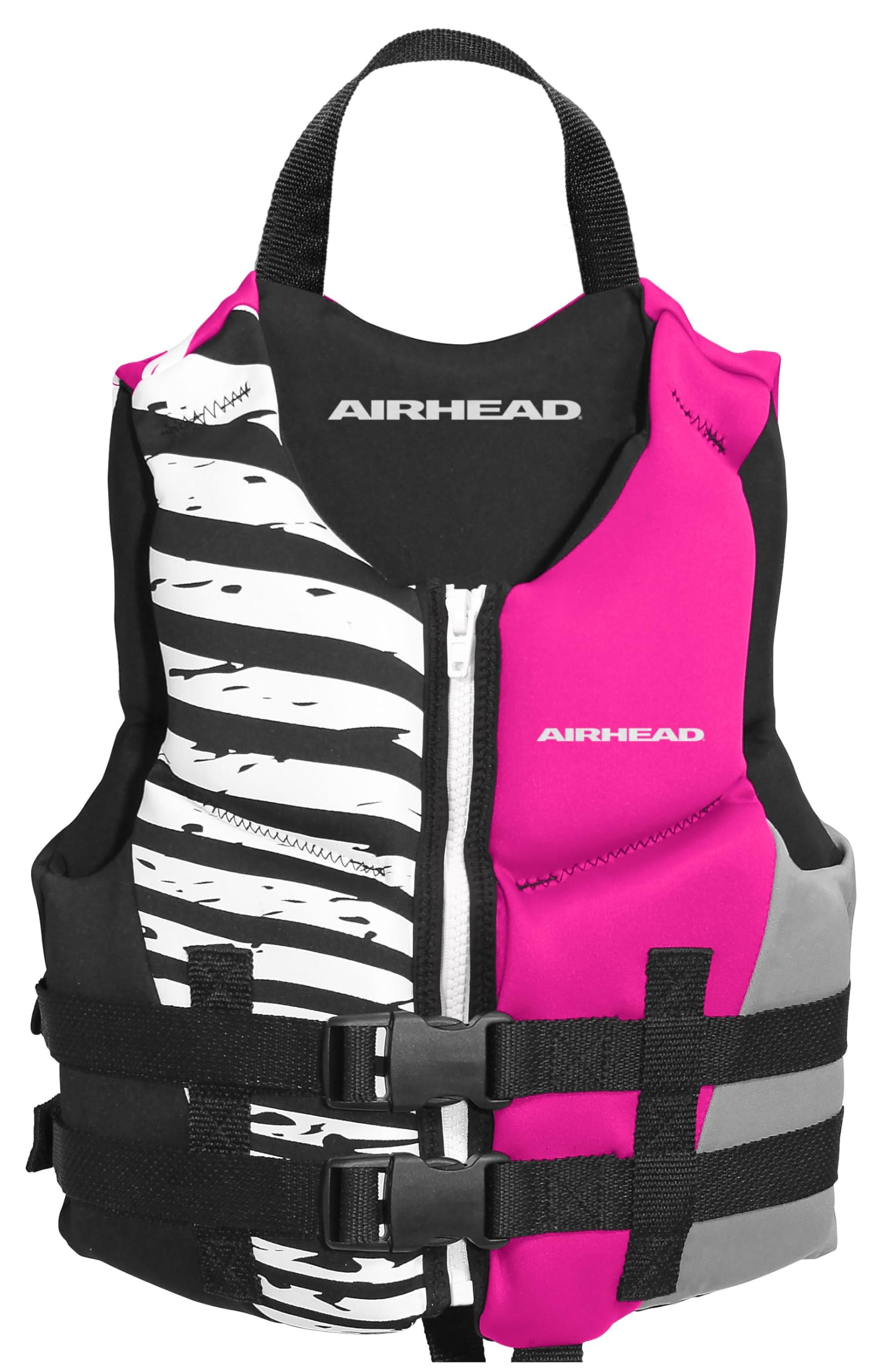
The fabric is the first thing anyone notices. NeoLite neoprene rather than the crinkly nylon most kids' vests are made from — it is soft against bare skin, it wicks, and it dries fast enough that the vest is not clammy on the ride home. If you have a child with sensitive skin or a low tolerance for scratchy straps, that matters more than anything printed on the tag.

The rest of the build is what you want on a boat: closed sides, a front zip backed by a buckle, and a crotch strap, so three separate things are holding it down. The grab handle on the back is the detail we ended up using most — hauling a tired kid out of the surf by the handle beats peeling them out of a vest in the shallows.

It comes in hot pink with a zebra print, which is either the selling point or the reason you keep looking. Either way it is easy to pick a kid out of a crowded pool. Neoprene wants a fresh-water rinse after salt and a shady place to dry, which is a small chore for the comfort it buys.

Pros

  • Soft quick-dry neoprene shell
  • Rear grab handle for lifting
  • Zip, buckle and crotch strap
  • Bright print easy to spot

Cons

  • Runs small for its 33-55 lb label
Our verdict

If your kid fights every vest, start here: the neoprene is the softest thing in this set, and the grab handle earns its keep on a beach day.

Check Latest Price
6

Newborns on Board

Full Throttle Infant

92 /100
Angler Score Outstanding

Key details

Leg Strap
Elasticized, included
Head Support
Oversized opening collar
Weight Range
Under 30 lb
Check Details on Amazon

The collar is the whole design. It is oversized, and it opens at a buckle so the vest can be laid flat and a baby slid in rather than pulled over the head. Once it is fastened, the foam sits behind and beside the head, which is the part that matters for a baby who cannot hold theirs up yet.

Underneath, an elasticized leg strap keeps the vest from riding up and the grab strap gives you something to hold when you lift a baby back into the boat. It is built for under 30 pounds, which is the whole first year for a lot of babies, and it floats a small one on their back rather than face-down.

It is the vest we hand to someone whose baby is still in a bucket seat, and it costs less than the Stohlquist infant by a fair margin. For a first season on the water, with a baby who will mostly be held, that is enough.

Pros

  • Collar opens flat for dressing
  • Oversized collar supports the head
  • Elasticized leg strap and grab strap

Cons

  • Bulky, and awkward to hold against your chest
Our verdict

A sensible first vest for a baby under 30 pounds: the collar opens flat to get it on a newborn, and the grab strap lets one adult lift them back aboard.

Check Latest Price
7

Pool and Calm Water

Aqua Oceans 7

93 /100
Angler Score Outstanding

Key details

Size
Child, 30-50 lb
Shell
Nylon over EPE foam
Design
Open side, three straps
Approval
USCG approved
Check Details on Amazon

Open sides are cooler and easier to pull on, and they are also the reason this vest can climb. With nothing under the crotch to anchor it, a child who is vertical in the water — treading, waiting, clinging to the ladder — gives the foam a clear path up toward the chin.

What you get is a Coast Guard-approved vest in nylon over thick EPE foam, with three adjustable straps and chest straps long enough to cover a real range of sizes. Of the two open-side vests in this set, it is the cheaper one.

It is labeled Child, 30 to 50 pounds, and it runs small. Weigh your child before ordering and treat 45 pounds as the practical ceiling rather than 50, because the straps will close on a bigger kid but the vest will not sit where it should.

For us this is a pool-and-pier vest. With an adult within arm's reach and the straps re-checked between swims, it floats a child and it costs little enough to keep a spare in the car. It is not the vest we reach for on a boat.

Pros

  • Three adjustable straps with a wide range
  • Nylon over thick EPE foam
  • Cheaper of the open-side vests here
  • Coast Guard approved

Cons

  • No leg strap to anchor it against ride-up
Our verdict

We rank the Aqua Oceans 7 as the value open-side option for pools and calm water, with the caveat that it climbs without a leg strap.

Check Latest Price
8

Classic Open-Side

Stearns Kids Life Vest

91 /100
Angler Score Outstanding

Key details

Shell
Nylon over PE foam
Closure
Three buckles, open sides
Weight Range
30-50 lb
USCG Approval
Type III
Check Details on Amazon

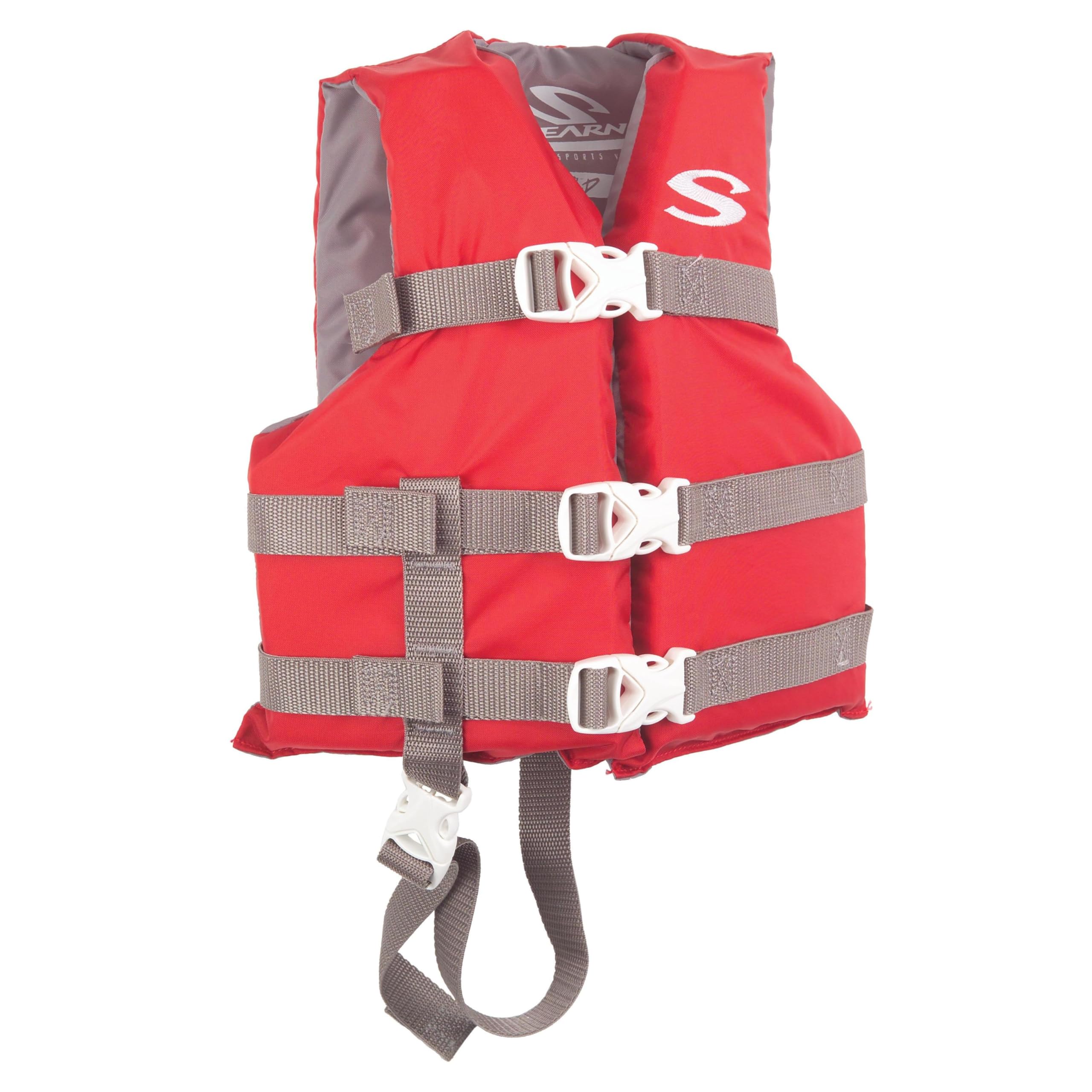
Three buckles, open sides, a nylon shell over PE foam. The Stearns is the plainest vest here, and plain is why this shape has been in rental racks and family boats for a long time.

The open cut is comfortable in heat, it packs flat in a duffel, and three buckles take up slack fast. It carries a Type III approval for 30 to 50 pounds, which covers a lot of 4- to 7-year-olds.

The buckles are the ones you will use most: one at the chest, two at the waist, all of them easy to work with cold, wet hands. Getting it snug on a reluctant kid takes about ten seconds, which is ten seconds less of them squirming.

The neck opening is where this one gets difficult. It is cut small, and a child at the top of the band ends up tight across the chest and high on the neck, which is the fit that makes a kid miserable and a vest ride up. At 35 to 40 pounds it does what it should. At 48, look at the Stohlquist youth instead.

Pros

  • Three buckles for a fast fit
  • Open sides vent in heat
  • Coast Guard Type III, 30-50 lb

Cons

  • Leg strap is listed but can arrive missing
Our verdict

A straightforward, widely used open-side vest for 30 to 50 pounds — we think it fits well in the middle of that band and poorly at the top.

Check Latest Price

How We Tested 14 Kids Life Jackets

We started with a shortlist of Coast Guard–approved vests in infant, child, and youth weight ranges, then cut anything whose stated weight range was too broad to mean much, whose straps adjusted on only one side, or whose price made no sense for gear a kid outgrows in a season. That left 14 vests, which we used for four months — weekly swim lessons, a week at a lake, pool afternoons, dock jumps, and a couple of tubing runs.

Every kid was weighed and matched to a vest's stated range before we zipped anything up. On the deck we checked where the shoulders sat, had them raise both arms overhead, and watched whether the vest climbed toward the ears. In the water they jumped off the dock, floated on their backs, and hung vertically; we noted whether the vest tipped them face-up or let them list forward, and how much paddling it took to keep a chin above the surface. A vest that let a kid wallow face-down never made it back into the bag.

Straps got the hardest scrutiny: we tugged side and shoulder webbing, then rechecked the same buckles after 20 minutes of swimming to see whether anything had crept loose or dug a red mark under an arm. The kids rated comfort themselves, and we looked for chafe at the neck and armpits and how hot the shell got in direct sun. At season's end we went over seams, zippers, and buckles for corrosion from lake water and chlorine, and set the price against how many seasons the sizing would realistically last.

How to Choose a Kids Life Jacket

Buy by Weight, Not by Age

Titles on these vests say things like ages 2 to 6, but the certification is a weight range, and that is the number to shop with. Weigh your child, then find the vest whose band contains that number: 20 to 30 pounds for the Stohlquist infant, 33 to 55 for the Body Glove, 50 to 90 for the Stohlquist youth.

The trap is buying room to grow. A vest sized for a heavier child can slide up over the chin, and a PFD that does not stay put is not protecting anyone. If your kid is within a few pounds of the top of a band, move up rather than squeezing the last season out of it.

What Stops a Vest From Riding Up

Flotation foam wants to rise, and on a child who is vertical in the water it will — up around the ears and, on a bad fit, over the chin. Three things hold it down: a crotch or leg strap, closed sides that wrap the torso, and a harness over the shoulders. The Body Glove's shoulder harness is the most deliberate version of that idea here; the Airhead Trend gets there with closed sides and a crotch strap.

Open sides breathe better and pull on easily, and they give the vest nothing to anchor against at the hip. Choose them for pool use and plan on re-tightening the straps between swims. For a boat, take closed sides or a leg strap.

Match the Vest to the Water and the Child

Infant and toddler vests carry a collar that supports the head, and the certified infant sizes are built for calm, near-shore water where a rescue is quick — the Stohlquist infant and the Full Throttle both take that shape. Older kids who swim and move around on deck are better served by a Type III vest with free arms, like the Stohlquist youth.

One more fit question people forget: where the kid will sit. A thick back panel fights a kayak seat or a boat cushion, which is why the youth Stohlquist keeps its back thin.

Comfort Is What Keeps It On

A vest a child fights is a vest that comes off the moment you look away, and chafe is the usual reason. Nylon shells can rub under the arms; neoprene, as on the Airhead Wicked, sits softer against skin and dries faster. Check the neck opening before anything else, because a small neckline turns a good vest into a miserable one — it is why we steer kids near 50 pounds away from the Stearns.

Try it on indoors over a swimsuit for ten minutes before the trip. If they are tugging at the collar after five, the cut is wrong for that child, not the brand.

Frequently Asked Questions

Final Verdict

The Body Glove Paddle Pals is the vest we put on a preschooler first. The harness over the shoulders answers the problem that undoes most kids' vests — the slow climb up around the ears — and the back buckle keeps it on a child who has learned to undo a front zip. It covers 33 to 55 pounds and nothing else, so it is one stage of a childhood rather than a vest for all of it.

Below that band, the Stohlquist infant is the more serious piece of equipment for a baby on open water. Above it, the Stohlquist youth takes over at 50 pounds with a back panel that clears a boat or kayak seat.